The Trap of AI Payments: On-Chain Transactions Do Not Equal Purchase of Real Services

marsbitPublicado em 2026-08-20Última atualização em 2026-08-20

Resumo

The Rise of AI Agent Payments and the Verification Gap AI agents are now autonomously purchasing services, such as API access or compute power, via on-chain payments. This raises a critical question: how do we verify what the agent actually bought? A proposed fraud-check mechanism involves cross-referencing three data points: the agent's reported purchase, an independently generated application receipt, and the blockchain settlement record. However, this system has a fundamental weakness. Unlike traditional three-way matching in corporate accounting—which involves independent parties (buyer, receiver, supplier)—two of the three verification sources in this model come from the same software system. The only truly independent record is the blockchain transaction, which only confirms a transfer of funds between addresses, not the quality or nature of the service delivered. Consequently, a merchant could receive payment for a promised service (e.g., a risk report) but deliver AI-generated gibberish, and the verification would still pass. This creates a market failure: AI agents, lacking human judgment, cannot assess service quality or shop around. The market could thus gravitate towards the lowest-cost, lowest-quality providers. The problem is compounded as tools for generating fake receipts evolve faster than fraud detection tools. While startups are emerging with solutions like "Know Your Agent" protocols and behavioral risk analysis, most current fraud detection focuses on...

Written by: Vaidik Mandloi

Compiled by: Chopper, Foresight News

Today, AI-generated fake receipts already account for 71% of all flagged expense fraud cases, a figure that was zero a year ago. Currently, most of these fraudulent activities are still carried out by humans.

Now, we have AI agents capable of discovering services and making payments via x402, all without any human review. This presents a significant challenge: how to verify what these agents actually purchase. OpenAI recently released a practical guide, offering a solution for implementing receipt verification and third-party reconciliation in payment processes.

This is currently the closest to a usable fraud-checking solution for agent payments that we have seen. This article breaks down the complete operational logic of this verification mechanism: Can on-chain settlement records prove that an agent bought the correct product from a legitimate supplier at the right price, or do they merely prove that funds were transferred?

Fraud Verification Mechanism

AI agents are already autonomously executing procurement activities. An agent responsible for procurement might pay for access to a permissions API to obtain data, invoke the computing power of other large models to process data it cannot handle itself, or purchase market intelligence behind paywalls. As such transactions increase, a critical question emerges: How do we verify what the agent actually bought?

All companies handling expense reimbursements today have a receipt verification process. After an employee completes a purchase and submits a receipt, the accounts payable department cross-references the receipt, purchase order, and bank statement before authorizing payment.

This process has been in use for decades and works effectively because the three verification records come from independent entities. The buyer issues the purchase order, another party confirms receipt, and the supplier provides the invoice. To commit fraud, one would need to collude with all three parties to forge the records, and the high cost of such collusion largely deters fraud.
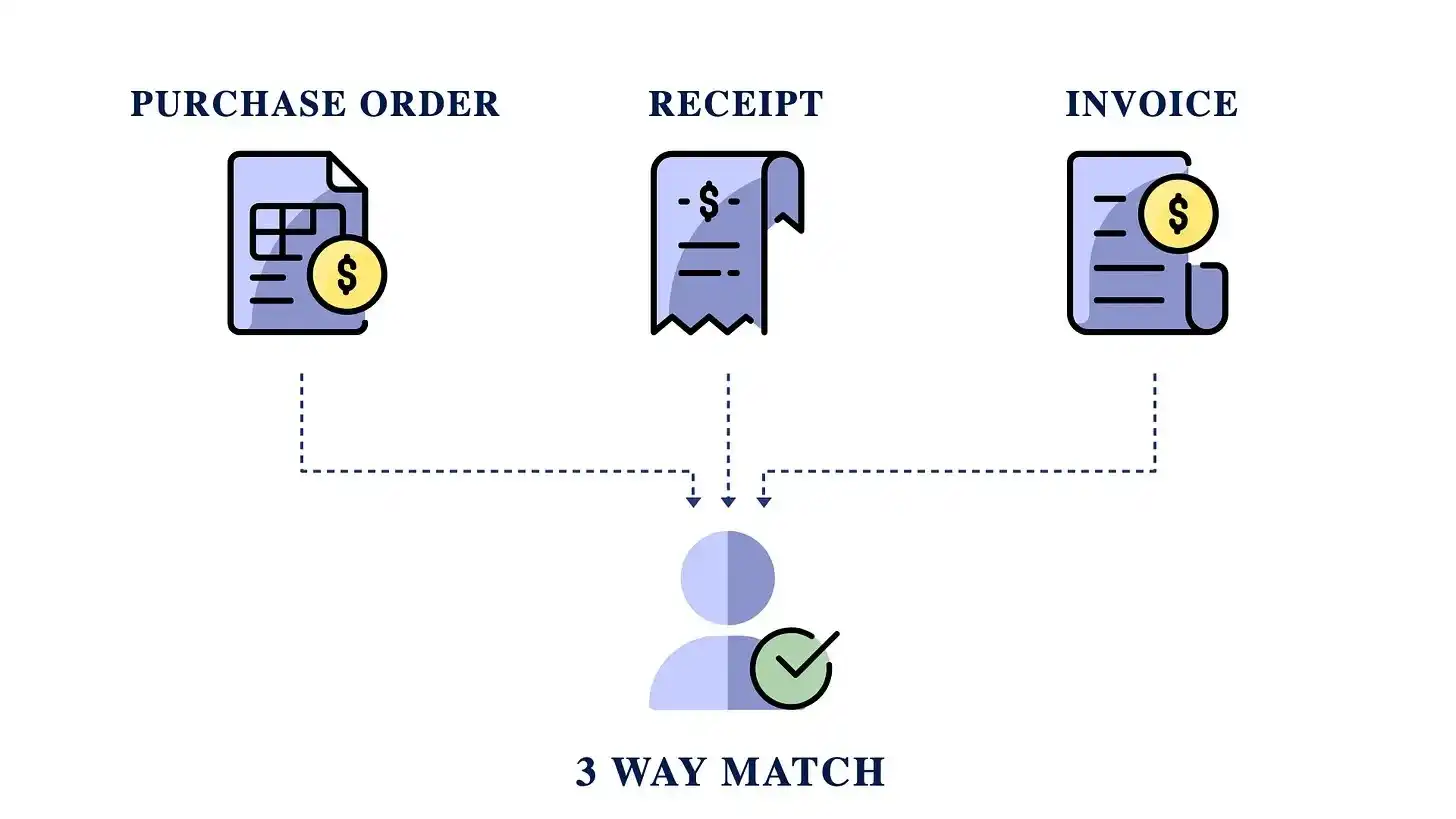
Now, agent payments are building a similar verification process. When an agent wants to make a purchase from a paid API, it cannot directly complete the transaction. The request first goes to the application layer, which checks it against pre-configured spending rules, including an approved merchant list, budget limits, and permitted expense categories. If the request violates the policy rules, the purchase is blocked outright.

After the on-chain payment is executed and the agent receives the corresponding service, the application layer performs a second round of verification, comparing three pieces of information:

  • The purchase details reported by the agent itself
  • A receipt independently generated by the application during the purchase process
  • The settlement record generated by the blockchain

Forged receipts can be identified at this stage. Even if the agent falsely claims the transaction did not occur, the application layer retains an independent record that can be cross-referenced.

This is a significant advancement for agent fraud detection, as there was previously no feasible verification method. However, compared to the traditional receipt verification model, this solution has a shortcoming. In the traditional model, the three credentials come from unrelated third parties. In the agent payment system, two credentials—the agent's report and the application-generated receipt—come from the software of the system's developer itself. The only truly independent external credential is the on-chain record.

Furthermore, the on-chain record itself carries very limited information. A payment signature typically only records the payer, payee, and transfer amount, but does not include details about the actual purchased item. Resource metadata, access addresses, or content descriptions might be transmitted along with the signature message but are not covered by cryptographic verification.

In essence, this verification can only confirm that the agent's report matches the transfer record. It cannot verify what the agent actually received after spending the money. For example: An agent spends $2 to purchase a supplier risk report. The chain can confirm the USDT transfer was completed. However, the report delivered to the agent might be just a few seconds of AI-generated, useless filler text. The entire system would still pass verification because the authorization is tied to the transfer action, not the purchased item itself.

This also leads to market-wide issues. The buyer is a software program; upon receiving a result, it simply continues execution without actively judging its quality. The agent won't invoke reputation systems or compare suppliers. Unless the developer intervenes manually, the agent will keep placing orders with the same merchant regardless of delivery quality. Suppliers providing high-quality services lose customers willing to pay a premium for quality. The entire market tilts towards "the lowest-cost provider that can fulfill the request."

Any payment system can only tolerate a certain level of fraud. The cost of completely eliminating fraud would outweigh the losses caused by fraud. For example, the credit card industry has a fraud rate of about 7 basis points, a level considered acceptable. If forced to reduce fraud further, the losses from legitimate transactions being wrongly declined would exceed the gains from avoiding fraud.

Agent payments might evolve similarly in the future: allowing a certain level of service quality flaws, with the risk absorbed by the scale of massive autonomous transactions. This logic might hold for small-scale scenarios like API calls. However, when the system is used to handle procurement contracts worth thousands or more, and the agent still cannot judge if it received value for money, the risk becomes difficult to accept.

Emerging Vulnerabilities

The speed of innovation in tools for forging receipts is outpacing that of fraud detection tools. Ramp recently launched an AI-powered accounts payable system, which flagged a large number of AI-forged document cases within the first 90 days. Emburse admitted in a survey that cases of using AI to mass-produce expense vouchers have already emerged.

In the agent scenario, the risk is further amplified. After transaction settlement, there is no human to manually review the purchase. An academic paper studying 15 mainstream, operational payment infrastructures on the market found security vulnerabilities in all of them. These systems handle funds for tens of thousands of merchants, and the disclosed vulnerabilities are reproducible.
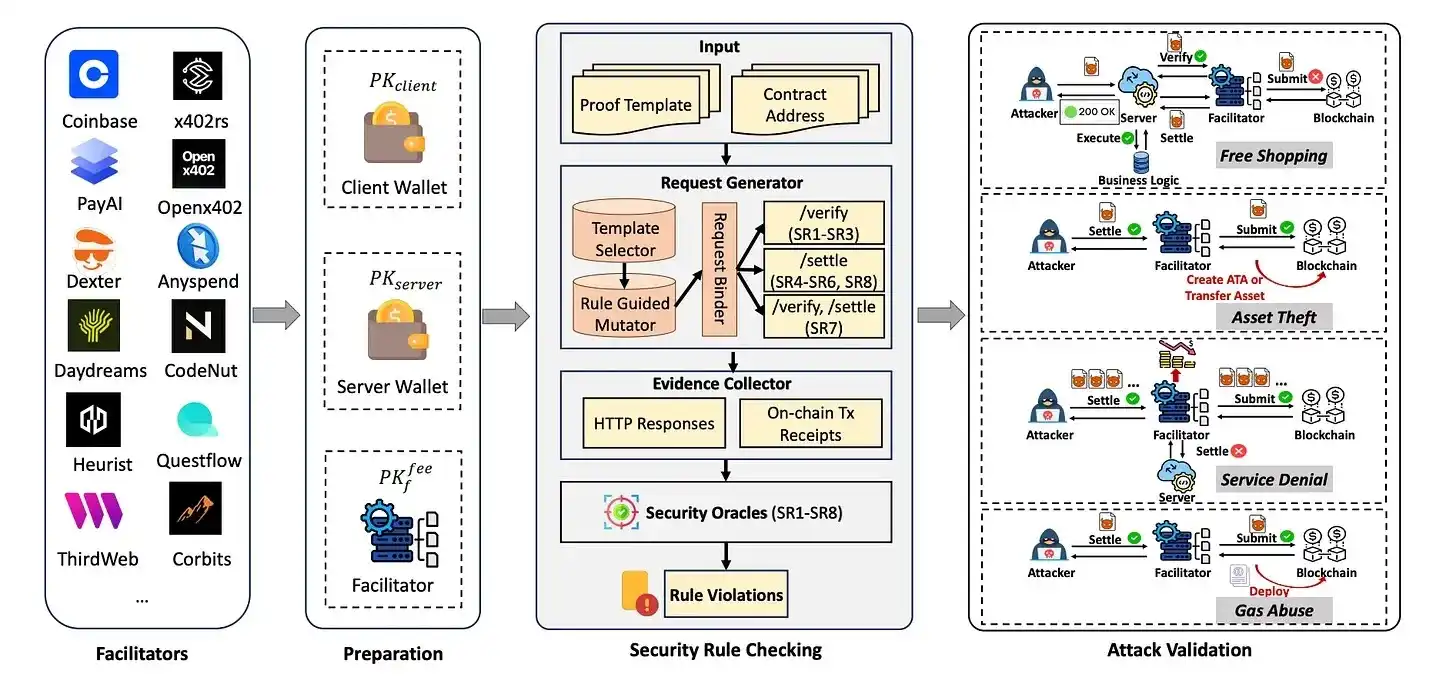
The root cause of these attack vectors is the decoupling of the payment action from the actual product delivery. In a service discovery layer attack case, researchers merely tampered with the server list returned by a service query, successfully inducing the agent to access a malicious service endpoint. From the agent's perspective, this service was indistinguishable from a normal listing, completely unaware it had been hijacked and redirected.

A number of startups are now trying to address this problem. shturl.cc/P raised $9.5 million, launching the KYA (Know Your Agent) protocol. This protocol is akin to KYC for software programs: before funds are transferred, it establishes a trust score for autonomous agents. Risky or unverified malicious agents are directly prevented from entering the payment process.

However, relying solely on identity verification cannot prevent situations where the merchant itself is legitimate but delivers subpar content. Sardine.ai, focusing on behavioral risk, completed a $70 million Series C funding. Its product uses transaction profiles from over 2 billion devices for fraud detection. They now deploy AI agents within their own risk control stack to detect various anomalous behaviors that static rule systems struggle to find.

In the underlying infrastructure space, Nekuda.ai secured $5 million in funding. The project proposes that commercial interactions between agents should not reuse old architectures designed for human transactions. There is a need to specifically build commercial SDKs for transactions between software entities, with trust models designed natively, not patched on later.

Most existing fraud detection systems today focus the scrutiny on the agent itself: Has the agent forged a receipt, overspent, or misreported a supplier? But the agent itself has no economic motive to commit fraud for profit. The party with the real incentive to commit fraud is the merchant. The merchant faces buyers—software programs—that do not evaluate service quality, compare prices, or actively switch suppliers.


Perguntas relacionadas

QAccording to the article, what key problem arises with AI agents autonomously making payments for services?

AThe key problem is verifying what the AI agent actually purchased. A transfer of funds on-chain only proves payment occurred, not that the correct service was received at the right price from a legitimate supplier.

QHow does the new AI agent fraud check mechanism work, and what is its main weakness compared to traditional receipt verification?

AIt works by cross-referencing three records after a payment: the AI's report of the purchase, an independently generated receipt from the application layer, and the blockchain settlement record. Its main weakness is that two of the three records (the AI's report and the app-generated receipt) come from the same software system, lacking true independence. The only independent external record is the blockchain transaction, which contains minimal information about the purchased item.

QWhat market-wide problem does the author suggest could result from AI agents making payments without evaluating service quality?

AThe market could tilt towards the 'lowest-cost provider capable of fulfilling a request.' Since AI agents don't compare prices or quality and will keep ordering from the same merchant, high-quality sellers lose customers willing to pay a premium. This creates a race to the bottom on service quality.

QWhat is a core limitation of current fraud detection tools focusing on the AI agent, as stated in the article?

AThey focus on whether the AI agent forged receipts, overspent, or misreported suppliers. However, the AI agent itself has no economic incentive to commit fraud. The real party with the incentive to act maliciously is the merchant, who faces buyers (the AI agents) that do not evaluate service quality.

QName one approach mentioned in the article that startups are taking to address the trust and fraud issues in AI agent payments.

AOne approach is developing protocols for 'Know Your Agent' (KYA), which establishes a trust score for autonomous agents before allowing them into the payment process, similar to KYC for humans. Another is building behavior-based risk analysis using AI agents to detect anomalies, and a third is creating new, natively designed commercial SDKs and trust models for software-to-software transactions.

Leituras Relacionadas

Jameson Lopp's BIP-110 Postmortem: Bitcoin Is Driven by Game Theory, Not Morality

Jameson Lopp's analysis concludes that BIP-110, a proposal to restrict arbitrary data (like inscriptions) on Bitcoin, failed due to economic and technical realities, not moral arguments. The proposal, championed by Luke Dashjr and others, aimed to "cleanse" the chain but never reached its 55% miner activation threshold. Upon its forced signaling deadline in August, only the OCEAN pool (with ~1% hash rate) supported it, creating a short-lived fork that quickly died as miners faced unredeemable block rewards. Lopp's earlier predictions about its economic infeasibility were proven correct. Technically, BIP-110 was flawed; workarounds to embed data compliant with its rules were demonstrated almost immediately, proving it couldn't achieve its stated goal. The debate often devolved into moralistic rhetoric, with supporters accusing opponents of supporting child exploitation material—a tactic Lopp criticizes as ineffective for building consensus. Lopp argues Bitcoin is driven by incentives and game theory, not morality. Past forks like Bitcoin Cash promised economic benefits, while BIP-110 offered only restrictions and reduced miner fees, gaining no substantial support from major economic players. He predicts the "puritans" behind the failed fork will continue complaining but their new chain will remain insignificant. The episode reaffirms that attempting to censor data on a permissionless, anti-censorship network like Bitcoin is a futile battle.

marsbitHá 45m

Jameson Lopp's BIP-110 Postmortem: Bitcoin Is Driven by Game Theory, Not Morality

marsbitHá 45m

Tokenization Scale Soars to $4.3 Billion, But Why Did Securitize Incur a $5.5 Million Loss?

Securitize's first quarterly report post-IPO reveals a paradox: while its tokenized assets under management hit a record $4.3 billion (up 16% YoY) and platform trading volume surged 147% to $5.3 billion, total revenue fell 5% to $14.4 million. Tokenization revenue specifically dropped ~12% to $7.8 million, leading to an adjusted EBITDA loss of $5.5 million. CFO Francisco Flores explained that most trading volume is not yet monetized, with the majority of tokenization revenue still coming from one-time projects like new protocol integrations. In contrast, asset servicing revenue, a more recurring stream, grew slightly to $6.6 million. The company has lowered its full-year revenue guidance to $70-$80 million from an initial projection of $110 million. Industry experts note this highlights a structural challenge for the tokenization sector. Scaling assets on-chain doesn't automatically scale a profitable business model. Current implementations often rely on costly, customized projects for each new asset or jurisdiction. The future, they argue, lies in building standardized infrastructure that generates recurring "infrastructure revenue" from post-issuance activities like compliance, distributions, and secondary trading—similar to enterprise software. Analysts caution against misinterpreting high trading volumes as indicative of a mature fee-based model, as Securitize's broad volume metric includes many non-monetized actions. The key test for the industry is whether adding billions in new assets can generate sustainable revenue without constant new custom projects.

marsbitHá 47m

Tokenization Scale Soars to $4.3 Billion, But Why Did Securitize Incur a $5.5 Million Loss?

marsbitHá 47m

The Five Paradoxes of Artificial Intelligence

**Five Paradoxes of Artificial Intelligence** Artificial intelligence (AI) is an era filled with paradoxes, which we navigate as we advance. **1. The Prediction Paradox** AI experts, from pioneers like Marvin Minsky to contemporary figures like Geoffrey Hinton and Demis Hassabis, have a history of inaccurate forecasts regarding AI's capabilities and timelines, such as achieving human-level machine intelligence or surpassing radiologists. Predictions about Artificial General Intelligence (AGI) vary wildly between optimistic entrepreneurs and skeptical academics, highlighting the inherent unpredictability of technological futures. **2. The Employment Quantification Paradox** Despite numerous studies from institutions like the OECD, IMF, and McKinsey attempting to quantify AI's impact on jobs, estimates of affected employment range from 0.4% to 67%, revealing vast inconsistencies. This paradox arises because isolating AI's effect from other economic, social, and technological factors is virtually impossible, and forecasts depend on static assumptions about a dynamically evolving technology. **3. The Productivity Paradox** While AI is a transformative General Purpose Technology, significant productivity growth has not yet materialized in major economies like the EU and has only matched historical averages in the US. This disconnect between rapid innovation and slow productivity gains, reminiscent of the "Solow Paradox" from the computer age, is often explained by time lags. History shows it takes decades for such technologies to diffuse and trigger complementary innovations that boost productivity. **4. The Data Value Paradox** Data is hailed as the "new oil" and critical for AI, yet its economic value is paradoxical. Its worth is realized only in use, not in straightforward trade. Despite policy emphasis and initiatives for data asset recognition on corporate balance sheets in China, the monetized value remains negligible—accounting for only about 0.06% of major telecom operators' total assets—highlighting the gap between perceived utility and financial valuation. **5. The Industrial Revolution Paradox** For decades, nearly every major new technology, from the internet and nanotechnology to blockchain and now AI, has been proclaimed as the driver of a "Fourth Industrial Revolution." This constant reassignment suggests prior labels were premature. True industrial revolutions are typically identified in hindsight, not in real-time. Furthermore, the coexistence of such a proclaimed transformative revolution with ongoing economic crises would be historically anomalous. Whether AI truly defines a new industrial revolution remains a narrative for the future to decide.

marsbitHá 50m

The Five Paradoxes of Artificial Intelligence

marsbitHá 50m

Trading

Spot
活动图片