The Storage Magnate Who Conquered a Trillion-Dollar Kingdom, Yet Ultimately Could Not Become the Richest

marsbitPublicado em 2026-06-15Última atualização em 2026-06-15

Resumo

**Summary:** "The Memory Magnate Who Built a Trillion-Dollar Empire, Yet Never Became the Richest" explores the journey of Zhu Yiming, founder of GigaDevice (603986) and co-founder of the soon-to-IPO ChangXin Memory Technologies (CXMT). The article positions GigaDevice, a fabless chip designer now valued at ~¥340 billion, as a prequel to the massive IDM (Integrated Device Manufacturer) venture, CXMT. Starting in 2005 with minimal capital, Zhu strategically "picked up the pieces" by focusing on niche markets like NOR Flash and microcontrollers (MCUs), areas major players were exiting. This allowed GigaDevice to grow into a diversified semiconductor company, maintaining robust profitability even during industry downturns by controlling costs. However, the piece argues that in the highly cyclical and capital-intensive memory chip industry, the fabless model has limits. True resilience and scale require the ability for "counter-cyclical expansion" – investing heavily during downturns – a tactic only possible for IDMs like Samsung or SK Hynix. This insight led Zhu to partner with the Hefei city government in 2016 to establish CXMT, an IDM focused on DRAM. Zhu's symbolic moves, like forfeiting salary and diluting his equity, were crucial in securing the massive state and bank funding needed. CXMT's equipment base is now valued even higher than that of BYD's vast auto manufacturing empire. Despite the potential for CXMT to reach a market cap of ¥1-2 trillion upon its IPO, Zhu's i...

Author | Eastland

Header Image | Visual China


Changxin Technology is poised to list on the STAR Market, with its market capitalization highly likely to exceed 1 trillion yuan, and some optimistic voices even calling for 2 trillion yuan.

Changxin Technology has no actual controller. Its top five shareholders (including Hefei State-owned Assets, the National Integrated Circuit Industry Investment Fund) collectively hold approximately 58% of the shares. The "soul figure" Zhu Yiming holds less than 3% of the shares (indirectly), so even if Changxin's market cap rises further, it will be difficult for him to rank among the top tycoons.

Regarding Changxin Technology, the author already published an article on January 26, 2026 (published on Huxiu). This article introduces another excellent company founded by Zhu Yiming—GigaDevice (SH:603986), a storage chip giant with a market cap of 340 billion yuan.

The development history of GigaDevice is the "Prequel to Changxin Technology".

Diversification Born from "Finding Good Deals"

In April 2005, Zhu Yiming returned to China and founded "Beijing Xinjia Zhaowei Microelectronics Technology" (renamed GigaDevice Limited in 2010), with registered capital of 2 million yuan.


In December 2012, it completed its shareholding reform. After multiple rounds of capital increases, its registered capital reached 75 million yuan. Among them, Zhu Yiming held 16.292%.


In August 2016, it was listed on the Shanghai Stock Exchange, raising 517 million yuan.


In 2020, GigaDevice raised approximately 4.28 billion yuan through a private placement.


In January 2026, GigaDevice was listed on the Hong Kong Main Board (HK:03986), raising 4.68 billion Hong Kong dollars.


As financing channels opened up, GigaDevice's product structure diversified from a single storage chip through internal R&D and acquisitions, forming four product lines: storage chips, microcontrollers (MCU), sensors, and analog chips. However, the vast majority of revenue comes from storage chips and controllers.

  • NOR Flash


NOR Flash is GigaDevice's founding business, covering a variety of products with capacities ranging from 512Kb to 2Gb. Its global market share in 2025 was about 20% (ranking third globally and first in mainland China). In 2025, it achieved mass production of 45nm node SPI NOR Flash.

With the iteration of smartphone supply, the market for smaller-capacity NOR Flash has been declining—from $7 billion in 2006 to $1.58 billion in 2016. Samsung stopped developing new NOR Flash products as early as 2010. Although Micron did not completely exit, its market share fell from being the global leader in 2010 to fourth place in 2025.

AI computing power has no upper limit for storage chip capacity and transmission speed requirements. But in fields like automotive, consumer electronics, and industrial control, the requirement for storage chips is simply 'fit for purpose.' NOR Flash, with its fast read speed, high reliability, and low cost, has irreplaceability. A high-end electric vehicle equipped with an advanced intelligent driving system contains about 30 NOR Flash chips.

As international giants successively shut down mid-to-low-end DRAM and consumer-oriented NAND businesses, GigaDevice, in cooperation with Changxin Storage, gradually launched DDR3 and DDR4 products.

Low-end does not equal useless. GigaDevice seized the dividend from the giants' exit, gradually growing its storage chip business by "finding good deals." In 2024, its global market shares for NOR Flash, SLC NAND, and niche DRAM were 18.5%, 2.2%, and 1.7%, respectively.

  • Microcontrollers (MCU)

Before 2013, this market was dominated by European giants like STMicroelectronics. This was because the most critical component in an MCU is precisely the Flash memory chip.

After gaining a foothold in NOR Flash, GigaDevice did not rush into the high-end storage chip market. Instead, it entered the MCU market in 2013.

By 2024, it had mass-produced 63 series and over 700 products. In 2022, it entered the new energy vehicle market, providing specialized MCUs for application scenarios such as body domain control and chassis control.

  • Sensors and Analog Chips

In 2019, it entered the touch and fingerprint recognition sensor market through the acquisition of Silergy. In 2024, it acquired Suzhou Saixin, leading to explosive growth in its analog chip business.


From 2015 to 2018, the combined revenue from storage chips + microcontrollers accounted for 100% of total revenue.

In 2019, sensor revenue was 435 million yuan, accounting for 6.3% of revenue;

In 2021, storage chip revenue increased by 66% year-on-year to 5.45 billion yuan; but microcontroller revenue surged by 225%, causing the storage chip share to drop to 64%;

In 2022, storage chip revenue fell by 11.5% to 4.83 billion yuan; microcontroller revenue grew by 15.2% to 2.83 billion yuan; the storage chip share dropped to 59%;

......

In 2025, storage chip and microcontroller revenues were 6.56 billion yuan and 1.91 billion yuan, respectively, together accounting for 92% of total revenue; sensor and analog products combined revenue was 720 million yuan, accounting for 8% of total revenue.
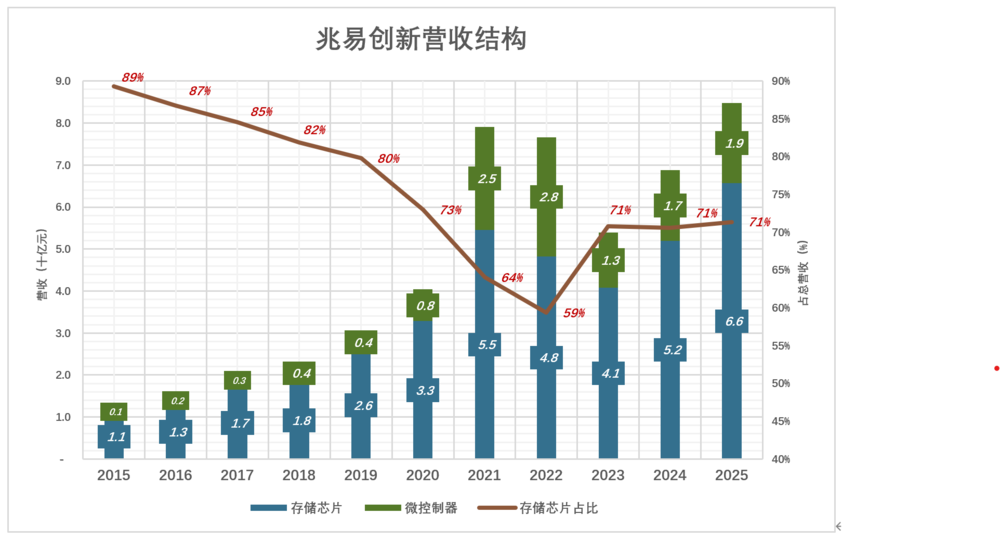
Only 800,000 yuan in cash was in the registered capital (the rest was contributed as non-patented technology), which is barely enough to even open a small restaurant. Based on his capital and technical strength, Zhu Yiming precisely "found good deals," developing and growing in the cracks between giants.

A Rare High-Performer in the Storage Industry

1) Shipment Volume, Unit Price, and Gross Profit

In 2025, the revenue index for storage chips was 200, and the sales volume index was 165 (with 2020 as the base year). The reason was an increase in the average selling price:

In 2020, storage chip shipments were 2.686 billion units, revenue was 3.28 billion yuan, with an average price of 1.22 yuan per unit;

In 2025, storage chip shipments were 4.436 billion units, and the average price rose to 1.48 yuan per unit, 21.1% higher than in 2020.
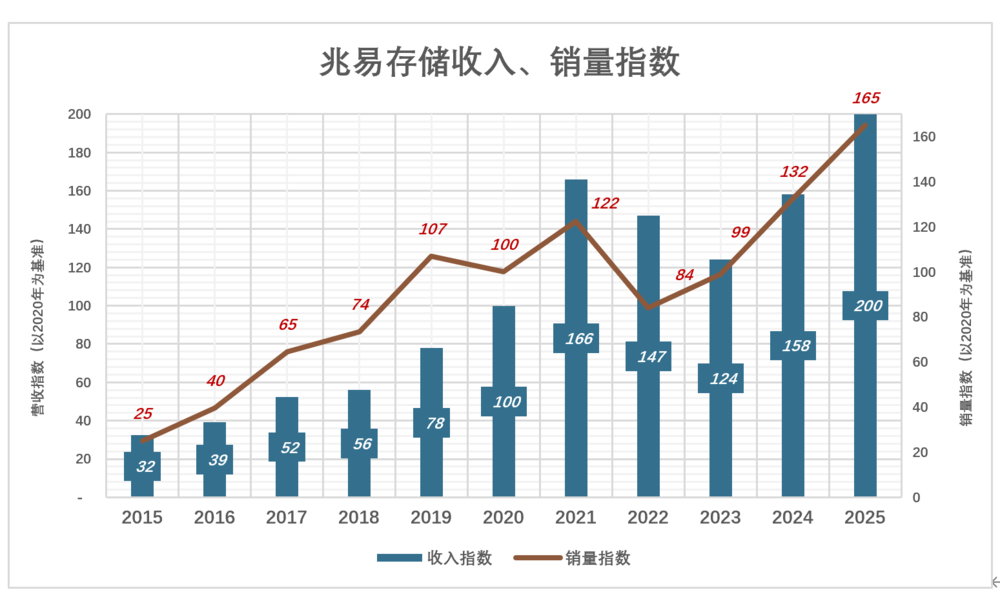

In 2022, demand for NOR Flash in the consumer, mobile phone, and PC sectors decreased. GigaDevice's storage chip shipments fell by 31.3% year-on-year. However, due to an increased proportion of mid-to-high-end products, gross profit per unit reached a record 0.86 yuan, with a gross profit margin of 40%.


In 2025, storage chip shipments reached 4.44 billion units, and gross profit per unit dropped to 0.63 yuan, 0.23 yuan lower than in 2022; but because costs decreased by 0.43 yuan, the gross profit margin actually increased to 43%.
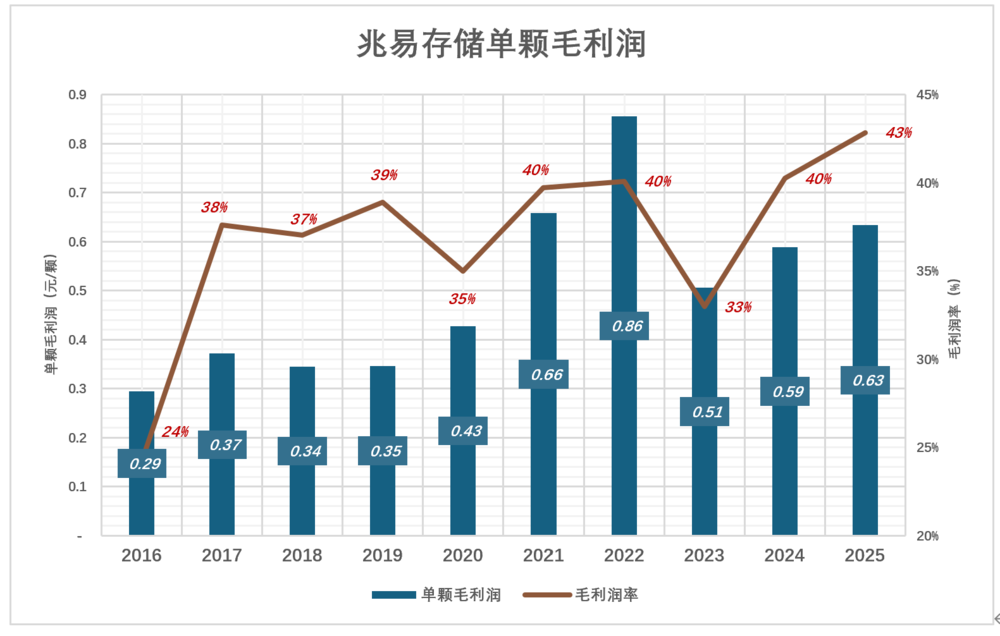

GigaDevice's storage chips are primarily small-to-medium capacity. In 2025, the average selling price was only 1.48 yuan, which is not comparable to DDR5 or HBM chips that cost tens or even hundreds of yuan each.

2) Gross Profit Margin, Expense Ratio

In the chart below, the blue line represents the gross profit margin, and the colored stacked bars represent the expense ratios. Operating profit is only possible when the blue "drowns out" the colors.

GigaDevice's blue line remains high above, demonstrating its strong high-performer credentials:


In the industry downturn of 2022, GigaDevice's gross profit was 3.88 billion yuan, with a gross profit margin as high as 47.7%; combined sales, management, and R&D expenses accounted for 20% of revenue; the gross profit margin was 28 percentage points higher than the total expense ratio!

In 2025, GigaDevice's revenue was 60% higher than in 2024; gross profit was 3.7 billion yuan, and the profit margin returned to above 40%;

In Q1 2026, performance exploded, with revenue increasing by 119% year-on-year; gross profit was 2.39 billion yuan, with a profit margin of 57.1%, 41 percentage points higher than the total expense ratio, far exceeding the profitability of 2022.
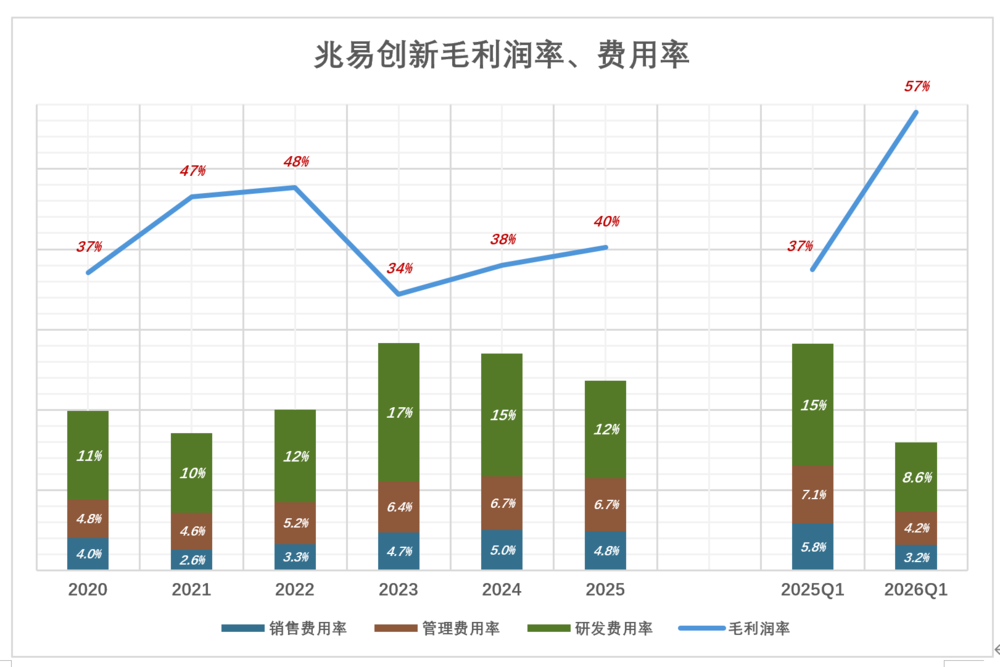


A 40% gross profit margin is not considered high for a light-asset company. It is quite remarkable for GigaDevice to control the total expense ratio below 30% while maintaining positive operating profit, especially at its revenue scale.

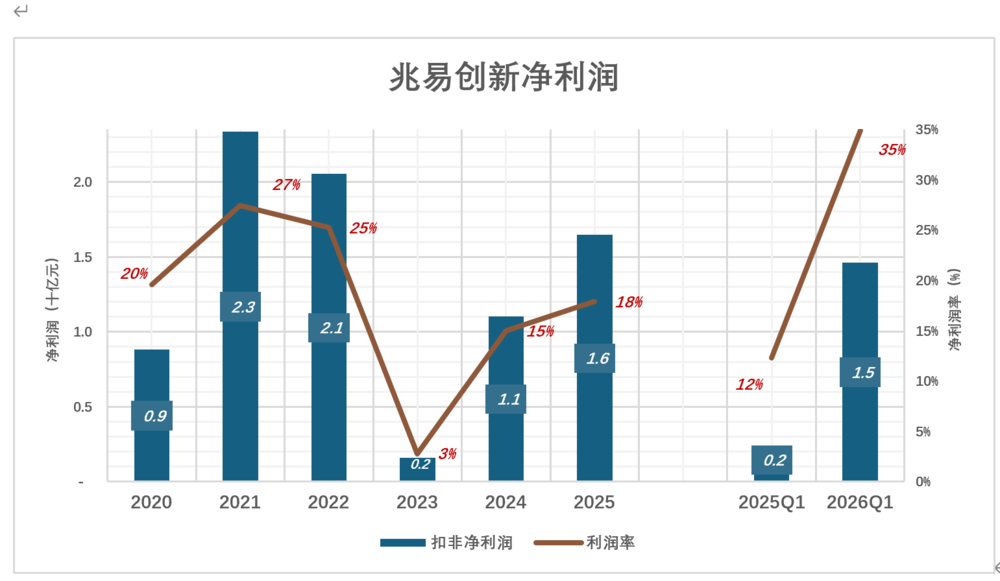
3) Cyclical Fluctuations in Net Profit

The storage chip industry exhibits strong cyclicality, and GigaDevice's performance clearly fluctuates with the industry cycle:


In 2021, net profit was 2.34 billion yuan, with a profit margin of 27.5%;

......

In 2023, net profit fell to 160 million yuan, with a profit margin of only 2.8%;

......

In 2025, net profit rebounded to 1.65 billion yuan, with a profit margin of 17.9%;

In Q1 2026, quarterly net profit reached 1.46 billion yuan, a year-on-year increase of 523%;


Binding with Changxin Forms the "Complete Entity"


Over the past 30 years, the storage chip industry has experienced four complete cycles:


1993~1996: Microsoft Windows drove DRAM demand to multiply, but overcapacity later emerged, causing prices to plummet;

2012~2015: Smartphones drove storage demand growth, but later this was completely offset by declining PC demand, leading to an industry downturn;

2016~2019: Android phone memory upgrades drove growth, but later this was completely offset by declining cloud computing demand, plunging the industry into deep losses;

2020~2023: The pandemic drove growth in mobile phone and PC shipments, and storage chip demand rose accordingly. Manufacturers, fearing shortages, overstocked. After the pandemic, the storage industry experienced a deep contraction;


In 2025, AI computing power created strong demand for high-bandwidth HBM chips. HBM uses a multi-layer chip stacking architecture, occupying about 3-4 times the wafer and packaging capacity of mid-to-low-end storage chips. The three giants—Samsung, SK Hynix, and Micron—allocated 90% of their capacity to high-end products like HBM and DDR5, leading to tight supply for mid-to-low-end products.

Semiconductor companies generally operate under four models: Vertical Integration (IDM), Fabless (Fablss), Foundry (Foundry),

and Outsourced Semiconductor Assembly and Test (OSAT).


IDM integrates chip design, manufacturing, packaging and testing, and product sales into one entity, representing a heavy-asset model.

The benefit is deep synergy between design and manufacturing, which helps optimize product yield, power consumption, and performance. The cost is high capital expenditure. Giants like Samsung, SK Hynix, and Micron adopt the IDM model.

The Fabless model allows companies to focus on chip design and R&D, outsourcing wafer manufacturing, packaging, and testing to specialized foundries, representing a light-asset model.

In a highly cyclical industry, does the light-asset model have a higher probability of success? In the storage chip field, the answer is no!


Taiwanese companies like ProMOS, Powerchip, and Inotera Memories adopted the Fabless model to avoid massive capital expenditure. When the storage chip industry was at a low point, these light-asset companies went bankrupt, were liquidated, or were acquired.


Heavy-asset giants engage in "counter-cyclical expansion"—investing huge sums to build factories and deploy advanced equipment; pouring fuel on the fire of overcapacity, accelerating price collapse, and speeding up the elimination of excess capacity.


Today's three storage chip giants (Samsung, Hynix, Micron) are all "survivors" of the industry's violent fluctuations.

Historical experience shows that counter-cyclical expansion is the "decisive move" in the storage chip field. The Fabless model is a light-asset model with no capacity to expand.


Due to the extremely high capital and technical barriers for R&D and manufacturing DRAM, GigaDevice found it difficult to achieve this on its own. In 2016, Zhu Yiming cooperated with the Hefei Municipal Government to establish Changxin Technology.

GigaDevice is not a complete entity and absolutely lacks the time and capital to evolve into an IDM model. Therefore, Zhu Yiming chose to cooperate with Hefei City.


In 2018, Zhu Yiming served as Chairman and CEO of Changxin Technology, explicitly stating he would not receive any salary before the company turned profitable. He also allocated half of the equity incentives he received (worth over 10 billion yuan) to reward employees.


In total, Zhu Yiming's shareholding proportion is slightly above 1% (post-listing). Zhu Yiming also voluntarily extended his lock-up period to 10 years.


Globally, it's not uncommon for founders of high-tech companies to make gestures like giving up salaries. Diluting equity often happens out of necessity (for financing), but control is the bottom line.


Zhu Yiming's series of actions made state-owned capital dare to invest heavily and banks dare to lend (long-term loans exceeding 100 billion yuan). As of the end of 2025, the original value of machinery and equipment at Changxin Technology reached 225.7 billion yuan, with accumulated depreciation of 55.2 billion yuan and a net book value of 169.3 billion yuan.

What does nearly 170 billion yuan worth of machinery and equipment mean? BYD has nine major production bases in China, with a double-shift capacity of about 8 million vehicles per year. Note, these are not simple assembly plants like a certain "super factory," but rather a vertically integrated industrial empire covering the entire new energy vehicle industry chain, from batteries to chips, producing over 75% of components in-house. As of the end of 2025, BYD's machinery and equipment had a net book value of 150.6 billion yuan, 18.7 billion yuan less than Changxin Technology's!


Assuming Changxin Technology's market capitalization reaches 2 trillion yuan, plus the value of his shares in GigaDevice, Zhu Yiming's net worth would not exceed 50 billion yuan, less than one-tenth of Zhong Shanshan's (According to the "2026 Hurun Rich List," the 20th-ranked Zhang Gang's family assets were 160 billion yuan).


*The above analysis is for reference only and does not constitute any investment advice!

Perguntas relacionadas

QWhy is Zhu Yiming unlikely to become a top-tier billionaire even if ChangXin Technology's market value soars?

ABecause he holds less than 3% of the shares (indirectly) in ChangXin Technology, which has no actual controller and its top five shareholders (including Hefei State-owned Assets and the Big Fund) collectively hold about 58%.

QWhat is the main development strategy that Zhuoyi Innovation adopted in its early stages?

AZhuoyi Innovation's main early strategy was 'cherry-picking' or seizing opportunities in market gaps left by giants. With limited initial capital (only 800,000 RMB in cash), it focused on niche areas like mid-to-low-end NOR Flash, SLC NAND, and later MCUs, where international giants were withdrawing or reducing presence.

QWhat are the two main product lines contributing to the majority of Zhuoyi Innovation's revenue?

AThe two main product lines are Storage Chips (primarily NOR Flash, SLC NAND, and niche DRAM) and Microcontroller Units (MCUs). In 2025, these together accounted for 92% of the total revenue.

QAccording to the article, why is the Fabless (asset-light) model not necessarily more successful in the memory chip industry?

ABecause the memory chip industry is highly cyclical. Fabless companies, being asset-light, cannot engage in 'counter-cyclical expansion'—investing heavily in new factories and advanced equipment during downturns. History shows that surviving giants like Samsung, SK Hynix, and Micron are IDM (Integrated Device Manufacturer) models that used heavy investments to outlast competitors and consolidate the market.

QWhat crucial strategic move did Zhu Yiming make to overcome the limitations of Zhuoyi Innovation's Fabless model in the high-end memory market?

AHe co-founded ChangXin Technology with the Hefei municipal government in 2016. This move created an IDM entity capable of the massive capital expenditure and advanced manufacturing required for DRAM (like DDR3, DDR4). To gain trust from state-owned assets and banks for heavy investment, Zhu made significant personal sacrifices, including forgoing salary until profitability and diluting his own equity and control.

Leituras Relacionadas

U.S. Tech Momentum Stocks Post Largest Single-Day Gain Ever, But Is the Plunge Over?

US tech momentum stocks staged a sharp rebound on Tuesday (July 21st). Morgan Stanley's TMT Momentum Factor surged over 12%, marking its largest single-day gain on record, exceeding even peaks from the 2000 dot-com bubble. Key momentum indices from Goldman Sachs also posted their strongest daily performances in years. The rally was led by semiconductors, with the Philadelphia Semiconductor Index jumping 4.6%. This rebound followed three consecutive down days and a cumulative 33% plunge in momentum stocks, one of the steepest drawdowns since the dot-com era. Analysts attribute the surge largely to a short squeeze. Heavy selling had pushed high-beta momentum stocks into deeply oversold territory, forcing many short sellers, particularly in Asia, to cover their positions, creating a self-reinforcing buying spiral. However, the rebound's internals appear weak. Trading volume was notably low, and advancing stocks still lagged decliners on the S&P 500, indicating a narrow, concentrated rally rather than broad market participation. Diverging views emerge on the outlook. BTIG warns the bounce has hit key resistance and recommends selling into strength, citing extreme volatility and historical parallels to past market tops. Conversely, Goldman Sachs and UBS believe the momentum unwind is nearing its end, suggesting it may be time to gradually add exposure, as positioning has been significantly reduced. They caution, however, that high volatility warrants a measured approach, potentially using defined-risk strategies. The upcoming earnings season, particularly reports from major tech firms like Alphabet, is seen as a critical test for the rally's sustainability. Simultaneously, bond markets flashed a warning, with yields rising partly due to spiking oil prices. Analysts note that if long-term Treasury yields break decisively higher, it could pose a significant headwind for equities, especially growth stocks.

marsbitHá 7m

U.S. Tech Momentum Stocks Post Largest Single-Day Gain Ever, But Is the Plunge Over?

marsbitHá 7m

U.S. Tech Momentum Stocks Record Largest Single-Day Gain Ever, but Has the Rout Ended?

U.S. tech momentum stocks staged a dramatic rebound on Tuesday, July 21st. Key momentum indices like the Morgan Stanley TMT Momentum Factor and Goldman Sachs' High Beta Momentum Long Index posted historic or near-historic single-day gains, fueled largely by semiconductor stocks. This sharp rally followed a severe three-day sell-off that saw momentum stocks plunge 33%, marking one of the steepest pullbacks since the dot-com bubble. Analysts attribute the bounce primarily to a short squeeze, as forced covering from over-leveraged traders, particularly in Asia, created a buying spiral. However, the rally's health is questioned due to weak market breadth—overall trading volume was low, and decliners outnumbered advancers in the S&P 500 despite the index's gain—suggesting a narrow, concentrated surge rather than broad recovery. Opinions on the sustainability diverge. BTIG strategists warn the rebound has hit key resistance levels, citing extreme volatility and historic stock dispersion as signs of an ongoing broader correction, and recommend selling into strength. Conversely, Goldman Sachs and UBS view the aggressive momentum unwinding as nearing its end, noting reduced positioning and a lack of new fundamental catalysts. They suggest the sell-off presents a selective opportunity to add exposure, albeit cautiously and gradually using defined-risk strategies. The immediate trajectory hinges on the ongoing earnings season, with market focus on Alphabet's capital expenditure guidance for AI investment clarity. Meanwhile, bond markets present a risk, with rising Treasury yields—potentially heading toward 5.5%—and widening credit spreads for mega-cap tech companies posing a threat to equity valuations. The combination of technical factors, earnings results, and macro conditions leaves the durability of the rebound in doubt.

链捕手Há 10m

U.S. Tech Momentum Stocks Record Largest Single-Day Gain Ever, but Has the Rout Ended?

链捕手Há 10m

Long-Divided Must Unite, Long-United Must Divide: When L1 Becomes Its Own Rollup, What Is Ethereum's Endgame?

"The Inevitable Cycle: When L1 Becomes Its Own Rollup – What is Ethereum's Endgame?" For years, the Ethereum community grappled with concerns that L2s were fragmenting the ecosystem and eroding L1's value. While L2s provided cheaper execution, they also splintered liquidity and the unified user experience of a single chain. This has prompted a fundamental reassessment of the relationship between L1 and L2. Ethereum's roadmap is evolving. The "Scale" initiative merges L1 and L2 expansion into a holistic framework. L1 itself is advancing with higher gas limits, statelessness, and zkEVM verification, no longer content to be just a low-throughput settlement layer. Consequently, the primary value proposition of L2s is shifting from merely providing cheap blockspace to offering L1 cannot easily provide: application-specific optimizations, privacy features, and flexible governance models. L2s are becoming a spectrum of execution environments with varying degrees of security inheritance from Ethereum. A critical challenge in this multi-chain future is interoperability. The vision is to make Ethereum "feel like one chain again." This relies on advancements in native account abstraction (like EIP-7702) and intent-based architectures (Open Intents Framework), where users declare desired outcomes, and solvers handle the complex cross-chain execution. Furthermore, shortening Ethereum's finality time from minutes to seconds is crucial, as it underpins trust between chains for bridges, stablecoins, and cross-chain applications. Perhaps the most provocative idea is that Ethereum L1 itself could become a form of "its own Rollup." As zkEVM and proof systems mature, high-performance nodes could execute transactions and generate validity proofs. Regular validators would then verify these proofs instead of re-executing all transactions. This blurs the traditional L1/L2 hierarchy, making "Rollup" more of a general execution-verification architecture. Native Rollup aims to integrate L2 validation more directly into the Ethereum protocol, allowing L2s to inherit L1's security more fully and move away from reliance on security councils. In the end, L2s are not destined to replace L1 or be made obsolete by it. The likely future is a unified system where diverse execution environments—each optimized for specific use cases like DeFi, gaming, or privacy—coexist. They will share a common foundation of security, liquidity, and verifiable state, seamlessly connected to restore a cohesive user experience. The next phase for Ethereum is not just about scaling through separation, but about intelligently reintegrating what was separated back into a coherent whole.

链捕手Há 26m

Long-Divided Must Unite, Long-United Must Divide: When L1 Becomes Its Own Rollup, What Is Ethereum's Endgame?

链捕手Há 26m

Agent Race Ends, Super Workbench Takes Over

The era of fragmented AI agents is ending. Over the past month, China's tech giants—Tencent, Alibaba, and ByteDance—have simultaneously shifted strategy: instead of launching new, standalone AI agents, they are consolidating their various agent projects into unified "super workbenches." Tencent integrated its QClaw teams into WorkBuddy, a strategic product hailed as a potential third flagship after QQ and WeChat. Alibaba is merging its QoderWork, Wukong, and MuleRun agents into a new "Qianwen Office" platform under DingTalk's leadership. ByteDance rebranded its TRAE SOLO coding agent to TRAE Work, signaling a broader focus on workflow collaboration. This convergence marks a pivotal industry consensus. The initial exploration phase, where companies rapidly built numerous overlapping agents for different scenarios, proved costly and inefficient. With open-source tools eroding technical barriers, competition has shifted from agent creation to resource consolidation and cost control. Historically, platform wars are won not by creating more products, but by simplifying them—as seen with browsers unifying web access and super-apps consolidating services. Now, the "super workbench" aims to become the unified AI entry point for work. This reflects a deeper market realization: the primary audience for AI is no longer just programmers (a market in the tens of millions) but all knowledge workers (a market of billions). The real opportunity lies in augmenting everyday tasks—managing emails, documents, data, and meetings—across the entire workday. The core battleground is becoming control over the primary AI entry point that employees use daily. Tencent's WorkBuddy leverages WeChat and Tencent Docs; Alibaba's Qianwen Office taps into DingTalk's organizational data; ByteDance's TRAE Work integrates with Feishu's workflows. Whoever owns this "super workbench" gains strategic control over orchestrating enterprise data and APIs. This shift is redefining enterprise software. Traditional SaaS applications, valued for their user interfaces, will recede into the background. Their core functionalities will be exposed as standardized "Skills" or APIs for the super workbench's agents to invoke. Software value will shift from selling user seats to charging based on API calls and outcomes delivered. The evolution of agents is moving through clear stages: first as novel standalone products, then as consolidated primary work entry points, and finally as pervasive, invisible capabilities embedded into the digital fabric. The recent moves by major tech firms signal the transition from the first stage into the second, accelerating toward the third. In the end, the most successful agent technology may become invisible—like electricity or the HTTP protocol—a fundamental, unnamed infrastructure powering work itself.

marsbitHá 53m

Agent Race Ends, Super Workbench Takes Over

marsbitHá 53m

Trading

Spot
活动图片





