The Scythe of Bitcoin's Leading Figure: A Record of a Nasdaq Robbery

marsbitPublicado em 2026-02-18Última atualização em 2026-02-18

Resumo

This investigation details a sophisticated financial scheme orchestrated by David Bailey, CEO of Nakamoto Holdings ($NAKA). Through a reverse merger with a shell company, NAKA's stock skyrocketed from $2 to over $30, luring retail investors while early PIPE investors entered at just $1.12 per share. The stock then collapsed by 99% to $0.29. Amid the crash, Bailey engaged in desperate debt refinancing, accruing massive losses. He then used the crippled public company to acquire his own private firms, BTC Inc and UTXO Management, at a fixed share price of $1.12—nearly four times the market rate. This acquisition, approved by shareholders during the stock's peak without their full understanding, resulted in massive dilution for existing investors. The entire operation, while technically compliant, transferred wealth from retail investors to insiders. Bailey, who compared himself to historical financial dynasties, ultimately used the wreckage of the public company to enrich himself and his private empire, showcasing a brutal intersection of influencer culture and public markets.

Editor's Note: This article provides an in-depth analysis of the astonishing capital operations behind David Bailey and the Nakamoto Holdings ($NAKA) he controls. From the frenzied surge during the backdoor listing to the 99% crash after retail investors entered the market, and then using the devastated listed company to acquire his private assets at a high premium, it is a meticulously designed wealth transfer leveraging information asymmetry and regulatory loopholes.

This is a brutal investigation into greed, compliance games, and influencer capitalism. It serves as a warning that when belief is packaged as a financial product, and when the slogan of decentralization meets centralized greed, retail investors are often the last exit liquidity. Understanding this story might give you more clarity and less blind following the next time a big name promotes an investment.

Below is the full content:

This morning, David Bailey used a listed company whose market value has evaporated by 99% to acquire two private companies he founded at a premium four times the current stock price—all without requiring a shareholder vote.

What's most shocking? This asset transfer drama was locked in long before retail investors bought their first share.

To understand how this was done, we must start from the beginning.

In May 2025, a zombie company named KindlyMD announced a merger with Nakamoto Holdings, a Bitcoin reserve tool founded by David Bailey.

The stock price soared from $2 to over $30 within days, attracting a flood of retail investors. Bitcoin influencers celebrated, and Bailey even compared himself to the Morgans, the Medicis, and the Rothschilds.
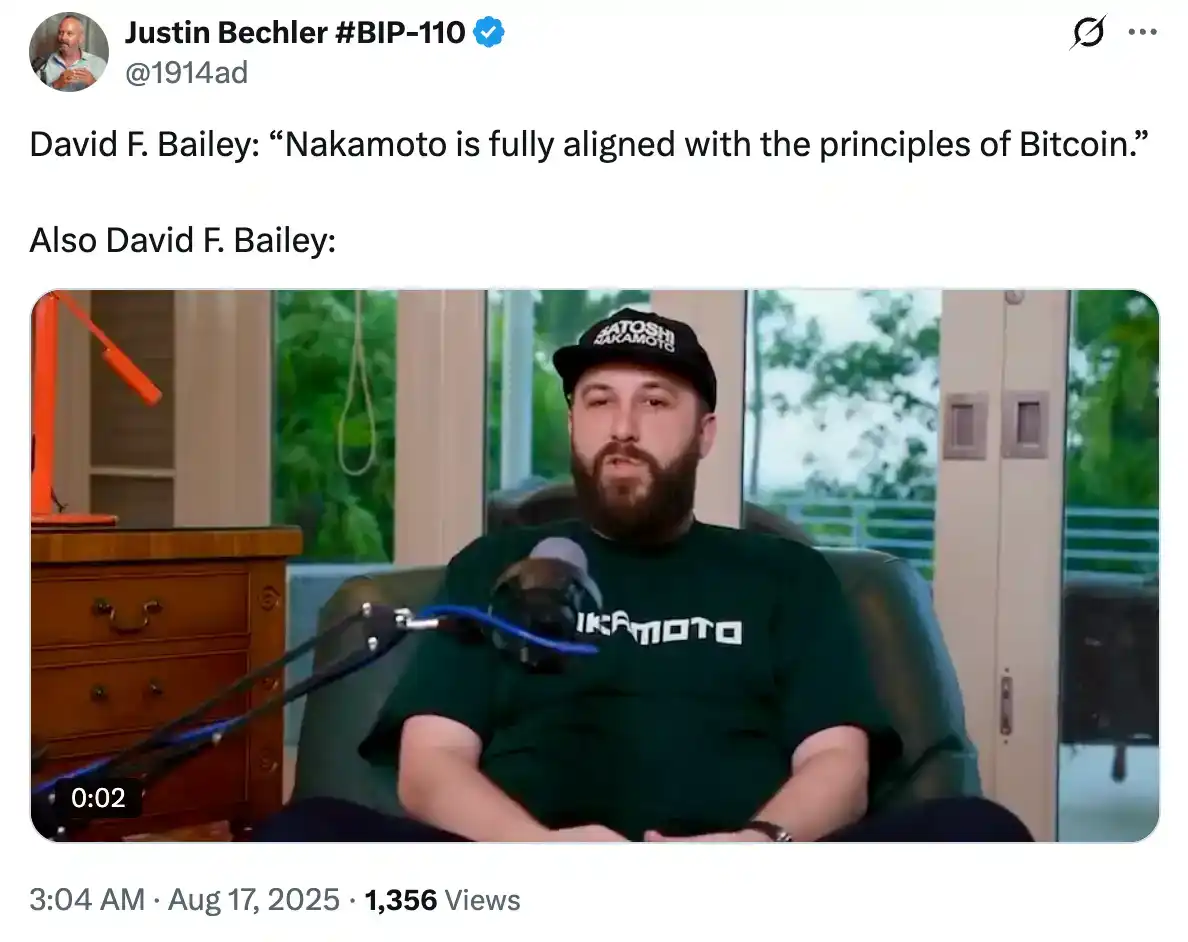
Nine months later, the stock price fell to 29 cents, and Bailey just used this stock to buy his own companies.

The Pump

The mechanism was quite ingeniously designed.

KindlyMD was originally an unnoticed micro-cap stock on Nasdaq. Nakamoto Holdings went public through a reverse merger, backed by $510 million in PIPE (Private Investment in Public Equity) financing and $200 million in convertible bonds.

On paper, it seemed like the birth of a Bitcoin reserve giant, with a new generation of Bitcoin influencers rushing to tell you why to buy $NAKA (of course, the reason was to own more Bitcoin).

Within days, NAKA's price-to-NAV ratio reached an astonishing 23x, meaning speculators paid $23 for every $1 of Bitcoin held by the company.

Michael Saylor's MicroStrategy never reached such a premium. The difference is that MicroStrategy has years of operational history, a software business generating actual revenue, and a CEO who didn't manipulate the transaction structure to enrich himself on the backend.

Insiders knew secrets that retail investors didn't. The PIPE investors—including the notorious BIP-110 opponents Udi Wertheimer, Jameson Lopp, and Adam Back—got in at $1.12 per share. Retail investors bought at $28, $30, $31, and even higher.

This information asymmetry was built into the structure from day one.

In June, Bailey completed another $51.5 million PIPE financing at $5.00 per share. Although the second batch of investors got in at a much lower cost than retail, it was still far above the $1.12 floor price, and they were ultimately harvested too.

Bailey celebrated the financing, saying it took less than 72 hours and investor demand was extremely strong.

Let's take a closer look at this strategy.

The Dump

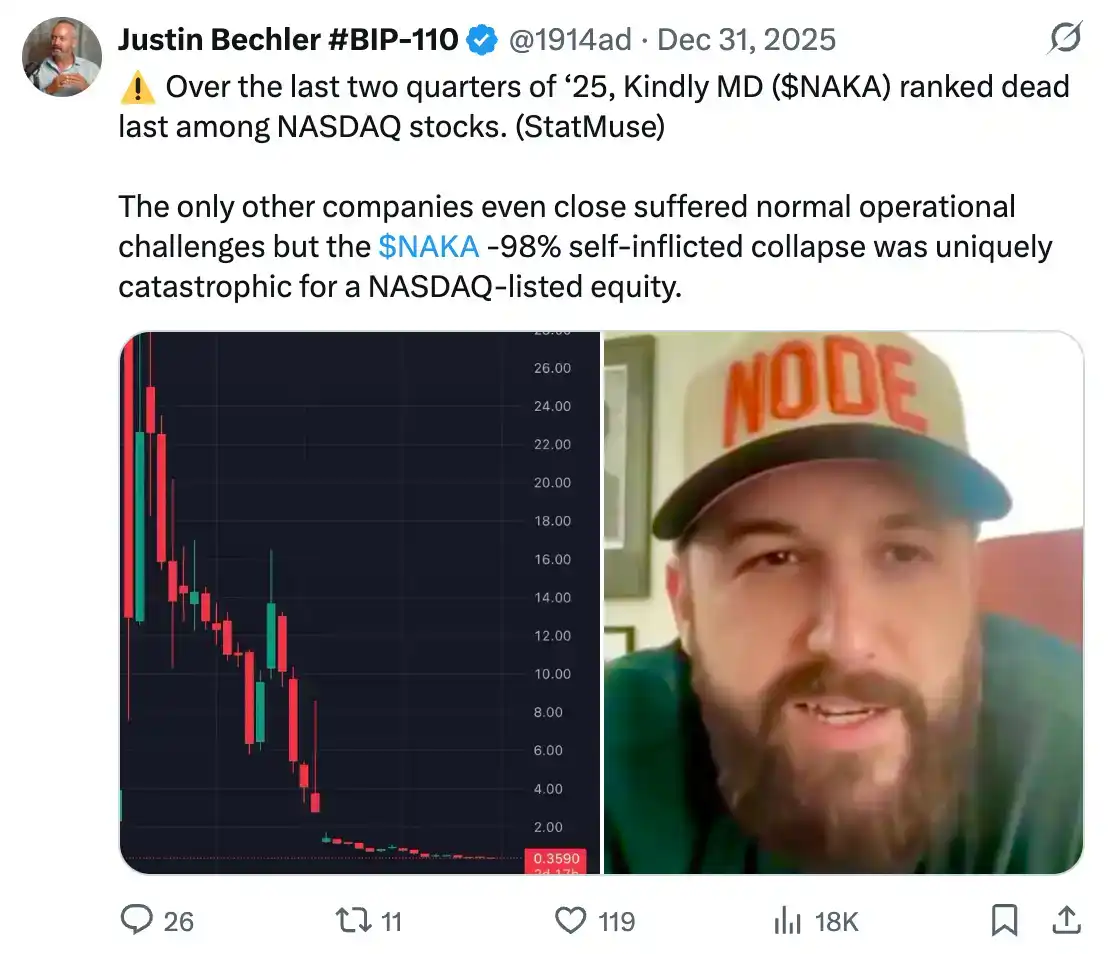
By September, NAKA had plummeted by 96%.

The early PIPE investors who obtained shares at $1.12 could finally cash out after the merger was completed in August, and they did so.

Bailey's response was quite bizarre for a public company CEO; he told shareholders who were just there for a quick trade to leave.

So they left.

The stock price continued to fall. Below $1. Below 50 cents. Below 30 cents. A company holding about 5,765 Bitcoins (worth over $500 million) now had a market cap of less than $300 million.

The market valued Nakamoto even lower than the Bitcoin on its balance sheet, which says a lot about how investors view the management team and corporate structure wrapped around these Bitcoins.
Debt Spiral

As the stock price crashed, Bailey changed lenders frequently, like a gambler borrowing money on the casino floor.

The initial capital structure included $200 million in convertible bonds from Yorkville Advisors, with a conversion price of $2.80. As NAKA's stock price fell below this level, the convertible bonds became debt that could devour equity. So, on October 3, Nakamoto took out a $203 million term loan from Two Prime Lending to redeem Yorkville's notes and interest.

Four days later, on October 7, they borrowed $206 million in USDT from Antalpha at 7% interest to repay Two Prime. Antalpha's loan had a term of only 30 days (with an option to extend for another 30 days). They replaced the term loan with a 30-day bridge loan within a week.

The plan was to convert this bridge loan into a $250 million 5-year secured convertible bond from Antalpha. Use the new convertible to repay the bridge loan, the bridge loan to repay the term loan, and the term loan to repay the old convertible.

But that $250 million convertible never materialized on Antalpha's terms.

On December 16, Nakamoto borrowed $210 million in USDT from Kraken at 8% interest, over-collateralized by 150% with Bitcoin from its treasury.
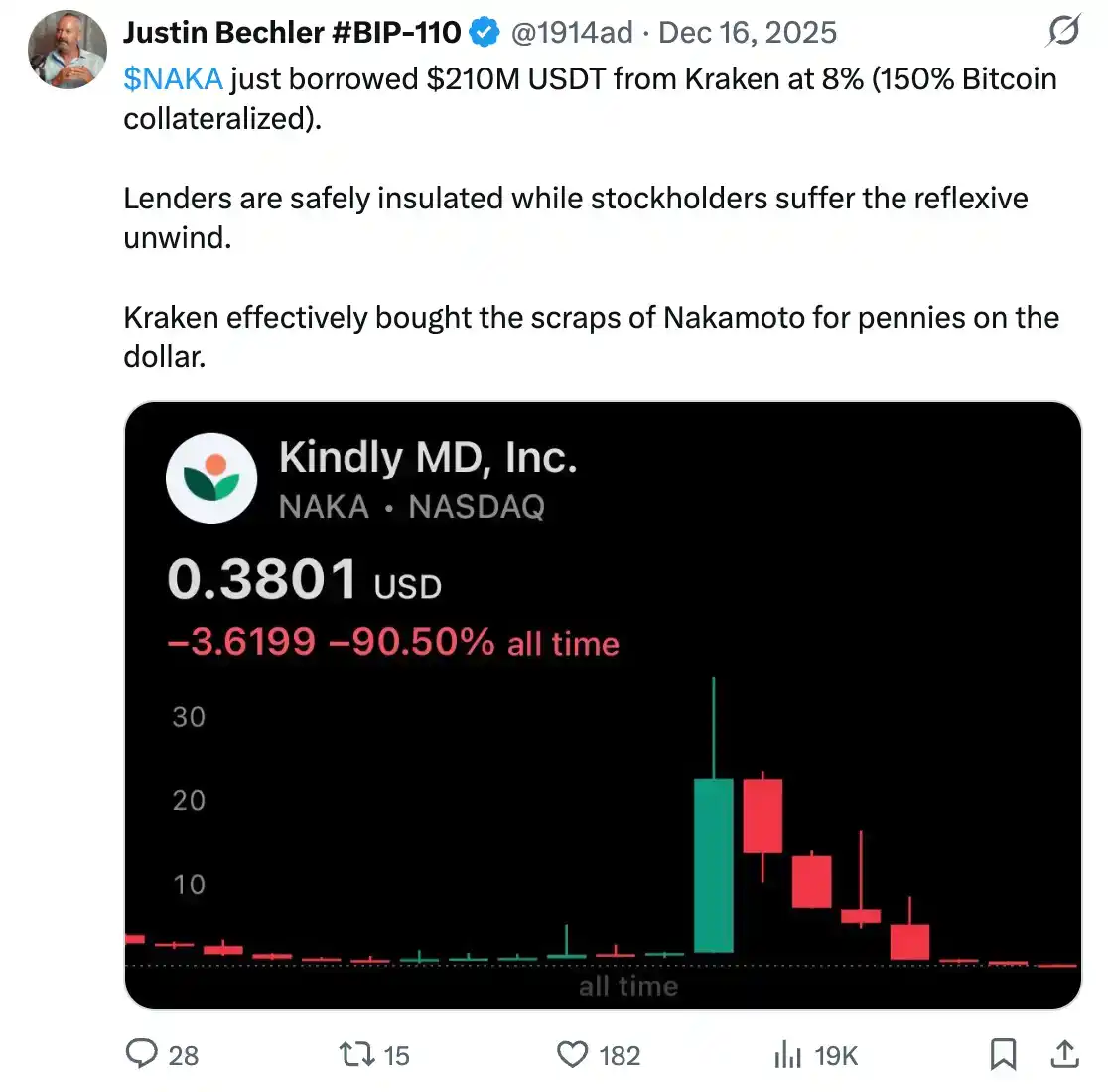
Do the math: The lender has $315 million worth of Bitcoin as collateral for a $210 million loan. If NAKA's stock goes to zero, Kraken takes the collateral. If Bitcoin drops 33%, Kraken remains unscathed. At every stage of this drama, the lenders were tightly protected, while common shareholders bore the full brunt of the reflexive crash.

Each new loan tightened the noose.

Countdown

On December 10, Nasdaq notified Nakamoto that it faced delisting risk because its stock price had been below $1 for 30 consecutive business days. The company must regain compliance by June 8, 2026, meaning the closing price must be above $1 for 10 consecutive trading days.

The current stock price is 29 cents.
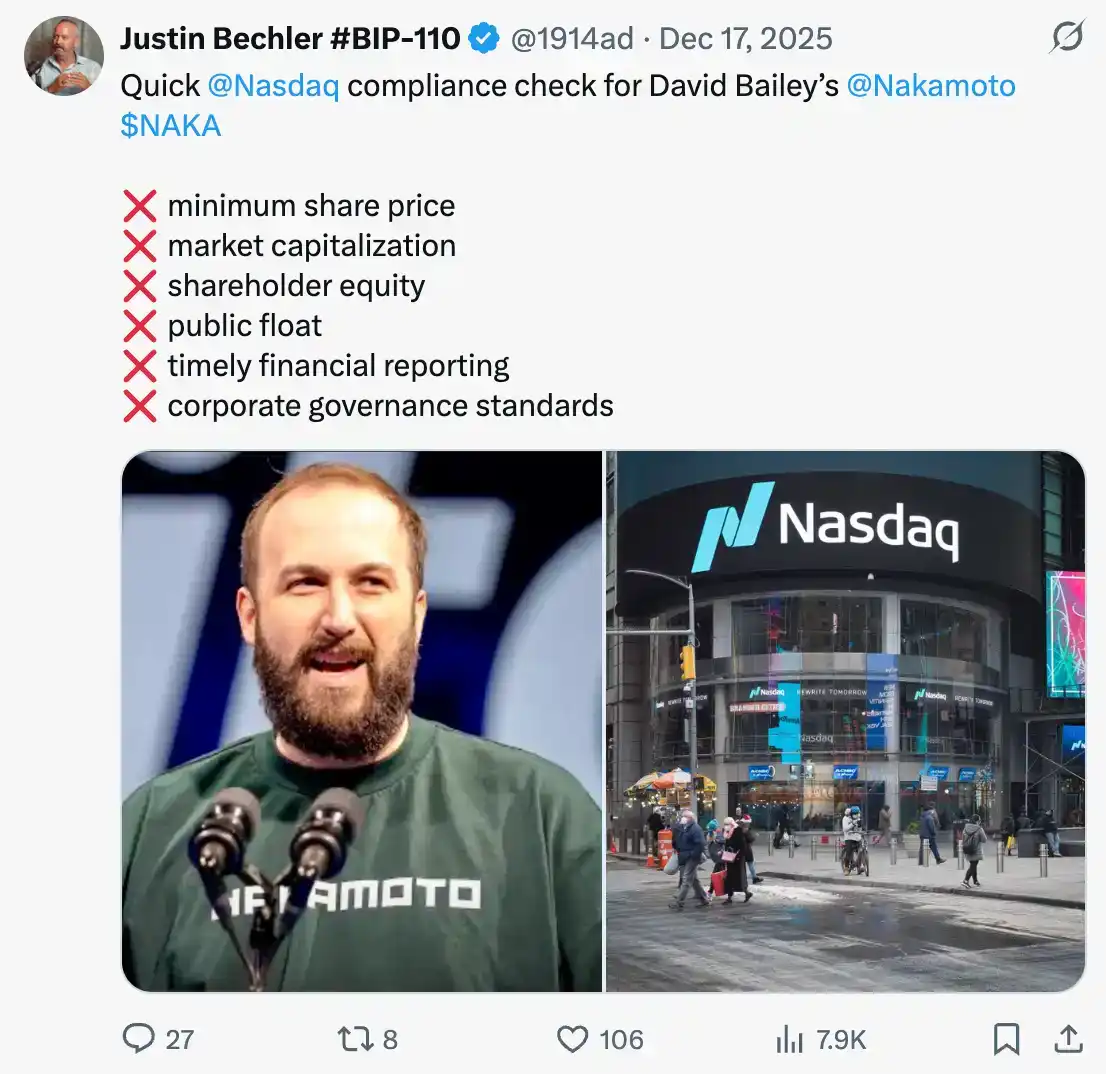
If delisted, Nakamoto would be unable to conduct ATM (at-the-Market) offerings, issue convertible bonds, or use stock as acquisition currency. Everything Bailey assembled in this shell relies on a Nasdaq listing that currently cannot be maintained.

Accounting Disaster

In November, Nakamoto filed a Form 12b-25 with the SEC, admitting it could not submit its quarterly financial report on time due to accounting complexities from the merger. Preliminary data revealed the truth:

The Nakamoto acquisition resulted in a $59.75 million loss (payment price higher than net asset value)

$22.07 million unrealized loss on digital assets

$1.41 million realized loss from selling Bitcoin

$14.45 million loss on debt extinguishment from refinancing rotations

A quarterly loss of approximately $97 million, partially offset by a $21.8 million accounting gain from contingent liabilities. This company, which was supposed to be the perfect Bitcoin reserve tool, couldn't even submit its books on time.

The Heist

This brings us back to this morning.

Nakamoto announced signing a definitive merger agreement to acquire BTC Inc and UTXO Management. BTC Inc owns Bitcoin Magazine and operates the Bitcoin Conference. UTXO manages a Bitcoin-focused hedge fund.

Bailey is the Chairman and CEO of the buyer, Nakamoto.

He is also the founder of the sellers, BTC Inc and UTXO.

He is the buyer, the seller, and the CEO approving the terms.

But weeks before the acquisition, he quietly handed the CEO title to Brandon Greene, creating a paper-thin separation between himself and the entities he was about to buy with shareholder equity.

This morning's deal was entirely financed with Nakamoto stock, priced at $1.12 per share based on a call option embedded in the original marketing services agreement. And $NAKA is still struggling to climb back to $0.29.

Bailey's companies received a stock valuation nearly four times the current market price. Security holders of BTC Inc and UTXO will receive 363.6 million shares, valuing the deal at $107.3 million at market prices.

But these shares were issued at $1.12, meaning the deal was structured when NAKA's stock was flying high, and the terms were never adjusted when the stock crashed.

Forget the fictional pricing on the contract. What really matters is that 363.6 million new shares just entered the float. Regardless of whether the documents say $1.12 or $0.29, existing shareholders were diluted by this quantity. The $1.12 label is a courtesy to the seller, but the dilution is real.

No additional shareholder approval was needed because the call option was already embedded in the original merger documents, and shareholders voted to approve them when NAKA's stock was still at $20, $30.

The retail investors who approved these terms had no idea they were authorizing the future acquisition of Bailey's private business at a locked-in high premium while their own shares were turning to dust.

Architecture of Self-Dealing

Stepping back, the entire architecture is breathtakingly elegant.
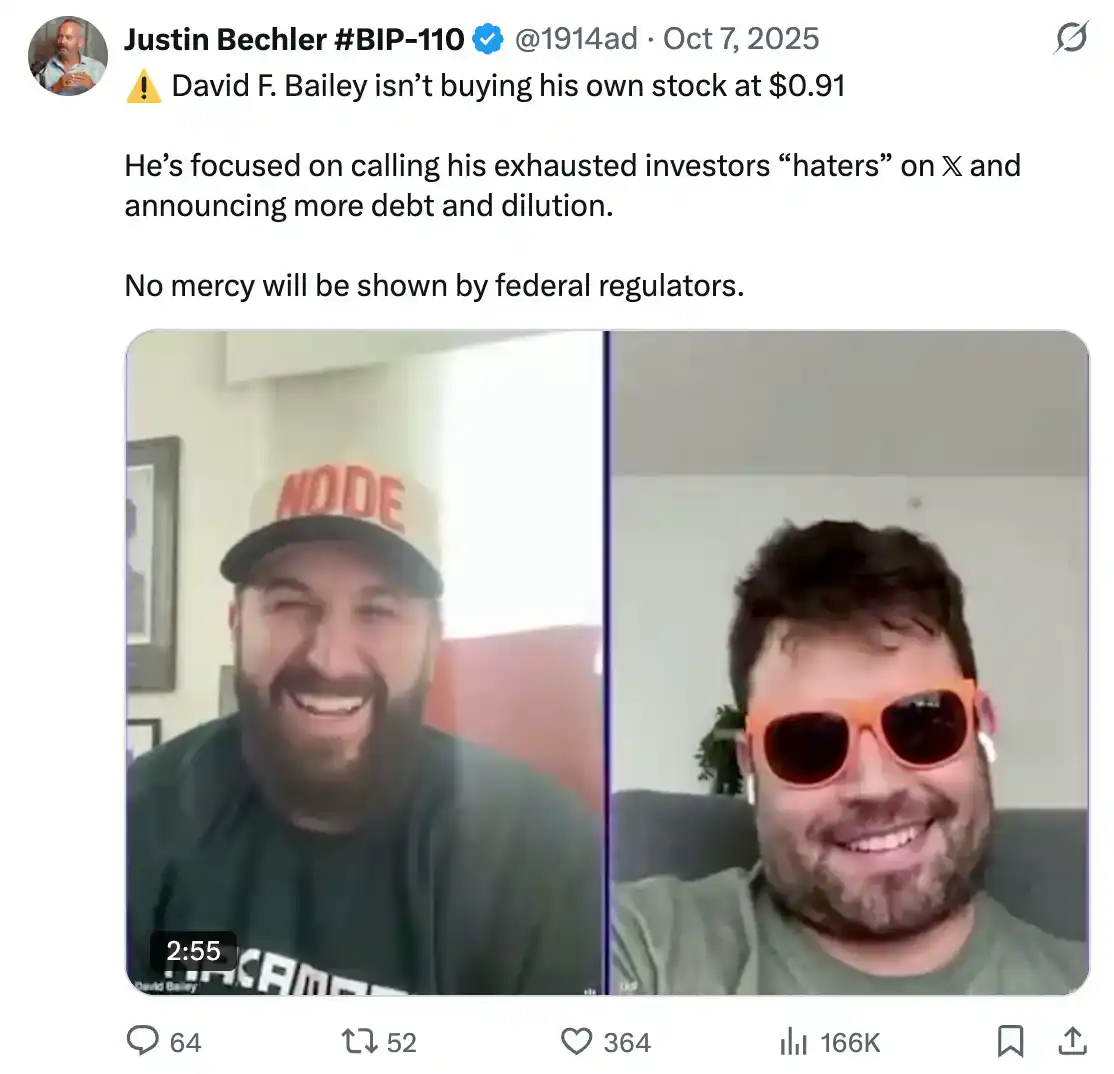
Bailey created Nakamoto Holdings. Merged it into a public shell company via KindlyMD, raising $710 million in the process. Driven by retail enthusiasm, the stock was pumped to 23x NAV. PIPE investors got in at $1.12, while the public paid 20 to 30 times that. The stock then crashed 99%.

During this time, the company changed lenders three times in a week, trying to manage $200 million in debt that was structured to convert to equity when the stock price was much higher.

Now, with the shattered stock price below 30 cents, Bailey is using this hollowed-out tool to swallow his private empire at terms agreed upon when the stock was a hundred times higher. The initial KindlyMD merger was the Trojan horse, and the acquisition of BTC Inc was the real payload.

Bailey told us from the start. In the initial press release, he said Nakamoto would acquire BTC Inc, subject to audit and call option exercise. The MSA was publicly filed, and the option terms were disclosed. Everything was legally compliant and fully transparent—just like all complex financial engineering, the truth was buried in piles of documents no one would read.

The person who operates Bitcoin Magazine, organizes the world's largest Bitcoin conference, and positions himself as a leader of the Bitcoin movement, built a public company, destroyed 99% of shareholder value, and is now using it to acquire his own businesses at a premium.

He once compared himself to the Medicis. At least the Medicis created value for Florence before taking their cut.

Nakamoto is the freak show that happens when influencer culture meets the public stock market.

Exit Liquidity

David Bailey raised $710 million from over 200 investors across six continents. He promised them a future like the Morgans, Medicis, and Rothschilds, a financial dynasty built on Bitcoin. He told them Nakamoto would bring Bitcoin to the center of global capital markets. He said their names would echo through history.

But he delivered a 99% loss.

He priced the PIPE at $1.12 while retail bought at $28. He embedded call options to acquire his own companies into the filings without shareholders understanding what they were authorizing. He rotated three lenders in a week to prevent $200 million in debt from crushing equity, accumulating $14 million in debt extinguishment losses along the way. He sold Bitcoin at a loss from the treasury that was supposed to only accumulate, not sell. He couldn't even submit quarterly financial reports on time. And when the stock price finally fell to 29 cents...

When the rubble was cleared and the retail investors who trusted him were wiped out, he exercised that call option, using the wreckage of their investment to buy his private empire at four times the market price.

Bailey holds 11 million shares at a cost of $1.12. Adam Back holds nearly 9 million shares. Balaji, Lopp, Yusko, Salinas, Jihan Wu—they all got in at a price that teachers, truck drivers, or first-time investors could never access. These are the people who shape the Bitcoin narrative. They run conferences, publish magazines, manage funds, post tweets. They are the supply chain of belief, turning skeptics into believers and believers into bag holders.

Now, Bailey owns Bitcoin Magazine, the Bitcoin Conference, and a hedge fund, all packed into a public company with a market cap only a fraction of its Bitcoin holdings, all acquired with stock priced four times the market value, all approved before a single cent from retail entered.

And he's not done.

Nakamoto has already filed with the SEC for a $5 billion ATM (At-the-Market) stock offering. Bailey now controls the media division, the conference division, the hedge fund, and a shelf registration that allows him to keep issuing stock collateralized by the Bitcoin treasury until the last bit of value is squeezed out.

When exactly did the Bitcoin community hand the keys to conference promoters and influencer capitalists? And why is anyone surprised when they drive away with the car?


Perguntas relacionadas

QWhat was the key mechanism David Bailey used to acquire his private companies at a premium using the struggling Nakamoto Holdings stock?

AHe utilized a call option embedded in the original marketing services agreement, which was approved by shareholders when the stock price was high, allowing the acquisition at $1.12 per share despite the market price collapsing to $0.29.

QHow did the PIPE investors benefit from the retail investors in the Nakamoto Holdings deal?

APIPE investors, including prominent Bitcoin figures, acquired shares at $1.12, while retail investors bought in at prices 20 to 30 times higher, around $28 to $31, creating a massive information asymmetry from the start.

QWhat was the consequences of Nakamoto's stock price falling below $1 for an extended period?

AThe company received a delisting notice from Nasdaq, threatening its ability to conduct ATM offerings, issue convertible notes, or use its stock as acquisition currency, which was crucial for Bailey's plans.

QWhat financial maneuvers did Nakamoto employ to manage its $200 million debt as the stock price collapsed?

AThe company rapidly cycled through lenders, first replacing a convertible note with a term loan, then a 30-day bridge loan, and finally a loan from Kraken secured by 150% over-collateralization of its Bitcoin treasury, accruing significant losses in the process.

QHow did David Bailey structure the acquisition to avoid additional shareholder approval for buying his own companies?

AThe call option for the acquisition was pre-approved by shareholders in the initial merger documents when the stock was highly valued, so no further vote was required when the deal was executed after the price crash.

Leituras Relacionadas

Trading

Spot
Futuros

Artigos em Destaque

O que é BITCOIN

Compreender o HarryPotterObamaSonic10Inu (ERC-20) e a Sua Posição no Espaço Cripto Nos últimos anos, o mercado de criptomoedas assistiu a um aumento na popularidade das moedas meme, cativando não apenas os traders, mas também aqueles que procuram envolvimento comunitário e valor de entretenimento. Entre estes tokens únicos está o HarryPotterObamaSonic10Inu (ERC-20), um projeto intrigante que mistura referências culturais no tecido das criptomoedas. Este artigo explora os principais aspetos do HarryPotterObamaSonic10Inu, examinando os seus mecanismos, a sua ética orientada pela comunidade e o seu envolvimento com o vasto panorama cripto. O que é o HarryPotterObamaSonic10Inu (ERC-20)? Como o nome sugere, o HarryPotterObamaSonic10Inu é uma moeda meme construída na blockchain Ethereum, classificada sob o padrão ERC-20. Ao contrário das criptomoedas tradicionais, que podem enfatizar a utilidade prática ou o potencial de investimento, este token prospera no valor de entretenimento e na força da sua comunidade. O projeto visa promover um ambiente onde utilizadores envolvidos possam reunir-se, partilhar ideias e participar em atividades inspiradas por diversos fenómenos culturais. Uma característica notável do HarryPotterObamaSonic10Inu é a zero taxa sobre transações. Este elemento atraente visa encorajar a negociação e o envolvimento da comunidade, isento de encargos adicionais que podem desencorajar os traders de pequena escala. A oferta total da moeda está fixada em mil milhões de tokens, uma cifra que marca a sua intenção de manter uma circulação substancial dentro da comunidade. Criador do HarryPotterObamaSonic10Inu (ERC-20) As origens do HarryPotterObamaSonic10Inu estão um pouco envoltas em mistério; os detalhes sobre o criador permanecem desconhecidos. O desenvolvimento deste token carece de uma equipa identificável ou de um plano explícito, o que não é raro no setor das moedas meme. Em vez disso, o projeto surgiu de forma orgânica, com o seu progresso a depender fortemente do entusiasmo e da participação da sua comunidade. Investidores do HarryPotterObamaSonic10Inu (ERC-20) No que diz respeito a investimentos externos e apoios, o HarryPotterObamaSonic10Inu também permanece ambíguo. O token não lista quaisquer fundações de investimento conhecidas ou apoio organizacional significativo. Em vez disso, o “sangue vital” do projeto é a sua comunidade de base, que informa o seu crescimento e sustentabilidade através da ação coletiva e do envolvimento no espaço cripto. Como Funciona o HarryPotterObamaSonic10Inu (ERC-20)? Como uma moeda meme, o HarryPotterObamaSonic10Inu opera principalmente fora dos quadros tradicionais que muitas vezes governam o valor dos ativos. Existem vários aspetos distintivos que definem como o projeto funciona: Transações Sem Taxas: Sem taxas sobre transações, os utilizadores podem comprar e vender o token livremente, sem a preocupação de custos ocultos. Envolvimento da Comunidade: O projeto prospera na interação da comunidade, aproveitando plataformas de redes sociais para criar entusiasmo e facilitar a participação. Discussões, partilha de conteúdo e envolvimento são elementos cruciais que ajudam a expandir o seu alcance e a fomentar a lealdade entre os apoiantes. Sem Utilidade Prática: Deve ser notado que o HarryPotterObamaSonic10Inu não oferece utilidade concreta dentro do ecossistema financeiro. Em vez disso, é classificado como um token principalmente para entretenimento e atividades comunitárias. Referência Cultural: O token incorpora de forma inteligente elementos da cultura popular para atrair interesse, conectando-se tanto com entusiastas de memes como com seguidores de criptomoedas. HarryPotterObamaSonic10Inu exemplifica como as moedas meme operam de forma diferente de projetos de criptomoedas mais tradicionais, entrando no mercado como construções sociais inovadoras em vez de ativos utilitários. Linha do Tempo do HarryPotterObamaSonic10Inu (ERC-20) A história do HarryPotterObamaSonic10Inu é marcada por vários marcos notáveis: Criação: O token surgiu de um meme viral, capturando a imaginação de muitos entusiastas de criptomoedas. Datas específicas de criação não estão disponíveis, sublinhando a sua ascensão orgânica. Listagem em Exchanges: O HarryPotterObamaSonic10Inu conseguiu entrar em várias exchanges, permitindo um acesso e negociação mais fáceis pela comunidade. Iniciativas de Envolvimento da Comunidade: Atividades contínuas direcionadas a melhorar a interação comunitária, incluindo concursos, campanhas em redes sociais e geração de conteúdo por fãs e defensores. Planos de Expansão Futura: O roteiro do projeto inclui o lançamento de uma coleção de NFTs, mercadorias e um site de eCommerce relacionado aos seus temas culturais, envolvendo ainda mais a comunidade e tentando adicionar mais dimensões ao seu ecossistema. Pontos-Chave sobre o HarryPotterObamaSonic10Inu (ERC-20) Natureza Orientada pela Comunidade: O projeto prioriza a contribuição coletiva e a criatividade, assegurando que o envolvimento dos utilizadores está na vanguarda do seu desenvolvimento. Classificação como Moeda Meme: Representa o epítome da criptomoeda baseada em entretenimento, destacando-se dos veículos de investimento tradicionais. Sem Afiliação Direta com o Bitcoin: Apesar da semelhança no nome do ticker, o HarryPotterObamaSonic10Inu é distinto e não tem qualquer relação com o Bitcoin ou outras criptomoedas estabelecidas. Foco na Colaboração: O HarryPotterObamaSonic10Inu é projetado para criar um espaço de colaboração e partilha de histórias entre os seus detentores, proporcionando uma via para a criatividade e o fortalecimento da comunidade. Perspectivas Futuras: A ambição de expandir além da sua premissa inicial para NFTs e mercadorias delineia um caminho para o projeto potencialmente entrar em avenidas mais mainstream dentro da cultura digital. À medida que as moedas meme continuam a capturar a imaginação da comunidade cripto, HarryPotterObamaSonic10Inu (ERC-20) destaca-se devido aos seus laços culturais e abordagem centrada na comunidade. Embora possa não se encaixar no molde típico de um token orientado para utilidade, a sua essência reside na alegria e camaradagem fomentadas entre os seus apoiantes, destacando a natureza em evolução das criptomoedas em uma era cada vez mais digital. À medida que o projeto continua a desenvolver-se, será importante observar como as dinâmicas comunitárias influenciam a sua trajetória no panorama em constante mudança da tecnologia blockchain.

1.4k Visualizações TotaisPublicado em {updateTime}Atualizado em 2024.12.03

O que é BITCOIN

Como comprar BTC

Bem-vindo à HTX.com!Tornámos a compra de Bitcoin (BTC) simples e conveniente.Segue o nosso guia passo a passo para iniciar a tua jornada no mundo das criptos.Passo 1: cria a tua conta HTXUtiliza o teu e-mail ou número de telefone para te inscreveres numa conta gratuita na HTX.Desfruta de um processo de inscrição sem complicações e desbloqueia todas as funcionalidades.Obter a minha contaPasso 2: vai para Comprar Cripto e escolhe o teu método de pagamentoCartão de crédito/débito: usa o teu visa ou mastercard para comprar Bitcoin (BTC) instantaneamente.Saldo: usa os fundos da tua conta HTX para transacionar sem problemas.Terceiros: adicionamos métodos de pagamento populares, como Google Pay e Apple Pay, para aumentar a conveniência.P2P: transaciona diretamente com outros utilizadores na HTX.Mercado de balcão (OTC): oferecemos serviços personalizados e taxas de câmbio competitivas para os traders.Passo 3: armazena teu Bitcoin (BTC)Depois de comprar o teu Bitcoin (BTC), armazena-o na tua conta HTX.Alternativamente, podes enviá-lo para outro lugar através de transferência blockchain ou usá-lo para transacionar outras criptomoedas.Passo 4: transaciona Bitcoin (BTC)Transaciona facilmente Bitcoin (BTC) no mercado à vista da HTX.Acede simplesmente à tua conta, seleciona o teu par de trading, executa as tuas transações e monitoriza em tempo real.Oferecemos uma experiência de fácil utilização tanto para principiantes como para traders experientes.

3.9k Visualizações TotaisPublicado em {updateTime}Atualizado em 2025.03.21

Como comprar BTC

O que é $BITCOIN

OURO DIGITAL ($BITCOIN): Uma Análise Abrangente Introdução ao OURO DIGITAL ($BITCOIN) OURO DIGITAL ($BITCOIN) é um projeto baseado em blockchain que opera na rede Solana, com o objetivo de combinar as características dos metais preciosos tradicionais com a inovação das tecnologias descentralizadas. Embora partilhe um nome com o Bitcoin, frequentemente referido como “ouro digital” devido à sua percepção como uma reserva de valor, o OURO DIGITAL é um token separado projetado para criar um ecossistema único dentro da paisagem Web3. O seu objetivo é posicionar-se como um ativo digital alternativo viável, embora os detalhes sobre as suas aplicações e funcionalidades ainda estejam em desenvolvimento. O que é o OURO DIGITAL ($BITCOIN)? OURO DIGITAL ($BITCOIN) é um token de criptomoeda explicitamente projetado para uso na blockchain Solana. Em contraste com o Bitcoin, que fornece um papel amplamente reconhecido como armazenamento de valor, este token parece focar em aplicações e características mais amplas. Aspectos notáveis incluem: Infraestrutura Blockchain: O token é construído na blockchain Solana, conhecida pela sua capacidade de lidar com transações de alta velocidade e baixo custo. Dinâmicas de Oferta: O OURO DIGITAL tem um fornecimento máximo limitado a 100 quatrilhões de tokens (100P $BITCOIN), embora os detalhes sobre o seu fornecimento circulante ainda não tenham sido divulgados. Utilidade: Embora as funcionalidades precisas não estejam explicitamente delineadas, existem indicações de que o token poderia ser utilizado para várias aplicações, potencialmente envolvendo aplicações descentralizadas (dApps) ou estratégias de tokenização de ativos. Quem é o Criador do OURO DIGITAL ($BITCOIN)? Neste momento, a identidade dos criadores e da equipa de desenvolvimento por trás do OURO DIGITAL ($BITCOIN) permanece desconhecida. Esta situação é típica entre muitos projetos inovadores no espaço da blockchain, particularmente aqueles alinhados com finanças descentralizadas e fenómenos de moedas meme. Embora tal anonimato possa fomentar uma cultura orientada pela comunidade, intensifica as preocupações sobre governança e responsabilidade. Quem são os Investidores do OURO DIGITAL ($BITCOIN)? As informações disponíveis indicam que o OURO DIGITAL ($BITCOIN) não tem apoiantes institucionais conhecidos ou investimentos proeminentes de capital de risco. O projeto parece operar num modelo peer-to-peer focado no apoio e adoção da comunidade, em vez de rotas de financiamento tradicionais. A sua atividade e liquidez estão principalmente situadas em exchanges descentralizadas (DEXs), como a PumpSwap, em vez de plataformas de negociação centralizadas estabelecidas, destacando ainda mais a sua abordagem de base. Como Funciona o OURO DIGITAL ($BITCOIN) A mecânica operacional do OURO DIGITAL ($BITCOIN) pode ser elaborada com base no seu design de blockchain e nas características da rede: Mecanismo de Consenso: Ao aproveitar o exclusivo proof-of-history (PoH) da Solana combinado com um modelo de proof-of-stake (PoS), o projeto assegura uma validação eficiente das transações, contribuindo para o alto desempenho da rede. Tokenomics: Embora mecanismos deflacionários específicos não tenham sido extensivamente detalhados, o vasto fornecimento máximo de tokens implica que pode atender a microtransações ou casos de uso de nicho que ainda estão por definir. Interoperabilidade: Existe o potencial para integração com o ecossistema mais amplo da Solana, incluindo várias plataformas de finanças descentralizadas (DeFi). No entanto, os detalhes sobre integrações específicas permanecem não especificados. Cronologia de Eventos Chave Aqui está uma cronologia que destaca marcos significativos relacionados ao OURO DIGITAL ($BITCOIN): 2023: O lançamento inicial do token ocorre na blockchain Solana, marcado pelo seu endereço de contrato. 2024: O OURO DIGITAL ganha visibilidade ao tornar-se disponível para negociação em exchanges descentralizadas como a PumpSwap, permitindo que os utilizadores o negociem contra SOL. 2025: O projeto testemunha atividade de negociação esporádica e potencial interesse em envolvimentos liderados pela comunidade, embora não tenham sido documentadas parcerias ou avanços técnicos notáveis até ao momento. Análise Crítica Forças Escalabilidade: A infraestrutura subjacente da Solana suporta altos volumes de transações, o que pode aumentar a utilidade do $BITCOIN em vários cenários de transação. Acessibilidade: O potencial preço de negociação baixo por token pode atrair investidores de retalho, facilitando uma participação mais ampla devido a oportunidades de propriedade fracionada. Riscos Falta de Transparência: A ausência de apoiantes, desenvolvedores ou um processo de auditoria publicamente conhecidos pode gerar ceticismo em relação à sustentabilidade e confiabilidade do projeto. Volatilidade do Mercado: A atividade de negociação depende fortemente do comportamento especulativo, o que pode resultar em volatilidade significativa dos preços e incerteza para os investidores. Conclusão O OURO DIGITAL ($BITCOIN) surge como um projeto intrigante, mas ambíguo, dentro do ecossistema em rápida evolução da Solana. Embora tente aproveitar a narrativa do “ouro digital”, a sua divergência do papel estabelecido do Bitcoin como reserva de valor sublinha a necessidade de uma diferenciação mais clara da sua utilidade pretendida e estrutura de governança. A aceitação e adoção futuras dependerão provavelmente da abordagem da atual opacidade e da definição mais explícita das suas estratégias operacionais e económicas. Nota: Este relatório abrange informações sintetizadas disponíveis até outubro de 2023, e desenvolvimentos podem ter ocorrido além do período de pesquisa.

92 Visualizações TotaisPublicado em {updateTime}Atualizado em 2025.05.13

O que é $BITCOIN

Discussões

Bem-vindo à Comunidade HTX. Aqui, pode manter-se informado sobre os mais recentes desenvolvimentos da plataforma e obter acesso a análises profissionais de mercado. As opiniões dos utilizadores sobre o preço de BTC (BTC) são apresentadas abaixo.

活动图片













