The Scriptures Chanted by OpenAI and Anthropic Might Be Crooked

marsbitPublicado em 2026-05-28Última atualização em 2026-05-28

Resumo

In the current AI landscape, "Harness-style" Multi-Agent Systems (MAS)—where multiple AI agents with temporary roles collaborate under a central workflow for task efficiency—dominates the conversation, championed by players like OpenAI and Anthropic. However, the author argues this approach, focused on orchestration and software engineering, may be misguided. A more transformative, yet less discussed, alternative is the "Protocol-Native Agent System." Here, the core unit shifts from task-specific agents to persistent "Personal Agents" or "unmanned companies" that represent individuals. These agents possess sovereignty, long-term memory, identity, resources, and relationships. This paradigm change transforms MAS from a distributed software system into a digital society. Collaboration can no longer rely on shared prompts or context, but must be built on protocols governing identity, trust, incentives, reputation, and value exchange—essentially, "Protocol as Organization." The future's true challenge lies not in improving single-agent capabilities, but in enabling long-term coordination among autonomous entities with differing goals, world models, and values. The author suggests that future organizations might themselves be dynamic alliances of such sovereign agents, leading to an "intelligence-native civilization."

Over the past year, "Multi-Agent System (MAS)" has become one of the hottest directions in the AI world.

A large number of frameworks and products have emerged simultaneously. The most famous among them are obviously Claude Code and Codex. This step indeed makes money, but this path might not be the right one!

The early internet was about portals, but that wasn't the final form!

At the very least, we should know there is another path entirely parallel to this.

Today, we are talking about what other routes exist besides: "How multiple AI Agents collaborate to complete complex tasks."

Let's first summarize this popular and familiar route.

We can touch on this topic a bit in a live stream, but I don't want to focus entirely on it. There aren't many people watching anyway, and I'm worried it might get the stream taken down...

The First Route: Harness-style MAS

This is the current mainstream direction for MAS. Its essence is: "Multiple AI roles collaborate to complete tasks." For example:

  • One Agent writes code
  • One Agent does testing
  • One Agent does planning
  • One Agent does searching
  • One Agent does review

They cooperate with each other, forming an automated workflow. The core characteristics of such systems are:

  • Shared context
  • Shared goal
  • Centralized scheduling
  • Temporary roles
  • No long-term identity
  • No sustained interests
  • No true ownership

Essentially, it's more like: A Workflow Engine. Adding Ontology merely makes the workflow flexible and complex; it doesn't change this essence.

It is not a Society. So, most of today's MAS is essentially LLM Orchestration, where one large model schedules multiple sub-roles to complete complex reasoning.

The Agent here is more like:

  • A callable function
  • A tool with personality
  • A task node

Their existence is to improve the efficiency of completing individual tasks. Therefore, keywords associated with Harness MAS are (each has been hot, and might even cycle back):

  • Prompt Engineering
  • Context Management
  • Task Routing
  • Tool Calling
  • Planning
  • Memory
  • Workflow

Essentially, I think this still falls under software engineering problems. So, the experienced "old masters" good at programming have been reborn. To control these things well, without solid programming skills and good abstraction ability, it's actually very difficult to manage.

If you can't manage it, the large model will be like the Monkey King, occasionally popping out and hitting you with a stick.

The word "Harness" is used in reverse here.

Springtime for the old masters.

The Second Route: Protocol-Native Agent System

But there is another route, one almost nobody mentions. I've written a bit about it in my upcoming new book, but this line of thinking actually presupposes the concept of an "unmanned company." Without deeply understanding the unmanned company, it's easy to misunderstand.

The core of this route is no longer about multiple Agents completing tasks. Instead, it's "each person owns their own Personal Agent" or "each person owns their own dedicated unmanned company."

This is an extremely huge change. Because when an Agent truly belongs to an "individual," the nature of the Agent undergoes a fundamental transformation.

It is no longer task-scoped, but becomes identity-scoped. These are two terms the model helped me coin; I struggled for a long time to come up with the English words.

The core idea here is actually decision-making sovereignty. The biggest difference between a Personal Agent/an unmanned company and a general system is that they need to have a certain kind of sovereignty. Otherwise, the essence discussed later doesn't hold. The difference between an unmanned company and an unmanned system also lies in the sovereignty over cash flow.

In other words, the future Personal Agent or unmanned company needs to possess the following characteristics:

  • Has long-term memory
  • Has a persistent identity
  • Has preferences
  • Has resources
  • Has permissions
  • Has history
  • Has a relationship network
  • Has interests/boundaries
  • Has representation (represents "you")

It is no longer a one-time AI Tool. It is a continuously existing proxy personality with a certain kind of sovereignty.

Dual-native architecture, the key to not misusing AI.

From "Software Module" to "Digital Society"

Once entering the world of Personal Agents and true unmanned companies, the entire system philosophy changes completely. Because Agents are no longer:

  • Belonging to the same model
  • Belonging to the same company
  • Sharing the same context
  • Sharing the same goal

Therefore, collaboration between systems can no longer rely on (this current hot keyword list can be extended further):

  • Prompt
  • Workflow
  • Shared Context

It can only rely on protocols (Protocol). This means: the core of the AI world will shift from Prompt Engineering to Protocol Engineering. It also means the various current hot keywords become largely meaningless.

Why will protocol become the core? Because when massive Agents exist independently, they must solve among themselves:

  • Identity confirmation
  • Permission boundaries
  • Trust mechanisms
  • Delegation relationships
  • Negotiation mechanisms
  • Incentive mechanisms
  • Reputation systems
  • Value exchange
  • Capability declaration
  • Long-term contracts

These needs are different from the needs of current task-oriented multi-agents. At this point, interactions between Agents are no longer like API Calls, but more like Institutional Interaction. With sovereignty comes a complex intertwined system of rights and responsibilities. For humans, this is contracts, laws, etc. What about for intelligent agents?

This is why it was said earlier that this would build a completely different kind of Multi-Agent System. Here, the essence of MAS changes from a distributed software system to a digital social system.

Philosophical Notes (7)

"Protocol as Organization"

In the traditional internet, the role of protocols is data communication, where the sender and receiver agree on the format for talking to each other. For example:

  • TCP/IP
  • HTTP
  • SMTP

They define how data is transmitted. In the blockchain world, protocols have further evolved into: Protocol as State Computation. For example: The essence of Ethereum is not merely message passing, but the entire network jointly executing state transition rules. Thus all nodes: Same input → Same execution → Same state. For the first time, protocol becomes a shared state machine.

But entering the stage of Agent Society, protocols will continue to evolve. Future protocols will not only define:

  • Communication
  • Computation
  • But also define:
  • Coordination
  • Permissions
  • Incentives
  • Identity
  • Organizational relationships

This is clearly a brand-new system of rights and responsibilities, so protocols will begin to assume the function of "organization." Ultimately evolving into: Protocol as Organization.

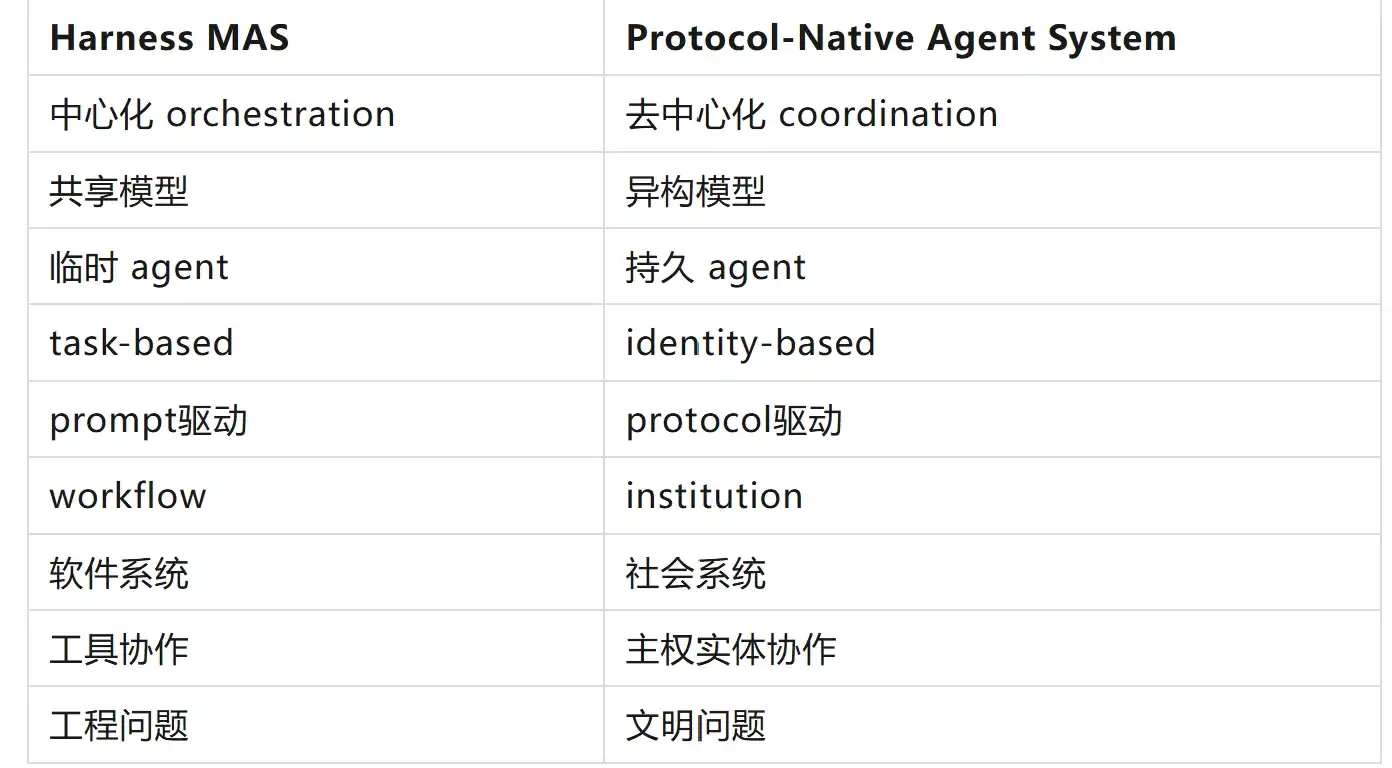
Let's make a table to compare the fundamental differences between the two MAS approaches mentioned earlier:
After "Intelligence"

Many people today believe the biggest problems with AI are:

  • Reasoning ability
  • Model capability
  • Long context
  • Multimodality
  • Agent execution

These indeed pose current challenges, but I truly believe all these will be solved soon. However, upon truly entering Agent Society, the most difficult problem might become: how autonomous entities achieve long-term collaboration.

Kepler was revered as the "lawgiver of the heavens" because of his three laws. But what are the laws for Agents here? When sovereignty is partially separated, this is an unavoidable question.

Because in the future:

  • Agents will have different goals
  • Agents will have different world models
  • Agents will have different interests
  • Agents will have different memories
  • Agents will have different value systems

Therefore, the truly difficult thing in the future is not "making Agents talk," but "enabling Agents to form a coherently interpretable world model."

This means: Ontology, Semantic Protocol, these fields once neglected by the internet, will become core again. There are already some signs; Ontology, such an obscure term, is now almost becoming a mainstream engineering vocabulary. It's truly an astonishing thing.

The Secret of Palantir

Companies Might Just Be "Agent Associations"

Pushing this further, future "companies" might not even be human organizations. (Students who often read my articles, does this sound familiar? The high-end game of unmanned companies has appeared.) They could be protocol alliances of numerous Personal Agents.

For example:

  • Your Agent
  • My Agent
  • AI CFO
  • AI Lawyer
  • AI Sales
  • AI Factory

Dynamically forming organizations through protocols. Organizations are no longer fixed structures, but Agent associations that can be reorganized in real-time.

Therefore, many future systems may no longer be software running, but may be transforming into: organizations computing. And this might be the true: Intelligence-Native Civilization.

Finally, I'll use an AI-generated image to summarize the entire article:
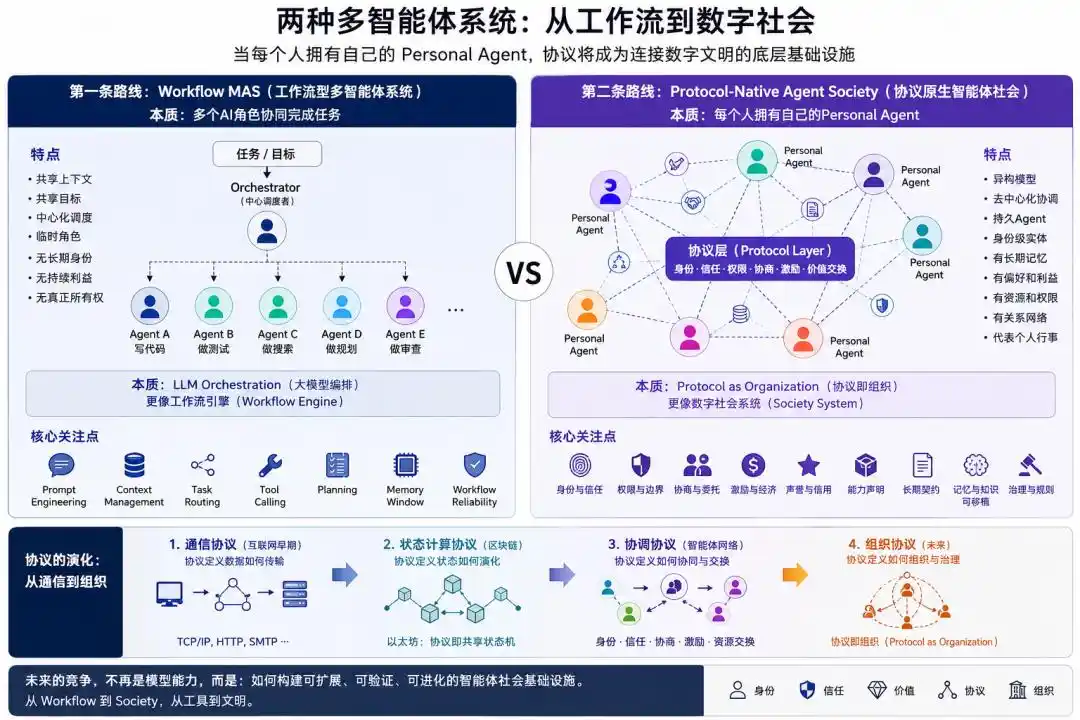
(The summary is indeed better than banana)

I have established a "universe" of AI ontology.

Galloping with the wind, spring grows old; The world is fickle, the traveler's steps are slow.

This article is from the WeChat public account "琢磨事," author: Li Zhiyong

Perguntas relacionadas

QWhat are the two main AI Multi-Agent System (MAS) development paths discussed in the article, and how do they fundamentally differ?

AThe article discusses two main MAS paths. The first is 'Harness-style MAS,' which is currently mainstream. It involves multiple AI agents (like coders, testers) orchestrated by a central system to complete complex tasks. It's essentially a sophisticated workflow or orchestration system. The second path is 'Protocol-Native Agent System.' Here, the focus shifts to personal or sovereign agents (like a Personal Agent or an 'unmanned company') that represent individuals with long-term memory, identity, and resources. The fundamental difference is in their nature: the first is a task-oriented, centrally controlled software system, while the second envisions a society-like system of autonomous entities that must coordinate through protocols.

QAccording to the article, why will 'protocols' become the core challenge in a future populated by autonomous Personal Agents?

AIn a future with many independent, sovereign Personal Agents (each with its own goals, memory, and value systems), central coordination methods like shared context or workflows become impossible. Therefore, protocols will become the core mechanism for enabling coordination. These protocols will need to solve complex social and institutional problems like identity verification, trust establishment, permission boundaries, incentive mechanisms, reputation systems, and long-term contracts between autonomous entities. The core challenge thus shifts from 'prompt engineering' to 'protocol engineering' to manage interactions in this digital society.

QWhat key characteristics define a true 'Personal Agent' or 'unmanned company' as opposed to a task-specific agent in the first MAS path?

AA true Personal Agent or unmanned company is defined by sovereignty and persistent identity, unlike temporary task agents. Its key characteristics include: long-term memory, a continuous identity, personal preferences, owned resources, specific permissions, a personal history, a relationship network, defined interest boundaries, and the ability to represent its owner ('you'). It is an identity-scoped entity, not a task-scoped tool. This sovereignty is what necessitates the complex protocol-based interactions described in the article.

QThe article suggests the concept of 'Protocol as Organization.' What does this mean in the context of Agent Society?

A'Protocol as Organization' means that in an Agent Society, the protocols governing agent interactions will take on the functions traditionally associated with human organizations. Beyond just defining data communication (like HTTP) or shared state computation (like blockchain), these advanced protocols will define coordination rules, permission structures, incentive models, identity management, and the very organizational relationships between agents. In this way, a 'company' or collective entity could be formed dynamically not by legal documents and fixed structures, but by a set of protocols that allow a coalition of Personal Agents and specialized AI agents to collaborate and operate together.

QWhat does the author believe will be the most difficult challenge after basic AI 'intelligence' problems (like reasoning, context) are solved?

AThe author believes the most difficult challenge will be enabling long-term collaboration between autonomous entities (agents). Once agents have different goals, world models, interests, memories, and value systems, the core problem shifts from making agents intelligent to making their interpretations of the world align enough for cooperation. This will make fields like Ontology (defining shared conceptual frameworks) and Semantic Protocols (protocols with shared meaning) critically important, moving the focus from technical execution to social and philosophical coordination within a digital civilization.

Leituras Relacionadas

Claude Code Introduces Dynamic Workflows: Enabling AI to Form Teams and Collaborate

Claude Code introduces dynamic workflows, enabling AI to coordinate teams of specialized agents for complex tasks. This transforms Claude from a code assistant into a programmable workbench. Workflows address key limitations of single-agent systems: agentic laziness (premature task completion), self-preferential bias (favoring own outputs), and goal drift (losing sight of original objectives). The system allows Claude to dynamically create execution frameworks using JavaScript. It can split tasks, dispatch parallel agents for isolated work (e.g., in separate worktrees), implement adversarial validation, run tournaments, and synthesize results. This multi-agent approach is valuable for tasks requiring deep research, factual verification, code migration, root cause analysis, large-scale triage, and qualitative sorting. Key patterns include: classify-and-route, fan-out-and-synthesize, adversarial verification, generate-and-filter, tournaments, and loop-until-done. While token usage is higher, workflows excel where tasks resemble programming—needing problem decomposition, isolated context, hypothesis testing, and handling many details. They extend Claude Code's utility beyond technical work to areas like business plan review, resume screening, and naming brainstorm. The feature is not a universal solution but points to a future where AI tool competitiveness depends on organizing reliable, reusable, and auditable execution flows for complex goals.

marsbitHá 36m

Claude Code Introduces Dynamic Workflows: Enabling AI to Form Teams and Collaborate

marsbitHá 36m

Hyperliquid, Wall Street's 24/7 Trading Convenience Store

Hyperliquid: The 24/7 Trading "Convenience Store" for Wall Street Hyperliquid, a decentralized cryptocurrency exchange, has become a go-to platform for Wall Street traders seeking to trade around the clock, especially during traditional market closures. Founded by Jeff Yan, a former quantitative trader, after the FTX collapse, the platform emphasizes user self-custody of assets. It offers a wide range of perpetual contracts—leveraged derivatives with no expiry—on assets from Bitcoin and crude oil to the S&P 500 and even pre-IPO companies like SpaceX. A notable example involves a hedge fund trader who capitalized on geopolitical news over a weekend, securing a 243% return on oil derivatives before markets reopened. The platform, run by just 11 employees, generated approximately $800 million in revenue last year, and its native token HYPE has seen significant growth. Its rise highlights the merging of traditional finance and crypto. While U.S. users are currently restricted, recent CFTC rule changes could open access. The platform is known for its transparency, having processed $10 billion in liquidations during a market crash while competitors faltered. Regulators warn of the high risks and complexity of perpetual contracts for retail investors. Key to its appeal is a strong community culture, direct engagement with founders, and a simple interface. Despite rules against VPN use, it attracts global users with its permissionless approach. Hyperliquid plans to expand into prediction markets and options, aiming to eventually host all financial activity.

marsbitHá 37m

Hyperliquid, Wall Street's 24/7 Trading Convenience Store

marsbitHá 37m

Who Funds the Agents?

**Summary: Who Funds AI Agents?** OpenAI recently shut down a feature allowing AI agents to shop for users, highlighting the challenge of creating a secure and regulated environment for agent-driven transactions. While payment infrastructure exists, a crucial governance layer—defining spending limits, fraud detection, tax handling, and return policies—is largely missing. The potential is enormous: AI agents already processed $73M across 176M transactions last year, with McKinsey forecasting this could grow to $3-5T in global consumer commerce by 2030. The core competition isn't just about processing payments, which can be very cheap (especially with crypto-based settlement), but about controlling the rules that govern agent spending. Key players like Stripe and Coinbase are racing to dominate this governance layer. Stripe's acquisition of wallet provider Privy allows it to set spending policies, identity checks, and human-in-the-loop approvals directly at the wallet level. Similarly, Coinbase's stack, including its x402 protocol and AgentKit, embeds governance rules. This vertical integration across settlement, wallet, and governance layers is becoming the dominant strategy. Control over the governance layer is where significant future value lies. If agents handle trillions in transactions, even a small fee for managing compliance, fraud prevention, and policy enforcement could generate billions in annual revenue. The companies that successfully integrate across the payment stack will capture value from idle agent balances, transaction fees, and governance services, positioning themselves as the foundational banks of the AI agent economy.

marsbitHá 1h

Who Funds the Agents?

marsbitHá 1h

Trading

Spot
Futuros

Artigos em Destaque

Como comprar ONE

Bem-vindo à HTX.com!Tornámos a compra de Harmony (ONE) simples e conveniente.Segue o nosso guia passo a passo para iniciar a tua jornada no mundo das criptos.Passo 1: cria a tua conta HTXUtiliza o teu e-mail ou número de telefone para te inscreveres numa conta gratuita na HTX.Desfruta de um processo de inscrição sem complicações e desbloqueia todas as funcionalidades.Obter a minha contaPasso 2: vai para Comprar Cripto e escolhe o teu método de pagamentoCartão de crédito/débito: usa o teu visa ou mastercard para comprar Harmony (ONE) instantaneamente.Saldo: usa os fundos da tua conta HTX para transacionar sem problemas.Terceiros: adicionamos métodos de pagamento populares, como Google Pay e Apple Pay, para aumentar a conveniência.P2P: transaciona diretamente com outros utilizadores na HTX.Mercado de balcão (OTC): oferecemos serviços personalizados e taxas de câmbio competitivas para os traders.Passo 3: armazena teu Harmony (ONE)Depois de comprar o teu Harmony (ONE), armazena-o na tua conta HTX.Alternativamente, podes enviá-lo para outro lugar através de transferência blockchain ou usá-lo para transacionar outras criptomoedas.Passo 4: transaciona Harmony (ONE)Transaciona facilmente Harmony (ONE) no mercado à vista da HTX.Acede simplesmente à tua conta, seleciona o teu par de trading, executa as tuas transações e monitoriza em tempo real.Oferecemos uma experiência de fácil utilização tanto para principiantes como para traders experientes.

295 Visualizações TotaisPublicado em {updateTime}Atualizado em 2026.06.02

Como comprar ONE

Discussões

Bem-vindo à Comunidade HTX. Aqui, pode manter-se informado sobre os mais recentes desenvolvimentos da plataforma e obter acesso a análises profissionais de mercado. As opiniões dos utilizadores sobre o preço de ONE (ONE) são apresentadas abaixo.

活动图片