The Safest Middleman in the Chip Industry Is Taking the Most Dangerous Path

marsbitPublicado em 2026-03-25Última atualização em 2026-03-25

Resumo

Arm, the semiconductor IP licensing giant, is embarking on a high-risk strategic shift by developing its own data center CPU, the Neoverse V3-based AGI CPU. This move, its first in-house chip in 35 years, aims to catapult the company's annual revenue from $4 billion to a targeted $15 billion for its chip business by 2031. This ambitious goal requires creating a new business line nearly the size of Intel's entire data center division. The core driver is the threat from its largest customers. Major cloud providers like AWS, Google, and Microsoft are increasingly designing and deploying their own powerful Arm-based server chips (Graviton, Axion, Cobalt), capturing the chip profits while Arm earns only licensing fees and royalties. This trend places a visible ceiling on Arm's traditional revenue growth from the data center sector. By building its own chip, Arm is now competing directly with its own licensees. While its first customer, Meta, lacks a mature in-house chip program, the strategy risks alienating key partners like Amazon and Google. Arm's bet is that the explosive growth of AI-driven data center demand, particularly for CPU-based AI inference tasks, is large enough to support both its new chip business and its ongoing IP licensing model. The success of this unprecedented dual-role strategy hinges on navigating this inherent conflict.

Between $4 billion and $15 billion lies not a growth curve, but a self-disruption of a business model.

On March 24, Arm unveiled the first self-developed data center CPU in its 35-year history in San Francisco. This chip, named the AGI CPU, features 136 Neoverse V3 cores, is built on TSMC's 3nm process, has a 300W TDP, with Meta as its first customer, and is set for large-scale deployment within the year. Simultaneously announced collaborations include OpenAI, Cerebras, Cloudflare, SAP, and SK Telecom.

At the launch event, Arm CEO Rene Haas presented a set of target figures, stating that the chip business aims to achieve $15 billion in annual revenue by 2031, with total company revenue reaching $25 billion and earnings per share of $9.

What do these numbers signify? Arm's total company revenue for FY2025 (ending March 2025) is $4.007 billion. According to Arm's annual report data, this includes $1.839 billion in licensing revenue and $2.168 billion in royalty revenue, with a gross margin of 97%. In other words, a company with $4 billion in annual revenue aims to build a new business nearly the size of Intel's entire data center division within five years. According to Intel's Q4 2024 earnings report, Intel's DCAI (Data Center and AI) division generated $12.8 billion in revenue for the full year 2024.
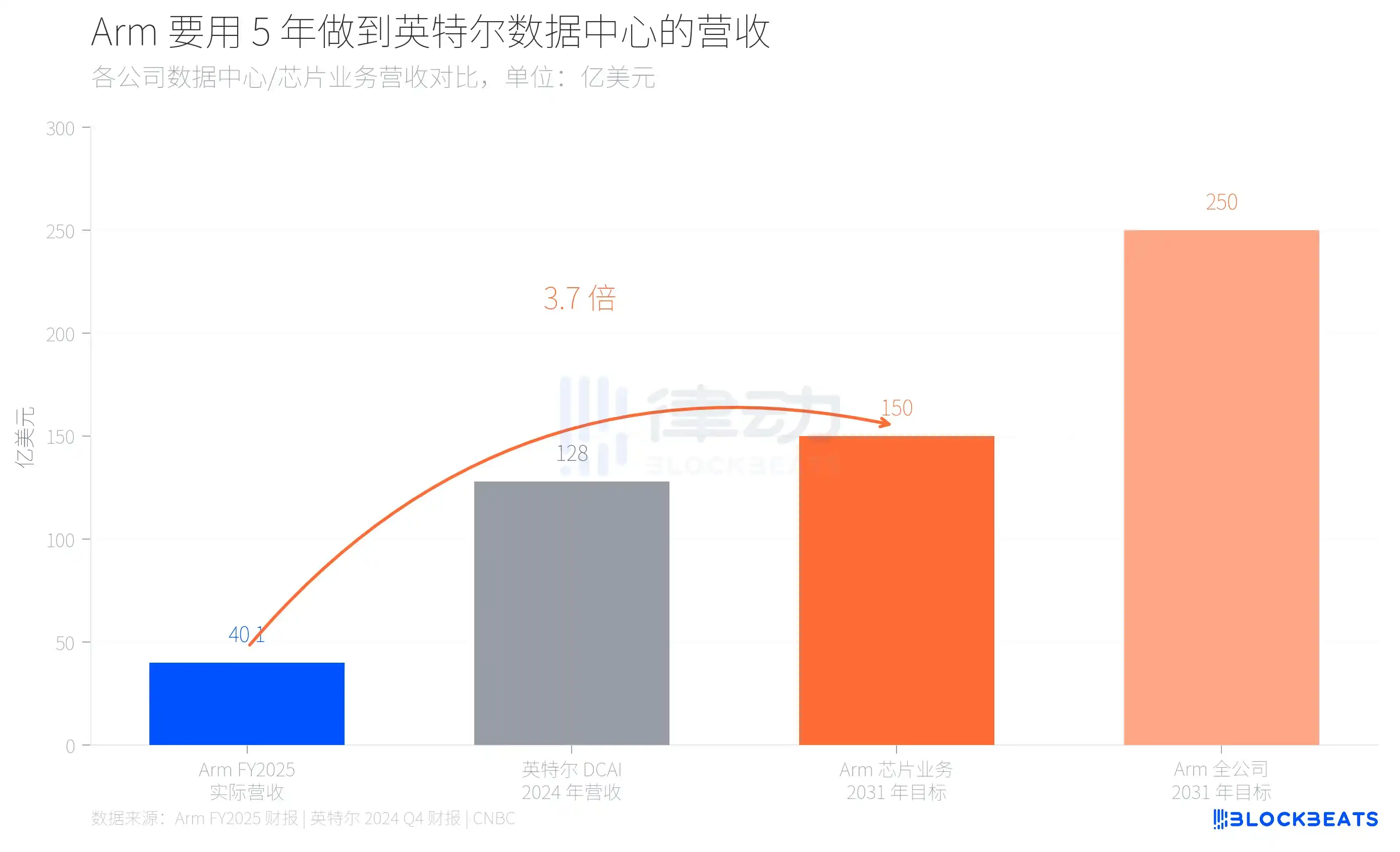
Behind the 3.7-fold leap from $4 billion to $15 billion is Arm's attempt to transform from a pure IP licensing company into a hybrid that sells both design blueprints and finished products. There is no precedent for this in the chip industry.

Why is Arm taking this risk? The answer lies in its customer list.

Over the past three years, Arm's largest data center customers have all been doing the same thing. According to AWS public data, Amazon has migrated over 50% of its EC2 computing power to its self-developed Graviton chips, with the latest Graviton5 reaching 192 cores. As disclosed by Google Cloud, Google's Axion chip has already facilitated the migration of over 30,000 internal applications, improving energy efficiency by 80%. Microsoft's Cobalt 200 is also based on the Arm Neoverse architecture, built on TSMC's 3nm process, with 132 cores.
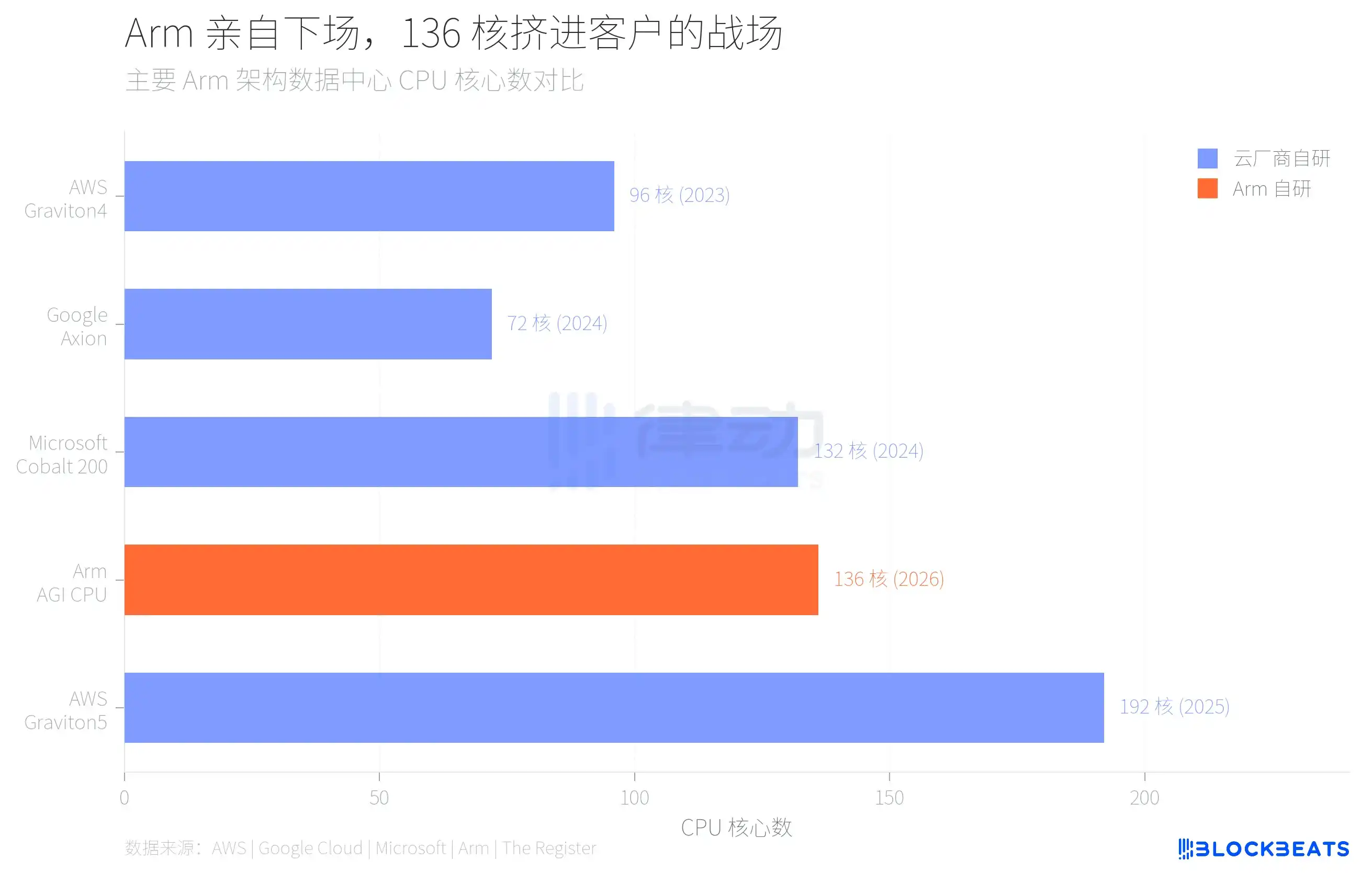
These cloud providers all use Arm's architectural license, but they design, tape out, and deploy the chips themselves. Arm earns licensing fees and royalties from this, not the profits from the chips. As more computing demands are absorbed by these self-developed chips, the revenue ceiling for Arm in the data center becomes increasingly clear.

Examining Arm's revenue structure over the past four years reveals this ceiling more concretely. According to Arm's financial reports from FY2022 to FY2025, total company revenue grew from $2.7 billion to $4.0 billion, with an average annual growth of about 14%. Within this, royalty revenue increased from $1.562 billion to $2.168 billion, while licensing revenue grew from $1.141 billion to $1.839 billion. Royalty growth has already slowed to around 20% in recent years, and much of this 20% growth comes from the upgrade cycle to the Armv9 architecture in mobile, not the data center.
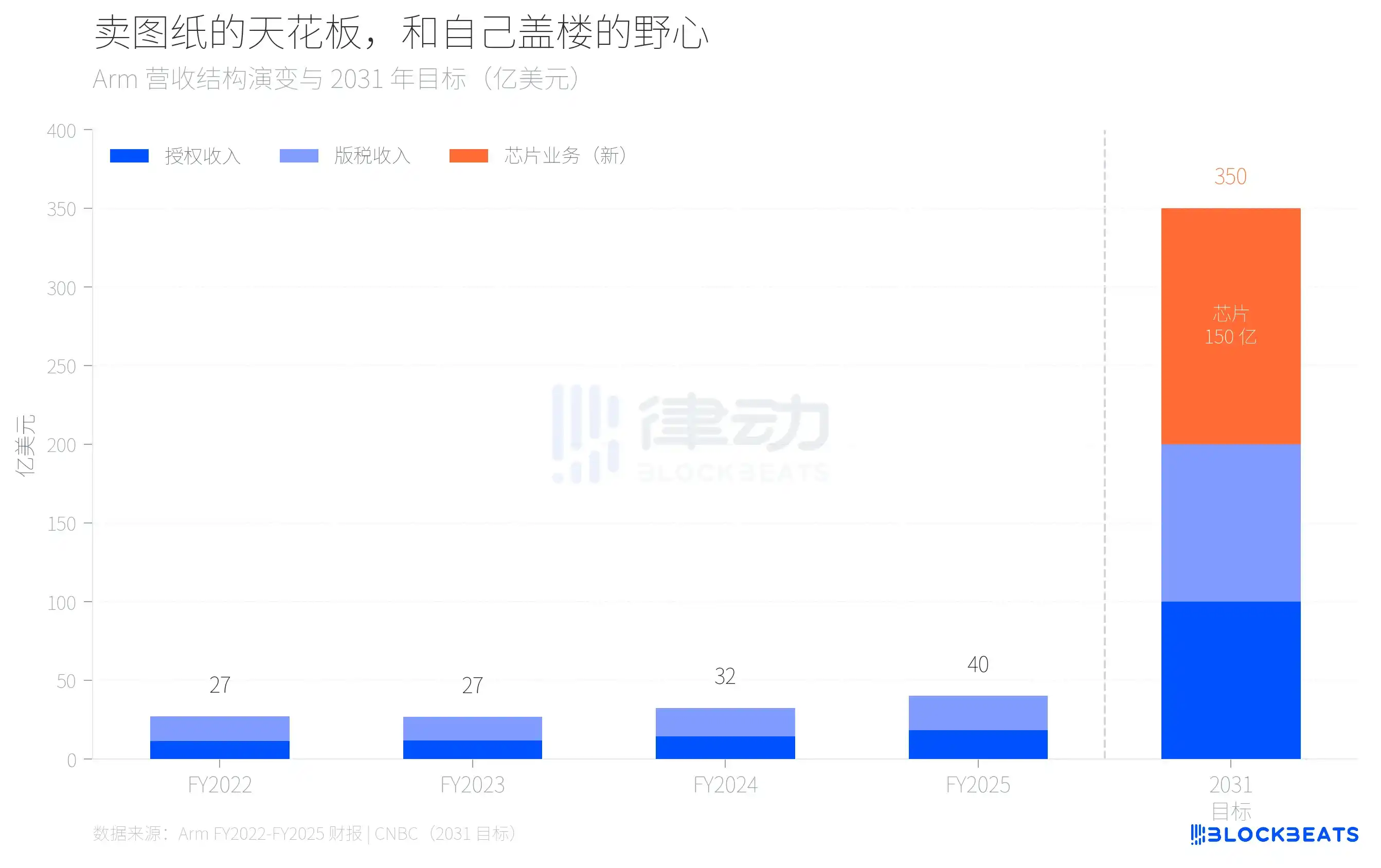
Extrapolating at this growth rate, even if both licensing and royalty revenues maintain around 20% annual growth, they would only reach approximately $10 billion by 2031. The remaining $5 billion to reach the $15 billion target must come from a business that does not exist today. This is the arithmetic logic behind Arm's decision to build its own chips.

By choosing to manufacture its own chips, Arm is essentially competing with its own customers. A company that sells architectural blueprints has started building houses itself, while its blueprint buyers have been building for several years.

This is the true backdrop of the 136-core AGI CPU. According to The Register, this chip has a base frequency of 3.2 GHz, boosting to 3.7 GHz, 12-channel DDR5 memory, 6 GB/s bandwidth per core, 96 PCIe 6.0 lanes, and supports CXL 3.0. Arm positions it as the "computing foundation for the agentic AI cloud era," specializing in CPU-side task scheduling and data flow management for AI inference, rather than directly competing with GPUs.

The pace of market share change is also telling. According to Omdia estimates, Arm architecture servers will account for about 21% of global shipments in 2025, with a growth rate of 70%. However, within hyperscale data centers, this proportion is already close to 50%. The 40-year monopoly of x86 is not collapsing; it's being replaced chip by chip.

The risk for Arm's self-developed chips lies not in technology, but in relationships. Meta's willingness to be the first customer is partly because Meta does not have a mature self-developed chip project like Amazon or Google. But how will Amazon, Google, and Microsoft view this? If a supplier starts competing for your business, would you still entrust it with your most critical architectural licenses?

Arm's bet is that the total data center market will grow faster than customer relationships deteriorate. Rene Haas evidently believes that the incremental demand for CPUs in the AI era is large enough for self-developed chips and architectural licensing to coexist. The $15 billion target is the price tag on this judgment.

After 35 years of selling blueprints, it's building its first house. The blueprints are still for sale, and the house is also being built. The question is whether there's enough room on the same plot of land for both.


Perguntas relacionadas

QWhat is the significance of Arm's first self-developed data center CPU, the AGI CPU, and who is its first major customer?

AThe AGI CPU is Arm's first self-developed data center CPU, marking a significant shift from its traditional IP licensing model to also manufacturing and selling finished chips. It is built on TSMC's 3nm process, features 136 Neoverse V3 cores, and has a 300W TDP. Meta is the first major customer and plans to deploy it at scale within the year.

QWhat are Arm's ambitious financial targets for its chip business by 2031, and how do they compare to its current revenue?

AArm aims for its chip business to achieve $15 billion in annual revenue by 2031, with total company revenue reaching $25 billion and earnings per share of $9. This is a massive increase from its FY2025 total revenue of approximately $4 billion, meaning the new chip business alone would need to grow to nearly the size of Intel's entire Data Center and AI division, which had $12.8 billion in revenue in 2024.

QWhy is Arm taking the risk of manufacturing its own chips, a strategy that puts it in competition with its own customers?

AArm is taking this risk because its largest data center customers, like Amazon (Graviton), Google (Axion), and Microsoft (Cobalt), are increasingly designing their own chips based on Arm's architecture licenses. While Arm earns licensing fees and royalties from these designs, it misses out on the larger profits from the actual chips. This trend places a clear ceiling on Arm's future revenue growth from its traditional business model, forcing it to seek new revenue streams by selling finished products.

QWhat is the potential conflict or risk for Arm in its new strategy of selling both IP licenses and finished chips?

AThe primary risk is damaging its relationships with its major architecture licensees, such as Amazon, Google, and Microsoft. By becoming a direct supplier of finished chips, Arm is now competing with its own customers. These companies may become reluctant to share their most critical architectural plans and designs with a supplier that is also a competitor, potentially jeopardizing Arm's core licensing business.

QHow does Arm justify its new strategy and what market trend is it betting on for success?

AArm is betting that the total market demand for data center CPUs, particularly driven by the agentic AI era, is growing fast enough to accommodate both its traditional licensing business and its new chip manufacturing venture. CEO Rene Haas believes the AI-driven demand for CPU-based tasks like AI inference scheduling and data flow management will be so substantial that the potential revenue from selling chips outweighs the risk of alienating some licensing customers.

Leituras Relacionadas

Trading

Spot
Futuros

Artigos em Destaque

Como comprar 4

Bem-vindo à HTX.com!Tornámos a compra de 4 (4) simples e conveniente.Segue o nosso guia passo a passo para iniciar a tua jornada no mundo das criptos.Passo 1: cria a tua conta HTXUtiliza o teu e-mail ou número de telefone para te inscreveres numa conta gratuita na HTX.Desfruta de um processo de inscrição sem complicações e desbloqueia todas as funcionalidades.Obter a minha contaPasso 2: vai para Comprar Cripto e escolhe o teu método de pagamentoCartão de crédito/débito: usa o teu visa ou mastercard para comprar 4 (4) instantaneamente.Saldo: usa os fundos da tua conta HTX para transacionar sem problemas.Terceiros: adicionamos métodos de pagamento populares, como Google Pay e Apple Pay, para aumentar a conveniência.P2P: transaciona diretamente com outros utilizadores na HTX.Mercado de balcão (OTC): oferecemos serviços personalizados e taxas de câmbio competitivas para os traders.Passo 3: armazena teu 4 (4)Depois de comprar o teu 4 (4), armazena-o na tua conta HTX.Alternativamente, podes enviá-lo para outro lugar através de transferência blockchain ou usá-lo para transacionar outras criptomoedas.Passo 4: transaciona 4 (4)Transaciona facilmente 4 (4) no mercado à vista da HTX.Acede simplesmente à tua conta, seleciona o teu par de trading, executa as tuas transações e monitoriza em tempo real.Oferecemos uma experiência de fácil utilização tanto para principiantes como para traders experientes.

596 Visualizações TotaisPublicado em {updateTime}Atualizado em 2025.10.20

Como comprar 4

Discussões

Bem-vindo à Comunidade HTX. Aqui, pode manter-se informado sobre os mais recentes desenvolvimentos da plataforma e obter acesso a análises profissionais de mercado. As opiniões dos utilizadores sobre o preço de 4 (4) são apresentadas abaixo.

活动图片