The Return of the Rimland: A Renewed Game Around Sea Power, Energy, and the Dollar

marsbitPublicado em 2026-04-13Última atualização em 2026-04-13

Resumo

Retitled "The Return of the Rimland: A Re-Game Surrounding Sea Power, Energy, and the Dollar," this analysis argues that the conflict centered on Iran is no longer a localized military issue but a systemic global struggle over who controls the flows of energy and trade. The U.S. is employing a "Rimland" strategy, using naval blockades, threats of 50% tariffs on nations aiding Iran, and the redirection of energy routes (like reactivating the Trans-Arabian Pipeline) to draw China into the conflict and bypass strategic chokepoints like the Strait of Hormuz. This has turned a regional confrontation into a structural shock impacting global energy markets, supply chains, and the financial system. Key market risks are not yet fully priced in. While oil prices have spiked, the second-order effects—such as tightened liquidity, pressure on tech investments (like AI from helium supply risks), reduced consumer spending, and agricultural supply shocks from high fertilizer costs—are only beginning to manifest. The Federal Reserve faces a dilemma on whether to tighten policy against this energy-driven inflation. The conflict's escalation is inevitable; the central questions are the pathways of its diffusion and when markets will price in these broader, systemic risks.

Editor's Note: Ceasefire, blockade, and tariff threats—the conflict surrounding Iran has not subsided but continues to spill over. From the Strait of Hormuz to the Red Sea, from energy corridors to trade秩序, the core of the situation is no longer a local military confrontation but a systemic博弈 around "who controls the flow."

Using the "Rimland" strategy as a线索, this article points out that the United States is attempting to turn the conflict from a regional issue into a global one by海上封锁 and restructuring energy routes, drawing China into it. As sanctions and interception measures escalate, the confrontation originally centered on the Middle East is transforming into a structural冲击 affecting global energy, supply chains, and the financial system.

More critically, the market has not fully digested this "chain reaction." The immediate fluctuations in oil prices are only the first step; their transmission to liquidity, tech investments, consumer spending, and even agricultural supply is just beginning to show. After the revaluation of energy prices, the real test is how the global economy will withstand the second-round冲击 triggered by this.

This means that the current issue is no longer whether the conflict will escalate, but along which paths its impact will扩散, and when the market will start to pay for these尚未定价 risks.

Below is the original text:

Alright, the situation is now clear.

The tensions we highlighted last Wednesday have proven to be irreconcilable.

Iran wants nuclear weapons and control over the strait; and Trump cannot accept either of these. How far apart are these two "target circles"? So much so that even Israel's war with Lebanon hasn't been included in the discussion agenda.

I won't claim my judgment was precise, but we may indeed have entered the "mid-game." This is not a conflict that can be called off in an afternoon. The core issue is very simple: Who will control the world's most important水道? And, is Iran willing to threaten its neighbors to gain bargaining chips for nuclear negotiations?

That is the key.

What is now becoming clear is a整套策略路径. Readers who have followed along, from "Fighting for the Dollar" to "Don't Take the Bait," to "Awakening the Hegemon" and "Fragile Peace," should already see the pattern.

Trump is executing a "Rimland" strategy.

Intercept shipping. Threaten to impose 50% tariffs on all countries providing weapons to Iran. Instead of attacking the内陆(heartland), control the maritime channels of energy transport to draw China into this博弈. For every mine Iran lays, for every oil tanker it attacks, retaliate tenfold—seize their vessels, control oil tankers, directly sell their crude oil.

Settle in U.S. dollars.
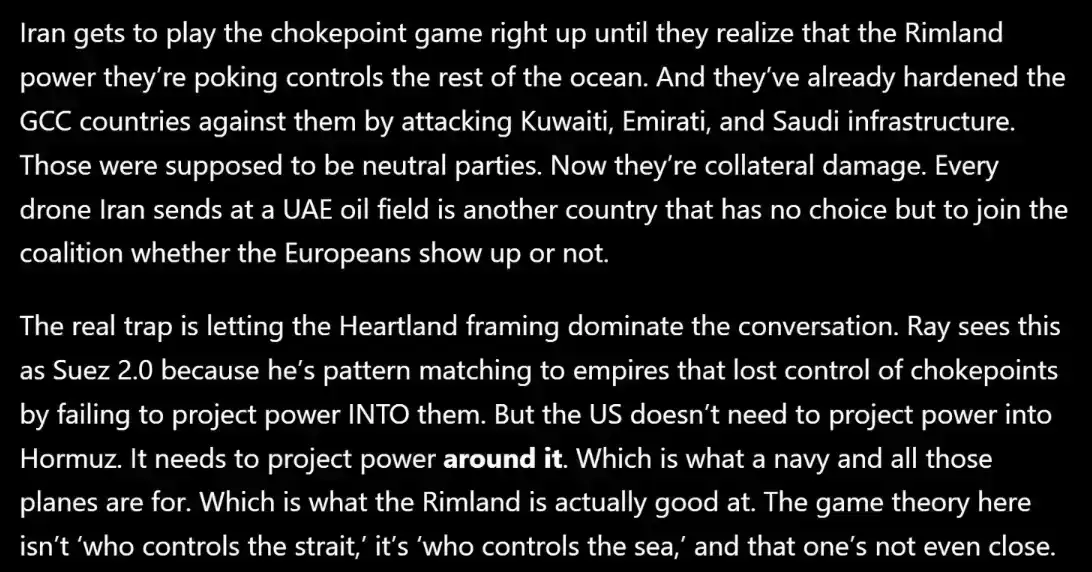
Then there's the "Abraham Accords." Saudi oil is transported via Jordan to the port of Haifa; the Trans-Arabian Pipeline (Tapline) is being reactivated. A corridor of physical infrastructure is connecting coastal countries into an energy network, completely bypassing the "heartland." This is a "Rimland alliance" built with pipelines and steel.

In my view, we have reached this point largely due to this process itself—Iran (and China) ignited Israel through Hamas' actions on October 7, thereby interrupting this normalization process; had this process advanced, it could have formed an alternative trade route bypassing the Strait of Hormuz and even the "Belt and Road."
This also explains the divergence between Washington and Brussels. The U.S. feels the weight of responsibility; Europe似乎 believes it can secure energy access through private negotiations while letting the "older brother" bear the cost of conflict. France, on one hand, blocked relevant UN Security Council resolution, while on the other, negotiated bilateral transit arrangements through the strait with various parties and called for the formation of an "alliance of independent nations." This is a typical "heartland" mindset: making deals with inland powers, avoiding direct conflict, as if maritime routes will maintain themselves.

Trump has just堵上了 this漏洞—and thus turned America's problem into the world's problem.

As of writing, crude oil prices have risen over 6%, stocks have fallen about 1%, and last week's gains due to the ceasefire look highly likely to be quickly erased. I bought some VIX call options over the weekend, so you could say I have a bit of a立场.

How the situation develops next depends on a series of more fundamental questions:

· Can the ceasefire hold for another week, or will it collapse in "reverse deduction"?·

Trump has stated he will intercept ships that have paid "tolls" to Iran—does this include Chinese ships? What will happen when they try to load crude from Kharg Island?

· He has also reiterated the threat of imposing 50% tariffs on any country providing weapons to Iran—does this mean a trade war is back on the agenda?

Then there's Iran's countermeasures: it could activate the Houthis, who still have the capability to make the Bab el-Mandeb strait difficult to pass. Notably, most oil tankers transporting crude via Saudi Arabia's "East-West Pipeline" are VLCCs (Very Large Crude Carriers) that cannot pass through the Suez Canal. If the Houthis escalate, it would affect not only Red Sea shipping but force these giant tankers carrying the most critical crude to take much longer routes.

The main thread is: this conflict continues to expand in scale and spillover scope.

By escalating actions to全面拦截 all ships paying "tolls" to Iran and reiterating tariff threats, Trump has explicitly drawn China into this博弈. Beijing has been hoarding crude for years precisely for scenarios like this. But against the backdrop of an economy dragged down by real estate, how long can the Chinese market remain "calm"? How likely is it to escalate confrontation to ensure energy supply?

From Venezuela to Iran, the sequence of these actions looks increasingly like a deliberately designed strategy.

The "Rimland" is returning.

Next, are the chain reaction questions at the market level:

· How bad will Monday's open be? The first round of selling came mainly from short-term funds and retail buying of put options. When will long-term funds start to see volatility as uncontrollable, forcing them to sell or hit risk limits?

· Last week, hedge funds quickly covered their "long AI hardware, short software" positions. But with oil prices, falling bonds, tightening liquidity,再加上 Gulf helium supply chain risks (a key input for chip manufacturing), is it enough to reprice expectations for the AI acceleration cycle?

· Before the conflict, the U.S. Q1 economy grew almost zero. As energy prices surge, household disposable income is eaten up by gasoline, heating, and jet fuel—will families cut spending or lever up further?

· Fed meeting minutes show policymakers are already discussing tightening policy to counter energy-driven inflationary pressures. A new round of debate on "how to handle negative supply shocks" is unfolding. Faced with an energy shock of this magnitude, can the Fed still "choose to look away"?

Ultimately, these questions point to a larger "chain reaction."

The "Rimland" strategy addresses energy and the dollar, but it does not solve the entire system supported by energy. The market is currently only pricing the "first node," it hasn't transmitted to the "second node" yet. Oil prices can revalue quickly on news, but agricultural production cycles don't. Urea prices are still at $700, and the USDA's projected wheat planting area will be the lowest since 1919—this won't reverse just because two diplomats shake hands. Farmers who couldn't afford fertilizer in March can't "replant" in April.


Perguntas relacionadas

QWhat is the core strategic concept discussed in the article regarding the US approach to the Iran conflict?

AThe article identifies the US strategy as a revival of the 'Rimland' strategy, which involves controlling key maritime energy transport routes and applying economic pressure (like tariffs and shipping interdictions) to draw global powers like China into the conflict, rather than engaging in direct inland ('heartland') military confrontation.

QAccording to the article, how is the conflict impacting global markets beyond the immediate oil price spike?

AThe article states that the initial oil price volatility is just the first step. The conflict's effects are beginning to transmit to broader areas, including liquidity, technology investment (potentially repricing AI cycle expectations due to helium supply risks), consumer spending (as energy costs erode disposable income), and agricultural supply chains (due to high fertilizer costs and reduced planting areas that cannot be quickly reversed).

QWhat specific action did the US take to counter European attempts to secure energy access independently?

AThe article states that the US, under Trump, 'plugged the loophole' by moving to intercept all ships that had paid 'transit fees' to Iran. This action countered European efforts (like France's bilateral passage negotiations and calls for an 'independent coalition') to privately secure energy transit deals while avoiding direct conflict, thereby making the US problem a global one.

QWhat is one major potential Iranian countermeasure discussed, and what would be its secondary effect on oil transport?

AA major potential Iranian countermeasure is activating the Houthis to disrupt the Bab el-Mandeb Strait. A secondary effect is that this would not only impact Red Sea shipping but also force Very Large Crude Carriers (VLCCs) carrying Saudi oil via the East-West pipeline to take much longer routes, as these massive ships cannot transit the Suez Canal.

QHow does the article connect the 'Rimland' strategy to the broader global economic system and the Federal Reserve's potential response?

AThe article argues that the 'Rimland' strategy addresses issues of energy and dollar control but does not solve the problems for the entire system that energy supports. It suggests the Federal Reserve may be forced to abandon its practice of 'looking through' energy-driven inflation and instead tighten monetary policy to confront a major negative supply shock, which would have widespread economic consequences.

Leituras Relacionadas

Google TPU Shipments Revised Up by 50%

Recent industry research indicates a significant upward revision in the shipments of Google's TPU (Tensor Processing Unit) chips. Previous expectations for 2027 were set at around 10 million units, but new estimates now point to 15 million units, a 50% increase. This substantial boost directly translates to higher demand across the entire supporting supply chain. Google's TPU clusters utilize a standardized all-optical interconnect architecture. Consequently, key hardware components are deeply integrated and scaled in fixed ratios with the chips. The 15 million TPU target will drive corresponding demand increases for NPO optical engines (roughly a 1:1 match), 1.6T optical modules, OCS optical switches, high-end server power supplies, fiber optics & MPO connectors, and liquid cooling solutions. Among these, liquid cooling is highlighted as the sector experiencing the most significant transformation and offering the most stable potential for excess returns. As next-generation TPU chips reach power levels where traditional air cooling is insufficient, liquid cooling becomes essential. 2026 is forecasted as the first year of substantial adoption for Google's liquid cooling solutions. This shift, coupled with delivery and capacity bottlenecks faced by incumbent overseas manufacturers, is creating a prime window for domestic Chinese suppliers to enter and secure Google's core supply chain. The market size for Google-specific liquid cooling is projected to potentially triple from a baseline of hundreds of billions to around 300 billion units by 2028. The logic for the fiber optic sector is also being rewritten. Once considered a cyclical commodity tied to telecom operator procurement, fiber is now a strategic and scarce resource for AI Data Centers (AIDC). A severe supply-demand imbalance, driven by the long lead time for preform production (18-24 months) and surging demand from cloud giants, is supporting strong performance. Chinese fiber manufacturers are well-positioned to capture a significant share of global AIDC demand, with exports potentially reaching 200-300 million core kilometers in 2026. Overall, the investment focus within the AI computing industry is shifting from pure "chip performance speculation" towards the more certain incremental growth in computing infrastructure and its supporting ecosystem. The upward revision in Google TPU shipments, along with the potential for further doubling by 2028, is seen as solidifying performance visibility for the entire supporting supply chain over the next two years.

marsbitHá 29m

Google TPU Shipments Revised Up by 50%

marsbitHá 29m

What Wall Street Really Wants After the Crypto Story Recedes

The tide of speculative crypto narratives has receded, revealing Wall Street's true objective: building a controlled, yield-generating, and compliant financial pipeline on distributed ledgers. They are migrating core functions onto blockchains, not for decentralization, but for efficiency and new revenue streams. Key developments include BlackRock's BUIDL fund, a tokenized treasury fund acting as a foundational reserve asset, and the rise of Securitize, which is going public and partnering with the NYSE to build a 24/7 digital securities trading and settlement system. This signals a major shift of securities clearing to blockchain technology. To make volatile assets like Bitcoin palatable for institutional investors, firms like BlackRock and Goldman Sachs are creating "covered call" ETFs (e.g., BITA). These products systematically sell options on Bitcoin holdings, transforming price volatility into stable monthly income, effectively repackaging crypto as a yield-bearing asset. Stablecoins are being positioned not as speculative tools but as efficient payment rails. Companies like Stripe and Mastercard are integrating them for instant, low-cost merchant settlements and cross-border card payments, respectively. Critically, new legislation like the GENIUS Act shapes them as non-interest-bearing, heavily regulated extensions of the US dollar system. In summary, Wall Street is quietly constructing a parallel, blockchain-based financial infrastructure featuring tokenized traditional assets, structured crypto yields, and programmable dollar pipelines—all under its control and fully integrated with existing regulatory and credit frameworks.

marsbitHá 45m

What Wall Street Really Wants After the Crypto Story Recedes

marsbitHá 45m

Tying Itself to SpaceX: Cursor's $60 Billion Rise

This article recounts the rapid rise of AI-powered coding startup Cursor and its 25-year-old MIT graduate CEO, Michael Truell. Launched in 2023, Cursor achieved explosive growth, reaching over 10 billion USD in revenue by late 2025. However, its journey highlights a central dilemma for AI application companies: dependence on foundational model providers. Cursor initially relied heavily on Anthropic's models but faced an existential threat when Anthropic launched its own competing coding tool, Claude Code. In response, Cursor declared an internal emergency in early 2026 and accelerated development of its own model, Composer. To secure the immense computing power needed, Truell struck a pivotal deal with Elon Musk's SpaceX in April 2026. The collaboration grants Cursor access to SpaceX's supercomputing resources for Composer, while SpaceX's Grok model benefits from Cursor's programming data. The agreement includes a potential 600 billion USD acquisition of Cursor by SpaceX later in the year, though a substantial termination fee is in place if the deal falls through. The story explores Cursor's intense, sometimes controversial hiring practices involving lengthy unpaid "work trials," its complex partnership-turned-rivalry with Anthropic, and its high-stakes gamble to ensure independence through the SpaceX alliance. The core question remains: will Cursor evolve into a defining, independent "generational" software company, or become a key piece in a tech giant's AI arsenal?

marsbitHá 50m

Tying Itself to SpaceX: Cursor's $60 Billion Rise

marsbitHá 50m

Warsh's Debut: Will the FED Chair Who Knows Crypto Best Bring Surprises or Shocks to the Market?

Kevin Warsh, the new Federal Reserve Chairman, prepares for his inaugural press conference amidst a challenging macroeconomic landscape: resurgent inflation, a bond market sell-off, and political pressure from President Trump for rate cuts. Uniquely, Warsh holds indirect investments in over 20 crypto and Web3 entities (e.g., Solana, dYdX), making him the first Fed Chair with disclosed crypto exposure. His stance may combine a hawkish, inflation-focused monetary policy with a crypto-friendly regulatory philosophy that shifts from Powell’s “same risk, same rule” approach toward a framework acknowledging blockchain’s productivity value. Warsh’s leadership could impact crypto markets across three dimensions: a paradigm shift in regulation (potentially accelerating pro-innovation legislation and stable币 rules), a re-pricing of risk premiums based on clearer communication and his view of AI as a structural disinflationary force, and a long-term reallocation of global institutional capital driven by increased legitimacy. Two potential scenarios for the press conference are outlined. A “positive surprise” would involve a dovish-leaning tone on rates coupled with signals of regulatory openness, potentially boosting crypto asset valuations. Conversely, a “negative shock” would see a more hawkish-than-expected stance on inflation and rates, triggering a broad risk-asset selloff that crypto markets would not escape. While ethics rules required Warsh to divest his crypto holdings upon confirmation, his deep understanding of the technology may fundamentally lower policy uncertainty and build a more receptive long-term foundation for digital assets’ integration into the mainstream financial system.

marsbitHá 11h

Warsh's Debut: Will the FED Chair Who Knows Crypto Best Bring Surprises or Shocks to the Market?

marsbitHá 11h

Trading

Spot
Futuros
活动图片




