The Recursive AI Anthropic Warned About: Tian Yuandong's New Company Has Just Taken the "First Step"

marsbitPublicado em 2026-06-12Última atualização em 2026-06-12

Resumo

Anthropic recently highlighted the rapid progress toward "recursive self-improvement," where AI systems autonomously design and train their successors. In response, Recursive Superintelligence, a new company co-founded by former Meta researcher Tian Yuan Dong, has publicly demonstrated its first step toward automating AI research. The company released a system designed to autonomously execute the full AI research cycle: generating ideas, implementing code, running experiments, and learning from results. It validated this approach by achieving state-of-the-art results on three diverse benchmarks: 1. **NanoChat Autoresearch:** Optimizing a small language model's validation loss under a fixed 5-minute GPU budget, improving upon the community's best result. 2. **NanoGPT Speedrun:** Reducing the time to train a GPT model to a specific loss on 8 H100 GPUs from 79.7 seconds to 77.5 seconds, beating a highly optimized, human-driven community effort. 3. **SOL-ExecBench:** Improving the overall score on NVIDIA's suite of 235 GPU kernel optimization tasks by 18%, closing the gap to the hardware limit. The system discovered novel optimizations in this highly specialized domain without direct human expertise. Recursive's system operates as a general framework, capable of parallel exploration and cross-task knowledge transfer while incorporating safeguards against reward hacking. The company, backed by $650M in funding and a star-studded team including Richard Socher and Alexey Dosov...

Recently, Anthropic published an article titled "When AI Builds Itself," which quickly sparked widespread discussion. The article revealed a striking set of internal data: as of May 2026, over 80% of the code in Anthropic's codebase had been written by Claude, with engineers merging eight times more code per day than in 2024. In an internal test, Claude improved the runtime of a piece of training code by approximately 52x over a baseline, whereas an experienced human researcher typically takes 4 to 8 hours to achieve a 4x speedup.

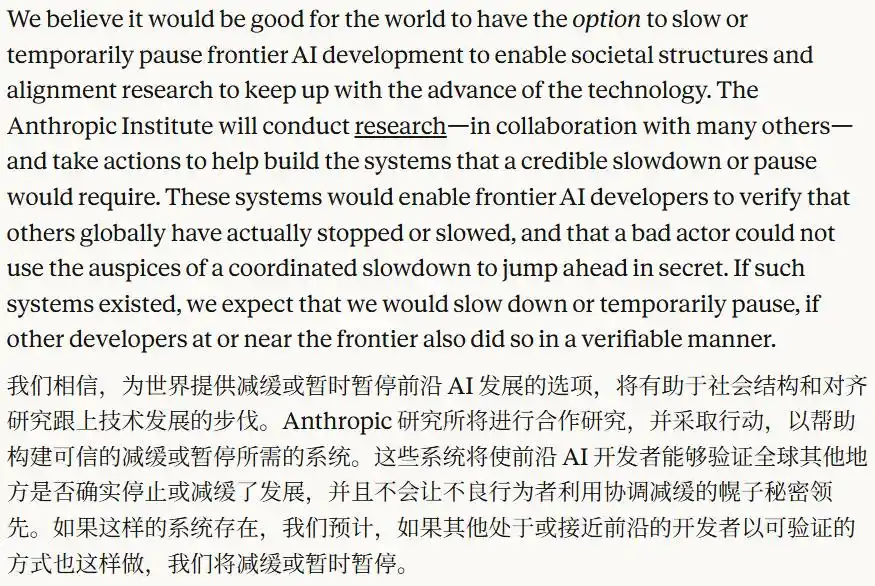
Anthropic points this trajectory towards a deeper destination: "Recursive Self-Improvement"—AI systems autonomously designing, building, and training their own successive versions, with humans no longer driving every step. Notably, the company also called for industry coordination to have the option to pause or even temporarily halt frontier AI development when the moment of recursive self-improvement arrives. And Anthropic is already doing this: restricting its latest Claude Fable 5 from being used for frontier AI research.

Now, Recursive Superintelligence has announced it has taken the first step toward automated AI research.

This new company co-founded by Tian Yuandong has been out of stealth mode for just one month, and has now released its first public technical achievement. They have built an open-ended automated knowledge discovery system and achieved state-of-the-art (SOTA) results on three benchmarks. Simply put, they have succeeded in making AI run experiments for you.
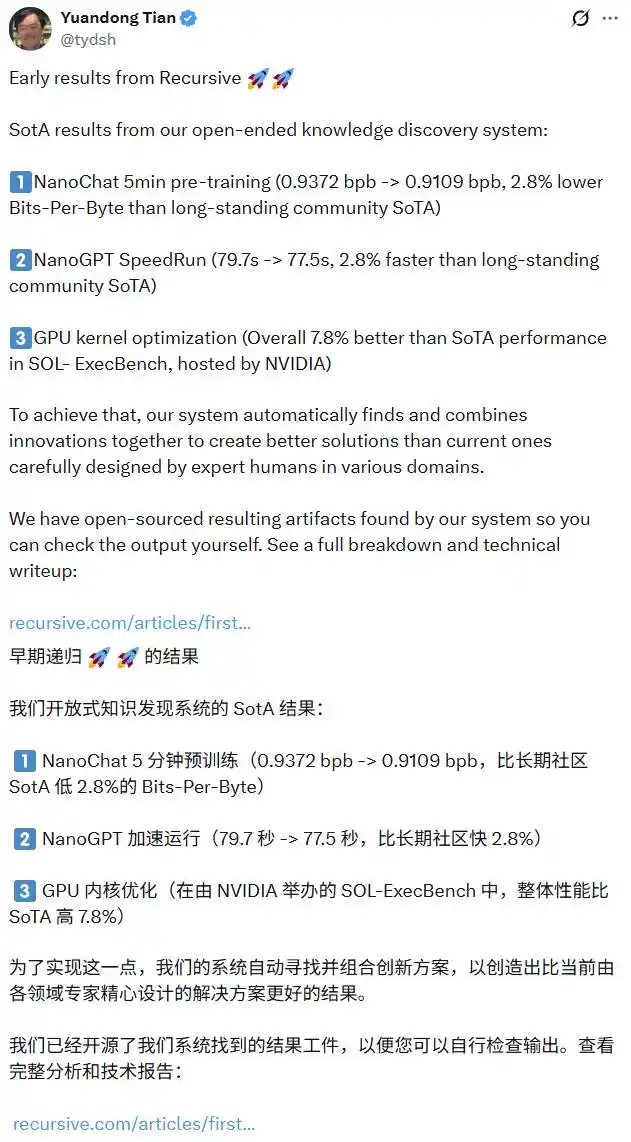
https://x.com/tydsh/status/2065062838255649082

The First Result: Let AI Run Experiments for You

Recursive's first public technical achievement is called "First Steps Toward Automated AI Research."
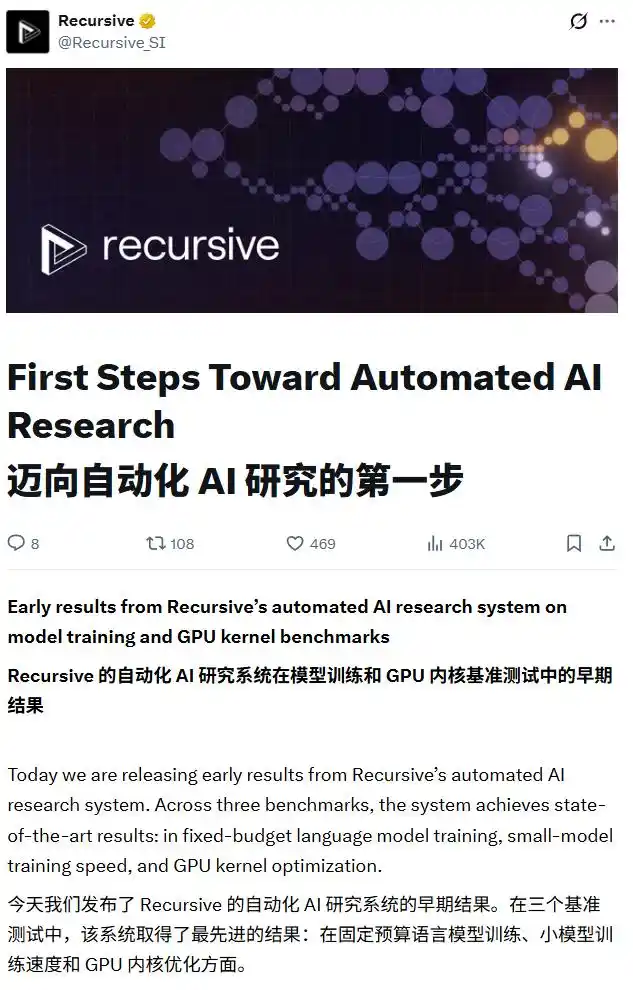
Tweet: https://x.com/Recursive_SI/status/2064980090702962699

Repo: https://github.com/recursive-org/first-steps-toward-automated-ai-research

Blog: https://www.recursive.com/articles/first-steps-toward-automated-ai-research

To summarize in one sentence, the core of this work is: building a system capable of autonomously advancing the AI research cycle and setting new records on three benchmark tests.

Before dissecting the results, it's necessary to understand the design logic of this system.

The traditional AI research process is a highly human-dependent closed loop of "propose idea—write code—run experiment—analyze results—propose new idea." Its efficiency bottleneck lies not in computing power, but in people. The number of researchers worldwide who can design frontier training pipelines is exceedingly small, and each round of experimental iteration requires their intensive involvement.

Recursive's system attempts to automate this closed loop.

Its working method is: for a clearly defined optimization objective, the system automatically proposes experimental ideas, implements code, runs validation, learns from it, and then decides how to search next. Multiple research lines can be advanced in parallel, effective discoveries can be reused across tasks, and mechanisms for detecting reward hacking are embedded within the entire loop to prevent the system from "taking shortcuts" to inflate evaluation metrics without genuinely improving anything.

This is not a specialized tool fine-tuned for a single problem, but rather a general-purpose research automation framework spanning different domains. Recursive demonstrates this using three significantly different test scenarios.

Three Battlefields, Three New Records
Scenario One: Small Model Training Under Fixed Compute Budget (NanoChat Autoresearch)

The rules for this benchmark come from the autoresearch project initiated by Andrej Karpathy (author of GPT-2, former OpenAI co-founder): on a single GPU, given a fixed training budget of five minutes, train a small language model to achieve the lowest possible validation loss (measured in BPB, lower is better).

This scenario is naturally suited for automated research: short experimental cycles, low metric variance, relatively easy detection of cheating behavior. Precisely because of this, a community project called "autoresearch@home" has been running on this benchmark for a long time—dozens of human researchers collaborating with hundreds of AI agents continuously pushing the metric down.

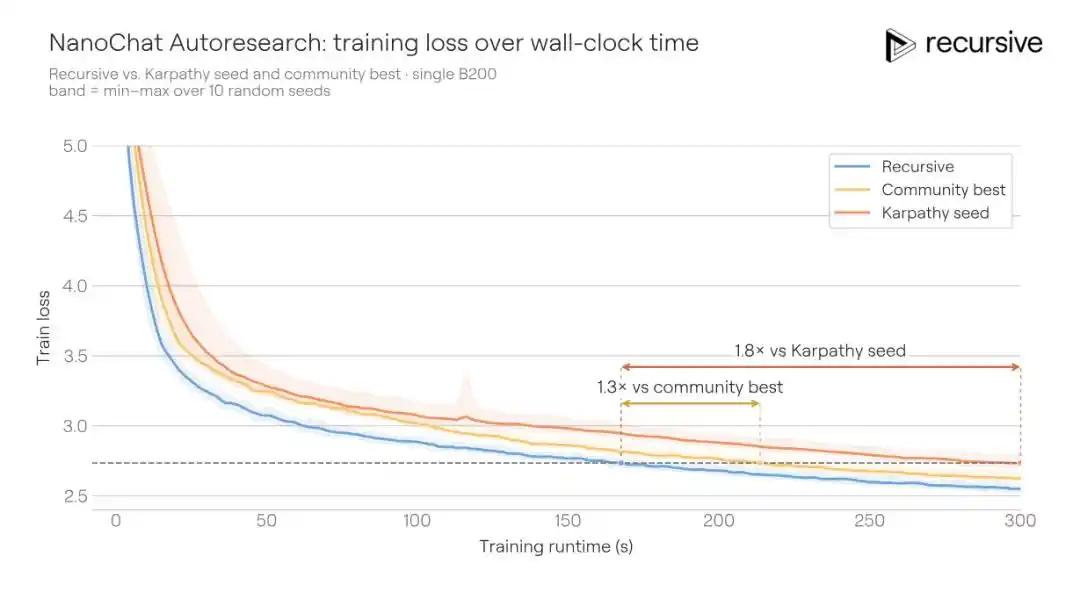
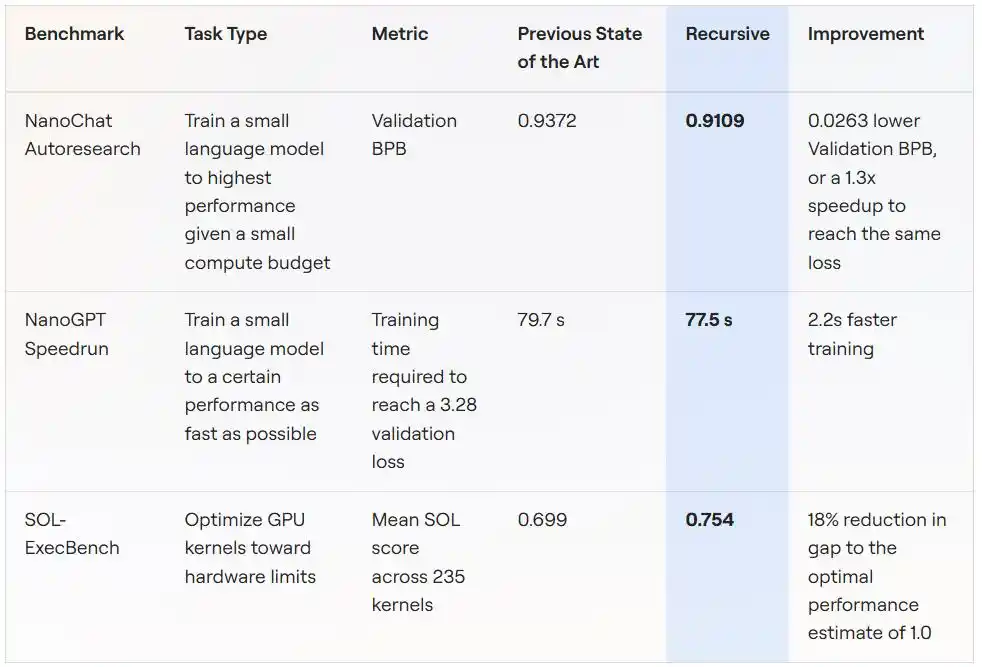
Recursive's system started from the same initial code and ultimately improved the validation BPB from the community's best of 0.9372 to 0.9109, an improvement of 0.0263 BPB. Put another way: to achieve the same training quality, Recursive's solution requires 1.3 times less training time than the competitor's.
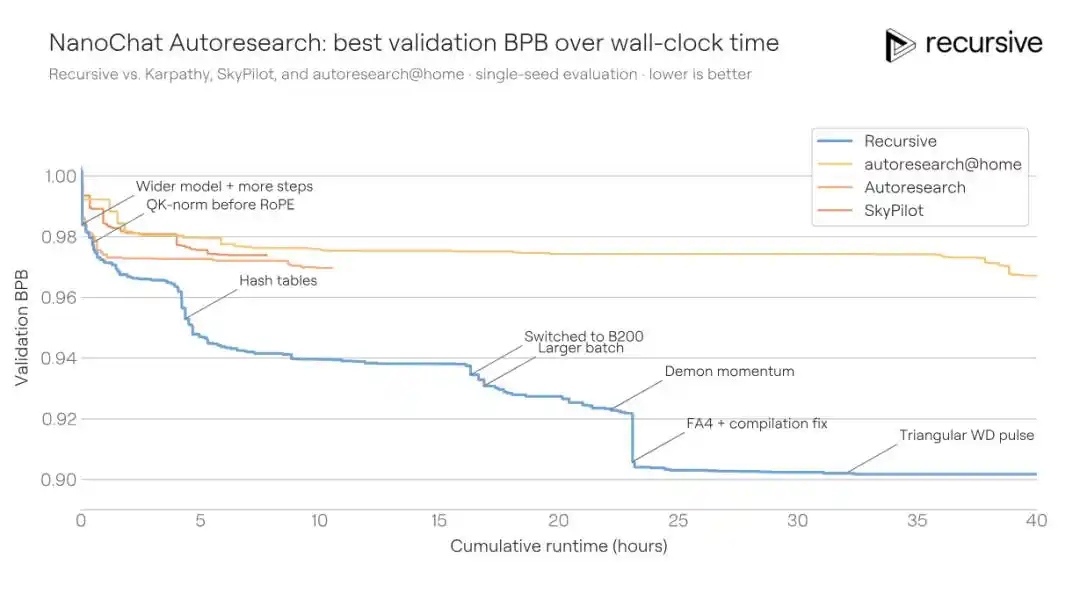
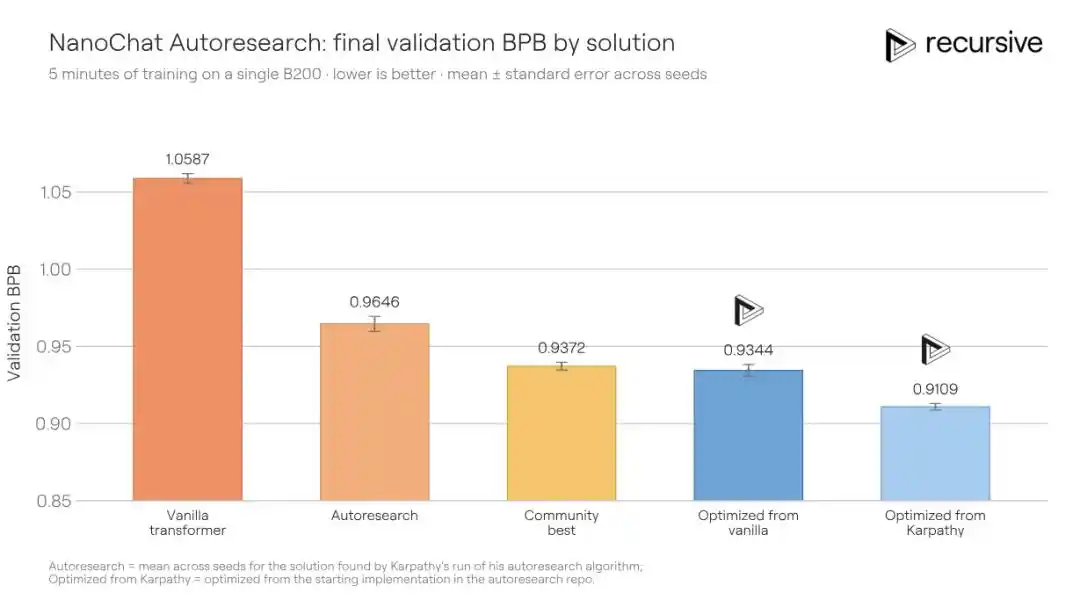
The improvements discovered by the system were not a single silver bullet. It combined architecture adjustments, auxiliary losses, attention mechanism modifications, optimizer behavior, weight decay scheduling, compiler settings, and more. One of the key discoveries was a richer short-context memory mechanism: within the attention's value path, embedding both bigram (adjacent word pairs) and trigram (triplet) information via hash tables, with weighted mixing via learnable gating. Different Transformer layers use different hash functions, reducing the probability of cross-layer collision.

This trick is conceptually related to works like DeepSeek Engram, but the system deployed it in a specific variant not yet seen in published literature for the fixed-budget scenario.

Scenario Two: Training Speed Limit Race (NanoGPT Speedrun)

If the previous scenario was about "going one step further" on an active community's results, this scenario is much harder.

NanoGPT Speedrun is another benchmark initiated by Karpathy and continuously optimized by the community for over two years: the shortest time required to train a GPT model to a validation loss of 3.28 on 8 H100 GPUs. Since mid-2024, the community has compressed the time from about 45 minutes to 79.7 seconds through 83 documented contributions. Each new solution must squeeze out more time from an already extremely optimized codebase, making the difficulty self-evident.

Recursive's system started from the existing optimal solution and further compressed the training time to 77.5 seconds, saving 2.2 seconds. This improvement is comparable to, or even better than, what recent human contributors have achieved.
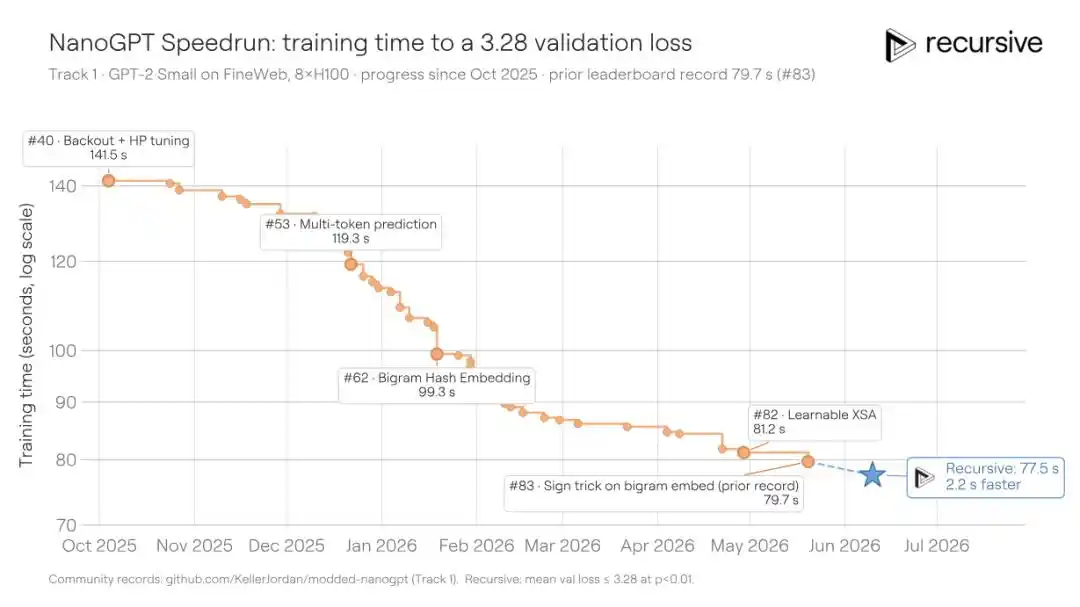
The core tricks found by the system this time include:

FP8 Precision Attention Computation. The community solution used FP8 (8-bit floating point) computation only in the model's final layer (language model head). The system extended FP8 into the matrix operations of the attention layers, using FP8 for forward propagation to achieve twice the Tensor Core throughput, while retaining BF16 for backward propagation to maintain stability.

Annealing Exploration Noise in the Optimizer. The system injected zero-mean Gaussian noise into the update steps of the NorMuon optimizer, with the noise amplitude linearly annealing to zero as training progressed. This is somewhat like giving the optimizer a behavior pattern of "explore boldly first, then converge robustly," helping the final solution settle in a flatter loss basin.

More Streamlined Fused MLP Kernel. The system rewrote a Triton GPU kernel so that forward propagation only stores activation values after ReLU squaring, and during backward propagation, the unsquared intermediate results are recomputed internally within the kernel, saving one full round-trip read/write of the activation tensor in high-bandwidth GPU memory—a direct hardware-level speedup.

Three improvements, belonging to three different specialized areas: precision strategy, optimizer design, and GPU kernel programming. The fact that the system found room for improvement on a result optimized by the community for two years speaks for itself.

Scenario Three: GPU Kernel Optimization (SOL-ExecBench)

The first two scenarios operated at the model training level. The third scenario delves deeper: optimizing GPU compute kernels.

SOL-ExecBench is a benchmark introduced by NVIDIA, containing 235 kernel writing tasks covering various real-world workloads like matrix multiplication, reduction, normalization layers, attention components, quantization routines, fused blocks, etc. The scoring metric is the SOL score: 0.5 corresponds to a baseline PyTorch implementation, and 1.0 corresponds to the hardware's theoretical limit. The previous best public score was 0.699.
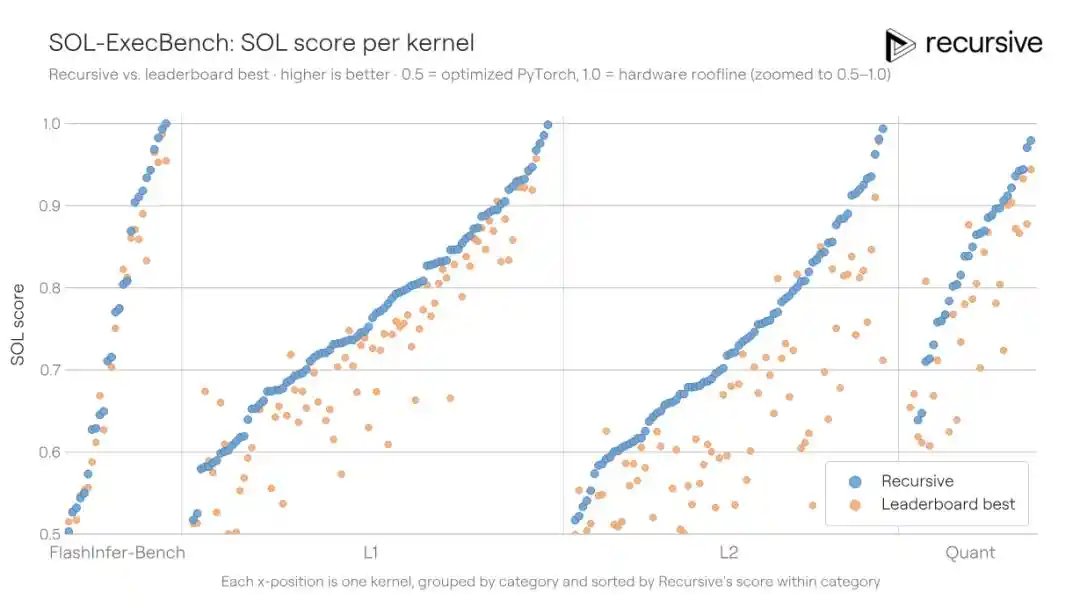
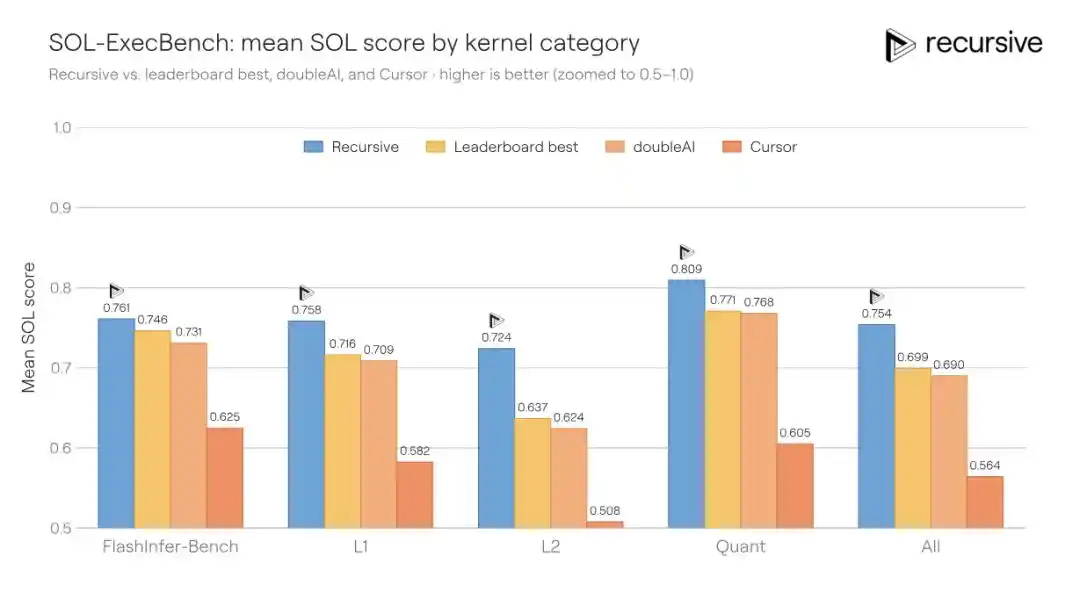
Recursive's system ran on all 235 kernels, allowing discovered optimization patterns (e.g., memory access strategies, tiling methods, reduction techniques) to be reused across tasks. The final score improved to 0.754, reducing the gap to the hardware limit by 18%.

This scenario is particularly significant because kernel engineering is an extremely specialized field—engineers who can write efficient Triton/CUDA kernels are rare globally. The Recursive team candidly admits in their blog, "We ourselves are not experts in kernel engineering. These ideas came from the system itself, not from our specialized background."

Recursive: Using AI to Research and Recursively Improve AI

The company releasing this achievement, Recursive Superintelligence, was founded between late 2025 and early 2026 and only came out of stealth last month. In addition to Tian Yuandong, former Research Scientist Director at Meta FAIR, the founding team includes:
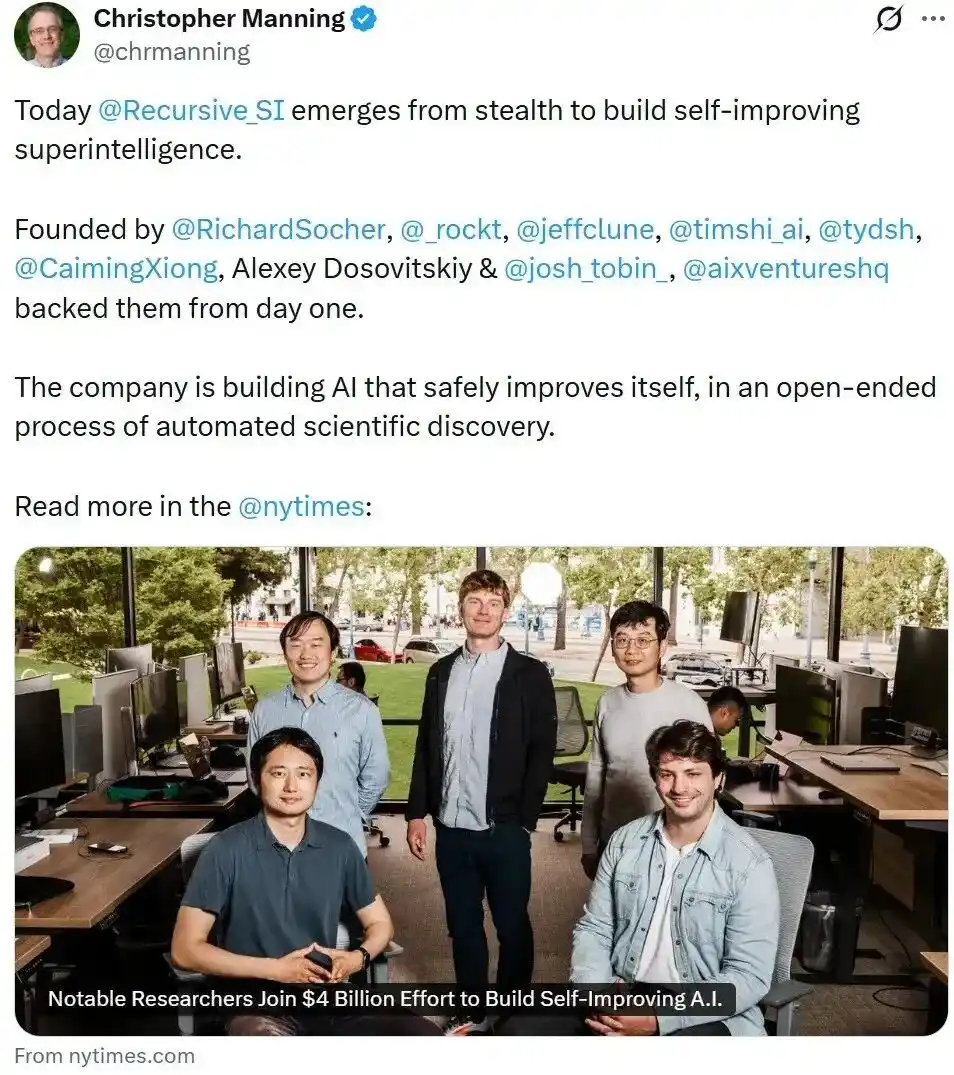
Richard Socher, Recursive CEO, former Chief Scientist at Salesforce.

Alexey Dosovitskiy, former Google DeepMind Research Scientist and first author of Vision Transformer, with over 160,000 Google Scholar citations.

Tim Rocktäschel, former DeepMind Principal Scientist and UCL AI Professor.

Peter Norvig, former Google Director of Research, co-author with Stuart Russell of the famous AI textbook "Artificial Intelligence: A Modern Approach."

Caiming Xiong, former VP of AI at Salesforce.

Tim Shi, former OpenAI researcher, co-founder and CTO of enterprise AI company Cresta.

Josh Tobin, Recursive CTO, former Research Lead at OpenAI and Uber ATG.

Jeff Clune, former VP of Research at Google DeepMind, Professor of Computer Science at the University of British Columbia, Canada.

Remarkably, this startup, without even having a public product yet, has already secured $650 million in funding with a valuation of $4.65 billion, led by GV (Google Ventures) and Greycroft, with follow-on investment from NVIDIA and AMD Ventures.

The company's core proposition directly corresponds to its name: building AI systems that can recursively enhance their own research capabilities, allowing AI to participate in and accelerate the R&D process of AI itself, ultimately forming a self-reinforcing closed loop.

For more details, refer to the report "After Leaving Meta, Tian Yuandong Just Announced His Startup."

Of course, Recursive is not alone in this arena. Yann LeCun's AMI Labs raised $1 billion in March this year, and David Silver's Ineffable Intelligence secured a $1.1 billion seed round in April, both pointing in a similar direction: enabling AI systems to autonomously generate knowledge and reduce human intervention in the research process. However, in terms of the pace of public achievements, Recursive's "First Steps" is likely one of the most concrete and reproducible technical demonstrations among similar companies to date.

The Dawn of the Recursive Paradigm

Placed within the broader industry context, Recursive's released achievement represents the preliminary realization of a new type of AI R&D paradigm: making the AI system itself the primary agent of research.

The core logic of this "recursive AI" is not complicated: AI enhances AI research capabilities, and the improved AI can then more effectively enhance itself, in a virtuous cycle. It does not rely on a single breakthrough, but on a system that continuously generates breakthroughs.

This approach has significant implications for the economics of AI research itself. The training pipelines for frontier models still heavily depend on a small number of researchers with specific skills, numbering no more than a few thousand globally. If automated research systems can take over even a portion of this work, both the speed and cost curve of AI progress will change.

This assessment also echoes other recent voices from the industry. For instance, Anthropic's "When AI Builds Itself" mentioned at the beginning of this article has a serious tone—it calls for industry coordination to have options to pause or temporarily halt frontier AI development when the moment of recursive self-improvement arrives, to allow time for societal structures and alignment research to catch up. For more details, see "AI Self-Evolution Too Fast, Anthropic Calls for Global Halt on R&D."
https://www.anthropic.com/institute/recursive-self-improvement

These two events happening simultaneously are thought-provoking. On one side, Anthropic is documenting and warning about the direction of this trajectory; on the other side, teams like Recursive are making step-by-step progress to turn this trajectory into reality.

Of course, Recursive itself acknowledges this is still the "first step": the current system works best in scenarios with clear metrics, rapid feedback, and detectable cheating. There is still considerable distance from autonomously advancing open scientific questions. Preventing reward hacking will be a core challenge on the path to scaling.

But a closed loop has begun to turn. The question now is simply how fast it will spin.

This article is from the WeChat public account "Machine Heart" (ID: almosthuman2014), author: Machine Heart in Recursive Evolution, editor: Panda


Perguntas relacionadas

QWhat is recursive self-improvement in AI, and why is it significant according to the article?

ARecursive self-improvement refers to AI systems autonomously designing, building, and training their own successor versions, reducing human intervention at every step. According to the article, this is significant because it points towards a future where AI progress could accelerate dramatically. As highlighted by Anthropic's data, AI (like Claude) is already writing most of their code and optimizing processes far beyond human efficiency, potentially leading to a self-reinforcing cycle of improvement that changes the economics and speed of AI development.

QWhat specific achievement did Recursive Superintelligence announce, and how does it work?

ARecursive Superintelligence announced its first public technical achievement: an open-ended automated knowledge discovery system for AI research. The system automates the traditional AI research loop of 'idea generation - coding - experimentation - analysis.' It works by autonomously proposing experimental ideas, implementing code, running validations, learning from results, and deciding the next search direction for a given optimization goal. It demonstrated this by achieving state-of-the-art results on three different benchmark tests.

QWhat are the three benchmark tests where Recursive's system achieved new records, and what were the key improvements?

A1. NanoChat Autoresearch: The system improved validation loss (BPB) by 0.0263 on a small model training task with a fixed 5-minute compute budget. A key improvement was a richer short-context memory mechanism using hashed bigram/trigram information in attention layers. 2. NanoGPT Speedrun: It reduced the training time to reach a target validation loss from 79.7 seconds to 77.5 seconds. Key improvements included FP8 precision in attention calculations, annealed exploration noise in the optimizer, and a more efficient fused MLP GPU kernel. 3. SOL-ExecBench: The system improved the overall score for GPU kernel optimization tasks from 0.699 to 0.754 (closing 18% of the gap to the hardware limit) by discovering and reusing optimization patterns across 235 different kernel tasks.

QWhy is the development of automated AI research systems like Recursive's considered a potential concern, as hinted by the article?

AThe development of automated AI research systems is a potential concern because it could lead to rapid, uncontrolled recursive self-improvement. As noted with Anthropic's warning, if AI systems become proficient at autonomously improving themselves, the pace of AI advancement could outstrip society's ability to develop safety measures, governance, and alignment research. This creates a risk scenario where highly capable AI emerges before adequate safeguards are in place, prompting calls for coordinated pauses in frontier AI development.

QWho are some of the notable founders and backers of Recursive Superintelligence mentioned in the article?

AThe notable founders include Tianyuan Dong (former Meta FAIR), Richard Socher (CEO, former Salesforce), Alexey Dosovitskiy (Vision Transformer co-author), Tim Rocktäschel (former DeepMind), Peter Norvig (co-author of 'Artificial Intelligence: A Modern Approach'), Caiming Xiong (former Salesforce AI VP), Tim Shi (former OpenAI), Josh Tobin (CTO, former OpenAI), and Jeff Clune (former Google DeepMind). The company raised $650 million in funding at a $4.65 billion valuation, led by GV (Google Ventures) and Greycroft, with participation from NVIDIA and AMD Ventures.

Leituras Relacionadas

The Revelation from the Raydium Theft Incident: New DeFi Vulnerabilities Lurking in Forgotten Old Contracts

**Raydium Exploit Reveals DeFi's Hidden Risk: Forgotten "Zombie" Contracts** A recent attack on Raydium's deprecated V3 AMM pools resulted in a loss of approximately $1.34 million. The hacker exploited pools that were no longer supported by Raydium's current UI or SDK but remained fully functional and accessible on-chain. This incident highlights a critical, often overlooked category of risk in DeFi: inactive or legacy smart contracts that projects fail to properly decommission. Since March 2025, there have been at least 8 publicly reported attacks targeting such abandoned contracts, with total losses around $10.8 million. Including older pools and deprecated features, the count rises to 10 incidents with roughly $22.5 million in losses. These "zombie contracts" represent a lifecycle management failure rather than a code vulnerability, yet they are typically misclassified under general "code bug" categories in security reports, masking the true scale of the problem. The root cause is that projects often merely document a contract as "deprecated" without taking essential technical steps to secure it: withdrawing remaining assets, disabling external call functions, and implementing ongoing monitoring. These forgotten, under-monitored components become prime targets for attackers. To address this, the industry needs to recognize "zombie contracts" as a distinct risk category and establish standardized decommissioning protocols. Essential steps should include: 1) a formal retirement announcement, 2) removal of all front-end integrations, 3) withdrawal of locked assets, 4) disabling key contract functions, 5) ongoing security monitoring, 6) clear user communication, and 7) a post-mortem analysis. The value of a DeFi project lies not only in its current TVL but also in the security of its historical codebase, which has now become a new attack surface.

Foresight NewsHá 1h

The Revelation from the Raydium Theft Incident: New DeFi Vulnerabilities Lurking in Forgotten Old Contracts

Foresight NewsHá 1h

Robots Begin to 'Consume Data': The Hidden Production Chain from Indian Data Factories to Billion-Dollar Humanoid Robots

Robots have started to 'consume data,' driving the formation of a new industrial supply chain focused on producing training data for embodied AI. Unlike large language models, which are trained on vast internet text corpora, embodied AI models face a 'data desert' in the physical world. This has created a massive demand for first-person perspective video data (Ego Data), captured by workers wearing cameras in places like Indian garment factories. Companies like Neocambrian AI are establishing 'data factories' where workers perform standardized tasks (e.g., sorting clothes, kitchen organization) to generate thousands of hours of video. Research, such as NVIDIA's EgoScale, demonstrates that scaling this human demonstration data predictably improves robot performance, particularly for dexterous manipulation. This has validated a training path combining large-scale human data for pre-training with smaller amounts of robot-specific data for fine-tuning. The value of different data types varies significantly, forming a 'data pyramid.' The base consists of low-cost, large-scale internet and Ego Data. Higher layers include more expensive motion-capture data (e.g., from data gloves), simulation/synthetic data, and the most costly and scarce layer: real robot teleoperation data. This demand has spawned a layered ecosystem of data suppliers: low-cost data factories, motion capture and alignment specialists, robot-native teleoperation service providers, simulation data companies, and platforms aiming for data standardization. Robot companies themselves are adopting a 'layered procurement' strategy: outsourcing generic Ego Data while building in-house capabilities for robot-specific adaptation data and the critical deployment/failure data generated in real-world applications. The industry is shifting focus from hardware and basic mobility to the data pipelines required for general-purpose capability. While parallels exist to data labeling companies like Scale AI in the LLM boom, the physical complexity of robot data—involving action success ambiguity and sim-to-real gaps—requires more integrated solutions for data collection, annotation, and a continuous feedback loop. The race is on to build the data engines that will teach robots to operate reliably in the unstructured real world.

marsbitHá 4h

Robots Begin to 'Consume Data': The Hidden Production Chain from Indian Data Factories to Billion-Dollar Humanoid Robots

marsbitHá 4h

Spicy Commentary | Michael Saylor's 'Player Talk'; 60-Year-Old Aunt Liquidated After 'Scamming a Young Man'

**"Spicy Commentary": Three Tales of Crypto's Wild Week** This week's "Spicy Commentary" column highlights three dramatic stories from the cryptocurrency world. First, **MicroStrategy's Michael Saylor** addressed the controversy over his company potentially selling Bitcoin. At the BTC Prague event, he clarified, "I never said the company can't sell Bitcoin. I told *you* never to sell *your* Bitcoin." This "do as I say, not as I do" stance was criticized by netizens as peak linguistic gymnastics, noting a history of him previously stating the company would "never" sell. Second, a **bizarre fraud case** emerged from Beijing. A 60-year-old woman, obsessed with getting rich from crypto but unwilling to risk her own savings, posed online as the 20-something "god-daughter" of a high-ranking official. She catfished a young man, convincing him to give her over 200,000 yuan for fabricated emergencies. She then invested all the stolen money into cryptocurrency with 10x leverage, only to lose everything in a market crash. The woman was sentenced to four years in prison for fraud. Finally, a **sobering trader's tale** surfaced on Reddit. A user posted "Tale of a crypto trader," confessing their net worth had plummeted from a peak of $45 million to roughly $17,200, primarily due to holding meme coins too long. The post, described as a crypto "book of confessions," sparked reactions ranging from sympathy to critique about greed, poor risk management, and the perils of treating meme coins as long-term investments instead of taking profits. The column concludes that this week featured masterful rhetoric, elaborate scams, and extreme financial volatility, stitching together another chapter in crypto's unpredictable theater.

Foresight NewsHá 4h

Spicy Commentary | Michael Saylor's 'Player Talk'; 60-Year-Old Aunt Liquidated After 'Scamming a Young Man'

Foresight NewsHá 4h

Tremble Humans, AI Continues Its Accelerated Sprint

Trembling, Humans: AI Continues Its Accelerated Sprint Yes, AI is still rapidly accelerating. While deep learning seemed to stall quickly in its early years, large models after years of development show no sign of hitting their ceiling. At the Zhiyuan Conference 2026, the focus is on enabling AI to move from the digital world into the physical world. Scaling Law remains effective, continuing to drive advancements in both large language models and multimodal models. The industry is now entering a phase of pursuing World Models, though unresolved technical paths and data issues mean this exploration may take 3-5 more years. Concurrently, breakthroughs in Agents are accelerating AI's real-world application in fields like healthcare and meetings. Making Agents truly useful requires key hardware-software co-design, evident from the strong presence of chip vendors at the conference. We stand at a new historical threshold where AI is becoming a foundational force reshaping the world. The first day of the conference highlighted AI's evolution from "knowing how to chat" to "knowing how to work." Scaling Law persists, World Models are the next key battleground, and Agents are transitioning from usable to好用 (user-friendly). Scaling Law is not ending but diversifying. New models like Anthropic's Fable 5 demonstrate scaling through parameter size, synthetic data, and reinforcement learning. Advancements in AI Coding and Agent deployment are enabling a trend of AI self-evolution, potentially allowing AI to take over digital world iterations. World Models represent the next frontier for large models extending into the physical realm, but no current model is truly impressive at solving real-world problems. Technical consensus is lacking, with debates on data sources (video, simulation, real-world). Different approaches are emerging: language-centric, pixel-centric, 3D-structure-centric, and visual-representation-centric models. Zhiyuan Institute is exploring a fifth path: unified latent space modeling fusing language and visual representations, and introduced its own under-development World Model, Physis-v0.1. On the product side, Agents are key to bringing AI into daily life. Since 2025, the "Year of the Agent," products have become more proactive and capable of complex tasks. Zhiyuan showcased four vertical Agents for cardiac diagnosis, autonomous research, meeting summarization, and protein risk discovery. However, technical challenges remain, particularly in context engineering like memory and orchestration. "Harness" – the engineering framework around an Agent – is crucial for maximizing its capabilities by clarifying intent, designing workflows, and incorporating validation and feedback. In summary, AI's breakneck pace continues on multiple fronts: foundational model scaling, the ambitious pursuit of World Models for physical understanding, and the ongoing refinement of practical Agents. The journey from capable to truly reliable and useful AI systems is well underway.

marsbitHá 4h

Tremble Humans, AI Continues Its Accelerated Sprint

marsbitHá 4h

Trading

Spot
Futuros

Artigos em Destaque

O que é GROK AI

Grok AI: Revolucionar a Tecnologia Conversacional na Era Web3 Introdução No panorama em rápida evolução da inteligência artificial, a Grok AI destaca-se como um projeto notável que liga os domínios da tecnologia avançada e da interação com o utilizador. Desenvolvida pela xAI, uma empresa liderada pelo renomado empreendedor Elon Musk, a Grok AI procura redefinir a forma como interagimos com a inteligência artificial. À medida que o movimento Web3 continua a florescer, a Grok AI visa aproveitar o poder da IA conversacional para responder a consultas complexas, proporcionando aos utilizadores uma experiência que é não apenas informativa, mas também divertida. O que é a Grok AI? A Grok AI é um sofisticado chatbot de IA conversacional projetado para interagir com os utilizadores de forma dinâmica. Ao contrário de muitos sistemas de IA tradicionais, a Grok AI abraça uma gama mais ampla de perguntas, incluindo aquelas tipicamente consideradas inadequadas ou fora das respostas padrão. Os principais objetivos do projeto incluem: Raciocínio Fiável: A Grok AI enfatiza o raciocínio de senso comum para fornecer respostas lógicas com base na compreensão contextual. Supervisão Escalável: A integração de assistência de ferramentas garante que as interações dos utilizadores sejam monitorizadas e otimizadas para qualidade. Verificação Formal: A segurança é primordial; a Grok AI incorpora métodos de verificação formal para aumentar a fiabilidade das suas saídas. Compreensão de Longo Contexto: O modelo de IA destaca-se na retenção e recordação de um extenso histórico de conversas, facilitando discussões significativas e contextualizadas. Robustez Adversarial: Ao focar na melhoria das suas defesas contra entradas manipuladas ou maliciosas, a Grok AI visa manter a integridade das interações dos utilizadores. Em essência, a Grok AI não é apenas um dispositivo de recuperação de informações; é um parceiro conversacional imersivo que incentiva um diálogo dinâmico. Criador da Grok AI A mente por trás da Grok AI não é outra senão Elon Musk, um indivíduo sinónimo de inovação em vários campos, incluindo automóvel, viagens espaciais e tecnologia. Sob a égide da xAI, uma empresa focada em avançar a tecnologia de IA de maneiras benéficas, a visão de Musk visa reformular a compreensão das interações com a IA. A liderança e a ética fundacional são profundamente influenciadas pelo compromisso de Musk em ultrapassar os limites tecnológicos. Investidores da Grok AI Embora os detalhes específicos sobre os investidores que apoiam a Grok AI permaneçam limitados, é reconhecido publicamente que a xAI, a incubadora do projeto, é fundada e apoiada principalmente pelo próprio Elon Musk. As anteriores empreitadas e participações de Musk fornecem um forte apoio, reforçando ainda mais a credibilidade e o potencial de crescimento da Grok AI. No entanto, até agora, informações sobre fundações ou organizações de investimento adicionais que apoiam a Grok AI não estão prontamente acessíveis, marcando uma área para exploração futura potencial. Como Funciona a Grok AI? A mecânica operacional da Grok AI é tão inovadora quanto a sua estrutura conceptual. O projeto integra várias tecnologias de ponta que facilitam as suas funcionalidades únicas: Infraestrutura Robusta: A Grok AI é construída utilizando Kubernetes para orquestração de contêineres, Rust para desempenho e segurança, e JAX para computação numérica de alto desempenho. Este trio assegura que o chatbot opere de forma eficiente, escale eficazmente e sirva os utilizadores prontamente. Acesso a Conhecimento em Tempo Real: Uma das características distintivas da Grok AI é a sua capacidade de aceder a dados em tempo real através da plataforma X—anteriormente conhecida como Twitter. Esta capacidade concede à IA acesso às informações mais recentes, permitindo-lhe fornecer respostas e recomendações oportunas que outros modelos de IA poderiam perder. Dois Modos de Interação: A Grok AI oferece aos utilizadores a escolha entre “Modo Divertido” e “Modo Regular”. O Modo Divertido permite um estilo de interação mais lúdico e humorístico, enquanto o Modo Regular foca em fornecer respostas precisas e exatas. Esta versatilidade assegura uma experiência adaptada que atende a várias preferências dos utilizadores. Em essência, a Grok AI combina desempenho com envolvimento, criando uma experiência que é tanto enriquecedora quanto divertida. Cronologia da Grok AI A jornada da Grok AI é marcada por marcos fundamentais que refletem as suas fases de desenvolvimento e implementação: Desenvolvimento Inicial: A fase fundamental da Grok AI ocorreu ao longo de aproximadamente dois meses, durante os quais o treinamento inicial e o ajuste do modelo foram realizados. Lançamento Beta do Grok-2: Numa evolução significativa, o beta do Grok-2 foi anunciado. Este lançamento introduziu duas versões do chatbot—Grok-2 e Grok-2 mini—cada uma equipada com capacidades para conversar, programar e raciocinar. Acesso Público: Após o seu desenvolvimento beta, a Grok AI tornou-se disponível para os utilizadores da plataforma X. Aqueles com contas verificadas por um número de telefone e ativas há pelo menos sete dias podem aceder a uma versão limitada, tornando a tecnologia disponível para um público mais amplo. Esta cronologia encapsula o crescimento sistemático da Grok AI desde a sua concepção até ao envolvimento público, enfatizando o seu compromisso com a melhoria contínua e a interação com o utilizador. Principais Características da Grok AI A Grok AI abrange várias características principais que contribuem para a sua identidade inovadora: Integração de Conhecimento em Tempo Real: O acesso a informações atuais e relevantes diferencia a Grok AI de muitos modelos estáticos, permitindo uma experiência de utilizador envolvente e precisa. Estilos de Interação Versáteis: Ao oferecer modos de interação distintos, a Grok AI atende a várias preferências dos utilizadores, convidando à criatividade e personalização na conversa com a IA. Base Tecnológica Avançada: A utilização de Kubernetes, Rust e JAX fornece ao projeto uma estrutura sólida para garantir fiabilidade e desempenho ótimo. Consideração de Discurso Ético: A inclusão de uma função de geração de imagens demonstra o espírito inovador do projeto. No entanto, também levanta considerações éticas em torno dos direitos autorais e da representação respeitosa de figuras reconhecíveis—uma discussão em curso dentro da comunidade de IA. Conclusão Como uma entidade pioneira no domínio da IA conversacional, a Grok AI encapsula o potencial para experiências transformadoras do utilizador na era digital. Desenvolvida pela xAI e impulsionada pela abordagem visionária de Elon Musk, a Grok AI integra conhecimento em tempo real com capacidades avançadas de interação. Esforça-se por ultrapassar os limites do que a inteligência artificial pode alcançar, mantendo um foco nas considerações éticas e na segurança do utilizador. A Grok AI não apenas incorpora o avanço tecnológico, mas também representa um novo paradigma de conversas no panorama Web3, prometendo envolver os utilizadores com conhecimento hábil e interação lúdica. À medida que o projeto continua a evoluir, ele permanece como um testemunho do que a interseção da tecnologia, criatividade e interação humana pode alcançar.

478 Visualizações TotaisPublicado em {updateTime}Atualizado em 2024.12.26

O que é GROK AI

O que é ERC AI

Euruka Tech: Uma Visão Geral do $erc ai e as suas Ambições no Web3 Introdução No panorama em rápida evolução da tecnologia blockchain e das aplicações descentralizadas, novos projetos surgem frequentemente, cada um com objetivos e metodologias únicas. Um desses projetos é a Euruka Tech, que opera no vasto domínio das criptomoedas e do Web3. O foco principal da Euruka Tech, particularmente do seu token $erc ai, é apresentar soluções inovadoras concebidas para aproveitar as capacidades crescentes da tecnologia descentralizada. Este artigo tem como objetivo fornecer uma visão abrangente da Euruka Tech, uma exploração das suas metas, funcionalidade, a identidade do seu criador, potenciais investidores e a sua importância no contexto mais amplo do Web3. O que é a Euruka Tech, $erc ai? A Euruka Tech é caracterizada como um projeto que aproveita as ferramentas e funcionalidades oferecidas pelo ambiente Web3, focando na integração da inteligência artificial nas suas operações. Embora os detalhes específicos sobre a estrutura do projeto sejam um tanto elusivos, ele é concebido para melhorar o envolvimento dos utilizadores e automatizar processos no espaço cripto. O projeto visa criar um ecossistema descentralizado que não só facilita transações, mas também incorpora funcionalidades preditivas através da inteligência artificial, daí a designação do seu token, $erc ai. O objetivo é fornecer uma plataforma intuitiva que facilite interações mais inteligentes e um processamento eficiente de transações dentro da crescente esfera do Web3. Quem é o Criador da Euruka Tech, $erc ai? Neste momento, a informação sobre o criador ou a equipa fundadora da Euruka Tech permanece não especificada e algo opaca. Esta ausência de dados levanta preocupações, uma vez que o conhecimento sobre o histórico da equipa é frequentemente essencial para estabelecer credibilidade no setor blockchain. Portanto, categorizamos esta informação como desconhecida até que detalhes concretos sejam disponibilizados no domínio público. Quem são os Investidores da Euruka Tech, $erc ai? De forma semelhante, a identificação de investidores ou organizações de apoio para o projeto Euruka Tech não é prontamente fornecida através da pesquisa disponível. Um aspeto que é crucial para potenciais partes interessadas ou utilizadores que consideram envolver-se com a Euruka Tech é a garantia que vem de parcerias financeiras estabelecidas ou apoio de empresas de investimento respeitáveis. Sem divulgações sobre afiliações de investimento, é difícil tirar conclusões abrangentes sobre a segurança financeira ou a longevidade do projeto. Em linha com a informação encontrada, esta seção também se encontra no estado de desconhecido. Como funciona a Euruka Tech, $erc ai? Apesar da falta de especificações técnicas detalhadas para a Euruka Tech, é essencial considerar as suas ambições inovadoras. O projeto procura aproveitar o poder computacional da inteligência artificial para automatizar e melhorar a experiência do utilizador no ambiente das criptomoedas. Ao integrar IA com tecnologia blockchain, a Euruka Tech visa fornecer funcionalidades como negociações automatizadas, avaliações de risco e interfaces de utilizador personalizadas. A essência inovadora da Euruka Tech reside no seu objetivo de criar uma conexão fluida entre os utilizadores e as vastas possibilidades apresentadas pelas redes descentralizadas. Através da utilização de algoritmos de aprendizagem automática e IA, visa minimizar os desafios enfrentados por utilizadores de primeira viagem e agilizar as experiências transacionais dentro do quadro do Web3. Esta simbiose entre IA e blockchain sublinha a importância do token $erc ai, que se apresenta como uma ponte entre interfaces de utilizador tradicionais e as capacidades avançadas das tecnologias descentralizadas. Cronologia da Euruka Tech, $erc ai Infelizmente, devido à informação limitada disponível sobre a Euruka Tech, não conseguimos apresentar uma cronologia detalhada dos principais desenvolvimentos ou marcos na jornada do projeto. Esta cronologia, tipicamente inestimável para traçar a evolução de um projeto e compreender a sua trajetória de crescimento, não está atualmente disponível. À medida que informações sobre eventos notáveis, parcerias ou adições funcionais se tornem evidentes, atualizações certamente aumentarão a visibilidade da Euruka Tech na esfera cripto. Esclarecimento sobre Outros Projetos “Eureka” É importante abordar que múltiplos projetos e empresas partilham uma nomenclatura semelhante com “Eureka.” A pesquisa identificou iniciativas como um agente de IA da NVIDIA Research, que se concentra em ensinar robôs a realizar tarefas complexas utilizando métodos generativos, bem como a Eureka Labs e a Eureka AI, que melhoram a experiência do utilizador na educação e na análise de serviços ao cliente, respetivamente. No entanto, estes projetos são distintos da Euruka Tech e não devem ser confundidos com os seus objetivos ou funcionalidades. Conclusão A Euruka Tech, juntamente com o seu token $erc ai, representa um jogador promissor, mas atualmente obscuro, dentro do panorama do Web3. Embora os detalhes sobre o seu criador e investidores permaneçam não divulgados, a ambição central de combinar inteligência artificial com tecnologia blockchain destaca-se como um ponto focal de interesse. As abordagens únicas do projeto em promover o envolvimento do utilizador através da automação avançada podem diferenciá-lo à medida que o ecossistema Web3 avança. À medida que o mercado cripto continua a evoluir, as partes interessadas devem manter um olhar atento sobre os avanços em torno da Euruka Tech, uma vez que o desenvolvimento de inovações documentadas, parcerias ou um roteiro definido pode apresentar oportunidades significativas no futuro próximo. Neste momento, aguardamos por insights mais substanciais que possam desvendar o potencial da Euruka Tech e a sua posição no competitivo panorama cripto.

517 Visualizações TotaisPublicado em {updateTime}Atualizado em 2025.01.02

O que é ERC AI

O que é DUOLINGO AI

DUOLINGO AI: Integrar a Aprendizagem de Línguas com Inovação Web3 e IA Numa era em que a tecnologia transforma a educação, a integração da inteligência artificial (IA) e das redes blockchain anuncia uma nova fronteira para a aprendizagem de línguas. Apresentamos DUOLINGO AI e a sua criptomoeda associada, $DUOLINGO AI. Este projeto aspira a unir o poder educativo das principais plataformas de aprendizagem de línguas com os benefícios da tecnologia descentralizada Web3. Este artigo explora os principais aspectos do DUOLINGO AI, analisando os seus objetivos, estrutura tecnológica, desenvolvimento histórico e potencial futuro, mantendo a clareza entre o recurso educativo original e esta iniciativa independente de criptomoeda. Visão Geral do DUOLINGO AI No seu cerne, DUOLINGO AI procura estabelecer um ambiente descentralizado onde os alunos podem ganhar recompensas criptográficas por alcançar marcos educativos em proficiência linguística. Ao aplicar contratos inteligentes, o projeto visa automatizar processos de verificação de habilidades e alocação de tokens, aderindo aos princípios do Web3 que enfatizam a transparência e a propriedade do utilizador. O modelo diverge das abordagens tradicionais de aquisição de línguas ao apoiar-se fortemente numa estrutura de governança orientada pela comunidade, permitindo que os detentores de tokens sugiram melhorias ao conteúdo dos cursos e à distribuição de recompensas. Alguns dos objetivos notáveis do DUOLINGO AI incluem: Aprendizagem Gamificada: O projeto integra conquistas em blockchain e tokens não fungíveis (NFTs) para representar níveis de proficiência linguística, promovendo a motivação através de recompensas digitais envolventes. Criação de Conteúdo Descentralizada: Abre caminhos para educadores e entusiastas de línguas contribuírem com os seus cursos, facilitando um modelo de partilha de receitas que beneficia todos os colaboradores. Personalização Através de IA: Ao empregar modelos avançados de aprendizagem de máquina, o DUOLINGO AI personaliza as lições para se adaptar ao progresso de aprendizagem individual, semelhante às características adaptativas encontradas em plataformas estabelecidas. Criadores do Projeto e Governança A partir de abril de 2025, a equipa por trás do $DUOLINGO AI permanece pseudónima, uma prática frequente no panorama descentralizado das criptomoedas. Esta anonimidade visa promover o crescimento coletivo e o envolvimento das partes interessadas, em vez de se concentrar em desenvolvedores individuais. O contrato inteligente implementado na blockchain Solana indica o endereço da carteira do desenvolvedor, o que significa o compromisso com a transparência em relação às transações, apesar da identidade dos criadores ser desconhecida. De acordo com o seu roteiro, o DUOLINGO AI pretende evoluir para uma Organização Autónoma Descentralizada (DAO). Esta estrutura de governança permite que os detentores de tokens votem em questões críticas, como implementações de funcionalidades e alocação de tesouraria. Este modelo alinha-se com a ética de empoderamento comunitário encontrada em várias aplicações descentralizadas, enfatizando a importância da tomada de decisão coletiva. Investidores e Parcerias Estratégicas Atualmente, não existem investidores institucionais ou capitalistas de risco publicamente identificáveis ligados ao $DUOLINGO AI. Em vez disso, a liquidez do projeto origina-se principalmente de trocas descentralizadas (DEXs), marcando um contraste acentuado com as estratégias de financiamento das empresas tradicionais de tecnologia educacional. Este modelo de base indica uma abordagem orientada pela comunidade, refletindo o compromisso do projeto com a descentralização. No seu whitepaper, o DUOLINGO AI menciona a formação de colaborações com “plataformas de educação blockchain” não especificadas, com o objetivo de enriquecer a sua oferta de cursos. Embora parcerias específicas ainda não tenham sido divulgadas, estes esforços colaborativos sugerem uma estratégia para misturar inovação em blockchain com iniciativas educativas, expandindo o acesso e o envolvimento dos utilizadores em diversas vias de aprendizagem. Arquitetura Tecnológica Integração de IA O DUOLINGO AI incorpora dois componentes principais impulsionados por IA para melhorar as suas ofertas educativas: Motor de Aprendizagem Adaptativa: Este motor sofisticado aprende a partir das interações dos utilizadores, semelhante a modelos proprietários de grandes plataformas educativas. Ele ajusta dinamicamente a dificuldade das lições para abordar desafios específicos dos alunos, reforçando áreas fracas através de exercícios direcionados. Agentes Conversacionais: Ao empregar chatbots alimentados por GPT-4, o DUOLINGO AI oferece uma plataforma para os utilizadores se envolverem em conversas simuladas, promovendo uma experiência de aprendizagem de línguas mais interativa e prática. Infraestrutura Blockchain Construído na blockchain Solana, o $DUOLINGO AI utiliza uma estrutura tecnológica abrangente que inclui: Contratos Inteligentes de Verificação de Habilidades: Esta funcionalidade atribui automaticamente tokens aos utilizadores que passam com sucesso em testes de proficiência, reforçando a estrutura de incentivos para resultados de aprendizagem genuínos. Emblemas NFT: Estes tokens digitais significam vários marcos que os alunos alcançam, como completar uma seção do seu curso ou dominar habilidades específicas, permitindo-lhes negociar ou exibir as suas conquistas digitalmente. Governança DAO: Membros da comunidade com tokens podem participar na governança votando em propostas-chave, facilitando uma cultura participativa que incentiva a inovação nas ofertas de cursos e funcionalidades da plataforma. Cronologia Histórica 2022–2023: Conceituação O trabalho preliminar para o DUOLINGO AI começa com a criação de um whitepaper, destacando a sinergia entre os avanços em IA na aprendizagem de línguas e o potencial descentralizado da tecnologia blockchain. 2024: Lançamento Beta Um lançamento beta limitado introduz ofertas em línguas populares, recompensando os primeiros utilizadores com incentivos em tokens como parte da estratégia de envolvimento comunitário do projeto. 2025: Transição para DAO Em abril, ocorre um lançamento completo da mainnet com a circulação de tokens, promovendo discussões comunitárias sobre possíveis expansões para línguas asiáticas e outros desenvolvimentos de cursos. Desafios e Direções Futuras Obstáculos Técnicos Apesar dos seus objetivos ambiciosos, o DUOLINGO AI enfrenta desafios significativos. A escalabilidade continua a ser uma preocupação constante, particularmente no equilíbrio dos custos associados ao processamento de IA e à manutenção de uma rede descentralizada responsiva. Além disso, garantir a criação e moderação de conteúdo de qualidade num ambiente descentralizado apresenta complexidades na manutenção dos padrões educativos. Oportunidades Estratégicas Olhando para o futuro, o DUOLINGO AI tem o potencial de aproveitar parcerias de micro-certificação com instituições académicas, proporcionando validações verificadas em blockchain das habilidades linguísticas. Além disso, a expansão cross-chain poderia permitir que o projeto acedesse a bases de utilizadores mais amplas e a ecossistemas de blockchain adicionais, melhorando a sua interoperabilidade e alcance. Conclusão DUOLINGO AI representa uma fusão inovadora de inteligência artificial e tecnologia blockchain, apresentando uma alternativa focada na comunidade aos sistemas tradicionais de aprendizagem de línguas. Embora o seu desenvolvimento pseudónimo e o modelo económico emergente tragam certos riscos, o compromisso do projeto com a aprendizagem gamificada, educação personalizada e governança descentralizada ilumina um caminho a seguir para a tecnologia educativa no domínio do Web3. À medida que a IA continua a avançar e o ecossistema blockchain evolui, iniciativas como o DUOLINGO AI poderão redefinir a forma como os utilizadores interagem com a educação linguística, empoderando comunidades e recompensando o envolvimento através de mecanismos de aprendizagem inovadores.

450 Visualizações TotaisPublicado em {updateTime}Atualizado em 2025.04.11

O que é DUOLINGO AI

Discussões

Bem-vindo à Comunidade HTX. Aqui, pode manter-se informado sobre os mais recentes desenvolvimentos da plataforma e obter acesso a análises profissionais de mercado. As opiniões dos utilizadores sobre o preço de AI (AI) são apresentadas abaixo.

活动图片