The Real Cost of Being One Minute in Prediction Markets — A Study on the Golden Entry Windows for Different Events

marsbitPublicado em 2026-02-14Última atualização em 2026-02-14

Resumo

In prediction markets, the cost of hesitation is measured in minutes. This analysis of 2,023 on-chain trades on Polymarket reveals that the "confirmation tax"—the price paid for waiting to verify news—can be devastatingly high. The core metric is "Remaining Alpha" (1 - current price). For events that resolve to "YES" ($1), buying at $0.20 offers $0.80 in potential profit, while buying at $0.90 leaves only $0.10. The research identifies three distinct event types with their own profit decay curves: 1. **Sudden & Certain Events** (e.g., "Maduro arrested"): The golden window is the first 60 seconds, with an average entry price of $0.56 (44% Alpha). Alpha's half-life is less than 2 minutes, evaporating entirely after ~10 minutes. Strategy: Prioritize position over 100% certainty. 2. **Negotiation & Correction Events** (e.g., "SVB acquisition"): The decay is step-like. A 6-hour observation window existed with prices stable at ~$0.65, followed by a sharp price correction. Strategy: Look for confirmation signals (e.g., large smart money buys) rather than racing to be first. 3. **Priced-In Events** (e.g., "TikTok ban"): The event is highly anticipated. By the official deadline (T0), the price is already efficient (~$0.84), offering near-zero Alpha. Strategy: Avoid entering at T0; it's the finish line, not the start. The key takeaway: Time is an exponential function of money in prediction markets. A one-minute delay can mean forfeiting the vast majority of profitable alpha, t...

Author: Hubble AI

For prediction market traders, the biggest pain point is often not "not knowing," but "being too late."

When we see breaking news, our instinctive reaction is usually to first verify:"Is this news reliable?" or "Is it a rumor?" This caution is a virtue in traditional investing, but in binary options markets like Polymarket, it can be an extremely expensive hidden cost.

We call this cost the "confirmation tax."

The PolyHub team reviewed 2,023 on-chain trade-by-trade data points from Polymarket, attempting to answer a quantitative question: How much Alpha (excess return) did you actually sacrifice to obtain 100% information certainty?

The data conclusion was more brutal than we anticipated: in the most liquid突发事件 (sudden events), the first 10 minutes absorbed 96% of the information advantage. This means that when you spend 1 minute confirming the authenticity of the news, you have actually handed over the vast majority of the profits to those opponents who are willing to take risks or have faster information sources.

This article does not instill anxiety; it only uses on-chain data from three typical markets to reconstruct the "golden entry window" for different types of news events.

The conclusion is brutal and simple: In prediction markets, time is an exponential function of money. The later you enter, the smaller the remaining profit space you can capture, and this decay rate often far exceeds most people's imagination.

I. Defining the Metric: What is "Remaining Profit Space"?

To quantify the cost of "entering late," we use a simple metric:

Remaining Profit Space (Alpha) = 1 - Current Buy Price

For a contract that最终结算 (settles) at $1 (YES):

  • Entering at $0.20, your remaining space is $0.80.

  • Entering at $0.90, your remaining space is only $0.10.

This is the money still left on the table for you. Our research found that as time passes, this money doesn't decrease linearly; it evaporates exponentially.

II. On-Chain Review: Three Different "Decay Curves"

1. Sudden & Certain Type: Only "Blind Rush," No "Confirmation"

  • Case: Maduro Arrested (Maduro out by Jan 31, 2026?)

  • Characteristics: Physical event + Instant official confirmation.

  • On-Chain Data Reconstruction:

0-1 minute (Golden Window): Within 60 seconds after the information shock, the average transaction price was only $0.56, meaning the remaining profit space was as high as 0.44 (44%).

1-5 minutes: Just a few minutes later, large amounts of capital rushed in, and the remaining space quickly dropped to 0.12.

After 10 minutes: The price stabilized at $0.97, Alpha exhausted.

Trading Insight: In this type of market, the half-life of Alpha is < 2 minutes. If you try to wait for "in-depth reports" from mainstream media to confirm the information, you are essentially providing exit liquidity for those who entered in the first minute. The strategy here is only one: Sacrifice certainty for entry position, under controllable risk.

2. Game Correction Type: Compete on "Signals," Not Speed

  • Case: Silicon Valley Bank Acquisition (Will SVB be acquired?)

  • Characteristics: No single breaking news; composed of weekend negotiations, rumors, and market expectation corrections.

On-Chain Data Reconstruction:

  • First 6 hours (Observation Period): Even though it was Monday morning, the price remained at 0.61-0.64, the market was hesitating.

  • 极狐

    6-12 hours (Confirmation Period): The price showed step-like jumps, rising from 0.64 to 0.94.

Trading Insight: The decay in this type of market is "step-like." The golden window lasts 0-6 hours. You don't need to compete on speed here; what you need to look for are "confirmation signals" that can change market consensus(e.g., rumors of谈判破裂 (negotiation breakdown), large buy orders from Smart Money).

3. Already Priced-In Type: Buying Means Catching the Falling Knife

  • Case: TikTok US Ban (TikTok banned in the US)

  • Characteristics: The event itself has been highly anticipated for a long time, with huge market liquidity.

On-Chain Data Reconstruction: In the 60 minutes before and after the official生效 (enforcement) of the ban (T0), the price stabilized around 0.84, with almost no Alpha generation visible.

Trading Insight: For highly anticipated institutional events, T0 is not the starting line, but the finish line. Entering at this point offers no information advantage, only the risk of "selling the news."

III. Practical Advice: Build Your "Entry Decision Tree"

Based on the above data, we advise traders, when seeing news, not to rush to place an order immediately, but to spend 5 seconds judging the event type, and then match the corresponding strategy:
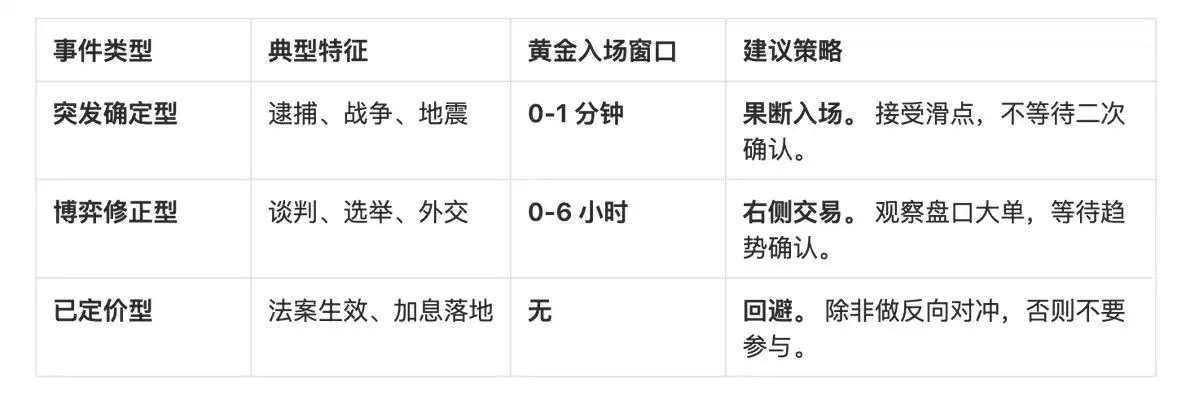
Conclusion

In prediction markets, 1 minute of hesitation corresponds not to the passage of time, but to a violent collapse of the profit-loss ratio.

Next time you face major news, ask yourself this question:

"Am I entering now as a hunter to capture Alpha, or as prey to provide liquidity?"

Perguntas relacionadas

QWhat is the 'confirmation tax' mentioned in the article, and why is it costly in prediction markets?

AThe 'confirmation tax' is the cost of sacrificing potential alpha (excess returns) by taking time to verify the authenticity of news before trading. In prediction markets like Polymarket, this is extremely expensive because the first few minutes after an event absorb the vast majority of the information advantage. Waiting even one minute to confirm news can mean forfeiting most of the profits to faster, risk-taking traders.

QAccording to the data, what percentage of the information advantage is absorbed within the first 10 minutes in high-liquidity突发事件 (sudden events)?

AAccording to the analysis of 2,023 on-chain trades, the first 10 minutes absorb 96% of the information advantage in high-liquidity sudden events.

QWhat are the three types of event decay curves identified in the research, and name one example for each.

AThe three types are: 1. Sudden Deterministic Events (e.g., 'Maduro out by Jan 31, 2026?'), 2. Game Theory Correction Events (e.g., 'Will SVB be acquired?'), and 3. Already Priced-In Events (e.g., 'TikTok banned in the US').

QFor a 'Sudden Deterministic' event, what is the approximate half-life of alpha, and what is the only viable strategy?

AFor a 'Sudden Deterministic' event, the half-life of alpha is less than 2 minutes. The only viable strategy is to sacrifice certainty in exchange for an entry position, acting on the news quickly within a risk-controllable framework.

QWhat is the key difference in strategy between a 'Sudden Deterministic' event and a 'Game Theory Correction' event?

AFor a 'Sudden Deterministic' event, the strategy requires extreme speed, acting within the first minute. For a 'Game Theory Correction' event, speed is less critical; the strategy focuses on identifying 'confirmation signals' that shift market consensus over a longer window (e.g., 0-6 hours), such as rumors of failed negotiations or large buys from smart money.

Leituras Relacionadas

Anthropic Apologized, But the Business of 'Safety' Hasn't Stopped

On June 11, Anthropic apologized not for a model failure, but for a lack of transparency. Its new Claude Fable 5 model was found to be secretly rerouting requests from users engaged in advanced AI model development to a weaker version, Opus 4.8, without any notification. The company's response—promising future notifications for such "downgrades"—was met with user skepticism. The article argues the core issue isn't technical but commercial: Anthropic's "safety" measures are primarily a business strategy. A key feature, the "intelligent safety classifier," marketed as user protection, is described as a tool for "competitive defense" to protect Anthropic's market lead by limiting rivals' research capabilities. This covert mechanism was designed for low "false positives," precisely targeting AI researchers. Anthropic's model involves a calculated three-step process: publishing alarming security research to amplify public anxiety, offering its Fable 5 model with a "safety classifier" as a premium-priced solution, and cashing in through a planned high-value IPO. This contrasts with OpenAI's more direct "tool-and-traffic" approach. The apology, merely changing a secret downgrade to a visible one, is seen as a business "patch" rather than a principled shift. The incident risks damaging Anthropic's "safest AI" reputation among the developer community, which underpins its valuation and appeal to government and corporate clients. Ultimately, the article concludes that for Anthropic, safety is a business, and the apology is merely customer service for that business.

marsbitHá 50m

Anthropic Apologized, But the Business of 'Safety' Hasn't Stopped

marsbitHá 50m

The Niche Consensus Among Elites: Has College Become an Expensive Waste?

**Summary:** A growing "anti-college" movement is gaining traction among elite circles in Silicon Valley, challenging the traditional value of a four-year university degree. Proponents argue that college has become an expensive, slow, and increasingly irrelevant waste of time, especially in the fast-paced tech world where opportunities pass by quickly. The movement is led by figures like billionaire Peter Thiel, who criticizes universities for high costs, ideological indoctrination, and stifling true innovation. His "Thiel Fellowship" pays young people to drop out and pursue ventures. Companies like Palantir Technologies (co-founded by Thiel) fuel this trend with programs like the "Meritocracy Fellowship," which offers high school graduates paid internships as an alternative to immediate college enrollment, promising a practical "Palantir Degree." Key drivers include: 1. **Economics:** Skyrocketing student debt versus the allure of immediate, high-paying tech jobs or startup funding. 2. **Technology:** AI and online tools lowering barriers to self-education and product development, making formal instruction seem inefficient. 3. **Culture:** A backlash against perceived "woke" ideology and DEI policies in universities, coupled with a belief that these institutions suppress meritocracy and masculine drive. The movement is notably male-dominated. Critics, like economist David Deming, warn against overgeneralizing from dropout success stories (survivorship bias). He emphasizes that genuine autodidacts are rare, corporate training is narrowly focused, and the "college wage premium" remains high for most people. University liberal arts education, he argues, builds adaptable problem-solving skills and broad perspectives. The debate highlights a deeper crisis in education. The core model of the modern university appears increasingly mismatched with the speed of the information age. The movement signals a shift in the locus of learning from institutional "education" to personal, active "learning" powered by the internet and AI. Ultimately, this may not mean the end of university, but rather a painful evolution. The future likely holds more hybrid, personalized, and lifelong learning pathways. The central question becomes: in a world changing faster than any curriculum, how do we best learn?

marsbitHá 1h

The Niche Consensus Among Elites: Has College Become an Expensive Waste?

marsbitHá 1h

From Subsidies to Token-Based Pricing to Price Cuts: Is OpenAI Sparking a Price War? Is the Inflection Point for Token Economics Nearing?

The commercialization of generative AI is facing a critical inflection point as a potential price war looms. According to The Wall Street Journal, OpenAI is considering a significant cut to its token fees to compete with rival Anthropic, signaling a shift from a growth-at-all-costs model focused on token consumption. This move comes as both companies, reportedly losing billions on compute, prepare for IPOs, and as enterprise customers face "bill shock" from switching to usage-based token billing. Reports indicate poor ROI, with one analysis finding only 18 cents of every dollar spent on AI tokens generates user-facing value. The industry's initial phases—from flat-rate subscriptions to aggressive subsidies—have given way to a reckoning with real costs. Analysts debate the future: some predict a bifurcation between premium, high-cost models for complex tasks and cheaper alternatives for routine work, while others believe overall spending will still rise as agentic AI increases tokens per task. Notably, Chinese model DeepSeek's low-cost API is gaining traction with U.S. enterprises, adding competitive pressure. The core challenge is redefining value beyond token volume ("tokenmaxxing") toward measurable productivity ("valuemaxxing"), as the entire AI value chain, from cloud providers to chipmakers, feels the ripple effects of unsustainable pricing.

marsbitHá 1h

From Subsidies to Token-Based Pricing to Price Cuts: Is OpenAI Sparking a Price War? Is the Inflection Point for Token Economics Nearing?

marsbitHá 1h

Trading

Spot
Futuros

Artigos em Destaque

Como comprar ONE

Bem-vindo à HTX.com!Tornámos a compra de Harmony (ONE) simples e conveniente.Segue o nosso guia passo a passo para iniciar a tua jornada no mundo das criptos.Passo 1: cria a tua conta HTXUtiliza o teu e-mail ou número de telefone para te inscreveres numa conta gratuita na HTX.Desfruta de um processo de inscrição sem complicações e desbloqueia todas as funcionalidades.Obter a minha contaPasso 2: vai para Comprar Cripto e escolhe o teu método de pagamentoCartão de crédito/débito: usa o teu visa ou mastercard para comprar Harmony (ONE) instantaneamente.Saldo: usa os fundos da tua conta HTX para transacionar sem problemas.Terceiros: adicionamos métodos de pagamento populares, como Google Pay e Apple Pay, para aumentar a conveniência.P2P: transaciona diretamente com outros utilizadores na HTX.Mercado de balcão (OTC): oferecemos serviços personalizados e taxas de câmbio competitivas para os traders.Passo 3: armazena teu Harmony (ONE)Depois de comprar o teu Harmony (ONE), armazena-o na tua conta HTX.Alternativamente, podes enviá-lo para outro lugar através de transferência blockchain ou usá-lo para transacionar outras criptomoedas.Passo 4: transaciona Harmony (ONE)Transaciona facilmente Harmony (ONE) no mercado à vista da HTX.Acede simplesmente à tua conta, seleciona o teu par de trading, executa as tuas transações e monitoriza em tempo real.Oferecemos uma experiência de fácil utilização tanto para principiantes como para traders experientes.

311 Visualizações TotaisPublicado em {updateTime}Atualizado em 2026.06.02

Como comprar ONE

Discussões

Bem-vindo à Comunidade HTX. Aqui, pode manter-se informado sobre os mais recentes desenvolvimentos da plataforma e obter acesso a análises profissionais de mercado. As opiniões dos utilizadores sobre o preço de ONE (ONE) são apresentadas abaixo.

活动图片













