The Midlife Crisis of Crypto GPs: No PMF, No Next Check from LPs

marsbitPublicado em 2026-06-01Última atualização em 2026-06-01

Resumo

The article "The Midlife Crisis of Crypto GPs: No PMF, No Next LP Check" analyzes the shifting crypto fundraising landscape. It argues the era of selling grand visions to LPs is over; GPs must now offer products with clear Product-Market Fit (PMF). The author categorizes crypto fundraising products into three types: Primary (VC funds), Liquid (trading strategies), and CeFi/DeFi Native Yield. This summary focuses on the Primary market. Key points include: * **Market Shift:** LPs are impatient, demand immediate returns, and are skeptical of future promises. The "easy money" narrative has faded. * **GP Value Erosion:** LP learning curves have shortened (aided by AI), reducing the value of a GP's basic "crypto knowledge." Superior judgment is now rare. * **Weakened LP Motivations:** Traditional reasons for LPs to invest in crypto VC funds (capturing industry beta, gaining access, leveraging GP judgment) have weakened due to new products like ETFs and increased LP sophistication. * **Surviving in Primary:** The primary market will likely persist for: 1) large funds in endowment mandates treating it as a lottery ticket, 2) family offices/HNWIs using proprietary capital, 3) a few funds with proven recent outperformance, and 4) funds with strong ecosystem "deal-making" capabilities. * **Conclusion:** For most GPs, rebuilding trust requires starting over in a niche, demonstrating alpha-generating ability, or providing concrete value/services to LPs.

Author: Yi.Pineapple

LPs are no longer buying dreams; GPs must sell products. This article will attempt to categorize current crypto fundraising products into three types: Primary, Liquid, and CeFi / DeFi Native Yield. The first part focuses on Primary: after VC blind pools have lost their appeal, who remains at this table, and who must prove themselves anew? The answer is at the end; you can scroll directly to the bottom.

Note: This article aims to provide a landscape overview of the entire crypto fundraising market. The first part mainly categorizes and explains the current market situation from a product perspective, while the second part will analyze more from the perspective of LPs. As the author is primarily based in the Asian market, this article may have a regional bias.

Market Status

Having lost the grand vision, most Crypto GPs who failed to earn excess returns this cycle must get down to earth and launch a product with PMF. They must either prove they still have the ability to generate excess returns for LPs through some niche market or help LPs/partners solve specific problems in order to survive.

  • For most GPs, this market has long moved from the stage of "buying a future vision" to the stage of "buying a specific product."
  • LPs have lost patience and no longer want to gaze at the stars and the sea; they want to see something that can make money immediately, right away, and with relative certainty.
  • Crypto LPs have lost trust in the market and are no longer willing to easily believe the "next cycle" narrative (this has been discussed too much and will not be elaborated here). Moreover, many did not make easy money this cycle. Once the way to make money becomes difficult, investment actions tend to become more cautious and conservative.
  • Most traditional LPs have also completed a round of learning and moved past the story-listening stage. The 2020/2021 bull market was the time of peak FOMO. Dollar funds were cheap (Treasury yield close to 0), LPs were still making money relatively easily (on the eve of the economic downturn), and Crypto was in an explosive period (there were many wealth creation myths, and there was still a dream to sell). Back then, many people, even with only a vague understanding of crypto, were willing to make impulsive purchases for the dream; or, for strategic reasons, paid to enter and learn.
  • AI and falling labor costs have also changed the positioning of GPs. The costs for LPs to learn, hire, analyze data, trade, and make small direct investments are all declining. The trend of LPs transforming into GPs is significant. If GPs only offer the vague capability of "I understand crypto," their value will become increasingly precarious.
  • As for the storytelling track, unless they are U.S.-based funds with strong brand power, who, based on their past track records, can still tell stories and visions in specific niches (e.g., a16z leveraging its advantage in the AI sector to talk about crypto * AI, Dragonfly leveraging its investments in Ethena/Polymarket to talk about internet capital markets), there is still an opportunity. In Asia, this positioning is already difficult. After all, to some extent, in both crypto projects and funds, the opportunity to tell stories often goes to those with a "white paper" (a play on words implying Western or native English speakers have an advantage).

Product Overview

This article categorizes crypto fundraising products into three major types for discussion: Primary, Liquid, and CeFi / DeFi Native Yield (Note: This categorization is not entirely precise; there are some blurred lines between the three). (*This time, only Primary is covered)

Primary VC:

In terms of transparency, they can be roughly divided into blind pools and those with clear pipelines.

In terms of liquidity, they can be roughly divided into primary and primary-secondary.
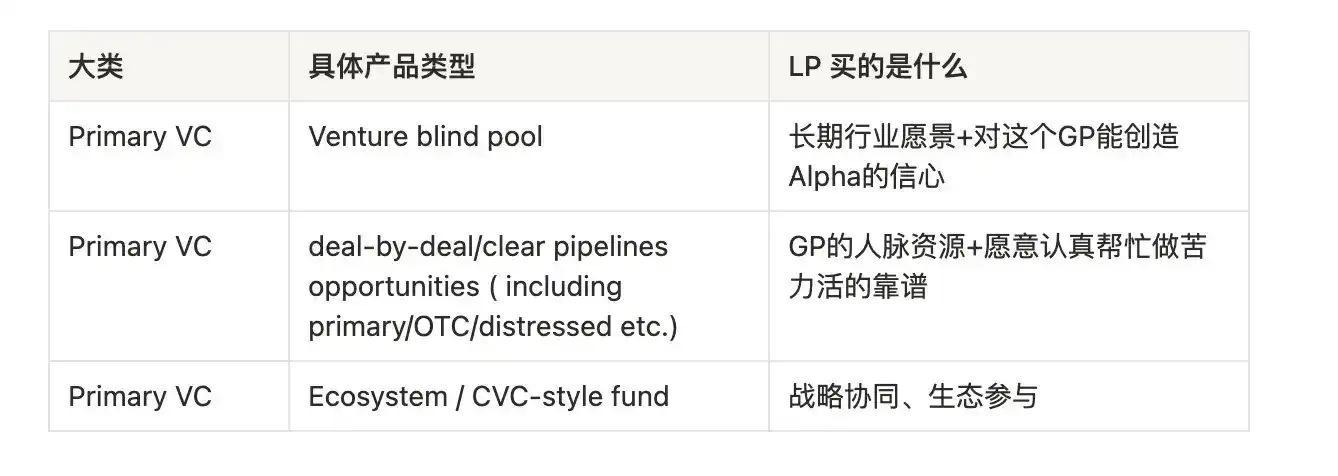
Liquid:

In terms of source of returns, roughly divided into alpha-focused (buying GP's personal ability) and beta-focused (buying industry trends).

In terms of directionality, roughly divided into directional (buying cycle judgments) and market neutral (buying market inefficiencies in immature markets).
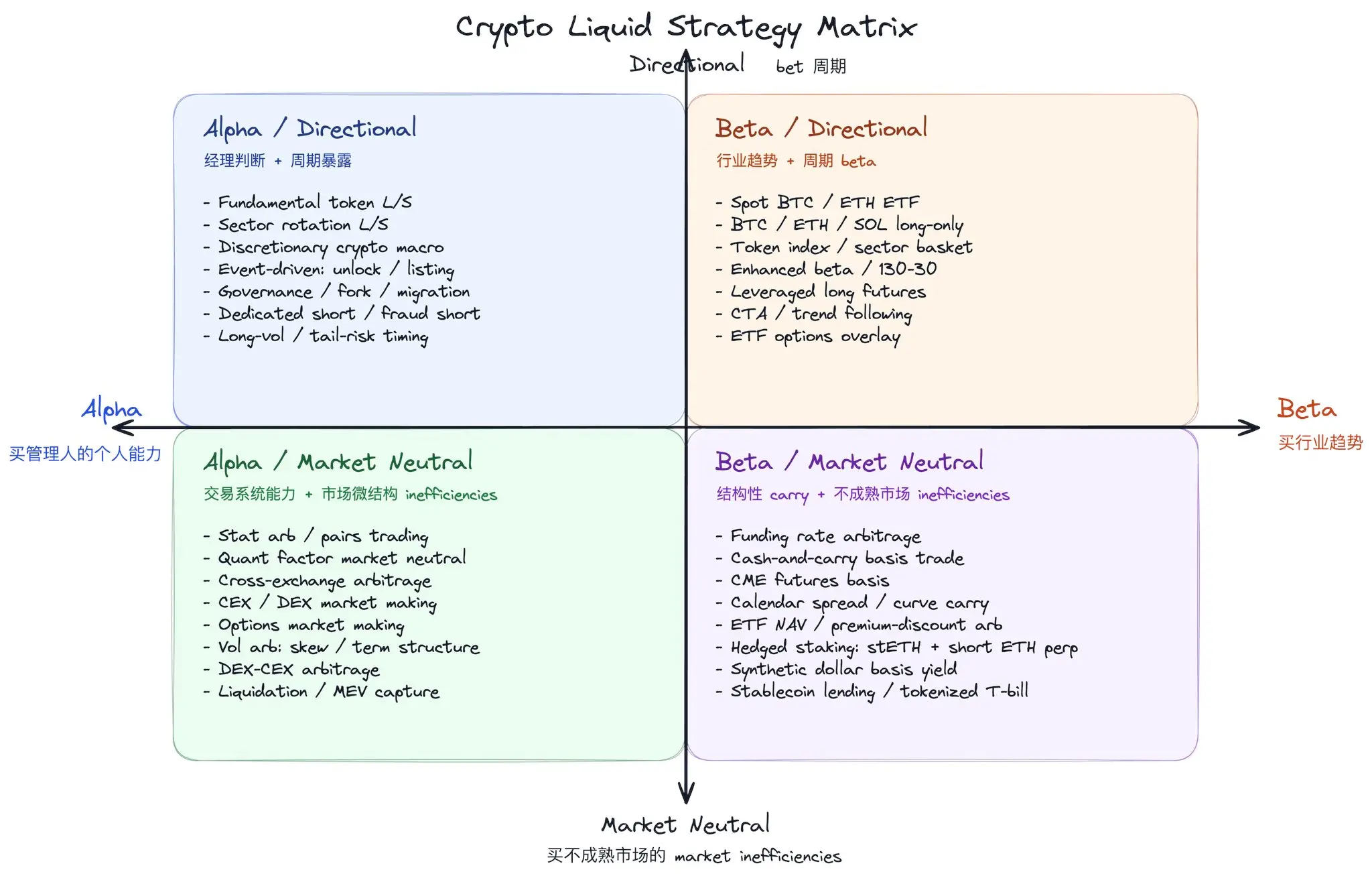
There are many ways to categorize; this is just to provide an idea

CeFi/DeFi Native Yield:

In theory, CeFi/DeFi Native Yield can be viewed as a type of return source within or spanning the crypto primary market and liquid market. The reason for listing it separately is mainly because, from the perspective of TradFi investors, they usually use the framework of traditional financial markets to understand crypto: for example, crypto VC can be understood as a sub-sector under the VC category, and staking/lending yield can be analogized to fixed income or cash management products.

However, crypto indeed contains some玩法 (play/mechanisms) and return mechanisms not entirely corresponding to traditional financial markets, such as mine-trade-sell, points/airdrop farming, protocol incentives, on-chain liquidity mining, etc. These are more like crypto-native issuance, user acquisition, and incentive mechanisms, warranting separate discussion.

Secondly, for many Crypto Native Investors, their earliest entry point and understanding of financial markets were not the traditional equity/bond market, but rather crypto-native scenarios like exchange wealth management products, staking, DeFi lending, LP, points/airdrop farming, basis trade, etc. Therefore, when they look at this part of the yield, they may not necessarily translate it into TradFi's fixed income, cash management, or alternative yield first. Instead, they more naturally understand it from the perspectives of protocol incentives, liquidity provision, token emission, on-chain risk, counterparty risk, and capital efficiency.

For Crypto Native LPs, accessing this part of the yield does not require a GP; at most, they might need a reliable key account manager.

For TradFi LPs, there are now some institutions packaging this part of the yield into fund forms to sell to TradFi LPs.

Primary Market

From the perspective of the entire primary market, crypto VC is just a sub-sector under the VC category. 2021 was a crazy year; whether crypto or non-crypto, the real returns of that vintage are not good. As a cruel fact, LPs have learnt their lessons, tired of any products with ultra-long lock-up periods (traditional VC typically 10 years, crypto VC also often 5-10 years). Because without a hard lock-up, they at least have the chance to withdraw part of their money if circumstances change.

In a sense, crypto is even worse off than traditional VC because the entire vision has collapsed. It is not a new industrial revolution; at most, it's a revolution in financial infrastructure. This judgment is not to disparage crypto—a revolution in financial infrastructure is still very important—but it's not as grand as many imagined in the last bull market. Worse, the market was too immature back then, and many projects were invested in without sufficient due diligence and legal protection. Many failed projects are a combination of investment failure and founders running away. There are already too many articles in the industry discussing the current dire situation; it will not be elaborated here.

Investing in VC is like VC investing in projects—a power-law business, a lottery-like business. As long as there are people willing to buy lottery tickets, this table will not disappear.

Why LPs invested in crypto VC back then, and why these reasons have weakened now

1. Invest to capture the beta of the industry

This reason was especially valid for tradfi LPs. It was true in the early days because market choices were few. For outsiders, on-ramping, buying tokens, going on-chain, using CEXs, and managing wallets were all difficult. They worried about losing private keys and CEXs running away. Investing in VC seemed like a more reliable access point then.

But today, when a traditional LP enters crypto, they have a whole set of choices before them: BTC ETF, ETH ETF, crypto ETP, DAT, custody accounts, SMAs, structured products. More importantly, these products do not require them to learn on-chain operations; they can trade just like they used to buy stocks.

According to CoinShares, the AUM of global digital asset investment products it covered reached about $156.9B in mid-May 2026. This number is not the total industry AUM, only the ETF/ETP/trust/closed-end funds and other listed or quotable products. But it's enough to show that gaining crypto exposure no longer requires investing in VC blind pools.

However, for long-term capital with clear mandates (e.g., endowment, etc.), this reason still applies. For them, to position in an industry often requires allocating to a basket of assets, so there is still likely a 1~2% allocation to Crypto VC.

2. Invest for accessibility

This usually happened to crypto LPs and some tradfi LPs with strategic positioning visions. At that time, many such LPs did not have the energy/time/ability to build their own investment teams, so they gave money to GPs, hoping to get good deal access.

But they later found this reason unstable too. When the market is good, GPs themselves don't have enough allocation, and it's hard for LPs to get truly good access. When the market is bad, competition is not fierce, and if you are willing to engage, getting allocation is not that difficult.

For traditional LPs, access had another meaning: they knew nothing at the time but hoped to enter the ecosystem and gain insider information by investing in crypto-native GPs. This was a strategic investment when there was no clear strategic target. Now the situation has changed. Many traditional LPs have either left for hotter industries like AI or have developed their own internal teams. AI and cheap researchers have narrowed the knowledge gap. New learners still exist, but their learning speed is accelerating, and their paths are multiplying; investing in the primary market with ultra-long lock-ups may not be the optimal choice for them.

3. Invest for judgment

This is the trickiest part. In a market developing extremely fast, unless GPs can continuously self-iterate, the judgment premium will disappear quickly. The rules of the game change every cycle, but it's not easy for people to change themselves (is this another version of "old habits die hard"?).

We must face a cruel reality: most GPs did not prove to LPs in the last cycle that they had superior judgment.

For traditional LPs, part of the purpose of investing in crypto-native GPs back then was to educate themselves and learn the industry through the GP's judgment. This typically happened to two types: one was companies hoping to strategically enter web3, such as large internet companies; the other was sophisticated tradfi investors, such as traditional GPs or family offices, who wanted to do their own web3 direct investment in the future. The learning period is now over, and only a small number of GPs who have truly proven they have superior judgment can remain on their investment lists.
For crypto LPs, they found that rather than betting on a GP's judgment, it's better to lose money themselves. Losing money themselves at least has emotional value, and they don't have to pay management fees.

4. Invest for deal-making ability

From an investment return perspective, deal-making ability mainly manifests as whether it can achieve a good exit for the project ultimately. Ideally, it would be best to help the project achieve healthy growth and ultimately obtain good returns in the secondary market. Otherwise, having the ability to organize the next round of financing is also important (essentially the difference between relying on retail investors or large investors to take over).

However, as a form of financial innovation, Crypto sometimes resembles a large-scale capital game. Sometimes, investment is just a way of exchanging interests, ensuring everyone has aligned interests and can make money together relatively assuredly.

5. Invest for reputation

For some large LPs, the money invested in a single VC is only about 1% of their overall portfolio, negligible. Sometimes they invest in a GP just to be cool (like investing in A16Z). However, most GPs are not in this category.

Who can still stay at the primary table

From a pure capital source perspective, the players most likely to continue staying at the primary table are:

Funds large enough to enter the mandates of endowments/other similar long-term patient capital. These institutions buy crypto VC as lottery tickets, without short-term funding pressure.

FOs, companies, HNW proprietary primary crypto investments using their own money. FOs/HNWs are more likely to do accelerator-like, very early funds; companies are more likely to do direct strategic investments/acquisitions.

The few funds that really made bets/accumulated BTC this cycle and actually generated excess returns for LPs. LPs believe they can win next time.

Funds with clear deal-making ability, possessing ecosystem resources that can be exchanged for interests with LPs.

For other players, if trust has been lost, it might be better to mentally start over and rebuild trust. Prove the ability to generate excess returns for investors again in a niche sector, or provide some specific service/value, and then scale up based on that.


Perguntas relacionadas

QAccording to the article, what is the main reason why most crypto GPs are now forced to develop a product with Product-Market Fit (PMF)?

AThe main reason is that LPs have lost patience and are no longer willing to invest based on future visions or 'the next cycle' narrative. They now demand immediate, relatively certain profit opportunities or specific problem-solving capabilities. The market has shifted from 'buying a future vision' to 'buying a specific product.'

QInto which three broad categories does the article classify crypto fundraising products?

AThe article classifies crypto fundraising products into three categories: 1. Primary (like VC funds), 2. Liquid (trading-focused products), and 3. CeFi / DeFi Native Yield (products based on staking, lending, airdrop farming, etc.).

QWhat was a key reason for traditional LPs to invest in crypto native GPs in the past that has now significantly weakened?

AA key past reason was 'Invest for accessibility'—LPs lacked the knowledge, team, or operational ability to enter crypto directly and used GPs to access deals and insider information. This has weakened as learning resources improved, internal teams were built, and easier access products (like ETFs) emerged, reducing the necessity of a VC blind pool for exposure.

QWhat does the article identify as 'the most tricky part' regarding the 'Invest for judgement' reason for backing a GP?

AThe most tricky part is that the 'judgement premium' of a GP can disappear quickly in the fast-evolving crypto market unless the GP can continuously self-iterate. The article states the harsh reality that most GPs failed to prove they had superior judgement in the last cycle, eroding LP trust.

QBased on the article, which types of players are most likely to remain at the 'primary' investment table?

A1. Large funds that fit into the mandate of long-term, patient capital like endowments. 2. Family Offices, companies, and High-Net-Worth individuals investing their own money. 3. A few funds that delivered outsized returns in this cycle. 4. Funds with clear ecosystem resources and deal-making ('攒局') capabilities for利益置换 (interest exchange).

Leituras Relacionadas

AI Trading Cools, South Korean Stocks Plunge 1.8%, Spot Gold Rises 1%, Bitcoin Dives

A sell-off in AI-related stocks, triggered by Broadcom's disappointing earnings forecast, sent shockwaves through global markets. South Korea's KOSPI led Asia's decline, plunging 1.8% as the risks from concentrated chip stock gains and surging leveraged investments came to the fore. The tech-heavy Nasdaq 100 futures fell 0.5% following Broadcom's 14% after-hours plunge, which signaled a slower-than-expected transition to AI clients. This pullback extended Wall Street's weakness, halting the S&P 500's nine-day rally amid hawkish Fed signals and renewed Middle East tensions. South Korean authorities convened an emergency meeting, pledging "immediate measures" against market volatility and warning of record-high stock margin debt. The adjustment rippled across assets: Bitcoin fell to around $64,000, its lowest since February, while safe-haven gold rose 1% on bargain hunting. Oil prices dipped on Middle East ceasefire news. Market analysts noted the sell-off was driven by profit-taking after massive gains, particularly in chip stocks like Samsung and SK Hynix, which now dominate the KOSPI. Wall Street banks are divided on Korea's outlook, with Goldman Sachs raising its target while Citigroup and others warn of overvaluation and a potential bubble. Bridgewater's Ray Dalio noted that great technological shifts often create bubbles. Meanwhile, Fed officials' hints at potential future rate hikes added to the cautious mood ahead of key U.S. jobs data.

华尔街日报Há 17m

AI Trading Cools, South Korean Stocks Plunge 1.8%, Spot Gold Rises 1%, Bitcoin Dives

华尔街日报Há 17m

Seeking Alpha's Hot Article: Why Might the U.S. Stock Market Crash in June?

In a recent Seeking Alpha article, financial professor and analyst Damir Tokic argues that the US stock market may be poised for a significant crash in June 2026. The core thesis centers on a "mega-bubble" in equities, particularly within the technology sector, which has driven the S&P 500 to near-record valuations, with a Shiller P/E ratio exceeding 40—a level comparable to the 2000 dot-com bubble. Tokic identifies two primary catalysts for a potential collapse. First, he points to unsustainable market exuberance fueled by what he terms the "Trump Stimulus"—massive AI capital expenditure by tech giants, which he believes is politically driven and cannot last. Second, and more urgently, he highlights the escalating Iran war as a critical threat. The ongoing closure of the Strait of Hormuz has created a severe global energy supply crunch. Strategic petroleum reserves are projected to hit critically low operational levels by June, potentially causing oil prices to spike above $200 per barrel and triggering a severe, supply-driven inflationary shock. This scenario, Tokic warns, would force the Federal Reserve's hand. Despite currently maintaining a dovish bias, the Fed would likely be compelled to officially pivot to a hawkish stance at its June FOMC meeting to combat soaring inflation and bond yields. He contends that such a shift—or even a failure to act, which would destroy Fed credibility—could be the trigger that punctures the market bubble. The resulting downturn, he concludes, could rival the bear markets of 2000 and 2008, advising investors to prepare for a major correction.

marsbitHá 39m

Seeking Alpha's Hot Article: Why Might the U.S. Stock Market Crash in June?

marsbitHá 39m

AI PC Battle: Bet on the Toll Booth, Not the Camp

**Title:** The AI PC Battle: Don't Bet on Sides, Bet on the Tollbooth **Summary:** The AI PC competition is moving beyond simple "x86 vs. Arm" narratives. The core investment thesis should focus on identifying which players can sustain margins, cash flow, and pricing power throughout the upgrade cycle, rather than backing a particular architecture. The opportunity is analyzed in three layers: 1. **The Advanced Foundry Tollbooth:** TSMC is positioned to collect "tolls" regardless of which chip designer wins, due to its dominant ~70% share in advanced semiconductor manufacturing, which is essential for high-end AI PC chips. 2. **Compute & Platform Spillover:** AMD represents an offensive in the x86 CPU+GPU space, while NVIDIA leverages its GPU and CUDA software stack dominance. Both benefit from the demand for increased local AI compute. 3. **Architecture Diffusion & Turnaround Plays:** ARM and Intel offer potential for significant upside (elasticity), but investments here require stricter discipline due to higher execution risks and competitive challenges. The industry is transitioning from concept to shipment validation. While short-term forecasts for AI PC adoption have been revised down slightly due to tariffs and procurement delays, the long-term trend towards AI becoming a standard PC feature remains intact. The key driver for upgrade cycles will be whether compelling enterprise applications (e.g., privacy-sensitive computing, low-latency inference) emerge beyond consumer-focused features like meeting summarization. Investment strategy should prioritize companies with platform-level advantages and recurring revenue streams. TSMC offers high certainty as the foundational tollbooth. AMD presents a strong offensive play within the established ecosystem. ARM and Intel are higher-risk, higher-potential-reward turnaround bets. The report cautions against chasing short-term hype and emphasizes a disciplined, long-term approach focused on buying ecosystem strength and cash-flow certainty after market enthusiasm subsides. **Key Risks:** Underwhelming AI PC applications slowing upgrade cycles; slow improvement in Windows on Arm compatibility; macro/tariff impacts on PC demand; potential advanced node supply-demand mismatches affecting TSMC; high overall AI sector valuations making stocks vulnerable to a risk-off shift in markets.

marsbitHá 54m

AI PC Battle: Bet on the Toll Booth, Not the Camp

marsbitHá 54m

Ten-Thousand-Word Analysis: From $10 to $290, MRVL Wins the Entire AI Era by 'Not Making GPUs'

Marvell Technology's stock price surged from under $10 in 2016 to a record $290 in June 2026, fueled not by making GPUs, but by dominating AI infrastructure connectivity. This analysis argues the market misvalues MRVL as merely a smaller Broadcom in custom AI chips, overlooking its true, unique position. Marvell's core strength lies in enabling high-speed data flow for AI clusters through three interconnected businesses. First, it holds a commanding ~70% market share in high-speed optical DSPs (essential for data center light modules), a deep-moat business with accelerating growth. Second, its custom AI chip design business serves hyperscalers like AWS, Microsoft, and Google, with a significant revenue pipeline despite lower margins. Third, stable cash flows come from Ethernet switch chips and enterprise storage controllers. Together, they form a full-stack "AI data movement" platform. CEO Matt Murphy's transformative leadership since 2016, involving strategic divestments, key acquisitions (like Inphi for optical DSPs), and securing long-term agreements with major cloud providers, repositioned the company. A pivotal $2 billion strategic investment from NVIDIA in 2026 underscored Marvell's critical role in the AI ecosystem, particularly through collaborations like NVLink Fusion. While Marvell faces risks—including client concentration (losing the Amazon Trainium3 design), lower-margin business mix, competitive threats, insider selling, and complex supply chains—its fundamentals remain strong. The optical interconnect moat is widening with the acquisition of Celestial AI (photonics fabric), and financial metrics show accelerating revenue growth and operating leverage. With a PEG ratio suggesting undervaluation relative to its growth, the thesis is that the market undervalues Marvell's monopolistic position in AI "plumbing" while overemphasizing its competitive custom chip segment. The story transcends investing, symbolizing how in any complex system—from the internet to AI—the value of "connection" ultimately surpasses that of individual "nodes."

marsbitHá 1h

Ten-Thousand-Word Analysis: From $10 to $290, MRVL Wins the Entire AI Era by 'Not Making GPUs'

marsbitHá 1h

Trading

Spot
Futuros

Artigos em Destaque

Como comprar CHECK

Bem-vindo à HTX.com!Tornámos a compra de Checkmate (CHECK) simples e conveniente.Segue o nosso guia passo a passo para iniciar a tua jornada no mundo das criptos.Passo 1: cria a tua conta HTXUtiliza o teu e-mail ou número de telefone para te inscreveres numa conta gratuita na HTX.Desfruta de um processo de inscrição sem complicações e desbloqueia todas as funcionalidades.Obter a minha contaPasso 2: vai para Comprar Cripto e escolhe o teu método de pagamentoCartão de crédito/débito: usa o teu visa ou mastercard para comprar Checkmate (CHECK) instantaneamente.Saldo: usa os fundos da tua conta HTX para transacionar sem problemas.Terceiros: adicionamos métodos de pagamento populares, como Google Pay e Apple Pay, para aumentar a conveniência.P2P: transaciona diretamente com outros utilizadores na HTX.Mercado de balcão (OTC): oferecemos serviços personalizados e taxas de câmbio competitivas para os traders.Passo 3: armazena teu Checkmate (CHECK)Depois de comprar o teu Checkmate (CHECK), armazena-o na tua conta HTX.Alternativamente, podes enviá-lo para outro lugar através de transferência blockchain ou usá-lo para transacionar outras criptomoedas.Passo 4: transaciona Checkmate (CHECK)Transaciona facilmente Checkmate (CHECK) no mercado à vista da HTX.Acede simplesmente à tua conta, seleciona o teu par de trading, executa as tuas transações e monitoriza em tempo real.Oferecemos uma experiência de fácil utilização tanto para principiantes como para traders experientes.

483 Visualizações TotaisPublicado em {updateTime}Atualizado em 2026.06.02

Como comprar CHECK

Discussões

Bem-vindo à Comunidade HTX. Aqui, pode manter-se informado sobre os mais recentes desenvolvimentos da plataforma e obter acesso a análises profissionais de mercado. As opiniões dos utilizadores sobre o preço de CHECK (CHECK) são apresentadas abaixo.

活动图片












