The Limits of Finance, The Channel Value of Global Markets

marsbitPublicado em 2026-03-10Última atualização em 2026-03-10

Resumo

This article explores the evolving relationship between traditional finance and decentralized finance (DeFi), focusing on the growing institutional interest in on-chain vaults and real-world assets (RWA). While major asset managers like BlackRock and Apollo are investing heavily in DeFi tokens, the sector faces challenges, including liquidity crises and structural limitations. A central theme is the absence of a native DeFi risk-free interest rate. Despite multiple attempts—from algorithmic stablecoins to liquidity staking tokens—DeFi has largely adopted USDT and USDC for their scale, effectively making U.S. Treasury bonds the de facto benchmark. However, this dependency creates vulnerability, as DeFi cannot interact bidirectionally with traditional finance. The article argues that the next phase of DeFi will revolve around vaults—on-chain repositories that aggregate assets and yield. These vaults, managed by "curators," aim to offer fixed-rate products and credit systems but currently lack mechanisms for asset price inflation and clear risk management. The piece concludes that while vaults and curators are gaining traction, the true innovation lies in creating efficient "channels" or broker-like systems that enhance global capital flow. These could eventually replace centralized exchanges as the primary liquidity hubs, enabling a more integrated and efficient financial system without relying on traditional tokenomics.

Author: Zuo Ye

No matter how many lies are woven, the truth will still illuminate the outline of light.

Asset management giants are showing increasing interest in on-chain Vaults, and the mainstreaming of the DeFi dream seems to be becoming a reality.

This is the best of times. BlackRock buys $UNI tokens, Apollo commits to buying hundreds of millions of dollars worth of $Morpho tokens, and Wall Street is collectively bullish on the future of DeFi.

This is the worst of times. BlackRock, Blackstone, and Blue Owl face concentrated redemption waves, and the founder of Aave warns that Wall Street is using RWA as a liquidity exit channel.

Crises always contain rare bargain prices. Faced with future asset price inflation, emerging forces are eager to act, completely disregarding the iceberg ahead.

No matter what you call it—DeFi/RWA/Vault—on-chain finance must eat the sugar coating and fire the cannonball back. Only by being good at breaking an old world can we possibly build a new Eden.

This sweet apple can even be made concrete—the risk-free rate.

The Dream of a Risk-Free Rate

Establishing a risk-free rate market based on on-chain assets and stablecoins is essential to have bargaining power against traditional asset management giants.

Let's start with a question to anchor our discussion: Why has DeFi not yet achieved a risk-free rate?

Or, reframe it as the linear narrative of how "U.S. Treasuries" became the benchmark rate for DeFi.
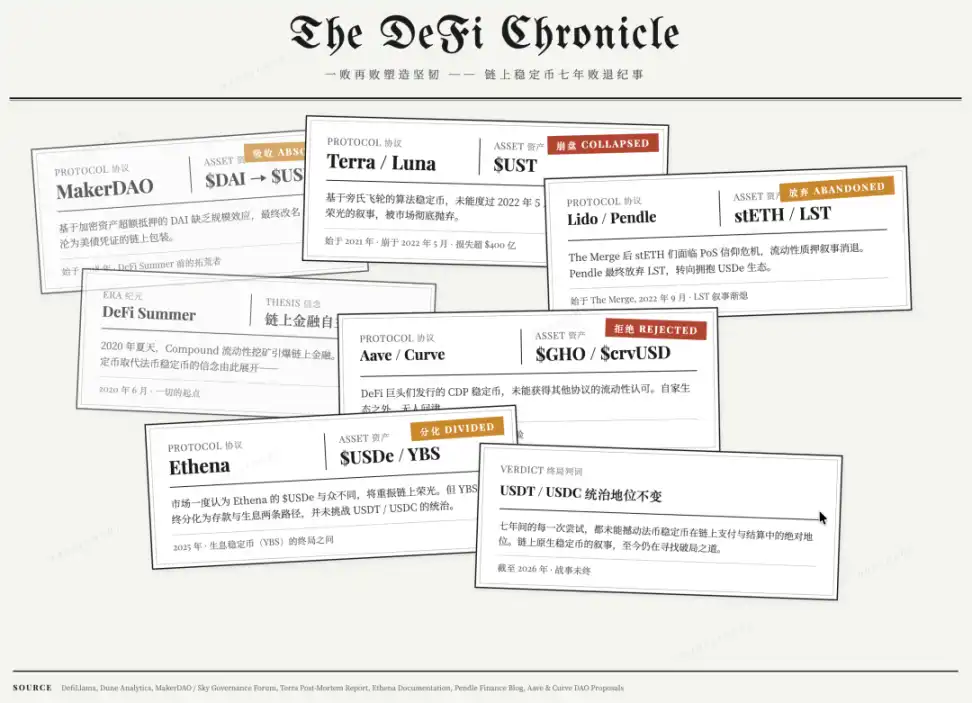
Image Caption: Stablecoin Chronicle

Image Source: @zuoyeweb3

Starting from the DeFi Summer of 2020, repeated failures have forged resilience:

  • Starting in 2018, DAI based on crypto assets lacked scale, and $USDS ultimately became a U.S. Treasury certificate.
  • Starting in 2021, the ponzi-based $UST did not survive the 2022 bank run; the story of rebuilding algorithmic stablecoin glory was abandoned.
  • In 2022, stETH and other LSTs faced a PoS faith crisis post-Merge; Pendle ultimately abandoned LSTs and embraced USDe.
  • In 2023/24, CDP stablecoins issued by DeFi giants like Aave/Curve were not recognized by other protocols.
  • In 2025, the market once believed Ethena's $USDe was different, reviving on-chain glory, but yield-bearing stablecoins ultimately split into deposit and yield activities, failing to challenge the dominance of USDT/USDC in their respective fields.

The facts are clear: It's not that USDT swallowed user profits, but that DeFi chose the scale effect of USDT/USDC.

Trading the Treasury profits generated from $300 billion for the entire market's trading foundation is not a bad deal for DeFi and the crypto market.

But at what cost?

The cost is not the evil of Tether taking profits, as claimed by yield-bearing stablecoin challengers, or the selfishness of banks prohibiting interest-bearing accounts, as accused by Coinbase and Donald Trump Jr.

The bitter pill DeFi has swallowed is that the U.S. Treasury rate is transmitted on-chain via stablecoins, but U.S. Treasuries are assets of the U.S. government, which acts without regard for on-chain sentiments.

This is also the fundamental reason for the bankruptcy of tokenomics. UNI relies on A16Z, A16Z relies on USD financing, the USD is an incarnation of U.S. Treasuries—so UNI is just the fourth derivative reliant on U.S. Treasuries. Why not just buy Treasuries directly, with no middlemen taking a cut?

U.S. Treasuries are the de facto benchmark for DeFi, but DeFi can only passively endure, unable to interact with them bidirectionally. This is the root of all happiness or pain.
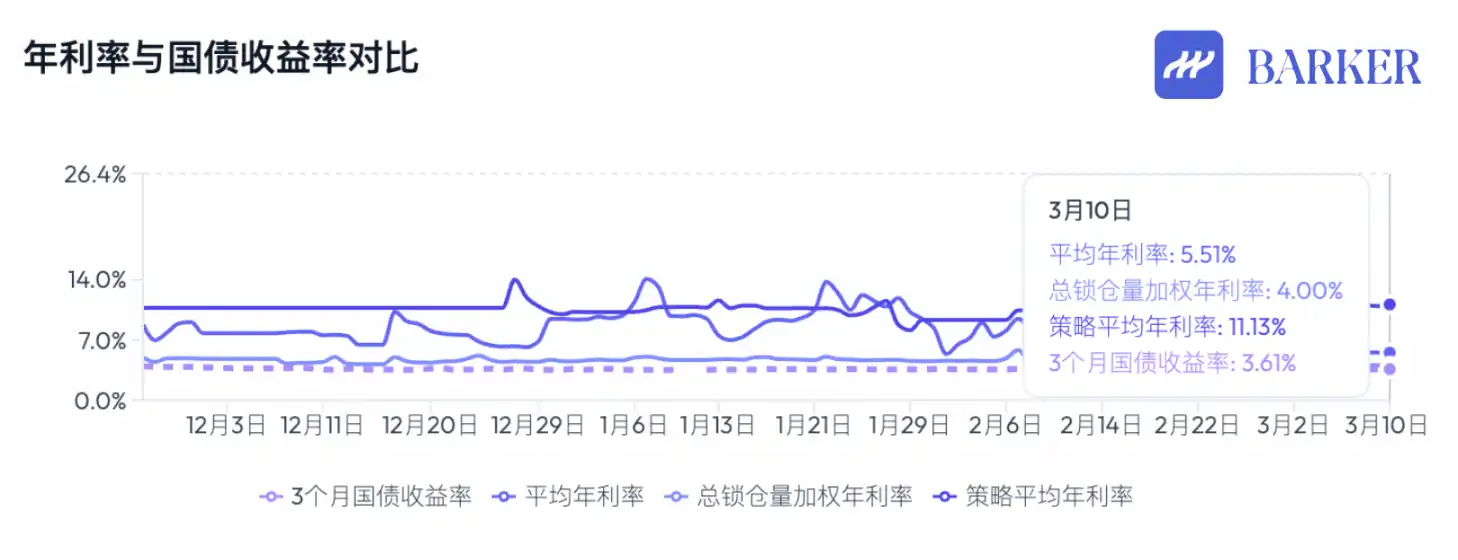
Image Caption: Comparison of On-Chain Stablecoin Yield APY and U.S. Treasury Yields

Image Source: @BarkerMoneyX

The salvation of DeFi never stops. Although tokenomics are bankrupt and DAO governance structures have collapsed, the overall direction of DeFi remains clear:

  1. Fixed-rate investment and financing, a recognized risk grading system, unsecured credit lending –> the main axis of the next stage,蕴含着某种形式的全民化产品 (implying some form of mass-market product);
  2. The expansion period for public chains, exchanges, and DeFi protocols is over. New application forms are evolving into Vaults. It's not yet certain that Vaults are the form of the mass-market product, but this is the starting point of the new stage.

Note here: Public chains and exchanges are no longer the center of value capture, but this does not mean their time is zero. Their period of asset price inflation has ended; only linear, steady growth remains.

This can also connect to the progressive relationship between UNI and U.S. Treasuries. Aave/Morpho are closer to asset management itself; their businesses don't have much narrative space but are indispensable for the industry.

The real star product will definitely be a Vault used by the masses, built on top of public chains and DeFi protocols, based on RWA-diversified assets, and triggering an asset price inflation mechanism.

For mass usage, Curators choose to ally with exchanges. Morpho entered Coinbase via Stakehouse; Aave expanded its C-end users through Metamask and other U-cards.

Based on RWA assets, Curators partner with custodians like Galaxy to constantly maneuver between crypto assets and real-world assets, such as Grove purchasing Galaxy's CLO bonds.

But what's missing is the Vault that triggers the price inflation mechanism. Even before this wave of large-scale asset management moving on-chain, BlackRock's BUILD token was already listed, and Circle's USYC also supports yield, but neither could replicate their own success.

It's not important that Vaults lack their own tokens. Asset price inflation is a mechanism. U.S. stocks, real estate, bonds, tulips, graphics cards, and Mac Minis all have their own price cycles. Current Vaults are just interest-bearing black boxes but have始终 failed to solve two problems:

  1. Where does the high yield actually come from?
  2. How is high risk actually handled?

Towards a New Financial System

The form of the channel is evolving; Vaults are not the endpoint.

The crypto industry evolves extremely fast. Before this year, we never dared to imagine that the global financial system would truly move on-chain, but today it is an undeniable ongoing process.

It's not yet time for a victory banquet. RWA can only serve as a funding source; Vaults are still boring deposit games. Various Curators haven't demonstrated brand效应 (brand effect). Veda-like white-label Vaults are highly similar to SaaS, and the operators (Curators) only earn management fees.

This has no imagination for price inflation. If traditional asset management, with its $2 trillion scale, endures cyclical煎熬 (hardships), it's hard to imagine Vaults being able to withstand it.
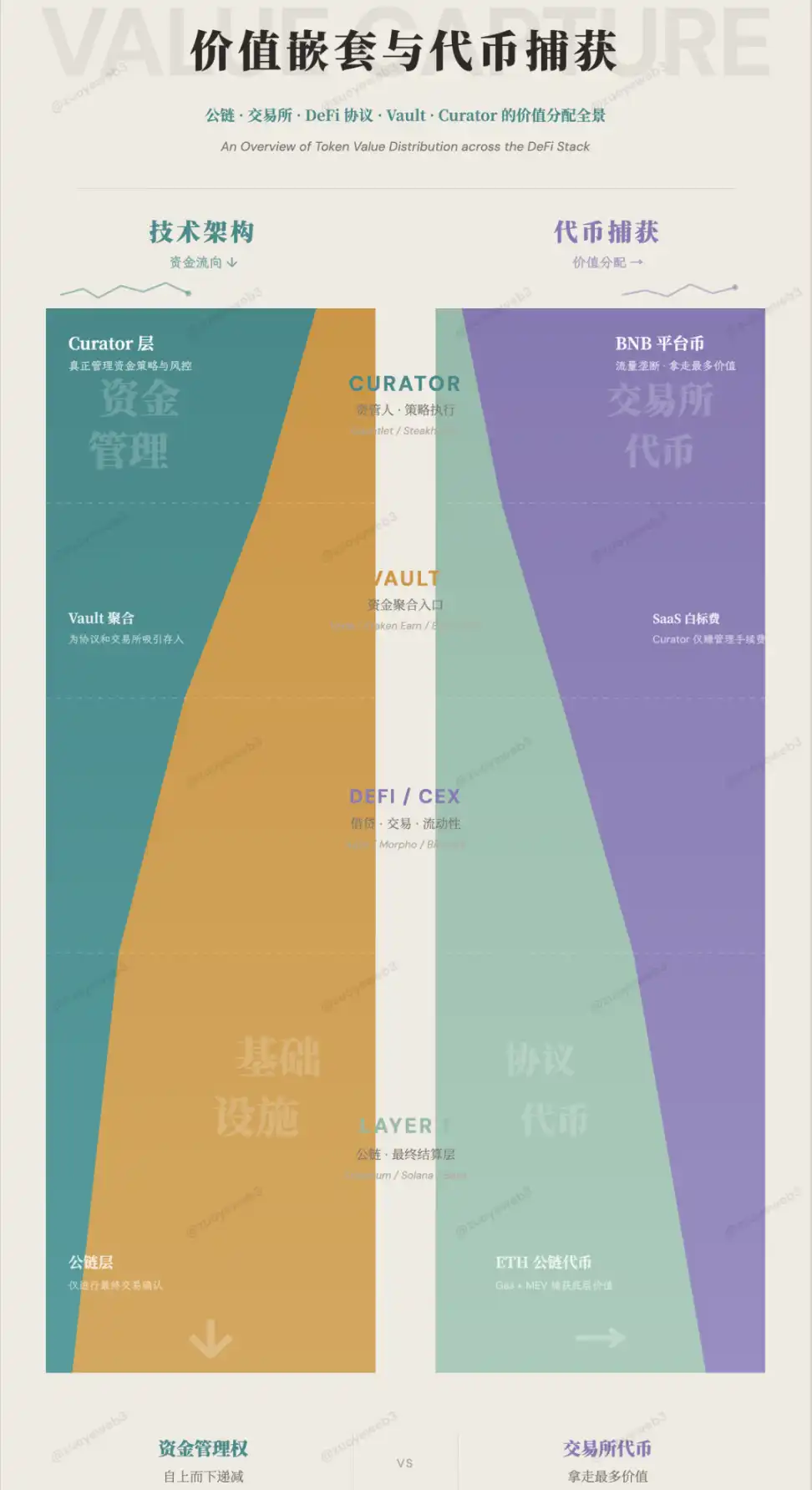
Image Caption: Fund Flows and Value Distribution

Image Source: @zuoyeweb3

Asset management moving on-chain is not driven by短暂情绪 (short-term sentiment). In a sense, it's like the banking industry's IOE—we can't go back to the paper era. Even Spark has begun unifying margin calculations for CEX/DEX positions; DeFi is becoming the next step for TradFi.

Whether Vaults, after absorbing sufficient funds, will trigger the establishment of a risk-free rate is the biggest博弈点 (point of contention) of this cycle.

During the previous DeFi Summer, TVL was the decisive metric. The amount of capital mapped to the get-rich-quick coefficient of tokens, creating mining that延续至 (continued into) airdrop farming, studios, and Binance Alpha. The core logic was "projects need more capital to support token growth."

But with Vaults, for the first time, there is a great demand for deposits but an inability to support their own tokens. Even if Morpho captures more market share from Aave, it cannot trigger a token surge.

Extending this, Hyperliquid compared to Binance, Lighter compared to Hyperliquid—their market size and token prices show a huge inversion. This is a great change unprecedented in DeFi.

On one hand, old infrastructure continues to吸血 (suck blood). For example, after the listing effect disappeared, $BNB should have declined, but CEXs still have a much larger user base than the entire on-chain + DeFi ecosystem. A very ironic fact: exchanges have retail users; DeFi protocols like Aave and Morpho have completely become the domain of a few professionals.

Against this background, the high risk of Vaults & Curators comes from code and structure:

  • Curve's immutable contract programming language could have problems; the xUSD team self-issued tokens.
  • Aave ended the superficial harmony between the DAO and the development team; Re7 severely damaged the credibility of on-chain asset management.

Against this background, where does the high yield of Vaults & Curators come from?

I know it's not regulatory arbitrage, HLP fees, or token incentives, but many still cling to these three, believing that traditional finance's compliance creates too-big-to-fail credibility.

They completely forget that tokenomics are already bankrupt, while Vault deposits have been growing. Sky is already deeply integrated into the Morpho system, and the future of Aave V4 is also institutionalization and modularization.

Moreover, this article has consistently emphasized that the capital scale of Vaults has not triggered some price inflation mechanism. This is the structural dilemma of Vaults.

The yield of Vaults essentially comes from the trading efficiency of global markets. If CEXs don't offer a certain Vault, then move on-chain to configure it. Personified Curators happen to be suitable for dealing with all sorts of people.

TradFi's global markets, even like U.S. stocks, face lengthy account opening, trading times, and process limitations. Can we really say that the gradual move towards 24/7 trading for U.S. stocks and DTCC going on-chain is also for arbitrage?

The final question: What mechanism can actually trigger asset price inflation, allowing the capital沉淀 (sedimented) in Vaults to create a price-to-dream ratio legend?

In other words, what is missing between Vaults and asset price inflation?

Channels are missing. Channels for funds to couple with each other. The personification of Curators hinders the programmability of DeFi Legos.

Currently, CEXs serve as a placeholder—still the quickest place for funds to intertwine.

Referring to the evolution of Perp DEXs, they are capturing market share from CEX futures. RWA funding sources are also抢夺 (snatching) market share from CEXs.

CEXs only have存量 (existing stock); they can't even solve their own user acquisition problems, let alone help Vaults expand to hundreds of millions of users. Vaults started by white-labeling, but in the future, they must build their own超级工厂 (gigafactories).

I speculate the channel will be some form of Broker product.

Under a high degree of social division of labor, Super Apps like exchanges that integrate deposit/withdrawal, trading, custody, and清算 (clearing) will gradually separate their businesses. Binance's compliance framework in Abu Dhabi's ADGM is already divided into three parts.

This will fundamentally facilitate the professionalism of fund handling while utilizing blockchain's unified ledger system, and it will require the coordination of Vaults & Curators.

Referencing Neobrokers like Robinhood/Trade Republic, they attract younger, retail-oriented users to participate in professional trading, then build asset management, wealth management, and other business forms. The model of stablecoins at the front end and Curator-managed Vaults is more efficient.

In summary, Binance monopolizes the capital flow, and BNB gets the strongest赋能 (empowerment). Next, Brokers handle fund interaction. Some asset form, or even纯粹的业务流 (pure business flow), could be extremely profitable. After all, Robinhood is just a fancy front for profitable market makers.

Conclusion

Compared to code and trading, regulation and tokens appear more stable.

Private credit and RWA cycles have halted. The rush to issue Document No. 402 feels prophetic. DeFi can serve as a liquidity exit channel, but it lacks the mechanism for asset price inflation.

Asset Management ≈ Aave/Morpho. They will slowly, like public chains, complete their historical task. They will exist long-term but only with scale growth and stable token prices.

Vaults & Curators ≈ Star fund managers. They are rapidly acquiring customers and monopolizing markets. Giantization already shows preliminary signs. Whether they can continuously capture value is highly doubtful.

Channels ≈ CEX (temporary). Ironically, they have the most room for innovation. Facilitating the freedom of funds will always receive the highest reward.

A highly efficient global market is operating on a traditional token-less public chain. This is the proposition of the next era, and everyone must provide an answer.

Perguntas relacionadas

QWhy hasn't DeFi established a risk-free interest rate yet?

ADeFi has not established a risk-free interest rate because it has chosen the scale and liquidity of USDT/USDC over creating its own native benchmark. The U.S. Treasury bond, which acts as the de facto benchmark, is a one-way street; its policies are set by the U.S. government without consideration for the on-chain ecosystem, making DeFi a passive recipient rather than an active participant in setting this rate.

QWhat is the fundamental problem with the current token economics model in DeFi according to the article?

AThe fundamental problem is that token economics has 'bankrupted.' The value of tokens like UNI is derived through multiple layers of dependency (e.g., UNI -> A16Z -> USD -> U.S. Treasuries), making them an inefficient proxy compared to holding the underlying asset (U.S. Treasuries) directly, with no intermediaries.

QWhat new application form is emerging as the focus of the next stage in DeFi, replacing protocols and exchanges?

AThe new application form emerging is the Vault (or金库). While public chains and exchanges will continue to exist with linear growth, Vaults are seen as the starting point for the next stage, potentially forming the basis for mass-market products built on top of existing infrastructure.

QWhat are the two core unresolved problems facing Vaults that prevent an asset price inflation mechanism?

AThe two core unresolved problems are: 1) The unclear source of high yields, and 2) The lack of a defined process for handling high risks. Vaults currently function as 'boring deposit games' or 'interest-bearing black boxes' without a mechanism to drive significant price appreciation.

QWhat does the article propose as the potential future 'channel' that could replace CEXs for efficient global market access and value capture?

AThe article proposes that a 'Broker' product形态 (product form), similar to neobrokers like Robinhood, could become the essential channel. This would involve a专业化分业经营 (professionalized separate operation) of functions currently bundled in CEXs (like deposits, trading, custody), using blockchain's unified ledger and managed by Vaults & Curators for greater efficiency and freedom of capital movement.

Leituras Relacionadas

Two Legends Lost in Three Days: Is Google's AI Talent Dam Cracking?

In three days, Google lost two AI legends. On June 18, Noam Shazeer, co-author of the seminal "Attention is All You Need" paper and Gemini co-lead, left for OpenAI. Just 48 hours later, John Jumper, 2024 Nobel laureate and AlphaFold lead, departed DeepMind for Anthropic. This follows Andrej Karpathy joining Anthropic in May. These moves highlight a structural trend: top AI talent is concentrating at mission-driven, pre-IPO firms like OpenAI and Anthropic, while Google becomes a primary source. The exodus stems from a core mission mismatch. Google's ad-centric model often subordinates AI research to product and revenue goals, creating friction for pioneers like Shazeer, who returned in 2024 only to leave again. In contrast, OpenAI and Anthropic offer singular focus on pushing AI boundaries, whether towards AGI or safety-aligned models, which deeply appeals to top researchers like Jumper. Financial incentives amplify the pull. With both OpenAI and Anthropic nearing IPO, employees stand to gain immensely from equity, an upside Google's mature stock cannot match. Furthermore, the 2023 merger of Google Brain and DeepMind, intended to consolidate strength, has instead created cultural tension and slowed the path from research to product, as evidenced by Gemini's pace. This talent redistribution is reshaping the AI landscape. While Google retains vast data and compute resources, its true crisis is the quiet, continuous loss of the people who define the field's future. The real moat in AI is not infrastructure, but the concentration of brilliant minds—a battle Google is currently losing.

marsbitHá 1h

Two Legends Lost in Three Days: Is Google's AI Talent Dam Cracking?

marsbitHá 1h

Behind the AI Report Card, Lies a Chinese 'Exam Setter'

Beyond the familiar performance charts like MMLU-Pro and MMMU, which major AI models strive to ace, stands a key "examiner": Chinese-Canadian researcher Wenhu Chen. An assistant professor at the University of Waterloo and founder of TIGERLab, Chen addresses the crucial need for more rigorous AI evaluation. As models like GPT-4 began scoring near-perfect results on older benchmarks like MMLU, it became difficult to distinguish their true capabilities. In response, Chen introduced MMLU-Pro in 2024, featuring harder, more reasoning-focused questions with more answer choices, successfully reintroducing meaningful performance gaps. His work extends to multi-modal evaluation with MMMU and its enhanced version, MMMU-Pro. These benchmarks test a model's ability to understand and reason with complex information from images, charts, and text across diverse academic subjects, exposing the significant challenges even top models face in genuine comprehension. Chen's background in complex QA, table reasoning, and his experience at Google DeepMind on projects like Gemini inform his approach. He understands that effective benchmarks must anticipate how models might "cheat" by memorizing data or avoiding visual analysis. His lab also actively researches video understanding and generation models (e.g., UniVideo, Vamba), ensuring his evaluation work is grounded in practical model-building challenges. Now at Meta's Super Intelligence Lab, Chen continues his focus on multi-modal data and evaluation, representing the deep yet often unseen contributions of Chinese talent in shaping the fundamental tools of the AI industry.

marsbitHá 1h

Behind the AI Report Card, Lies a Chinese 'Exam Setter'

marsbitHá 1h

Alliance Co-founder's Letter to Entrepreneurs: Written at the Moment Cursor Sold for $600 Billion

Alliance Co-founder's Letter to Entrepreneurs: On Cursor's $60 Billion Sale Many aspiring founders see massive exits like Cursor's $60B sale and wonder why they can't achieve the same, often concluding opportunities are exhausted. But great companies aren't built in obvious, crowded spaces. Cursor, like Stripe, Figma, and Shopify before it, started with a non-consensus belief about the future. Before ChatGPT, they believed AI would transform knowledge work. They focused on a genuinely exciting domain, became their own customer, and obsessed over power users. Their journey involved years of "glass-chewing" effort before the market was ready. The pattern is consistent: identify a long-term technological shift, find a missed entry point, and execute for years before the trend becomes obvious. First-generation products (PayPal, Adobe, Amazon) prove a market exists. Second-generation winners (Stripe, Figma, Shopify) rebuild that market around new insights, technology, or changing customer behaviors. Founders must identify their phase in the cycle. Early entrants like Coinbase or Cursor focus on making new technology usable for power users. Later entrants find the "yin" to the established "yang"—the blind spots incumbents miss as they grow distant from individual users. The key is deep market immersion. Use every product in your space. Talk to users. Build an audience. Stop looking for ideas and start *seeing* them everywhere. Then, choose one. The idea must offer a 10x improvement or solve a "hair-on-fire" pain point—something severe enough that users are already crafting workarounds. When building, avoid feature bloat. Ask: why would someone switch? Great startups rarely force new behaviors; they improve familiar workflows with drastically lower friction (e.g., Cursor forked VS Code instead of creating a new editor). Distribution is the underestimated moat. Before product-market fit, achieve distribution-market fit. How do customers discover new tools? Founders like those at Airbnb, Stripe, and Cursor did unscalable, manual work to recruit early users. The final, unteachable ingredient is resilience. Cursor built for years pre-market, faced rejection, and persisted. So did Airbnb, Nvidia, and Rain (which launched post-FTX collapse). The lesson isn't that these founders were smarter, but that they stayed in the game long enough for their insights to compound. Framework: Spot technological cycles. Cultivate unique insight. Obsess over your market. Talk to customers. Find a hair-on-fire problem. Build the simplest wedge. Win your distribution channel. Above all, don't quit when it gets hard. Most people won't do these things consistently. The few who do build the next generation of great companies. Go build.

marsbitHá 1h

Alliance Co-founder's Letter to Entrepreneurs: Written at the Moment Cursor Sold for $600 Billion

marsbitHá 1h

Weekly Editor's Picks (0613-0619)

Weekly Editor's Picks (0613-0619): Market Insights & Analysis This weekly digest curates in-depth analysis often lost in the information flow, focusing on key insights across macro trends, investment, and technology. **Macro & Geopolitics:** With the Strait of Hormuz reopening and military conflict shifting to negotiation, markets are pivoting from "war shock" to "supply restoration." Trades include shorting crude risk premiums, longing airlines/tourism, Asian energy importers, and bond duration, while shorting inflation expectations. LNG, fertilizer, and chemical chains are also being repriced. **Investment & VC:** Ray Dalio advises against betting on concentrated AI giants dominating indices, advocating for diversified portfolios of high-quality, low-correlation assets instead. Analysis covers the 4-year crypto cycle, predicting the core surviving product by 2029 will be asset trading markets. Current BTC metrics suggest a potential bottoming zone, presenting a patient accumulation window. SpaceX's high-profile IPO at a $2.1T valuation faces scrutiny over fundamentals, with key watchpoints being its likely inclusion in the Nasdaq index and Q2 earnings. Concerns are raised about potential "gamma squeeze" and systemic risks if its narrative-driven valuation gets amplified by passive index funds. Robinhood (HOOD) is noted for breaking its high correlation with crypto, bolstered by its stock trading and new underwriting business. **Web3 & AI:** A warning highlights ~$1.8T in off-balance-sheet AI infrastructure commitments (purchase commitments, leases) as a potential systemic risk if AI monetization lags. AI models are being used for World Cup predictions, adding a new layer for betting markets. A cost breakdown of a $20 AI subscription reveals the supply chain from model companies to cloud, GPUs, and power. **Prediction Markets:** The emergence of prediction market "concept stocks" is noted, with Robinhood developing its own platform, Rothera, signaling a shift from market competition to a "channel war" for user access. **CeFi & DeFi:** The SpaceX IPO tested perpetual contract mechanisms for pre-IPO assets, highlighting challenges in handling corporate actions like stock splits on-chain. The de-pegging of STRC (Strategy's preferred share) to ~$89 reflects market concerns over MicroStrategy's capital structure and BTC-backed leverage model. BlackRock's covered-call Bitcoin ETF (BITA) offers yield but caps upside, appealing to yield-seeking institutions. **Ethereum:** An opinion piece argues Ethereum's core strength is its vast developer community and composability, solidifying its role as the default operating system for the financial internet. **Weekly Hot Topics:** Include the US-Iran deal reopening the Strait of Hormuz, Fed's hawkish hold, Anthropic restricting model access, SpaceX acquiring Cursor, and a humorous stock surge for "Liuliumei" due to its "LLM" ticker.

marsbitHá 1h

Weekly Editor's Picks (0613-0619)

marsbitHá 1h

Alliance's Co-Founder's Letter to Entrepreneurs: Written on the Occasion of Cursor's $60 Billion Sale

In this letter to entrepreneurs, Alliance reflects on the success of Cursor's $60 billion sale to Elon Musk, using it as a case study to counter the misconception that opportunities in crowded fields like AI or crypto are exhausted. The piece argues that great companies like Cursor, Stripe, Figma, and Shopify are not built by geniuses with perfect ideas, but by founders who start with a non-consensus belief about the future and build for years before that future becomes obvious to everyone. They identify long-term shifts, find overlooked entry points, and execute relentlessly. The framework for success involves: 1. **Identifying your place in the technology cycle**: Early-stage opportunities focus on making new tech usable for power users (e.g., Coinbase, Cursor). Later-stage opportunities involve finding the "yin" to an existing "yang"—the blind spots of first-generation players (e.g., Stripe vs. PayPal, Figma vs. Adobe). 2. **Cultivating unique insights**: Immerse yourself deeply in the market. Use every product, talk to users, and build an audience. Insights will emerge naturally from deep engagement. 3. **Finding a "hair-on-fire" problem**: Look for a 10x improvement or a severe, urgent pain point. The strongest signal is people already building clumsy workarounds. 4. **Building a focused MVP**: Don't just add features because you can. Ask why users would abandon their current tool for yours. The best startups rarely force new behaviors; they improve familiar workflows with drastically lower friction. 5. **Winning a distribution channel**: Distribution is often the moat. Before product-market fit, achieve channel-market fit. Find where your customers are and build an engine to reach them, even through unscalable, manual efforts initially. 6. **Persistence**: The final, unteachable ingredient is resilience. Success stories like Cursor, Airbnb, and Nvidia involved years of grinding, rejection, and perseverance when the path forward seemed unclear. The conclusion is that there is no secret. Most people fail to consistently execute these steps over the long term. The few who do build the companies that define the next era. The world is yours to create.

链捕手Há 1h

Alliance's Co-Founder's Letter to Entrepreneurs: Written on the Occasion of Cursor's $60 Billion Sale

链捕手Há 1h

Trading

Spot
Futuros
活动图片