The Largest Market for Stablecoins Is Not Cross-Border Payments

比推Publicado em 2026-03-09Última atualização em 2026-03-09

Resumo

Stablecoins are experiencing significant growth, with their circulating supply more than doubling and adjusted transaction volume tripling over the past two years. However, the nature of this growth is shifting. Data from Allium’s latest report indicates that stablecoins are increasingly being used as a payment rail rather than a savings or speculative asset. Key metrics show that transaction velocity has increased from 2.6x to over 6x, indicating that stablecoins are being used more frequently for transactions rather than held as stores of value. While consumer-to-consumer (C2C) transactions remain the largest category by volume, their growth has slowed. In contrast, consumer-to-business (C2B) and business-to-business (B2B) payments are growing rapidly—131% and 87% respectively—suggesting increased adoption in commercial use cases like subscriptions, invoices, and supply chain payments. Notably, the narrative that stablecoins are primarily used for cross-border remittances is contradicted by the fact that about 74% of transactions are domestic. The declining average transaction size further supports the idea that stablecoins are being used for routine, lower-value payments rather than large international transfers. This shift positions stablecoins as competitors to domestic payment systems like ACH, rather than as tools for global remittances. The maturation of stablecoin infrastructure is evident as usage moves beyond experimental peer-to-peer transfers toward consisten...

Author: Prathik Desai

Original Title: The Maturity Fingerprint

Compiled and Edited by: BitpushNews


Everyone believes stablecoins are growing. In just two years, their circulating supply has more than doubled, while adjusted transaction volume has more than tripled. Last month, the monthly adjusted transaction volume of stablecoins hit a record high. Some people scoff at these numbers, while Crypto Twitter (CT) celebrates.

But numbers alone are insufficient to explain the nature of this growth. Equally important is the context in which growth occurs—such as who is using stablecoins, for what purposes, and whether usage patterns are changing. Allium gave us a preview of their latest report on stablecoin infrastructure—'Stablecoins: The Rise of a New Payment Rail.' This is a very important report because the charts show that the use of stablecoins is shifting from enabling low-cost cross-border remittances to supporting general commerce and supplier payments between businesses.

Most current debates about stablecoins focus on whether they are financial products (like banks, Treasury wrappers, yield vehicles) or merely payment infrastructure. Policy-level debates about stablecoin interest assume that stablecoins primarily function as financial instruments. But the data in the report tells a different story: the recent composition of stablecoin activity increasingly resembles a payment rail rather than a savings product.

This mirrors the evolution pattern we saw with the Automated Clearing House (ACH) network: from initially replacing paper checks in payroll to becoming the backbone of general commerce, B2B payments, and consumer bill payments.

This article will combine data from Allium's stablecoin infrastructure report to explain why it changes our perspective on the direction of stablecoins.

The Differentiation of Velocity

Since January 2024, the circulating supply of stablecoins (total supply minus non-circulating supply) has grown by over 100%. During the same period, adjusted transaction volume (excluding wash trading, internal entity transfers, and round-tripping) increased by 317%.

In the accumulation phase of any new asset, supply growth typically outpaces usage growth. As the asset matures, usage growth outpaces supply growth. This is because asset holders are spending the asset more frequently. Here, since adjusted transaction volume is growing much faster than the circulating supply of stablecoins, it indicates that stablecoins are maturing from a store of value asset to a more popular medium of exchange or value transfer tool.

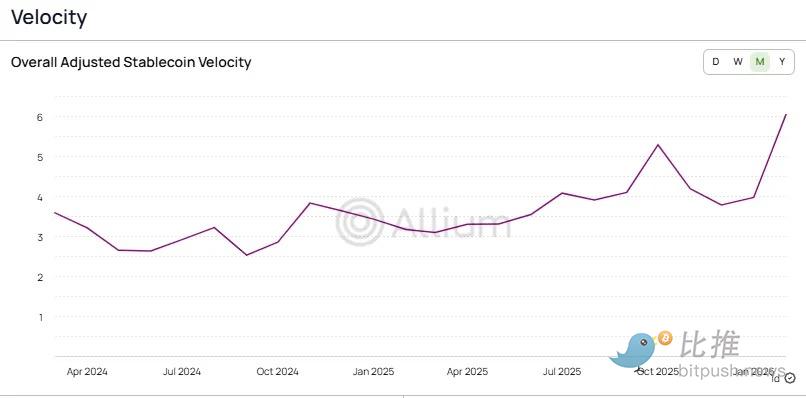
This shift is reflected in the velocity of stablecoins, calculated as adjusted transaction volume divided by circulating supply.
Allium

The velocity of stablecoins has increased from 2.6x to over 6x in the past two years, reflecting that each dollar of stablecoin supply is now turning over 2.3 times more actively than in January. Benchmarking this against traditional payment rails shows how mature stablecoin usage has become.

Another metric that establishes the maturity of stablecoin usage is the number of transactions. It is least affected by large-value noise. Therefore, when the growth in the number of payment transactions outpaces the growth in transaction value, it indicates that the average payment amount is decreasing. This behavior is typical of a payment rail gaining traction, rather than an experimental tool shuttling between exchanges.

This raises the question: who is making these payments, and what are they paying for?

In 2025, the consumer-to-consumer (C2C) category remained the largest channel, ahead of consumer-to-business (C2B), business-to-business (B2B), and business-to-consumer (B2C). But its growth rate was the slowest among the four categories.
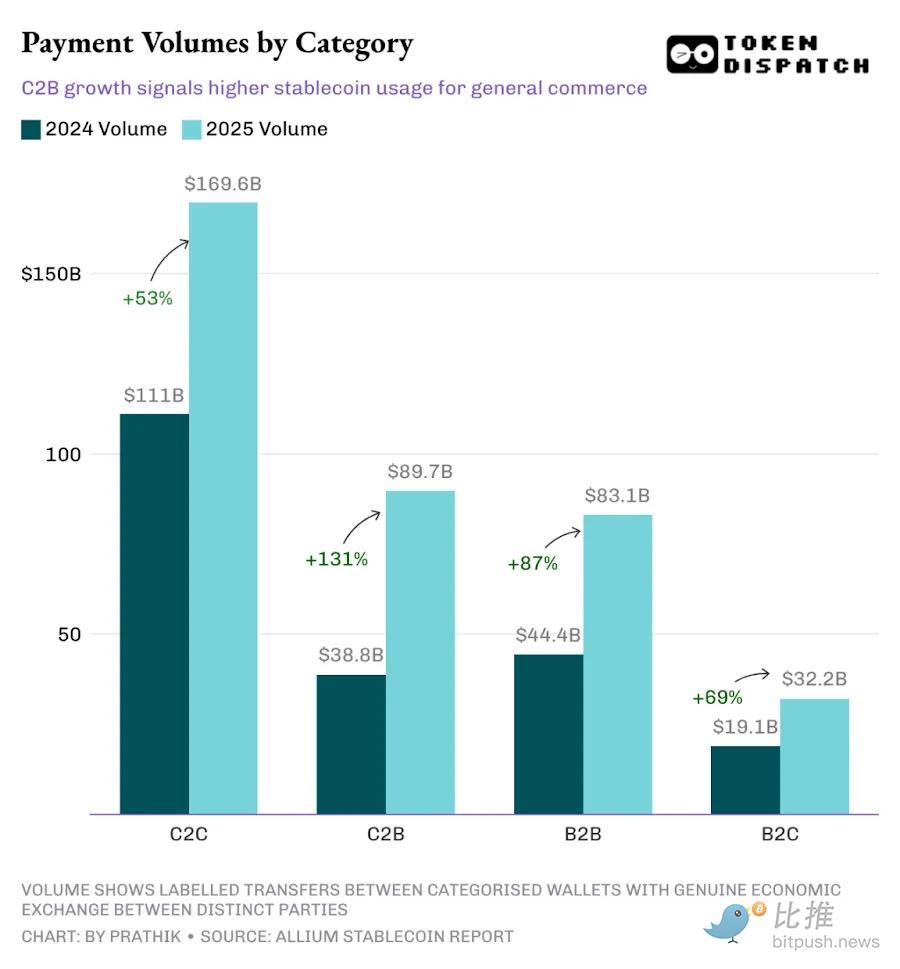
The slowdown in C2C growth further confirms the maturation of stablecoin usage, as person-to-person transfers are the simplest use case. They require no merchant integration, no invoicing tools, no APIs, and have minimal adoption barriers. This is the typical starting point for every new payment technology.

When India launched the Unified Payments Interface (UPI) a decade ago, retail users joined first, driven by cashback and other customer acquisition strategies. I remember using Google Pay (initially launched as Tez in India) to transfer money between my own accounts just because it gave me a one-dollar cashback. Only when commercial tools, reporting, and dedicated payment confirmation audio device systems (speakers) were introduced did stores and institutions join.

As infrastructure matures, commercial use cases begin to absorb market share. And this transformation seems to be happening.

The high growth in C2B indicates that more users are using stablecoins for general commerce, subscriptions, and merchant payments. Meanwhile, the growth in B2B indicates that commercial counterparts are beginning to adopt stablecoins in invoice processing, supply chain payments, and financial operations. Both growth rates (131% for C2B and 87% for B2B) exceed the overall payment growth rate of 76%, indicating that the share of commercial payment volume is expanding.

When you combine the growing C2B transaction volume with the decreasing average transaction value in C2B (from $456 to $256), it suggests a trend of people starting to use stablecoins for recurring purchases.

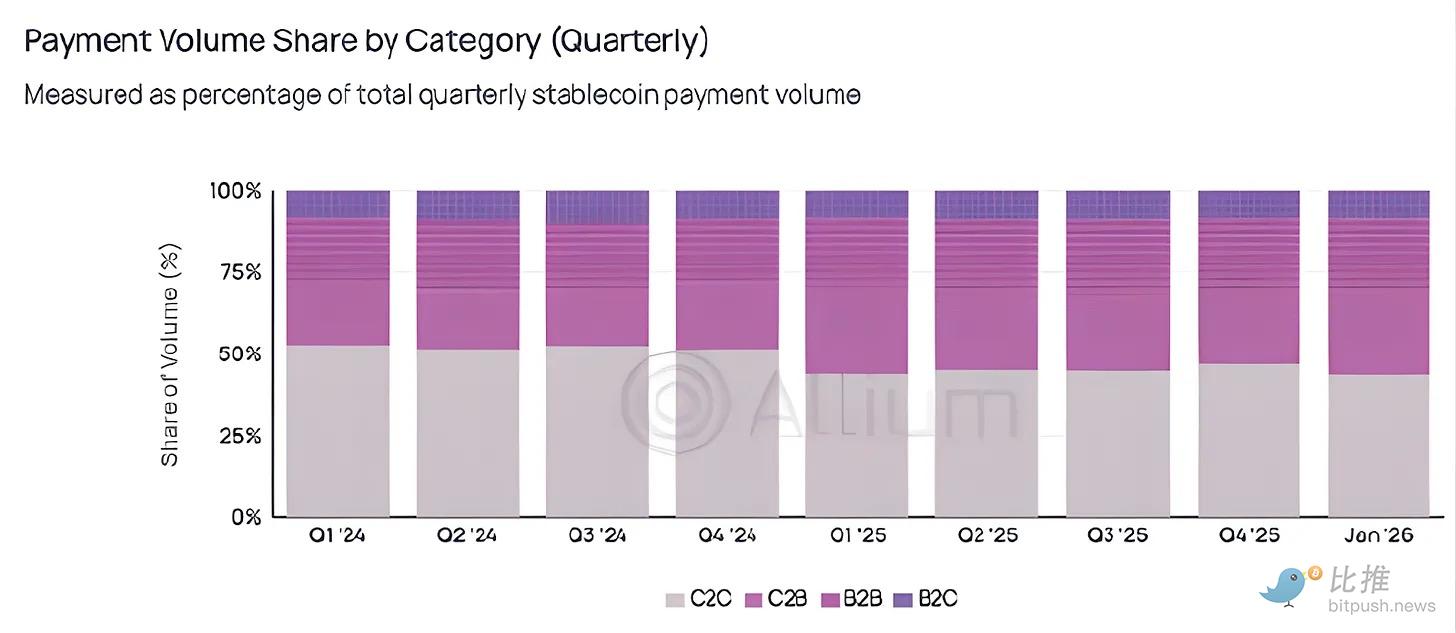
Although peer-to-peer (P2P) categories still dominate in absolute terms, they will soon cede ground. Quarterly share data makes this rotation even more undeniable.
Allium

After falling below the 50% mark in Q1 2025, C2C's share of total payment volume has never exceeded 50% again.

The world seems to be moving beyond the experimental phase of using stablecoins for low-risk, low-frequency peer-to-peer transfers, toward consistently using them for high-frequency payments.

When I first started tracking stablecoin adoption, a mainstream narrative supporting stablecoins was how they could enable cross-border remittances and potentially disrupt Western Union by allowing workers in developed economies to send money home. But the data tells a different story.

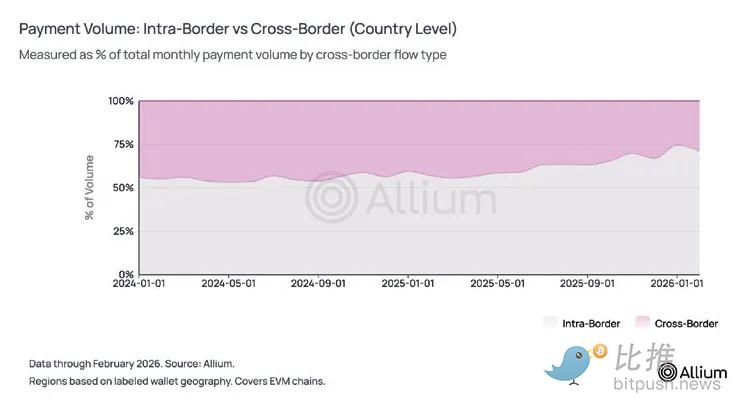
Currently, about three-quarters of stablecoin payments occur domestically. Over the past year, the share of cross-border payments at the country level has decreased from 44% to about 25-29%. At the regional level, 84% of payments remain within the same geographic region.
Allium

Based on all our previous charts, it is clear that stablecoins are not competing with SWIFT in the international settlement space. Instead, B2B metrics—including 74% domestic dominance, declining average transaction size, payroll, and growing invoice use cases—point to stablecoins competing with domestic payment rails like ACH.

For reference, ACH B2B payments grew about 10% in 2025, while stablecoin B2B payments grew 87% during the same period. I realize the absolute scales are not comparable, and we must consider the low base effect of stablecoins. However, this growth cannot be ignored.

Outlook

For a long time, I viewed cross-border remittances and peer-to-peer transfers as the main drivers of stablecoin adoption.

Imagine a son in India receiving dollars from his family in Dubai on a bank holiday without intermediaries taking 7% to 8% in fees—this narrative is indeed appealing. This story still holds today, but perhaps it is no longer the main storyline.

Interestingly, the narrative of domestic consumption scenarios has quietly and rapidly surpassed everything else. C2C's market share hasn't returned to 50% for over a year, a metric that never seemed to trend in crypto discussions. But it is this metric that marks stablecoins' transformation from a 'crypto product' to 'financial infrastructure'—enabling transactions between consumers and businesses, or between businesses themselves.

It's also worth noting that the payment transaction volume labeled by Allium is based on their analysis of wallets they can cover, identify, and tag. Although this data shows that payment transactions account for only 2% to 3% of the total adjusted stablecoin transaction volume, this should be considered a lower bound—as there are undoubtedly many wallets that Allium has not covered.

Moving forward, I will focus on two directions: whether the shares of C2B and B2B continue to rise, and whether the average transaction value can remain low in the coming quarters. If these trends persist even during a crypto market downturn, it will indicate that stablecoin payment infrastructure has truly begun to decouple from the speculative cycles of the crypto market.


Twitter:https://twitter.com/BitpushNewsCN

Bitpush TG Discussion Group:https://t.me/BitPushCommunity

Bitpush TG Subscription: https://t.me/bitpush

Original link:https://www.bitpush.news/articles/7618187

Perguntas relacionadas

QWhat does the data from Allium's report indicate about the primary use case of stablecoins?

AThe data indicates that stablecoins are increasingly being used as a payment rail for general commerce and B2B payments, rather than primarily for cross-border remittances or as savings products.

QHow has the velocity of stablecoins changed over the past two years, and what does this signify?

AThe velocity of stablecoins has increased from 2.6x to over 6x in the past two years, signifying that stablecoins are maturing from a store of value asset into a more active medium of exchange or value transfer tool.

QWhich payment category has the slowest growth rate among C2C, C2B, B2B, and B2C, and what does this suggest?

AThe Consumer-to-Consumer (C2C) category has the slowest growth rate, suggesting that stablecoin usage is maturing beyond simple peer-to-peer transfers, which are the typical starting point for new payment technologies.

QWhat percentage of stablecoin payments are domestic, and how has this changed over the past year?

AApproximately 74% of stablecoin payments are domestic, and the share of cross-border payments at the country level has decreased from 44% to about 25-29% over the past year.

QWhat two trends should be monitored to determine if stablecoin payment infrastructure is decoupling from crypto market speculation cycles?

AThe two trends to monitor are whether the share of C2B and B2B payments continues to rise and whether the average transaction size remains low in the coming quarters, even during crypto market downturns.

Leituras Relacionadas

From South Korea to the United States: Blue-Collar Jobs Are Becoming Increasingly Popular, Thanks to AI

AI is reshaping the labor market's value proposition. The traditional four-year college degree is losing its appeal as a guaranteed career path, while skilled blue-collar trades like electricians, welders, and plumbers are experiencing historic demand and wage premiums. This shift is driven by dual pressures: AI's displacement of certain white-collar roles and a booming need for physical infrastructure and data center construction. Data confirms the trend. In the U.S., vocational school revenue surged, and a significant portion of recent layoffs are AI-related. Surveys show a majority of Gen Z adults plan to pursue blue-collar work, citing better job security against AI automation. Vocational education interest has exploded recently. Experts cite a psychological shift as younger generations seek tangible, AI-resistant careers and avoid high student debt. In many cases, salaries for skilled trades now match or exceed those requiring a bachelor's degree. In South Korea, semiconductor vocational high schools boast near-total employment, with graduates securing high-paying roles at companies like Samsung. The shortage is structural, exacerbated by a retiring baby boomer workforce and massive infrastructure projects. Companies like JPMorgan Chase, Meta, and Lowe's are investing heavily in training programs. However, overcoming historical stigma and a "perception gap" around trade careers remains a key challenge to closing the talent gap.

marsbitHá 5m

From South Korea to the United States: Blue-Collar Jobs Are Becoming Increasingly Popular, Thanks to AI

marsbitHá 5m

Qualcomm: AI Hype Subsides, When Will Smartphones Emerge from the Gloom?

Qualcomm reported its Q3 FY2026 results (ending June 2026), with revenue of $9.95B, down 4% YoY but above expectations. Gross margin declined to 53.1%, pressured by rising costs across manufacturing and memory. Key business segments showed mixed performance: Handset revenue fell 19.6% YoY to $5.09B, dragged by an 11% decline in non-Apple Android shipments and weaker high-end mix. Conversely, Automotive revenue surged 61% to $1.59B, and IoT grew 9% to $1.83B. Core operating profit dropped 41% YoY due to margin compression and higher expenses. Management's Q4 FY2026 guidance projects revenue of $9.7B-$10.5B, in line with consensus, but Non-GAAP EPS guidance of $2.05-$2.25 fell short of expectations. Amidst persistent weakness in its core handset market, Qualcomm is pursuing growth in AI, focusing on Edge AI (smartphones, PCs, automotive) and Data Center AI. Its data center strategy includes four pillars: AI accelerators (e.g., AI200), commercial CPUs (Dragonfly C1000), custom silicon, and connectivity solutions. While these initiatives initially boosted its stock, concerns over AI capital expenditure sustainability have since erased those gains. The company targets $5B in data center revenue for FY2027 and $15B for FY2029. The report concludes that with the traditional handset business still under pressure, the data center opportunity is currently viewed as a longer-term option, and a more conservative valuation based on core operations may be warranted until AI contributions materialize.

marsbitHá 10m

Qualcomm: AI Hype Subsides, When Will Smartphones Emerge from the Gloom?

marsbitHá 10m

From TPU to Self-Evolving Agents: How Jeff Dean Predicts the Next Step in AI

At the 2026 YC Startup School, Jeff Dean outlined his vision for AI's next phase, shifting focus from simply scaling models to building intelligent, autonomous systems. He believes AI's progress is no longer just about creating smarter models, but about integrating them into systems capable of long-term, iterative work, automated experimentation, and continuous learning. This evolution moves the competition from "who has the bigger model" to "who can best organize intelligence." Dean suggests AI capabilities are now comparable to a junior engineer, enabling the automation of complex workflows. However, the true challenge and opportunity lie in managing these AI "workers" at scale. He emphasizes the importance of **context engineering**—structuring tools, memory, and feedback loops—over raw model power. For startups, this means building deep expertise in niche domains where general models currently fail (near 0-1% success rates), leveraging proprietary data, specialized tools, and domain-specific evaluators. A recurring theme is re-examining fundamental constraints. Dean's past work, like moving Google's search index to memory or creating the TPU, stemmed from questioning outdated assumptions about hardware and cost. He sees similar inflection points today, particularly in **specialized inference hardware** to drastically reduce latency and energy consumption for real-time Agent operation. Notably, he points out that in modern AI systems, the dominant cost is often not computation but **data movement**. Reliable, long-running Agents require robust system design, borrowing concepts from distributed computing like checkpointing, state management, and parallel exploration to handle failures and maintain progress over days or weeks. As AI automates execution, the scarcest human skills will shift to **defining clear specifications**, **judging what problems are worth solving** (taste), and designing effective feedback loops. Ultimately, Dean's framework prioritizes understanding the problem deeply, identifying the true bottlenecks, and systematically building closed-loop systems where AI can not only perform tasks but also improve AI itself.

marsbitHá 10m

From TPU to Self-Evolving Agents: How Jeff Dean Predicts the Next Step in AI

marsbitHá 10m

Trading

Spot
活动图片





