The Largest IPO in History Ignites Heated Debate: Is SpaceX Worth $1.77 Trillion?

marsbitPublicado em 2026-06-11Última atualização em 2026-06-11

Resumo

SpaceX's potential IPO is priced at $135 per share, aiming to raise $75 billion and valuing the company at approximately $1.77 trillion, which would make it the largest IPO in history. This valuation has sparked intense debate among investors. Bullish analysts, including major underwriters Goldman Sachs and Morgan Stanley, argue the valuation is justified by SpaceX's long-term potential. They see it not just as a rocket company but as a future leader in space infrastructure, with key growth drivers being Starlink satellite internet, low-cost rocket launches, and future AI-related ventures. They project revenues reaching hundreds of billions to trillions of dollars by 2030-2040. ARK Invest's model suggests a 2030 enterprise value could reach $2.5 trillion. Bearish analysts from independent research firms like Morningstar, PitchBook, and New Constructs contend the IPO price is excessively high, already pricing in unrealistic future growth. Using DCF and sum-of-the-parts models, they estimate fair value between $780 billion and $1.7 trillion, significantly below the IPO target. They highlight risks such as the speculative nature of AI projections, over-dependence on Elon Musk, high growth expectations, and corporate governance concerns. Trefis set a target price of just $79 per share. While both sides acknowledge SpaceX's unique position in commercial space, the core disagreement centers on whether the $135 share price offers a reasonable margin of safety or is overly optimis...

Original Author: Biteye

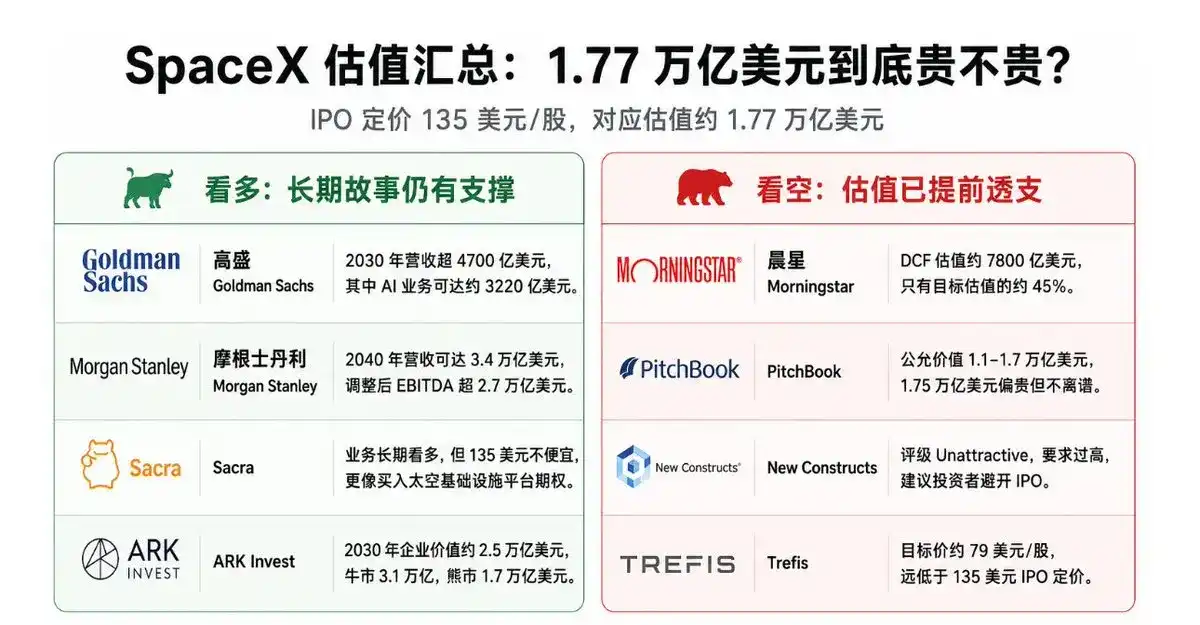
Currently, the SpaceX IPO pricing is preliminarily set at $135 per share, with a planned fundraising scale of approximately $75 billion, corresponding to a fully diluted valuation of about $1.77 trillion. This essentially secures its position as the largest IPO in the history of capital markets.

If this scale is ultimately achieved, Musk's net worth is expected to surge by over $220 billion, challenging for the title of the world's first trillionaire.

However, heavy is the head that wears the crown. The reason the SpaceX IPO attracts such attention is not only its potential to become the largest IPO ever but also because the capital markets are already fiercely debating its valuation.

Is SpaceX really worth $1.77 trillion? With an extra $220 billion in his wallet, will Musk be able to sleep soundly?

🌟 The Bull Case: Underwriters Weave a Long-Term Story with Starlink + Rocket Launches + AI

Bulls believe investing in SpaceX is not merely about backing a rocket company but rather about getting an early stake in the future gateway to space infrastructure.

The $1.77 trillion valuation seems high, but if Starlink, low-cost launches, and AI businesses continue to deliver, $135 has a long-term story to support it.

Goldman Sachs @GoldmanSachs

X Followers: 1.132M | XHunt Rank: 12015 | Global top-tier investment bank, one of the core underwriters for the SpaceX IPO.

Core View: SpaceX's valuation should not be understood solely as a traditional aerospace company; Starlink and future AI business must be incorporated into the long-term growth model.

Goldman Sachs expects SpaceX's revenue in 2028 to be around $160 billion, exceeding $470 billion by 2030.

The AI division is considered the most aggressive part. Goldman Sachs projects SpaceX's AI-related revenue could reach approximately $322 billion by 2030.

Morgan Stanley @MorganStanley

X Followers: 742K | XHunt Rank: 32049 | Global top-tier investment bank, one of the core underwriters for the SpaceX IPO.

Core View: SpaceX's long-term value stems from the compound growth of "Space + AI," with a future revenue ceiling far higher than traditional aerospace companies.

Morgan Stanley similarly expects SpaceX's 2028 revenue to be around $160 billion.

More aggressive is the long-term forecast: by 2040, Morgan Stanley projects SpaceX's revenue could reach $3.4 trillion, with adjusted EBITDA exceeding $2.7 trillion.

If you're buying the gateway to space infrastructure for the next decade+, $135 is undervalued, but it will take a long time to realize.

Sacra

An independent research firm focused on private tech companies, specializing in deep-dive company analysis and valuation breakdowns.

Core View: Bullish on the business long-term, but $135 is not a low valuation; it's more like paying upfront for an option on SpaceX transforming from an aerospace company into a space infrastructure platform.

Sacra estimates SpaceX's 2025 revenue at approximately $18.7 billion, with Starlink contributing $11.4 billion, already becoming the company's most important profit center.

It believes SpaceX's core advantage lies in vertical integration: building its own rockets, launching them, deploying its own satellites, and controlling terminals and ground networks, creating a cost advantage difficult for competitors to replicate.

If only considering the current Starlink and rocket launch businesses, $135 is not cheap. If one believes SpaceX can further expand from an aerospace company into a comprehensive platform covering satellite internet, low-cost launches, and more space infrastructure, this price becomes easier to accept.

ARK Invest @ARKInvest

X Followers: 816K | XHunt Rank: 1637 | Innovation-focused investment firm led by Cathie Wood, long-term tracker of disruptive technology assets.

Core View: While SpaceX's $1.77 trillion valuation is high, it's not entirely without support when considering the long-term opportunity through 2030.

ARK Invest's open-source valuation model for SpaceX shows an expected enterprise value of approximately $2.5 trillion by 2030. According to its model, the bull case scenario is around $3.1 trillion, and the bear case scenario is around $1.7 trillion.

ARK's core logic is that SpaceX's value comes not just from rocket launches but from Starlink's global satellite internet network, low-cost launch capability, and future space infrastructure businesses.

Based on ARK's projections, the IPO subscription price of $135 still has some upside potential.

🌟 The Bear Case: Independent Firms Believe IPO Valuation is Already Severely Overextended

The bear camp does not deny that SpaceX is one of the world's most unique commercial aerospace assets, nor do they deny Starlink's long-term value.

However, they believe the $1.77 trillion IPO valuation has already priced in too much future growth, especially given the significant uncertainty surrounding the AI business.

Morningstar @MorningstarInc

X Followers: 238K | XHunt Rank: 98209 | Globally renowned independent investment research firm, commonly using fundamental analysis and DCF models to assess company value.

Core View: SpaceX is a good company, but the IPO valuation is clearly on the high side.

Using a DCF model, Morningstar gives SpaceX a fair value estimate of approximately $780 billion, only about 45% of the IPO target valuation of $1.77 trillion.

In Morningstar's breakdown, the valuation for SpaceX's core launch business + Starlink is approximately $611 billion, with the xAI / AI-related business valued at around $170 billion on a probability-weighted basis.

Morningstar also highlights two risks: Musk is a key figure at SpaceX, and the company's valuation carries a significant "Musk premium." After the IPO, selling pressure may arise as lock-up periods expire for early shareholders and employees.

Morningstar believes the $135 price is clearly expensive and not suitable for rushing into the IPO; there may be better buying opportunities post-IPO.

PitchBook @PitchBook

X Followers: 48K | XHunt Rank: 49174 | Global platform for private equity, venture capital, and private company data, covering valuations and financing information for numerous private companies.

Core View: Around $1.5 trillion is acceptable, $1.75 trillion is expensive, but not entirely irrational.

PitchBook uses a Sum-of-the-Parts model to estimate SpaceX's fair value range between $1.1 trillion and $1.7 trillion, primarily focusing on the launch business and Starlink, not entirely reliant on the xAI narrative.

The $135 price is already near or slightly above the upper end of PitchBook's valuation range – not cheap, but not completely outrageous if one takes a long-term view on Starship and Starlink execution.

New Constructs @NewConstructs

X Followers: 5675 | XHunt Rank: - | Independent equity research firm focusing on financial quality, valuation risks, and reverse DCF analysis.

Core View: SpaceX is not worth participating in at a $1.75 trillion valuation; it advises investors to avoid the IPO.

New Constructs rates SpaceX as Unattractive. They argue that the $1.75 trillion valuation implies excessively high future growth and profit requirements. SpaceX would need to simultaneously become one of the highest revenue and profit-generating companies in the U.S. stock market to justify this price.

Risks cited include: inadequate internal accounting controls at SpaceX, public investors having almost no voting rights, a large portion of IPO proceeds potentially used to repay debt, potentially misleading non-GAAP metrics, and related-party transaction risks.

To justify a $1.75 trillion valuation, SpaceX's revenue may need to reach $1.1 trillion by 2035, implying an average annual growth rate of about 50% over the next decade. New Constructs believes such growth rates have almost no historical precedent.

New Constructs' judgment is the most direct: the risk-reward at this price is unfavorable, and they recommend not participating in the IPO.

Trefis @Trefis

X Followers: 2661 | XHunt Rank: - | Independent U.S. stock valuation platform that derives target prices by breaking down business models.

Core View: SpaceX is an exceptionally unique company, but the $135 offering price is clearly overvalued.

Trefis acknowledges SpaceX's long-term advantages in commercial aerospace, Starlink satellite internet, and low-cost launches but argues these advantages do not mean investors should ignore price.

Trefis gives SpaceX a target price of approximately $79 per share, far below the $135 IPO price.

🌟 Final Thoughts

Whether from the bull or bear side, most essentially acknowledge that SpaceX is one of the world's most unique commercial aerospace companies.

The real point of contention is whether the $135 price offers any margin of safety.

📈 Bulls believe buying SpaceX is about the long-term story of Starlink, low-cost launches, AI, and future space infrastructure.

📉 Bears argue that $135 has already priced in expectations to the fullest.

Currently, the $SPCX IPO subscription is already oversubscribed by 4 times, indicating that despite the valuation debate, capital enthusiasm for SpaceX remains high.

🙋 So the question is: Will you participate in the $SPCX IPO? Do you think Musk's $220 billion gain is well-deserved, or will it keep him up at night?
Perguntas relacionadas

QWhat is SpaceX's proposed IPO share price and what would the corresponding fully diluted valuation be?

ASpaceX's proposed IPO price is $135 per share, which would result in a fully diluted valuation of approximately $1.77 trillion.

QAccording to Goldman Sachs and Morgan Stanley, what is the core narrative supporting the bullish case for SpaceX's high valuation?

AThe bullish case, as presented by Goldman Sachs and Morgan Stanley, revolves around SpaceX being a long-term investment in future space infrastructure, combining growth from Starlink, low-cost launch services, and future AI-related business segments.

QWhat is Morningstar's fair value estimate for SpaceX and how does it compare to the proposed IPO valuation?

AMorningstar's fair value estimate for SpaceX is approximately $780 billion, which is only about 45% of the proposed $1.77 trillion IPO valuation.

QWhat are some of the key risks associated with SpaceX's IPO as highlighted by New Constructs?

ANew Constructs highlighted several key risks: the valuation implies extremely high future growth requirements, insufficient internal accounting controls, minimal voting rights for public investors, the possibility of IPO proceeds being used to repay debt, potentially misleading non-GAAP metrics, and risks related to related-party transactions.

QWhat is the main point of contention between the bullish and bearish perspectives on SpaceX's IPO according to the article's conclusion?

AThe main point of contention is whether the IPO price of $135 per share provides a reasonable margin of safety. Bulls see it as justified by long-term growth in space infrastructure, while bears believe it already fully prices in optimistic future expectations.

Leituras Relacionadas

7 Months After the Collapse of Huiwang, Southeast Asia's Escrow Platforms Undergo a Major Reshuffle

Following the collapse of Huione Pay—dubbed the "Alipay of Southeast Asia"—seven months ago, the region's underground financial guarantee platform sector is undergoing a significant reshuffle. This power vacuum has been swiftly filled by emerging platforms such as XinBi, Tiger/Navigator, JinBei (renamed JinBo), Dali/Tiancheng, and FullyLight. These platforms, operating largely via Telegram and offering services like escrow for illicit transactions, have absorbed the vast user base and markets left behind by Huione. While positioning themselves as "trust intermediaries," their primary clientele consists of networks involved in online scams, money laundering, illegal gambling, and even human trafficking. For instance, the Tiger/Navigator platform explicitly provides "escrow" services for kidnapping-for-ransom operations ("强押车交易"). Data underscores the immense scale: Huione alone processed over $103 billion in cryptocurrency payments and facilitated over $31 billion through its escrow market before its downfall, linking it to Cambodia's notorious Prince Group. Since its collapse, competitors have seen explosive growth. For example, the XinBi platform has accumulated over $1.6 billion in total USDT revenue, while platforms like NewPay, OkPay (under Dali), and FullyLight Wallet collectively processed over $4.8 billion in USDT in a single year. This ecosystem thrives in regions like Cambodia and Myanmar, where regulatory gaps allow these platforms to act as critical financial infrastructure for sprawling cybercrime industries, from scam compounds to online casinos. The article concludes that the moniker "Southeast Asian Alipay" is a misnomer, obscuring the platforms' fundamental role in enabling serious criminal enterprises rather than representing legitimate financial innovation.

Odaily星球日报Há 17m

7 Months After the Collapse of Huiwang, Southeast Asia's Escrow Platforms Undergo a Major Reshuffle

Odaily星球日报Há 17m

The Changing Landscape: What Are Crypto VCs Experiencing?

Title: The Shifting Landscape of Crypto Venture Capital The era of dedicated crypto venture capital funds is undergoing a significant transformation. Once essential for navigating the sector's complexity and high risk, these specialized funds are now facing an identity crisis as the market matures. This shift mirrors historical patterns in other specialized investment classes like cleantech and SPACs, where initial information advantages dissipate as technologies become mainstream and integrated into existing industry frameworks. The article argues that crypto is reaching a critical inflection point, transitioning from a "building phase" to an "integration phase." Major players like Stripe, BlackRock, and Visa now engage with crypto not for its novel mechanics but as a foundational financial infrastructure. Their needs—regulatory compliance, banking partnerships, distribution channels—align with traditional fintech, a domain easily understood by large, generalist funds like Sequoia and Founders Fund. This evolution creates a "barbell effect" within the VC landscape. On one end are massive, diversified platforms that can incorporate crypto as one vertical among many. On the other are small, nimble funds focused on niche, experimental projects. The middle ground—medium-sized dedicated crypto funds—is being squeezed out. Their typical fund size makes it impossible to generate sufficient returns solely from early-stage crypto bets, yet they cannot compete with giants for later-stage deals. Consequently, leading crypto-native firms like Paradigm and Framework Ventures are expanding into AI, robotics, and other sectors, driven partly by LP pressure for better returns amid a broader VC DPI crisis. Others, like Dragonfly and a16z, have narrowed their crypto focus predominantly to financial infrastructure like stablecoins, reframing the sector's core narrative. For crypto entrepreneurs, this consolidation presents challenges. While generalist funds offer larger checks and broader resources, crypto projects now compete fiercely with AI for attention and capital within these firms. Furthermore, the long-term, non-commercial foundational work that built the ecosystem—funded by dedicated crypto VCs—is less likely to attract generalist capital focused on direct returns. The conclusion is that "crypto investor" as a standalone category is becoming obsolete, akin to "internet investor." Crypto is becoming a baseline infrastructure layer. The future will see a barbell structure: large-scale growth financing handled by generalist funds, while pioneering, speculative projects are funded by small, specialized vehicles. The dedicated crypto funds of the 2017-2021 boom, which incubated core infrastructure, are giving way to this new, bifurcated reality.

Foresight NewsHá 35m

The Changing Landscape: What Are Crypto VCs Experiencing?

Foresight NewsHá 35m

As Consensus Accelerates, What Are Young Investors Betting On?

Title: As Consensus Forms Faster, What Are Young Investors Betting On? In the rapid evolution of tech investment, a new generation of young investors is navigating a landscape where AI, robotics, commercial aerospace, and quantum computing are advancing simultaneously. Traditional investment logic based on financial models is giving way to a need for deep technical understanding and the ability to act before industry consensus forms. An analysis of trends from the "WAIC FUTURE TECH" list of young investment leaders reveals key shifts in focus. The first major trend is the movement of AI from the digital screen into the physical world. Investment is shifting from large language models and chatbots towards embodied AI, robotics, AI hardware, and edge computing. While demonstrations generate excitement, the real challenge lies in achieving scalable, reliable, and cost-effective delivery in complex real-world environments like factories and logistics. Success depends not just on algorithms but on the integration of sensors, actuators, and control systems. Second, the competitive focus for large models is moving beyond raw capability toward building an "intelligence flywheel." The goal is to create self-reinforcing systems where user interaction generates data, improving the model, which in turn enhances the user experience and attracts more engagement. Companies that successfully embed AI into workflows to create these closed-loop systems can build lasting value that isn't easily erased by the next model upgrade. Third, facing a potential bottleneck in high-quality human-generated data, investors are looking at new underlying technologies. Reinforcement learning and self-play, as demonstrated by AlphaGo Zero, offer paths for AI to generate its own experience. Scientific foundation models, which aim to build general AI capabilities for fields like life sciences and materials discovery, represent a non-consensus direction that could unlock new frontiers of knowledge and data. Finally, in deep-tech areas like quantum computing, commercial aerospace, and space-based infrastructure, patient capital is essential. These fields have long, uncertain development and validation cycles involving complex engineering, supply chains, and regulations. Investment here requires a long-term view, focusing on foundational team capabilities and the eventual emergence of market demand, even if commercial returns are distant. Collectively, these trends illustrate how young investors are adapting to a new era. They are learning to make earlier, technically-informed judgments, balance hype with real-world viability, and provide the patient capital needed to build the deep-tech foundations of the future.

marsbitHá 1h

As Consensus Accelerates, What Are Young Investors Betting On?

marsbitHá 1h

Trading

Spot
活动图片





