The Hidden Market Makers Behind the Gold Surge: This Crypto Firm Earning Billions Annually Has Amassed 140 Tons of Gold

marsbitPublicado em 2026-01-28Última atualização em 2026-01-28

Resumo

The article reveals that Tether, the issuer of the USDT stablecoin, has accumulated approximately 140 tons of physical gold, valued at around $23 billion, making it one of the largest private holders of gold globally—surpassing many national reserves. Tether’s CEO, Paolo Ardoino, announced ambitions to become one of the world’s top “gold central banks.” The company has been aggressively purchasing gold since 2025, acquiring over 70 tons last year alone, significantly influencing gold's price surge. Tether’s gold is stored in a secure Swiss vault, and the firm is expanding its influence by hiring seasoned metal market executives, investing in gold mining royalties, and launching a gold-backed stablecoin, XAU₮, which dominates the tokenized gold market. The company’s aggressive accumulation is backed by substantial profits—$15 billion in net income in 2025—driven primarily by interest from its vast holdings of U.S. Treasuries and strategic Bitcoin investments. Tether is expanding its reach with a new federally regulated stablecoin, USAT, targeting the U.S. market. Its growing influence in both traditional finance and crypto has positioned it as a major, albeit controversial, force in global markets.

Author: Nancy, PANews

Gold is going crazy. In less than a month since the start of the year, various funds have been frantically buying, pushing gold prices to repeatedly hit new historical highs.

Amid this precious metal狂欢盛宴, an "invisible big player" has unexpectedly come into view: stablecoin giant Tether has quietly accumulated 140 tons of gold reserves.

Holding 140 Tons of Gold, Aiming to Become the World's Largest Gold Central Bank

Tether, which 'has mines at home,' is becoming a major player in the gold market.

"We will soon become one of the world's largest 'gold central banks,' so to speak." Tether CEO Paolo Ardoino recently stated unabashedly in an interview with Bloomberg.

This is not just talk. To date, Tether has accumulated approximately 140 tons of physical gold, worth about $23 billion at current prices. Typically, Tether purchases directly from Swiss refineries and top global financial institutions, with large metal orders often taking months to deliver. Upon arrival, the gold is stored in a nuclear bunker built during the Cold War in Switzerland, protected by multiple layers of heavy steel doors, and Switzerland boasts one of the world's top confidentiality systems.

In terms of scale, Tether has become the largest known holder of physical gold outside the banking systems and nations, ranking among the top 30 global gold holders, with holdings exceeding those of countries like Greece, Qatar, and Australia.

Although Tether began布局 gold assets many years ago, its large-scale entry真正 occurred in 2025. Last year alone, Tether purchased over 70 tons of gold, becoming one of the top three buyers of gold globally this year. Its procurement scale not only surpassed that of almost all single central banks except the Polish central bank but also exceeded that of many large gold ETFs.

It can be said that Tether is also a significant driver behind this year's rise in gold prices.
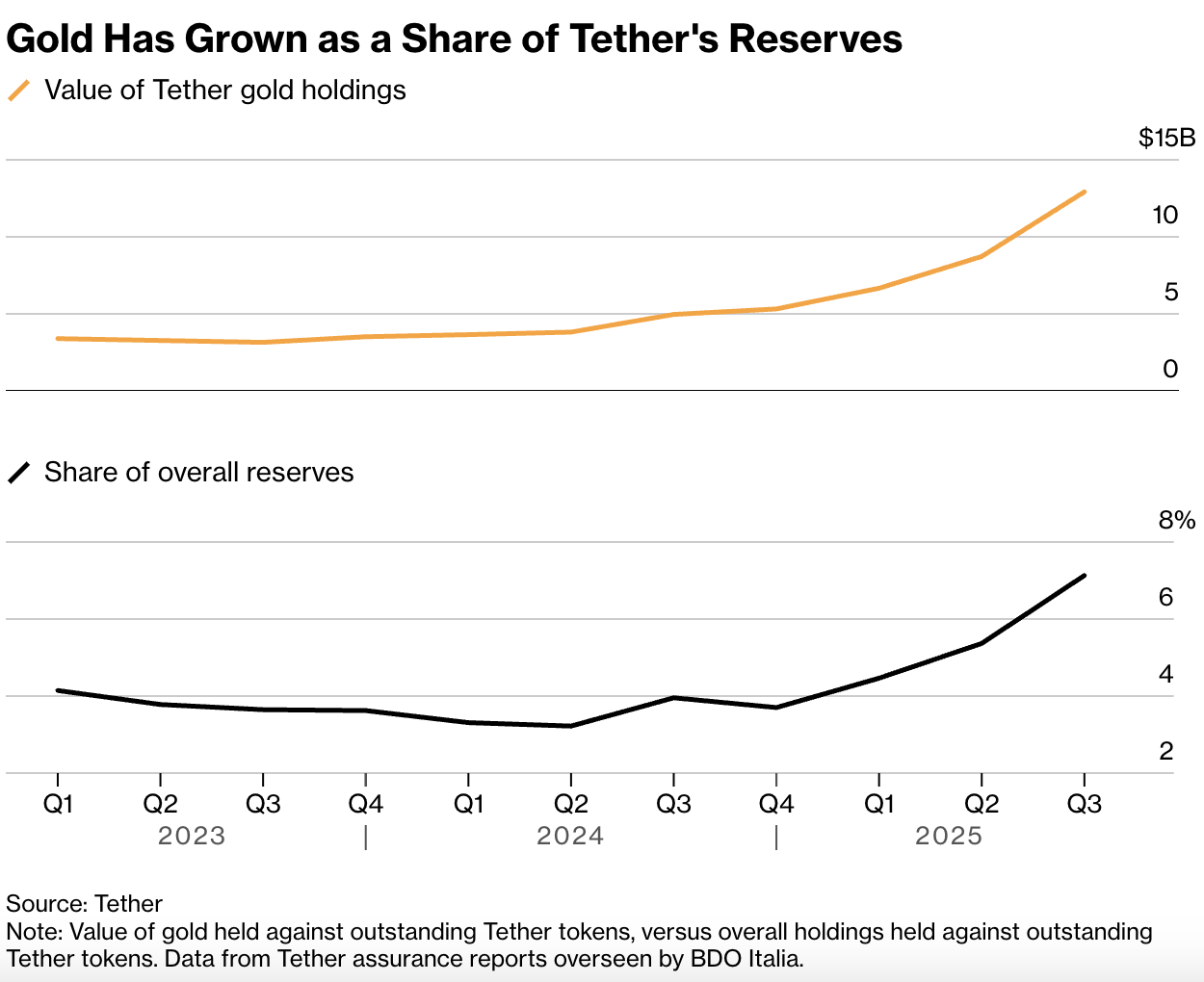
According to Ardoino, Tether's current gold procurement rate is about 1 to 2 tons per week, and it plans to maintain this pace in the coming months, "maybe slowing down, but we will assess gold demand quarterly."

But Tether's ambitions go beyond just hoarding gold. In the Bloomberg interview, Ardoino stated that Tether is evaluating the market and potential trading strategies, planning to actively trade its gold reserves to capture arbitrage opportunities. Simultaneously, the company is working on building "the world's best gold trading floor," aiming to establish stable, long-term channels for gold acquisition and compete with large banks like JPMorgan Chase and HSBC that dominate the global precious metals market.

To this end, Tether last year prominently brought on two heavyweight trading veterans: former HSBC global head of metals trading Vincent Domien, and former head of precious metals procurement for Europe, the Middle East, and Africa, Mathew O’Neill, specifically负责 expanding its gold business landscape. (Related reading: Tether's Gold Empire: The Ambition and Cracks of a 'Borderless Central Bank')

Upstream in the industry chain, Tether has also begun using its financial muscle to secure positions. Tether has successively invested in several Canadian mid-tier gold mining royalty companies, including Elemental Royalty, Metalla Royalty & Streaming, Versamet Royalties, and Gold Royalty, locking in future production capacity and revenue sharing through equity investments.

At the financial product level, Tether launched the gold-pegged stablecoin Tether Gold (XAU₮) as early as 2020. As of the end of last year, this token was backed by 16.2 tons of physical gold. Not long ago, Tether also introduced a new unit of account for XAU₮ called Scudo, where 1 Scudo represents one-thousandth of a troy ounce of gold, aiming to make gold a more usable form of payment.

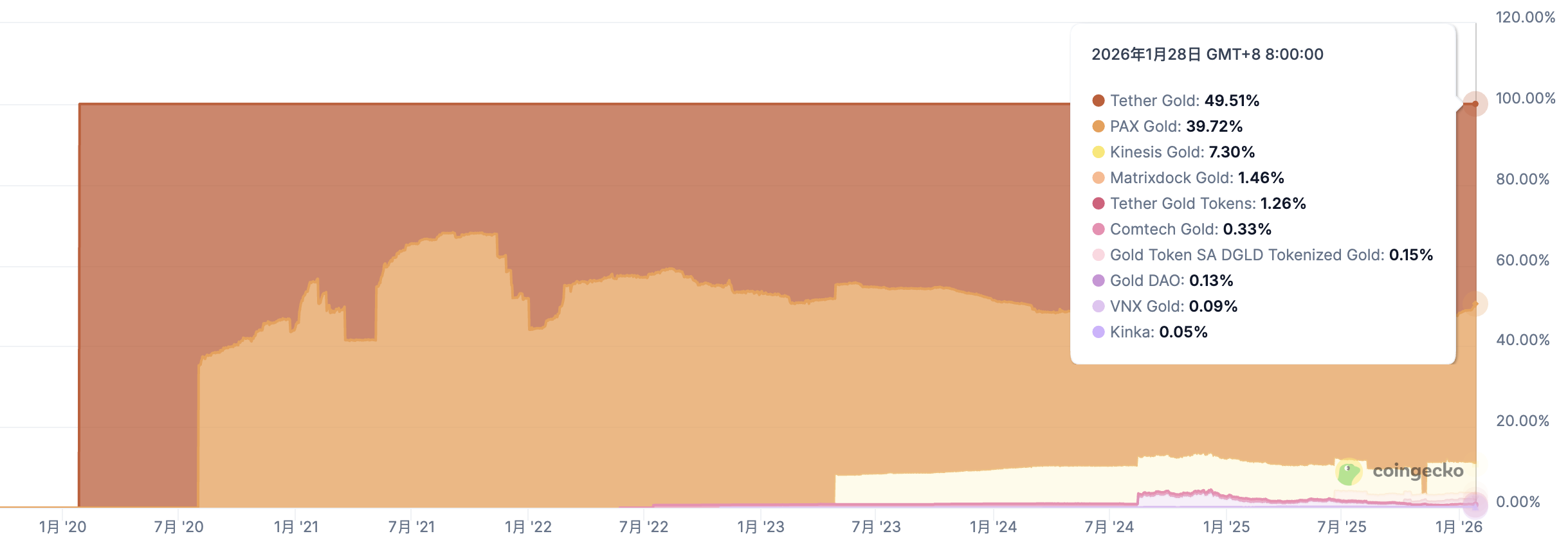
CoinGecko data shows that as of January 28, the circulating market value of XAU₮ had reached $2.7 billion, growing about 91.3% over the past year, capturing 49.5% of the tokenized gold track market share, firmly holding the top position.
From physical gold hoarding to industry chain布局, to financial product innovation, the large-scale investments by this gold enthusiast have even left traditional commodity圈 insiders baffled, with some形容 Tether as "the strangest company they have ever encountered."

But now, as gold prices continue to刷新历史 highs, Tether's bet is yielding惊人的 returns.

Earning $15 Billion Annually, Building a Capital Arsenal

The confidence behind Tether's疯狂囤积 gold comes from a high-speed运转的 "money printing machine."

According to a Fortune report, Tether generated approximately $15 billion in net profit in 2025, a significant increase from the previous year's $13 billion. This百亿 profit is supported by a global workforce of only about 200 people. Roughly calculated, the per capita profit is as high as $75 million, an efficiency level that leaves traditional financial giants in the dust.

The core of this profitability comes from the capital pool沉淀 by its stablecoin business.

Today, the US dollar stablecoin USDT issued by Tether is the most widely used stablecoin globally, with over 500 million users. CoinGecko data shows that as of January 28, 2026, the circulation of USDT issued by Tether was接近 $1870 billion, firmly holding the top spot in the stablecoin赛道. Trading activity is同样领先; Artemis Analytics data shows that in 2025, total stablecoin transaction volume grew 72% to $33 trillion, with USDT contributing $13.3 trillion, accounting for over 33%.

Building on this, Tether is further expanding the scale of its capital沉淀 through合规化.

On January 27, Tether officially launched USAT, a stablecoin regulated by the U.S. federal government. It is issued by Anchorage Digital Bank, the first federally regulated stablecoin issuer in the U.S., with Cantor Fitzgerald serving as the designated reserve custodian and preferred primary dealer, and former White House advisor Bo Hines appointed as CEO. This is seen as a key step for Tether's full-scale entry into the U.S. domestic market.

Simultaneously, leveraging its investments in content platforms like Rumble, Tether is attempting to integrate USAT business into the traffic ecosystem, thereby quickly reaching 100 million U.S. users, with a target of a $1 trillion market cap within five years. If progress is smooth, USAT could become the first真正意义上的 competitor to USDC in the U.S. market.

After obtaining an almost zero-cost liability side, Tether easily套取 interest rate differentials by allocating high-liquidity, low-risk assets.

Among these, U.S. Treasury interest is the core source of Tether's收益. In a high-interest rate cycle, U.S. Treasury interest directly amplifies Tether's profitability. Currently, Tether holds approximately $1350 billion in U.S. Treasury bonds, exceeding the holdings of sovereign nations like South Korea and making it the 17th largest holder of U.S. Treasury bonds globally.

Additionally, Tether is also a super player in Bitcoin. Since 2023, Tether has allocated up to 15% of its monthly net profit to定期 Bitcoin. Its current holdings exceed 96,000 BTC, making it one of the largest institutional holders of Bitcoin globally, with an average cost of about $51,000, far below the current market price.围绕 the Bitcoin ecosystem, Tether has also built its own mining farms, invested in mining companies, and布局 DAT (Crypto Treasury), continuously expanding its industry influence, and has一度 been the subject of overseas conspiracy theories about being a "BTC隐形操盘手." (Related reading: Caught in BTC隐形操盘手 Conspiracy Theories? Unveiling the Full Picture of Tether's Bitcoin Strategy)

Furthermore, to leverage more potential收益, Tether has开启了大撒币 mode over the past few years, extending its investment触角 to areas such as satellite communications, AI data centers, agriculture, telecommunications, and media.

Thus, an arbitrage machine spanning traditional finance and the crypto world has gradually taken shape, continuously supplying Tether with capital ammunition, becoming the chips for its large-scale bets.


Perguntas relacionadas

QHow much gold has Tether accumulated and what is its current value?

ATether has accumulated approximately 140 tons of physical gold, with a current value of about $23 billion.

QWhat is Tether's goal regarding its gold reserves, as stated by its CEO?

ATether's CEO, Paolo Ardoino, stated that the company aims to become one of the world's largest 'gold central banks'.

QWhat was Tether's net profit in 2025 and what is the primary source of this profitability?

ATether's net profit in 2025 was approximately $15 billion, primarily sourced from the interest on U.S. Treasury bonds held from its stablecoin business.

QWhat is the name of the gold-backed stablecoin issued by Tether and what is its market position?

ATether's gold-backed stablecoin is called Tether Gold (XAU₮), and it holds a 49.5% market share in the tokenized gold sector, ranking first.

QHow does Tether store its physical gold reserves and where are they located?

ATether stores its physical gold in a nuclear bunker from the Cold War era in Switzerland, which has multiple layers of heavy steel doors and top-tier confidentiality systems.

Leituras Relacionadas

After Three Consecutive Quarters of Decline, Can the Crypto Market Find a Window for Stabilization in Q3?

The cryptocurrency market has just concluded its worst-performing quarter since 2022, with total capitalization dropping 12.6% to $2.1 trillion. All core metrics indicate capital is leaving the sector, not just rotating within it. Bitcoin fell 14.2% and Ethereum dropped 25.4% in Q2, breaking their previous correlation with US tech stocks. A key driver is the reversal in US spot Bitcoin ETF flows, which saw a net outflow of approximately $4.67 billion in Q2, including a record monthly outflow near $4.5 billion in June. While recent data suggests long-term holders are accumulating again, sustained ETF outflows mean continued selling pressure. Market focus is now singularly on the Federal Reserve. The upcoming July FOMC meeting is seen as the most critical event for Q3. A dovish signal could support Bitcoin reclaiming a $68,000-$84,000 range, while a hawkish stance might establish a new trading band around $50,000-$56,000. Additionally, regulatory uncertainty persists, with the progress of the crucial *CLARITY Act* stalling in the Senate, reducing its perceived 2026 passage probability to 40-45%. Despite the broad downturn, a few sectors showed growth. Prediction markets saw nominal volume surge 48.7% year-over-year to $113.8 billion, and tokenized collectibles transaction volume rose 143% quarterly to $1.4 billion. The Real-World Asset (RWA) tokenization sector also continued steady growth, now representing ~$28.1 billion in on-chain value. The market's foundation for an extreme crash appears limited, with Bitcoin price hovering near its 200-week moving average. However, the trading paradigm has shifted from narrative-driven speculation to decisions based on price action, policy developments, and interest rate expectations, making a broad sentiment-driven rally unlikely in the near term.

marsbitHá 4m

After Three Consecutive Quarters of Decline, Can the Crypto Market Find a Window for Stabilization in Q3?

marsbitHá 4m

BIT Trading Moment: BTC Still Suppressed by Weekly 200 EMA, Rejection May Restart Decline; Storage and Semiconductors that Surged Last Night Begin Falling in Evening Trading

**Crypto & Stock Market Wrap: Bitcoin Tests Resistance, Stocks Retreat After AI Surge** Bitcoin consolidates around $66,000, facing key resistance near $68,000—an area seen as a major psychological and technical hurdle where previous rallies have failed. Analysts note the cryptocurrency is caught between its 200-week moving average (~$63,333) and 200-week EMA (~$68,328). A clear break above $68k is needed to signal a stronger bullish trend, while a rejection could lead to a retest of $63k support. Market sentiment remains cautious, with low futures open interest pointing to a low-liquidity rebound rather than a full bull market. Bitcoin spot ETFs saw another $203 million inflow. US stock futures pointed lower after a strong Tuesday session led by a massive rebound in semiconductors and memory stocks. The rally was fueled by renewed optimism about AI-driven hardware demand, with Micron, SanDisk, and SK Hynix surging. However, those gains reversed in pre-market trading. Super Micro Computer (SMCI) soared over 20% after hours on strong guidance and a record backlog. Other standouts included Rocket Lab and nuclear energy plays Oklo and X-Energy. Rising oil prices (Brent above $91) and climbing Treasury yields (10-year near 4.64%), however, are reigniting inflation concerns and acting as a headwind for equities. In Asia, markets were mixed. South Korea's KOSPI pared early gains to close slightly higher as semiconductor stocks like SK Hynix gave back initial surges. Japan's Nikkei edged lower as the yen hit a fresh 38-year low against the dollar, raising fears of potential market intervention. Key events to watch include the Samsung Galaxy launch, AMD's AI event, and a slew of major tech earnings from Alphabet, Tesla, and IBM after the close on Wednesday, followed by the ECB meeting and Intel's earnings on Thursday.

marsbitHá 12m

BIT Trading Moment: BTC Still Suppressed by Weekly 200 EMA, Rejection May Restart Decline; Storage and Semiconductors that Surged Last Night Begin Falling in Evening Trading

marsbitHá 12m

Former CFTC Chairman, Circle President Tarbert: Preaching Long-Termism While Cashing Out $30 Million Himself

Former CFTC Chairman and Circle President Heath Tarbert has consistently advocated for a long-term vision in public, urging patience from investors as Circle’s stock price has fallen significantly from its peak. However, it has been revealed that since Circle’s IPO, Tarbert has continuously sold his CRCL shares through pre-arranged trading plans, cashing out approximately $30 million, without making any public market purchases. This contrast between his public messaging and personal actions has drawn criticism. Tarbert joined Circle in July 2023 as Chief Legal Officer, leveraging his regulatory experience to help guide the company through its IPO and expansion. Despite promoting stablecoins as long-term infrastructure, he established a 10b5-1 trading plan just before Circle went public, leading to substantial stock sales over the following year. In March 2026, he initiated another plan to sell more shares. His career trajectory highlights a pattern of moving between high-level regulatory roles and influential positions in the financial sector. After resigning as CFTC Chairman in early 2021, he joined Citadel Securities as Chief Legal Officer just 27 days later, during a period of intense regulatory scrutiny for the firm. He later joined Circle, aiding its efforts to navigate regulatory challenges for its public listing. While Tarbert's expertise in policy and compliance is valuable to companies like Circle, his actions—advocating long-term confidence while personally divesting—raise questions about the alignment between his public statements and his private financial decisions, leaving investors who followed his advice to bear the market risks.

marsbitHá 35m

Former CFTC Chairman, Circle President Tarbert: Preaching Long-Termism While Cashing Out $30 Million Himself

marsbitHá 35m

Gate Research Institute: The 'Wall Street-ization' Wave of Crypto Financial Products – Competition or Integration?

The article titled "Gate Research Institute: Are Crypto Financial Products Sparking a 'Wall Street' Wave—Competition or Convergence?" explores the evolving relationship between the crypto ecosystem and traditional finance (TradFi). The piece begins by reflecting on Bitcoin's original 2009 vision of decentralization, disintermediation, and moving away from banks. It then contrasts this with the 2024 landscape, where key crypto assets like Bitcoin are increasingly held through Wall Street products like ETFs issued by giants like BlackRock. The article questions whether this signifies that TradFi is systematically taking over the rights to issue, price, custody, and distribute crypto financial assets. The core argument is that this is not a zero-sum takeover but rather a bidirectional convergence where each side addresses the other's weaknesses. Crypto offers 24/7 global markets, programmable settlement, and open access but lacks compliant channels, institutional-grade custody, deep fiat liquidity, and mainstream distribution. TradFi possesses these but is constrained by legacy systems, limited operating hours, and slow settlement. Two primary convergence paths are highlighted: * **Path A (CEX to TradFi):** Exemplified by Gate, which has progressed from offering tokenized stocks and CFDs to providing direct, real stock trading (US, Hong Kong, South Korea) within its platform, using USDT. * **Path B (TradFi to Crypto):** Exemplified by Robinhood, which has integrated crypto trading, acquired exchanges like Bitstamp, and is moving traditional assets like stocks onto the blockchain via tokenization and its own Layer 2. Both paths are ultimately competing to become the next-generation, unified financial account—a "super account" where users can seamlessly trade cryptocurrencies, stocks, ETFs, RWA (Real World Assets), and tokenized treasury products in one interface. The growth of RWA and tokenized treasuries (e.g., BlackRock's BUIDL) is presented as the asset-layer fusion, providing stable, yield-bearing assets on-chain and acting as a bridge between the two worlds. In conclusion, the "Wall Street-ization" of crypto is framed as a mutual transformation. Decentralized ideals persist in the protocol layer, while at the application layer, a more efficient, global, and accessible unified capital market is emerging from this convergence. The future competition lies not between crypto exchanges and stockbrokers, but between platforms vying to offer the most comprehensive asset coverage, liquidity, and user experience within a single account.

marsbitHá 39m

Gate Research Institute: The 'Wall Street-ization' Wave of Crypto Financial Products – Competition or Integration?

marsbitHá 39m

Trading

Spot
活动图片




