The Hidden Costs and Structural Dilemmas of Tokenized Assets

marsbitPublicado em 2026-01-16Última atualização em 2026-01-16

Resumo

Tokenized assets face a critical structural challenge: a severe lack of deep, reliable on-chain liquidity. While tokenization promises to unlock trillions in traditional assets for DeFi, the reality is that markets for tokens like gold (PAXG, XAUT) and stocks (e.g., TSLAx, NVDAx) are extremely shallow compared to their traditional counterparts (e.g., CME). This results in exponentially higher slippage—often exceeding 100 basis points for trades over $4M—and makes large transactions costly or impossible. Fragile liquidity also leads to market instability, such as flash crashes on exchanges that trigger cascading liquidations across connected DeFi protocols. The root cause is a misalignment with market makers' incentives: high minting/redemption fees, slow settlement times, and capital lock-ups make providing liquidity for tokenized assets inefficient and risky. Without a new market structure that bridges on-chain access with off-chain liquidity depth, tokenization will remain stuck in a low-liquidity equilibrium, limiting its scalability and utility in DeFi.

Author:Yuki is short, so is life

Compiled by: Jiahuan, ChainCatcher

Liquidity is the source of confidence in assets. Only with sufficient depth can the market accommodate large transactions, whales can freely build positions, and assets can function as collateral, as lenders need to ensure they can be liquidated smoothly when necessary. Tokenized assets with insufficient depth struggle to attract users, which not only suppresses market participation but also creates a vicious cycle of liquidity drying up.

The original intention of tokenization was to maximize capital liquidity, unlock the utility of DeFi, and open up access to off-chain assets. Its promise is highly attractive: bringing trillions of dollars from traditional financial markets on-chain, allowing anyone to access, lend, and combine them in ways never permitted by traditional finance.

But beneath the surface, most tokenized assets trade in markets that are illiquid and fragile, unable to support sufficient transaction规模. As a prerequisite for composability and financial utility, true liquidity has not yet materialized. The resulting costs and risks may be imperceptible in small transactions, but once large funds attempt to enter or exit, these hidden dangers quickly become apparent.

The Current Liquidity Landscape

The first hidden cost of tokenized assets is reflected in slippage.

Taking tokenized gold as an example, the chart below compares the expected slippage for different transaction sizes between major centralized exchanges and the traditional gold market. The difference is staggering.
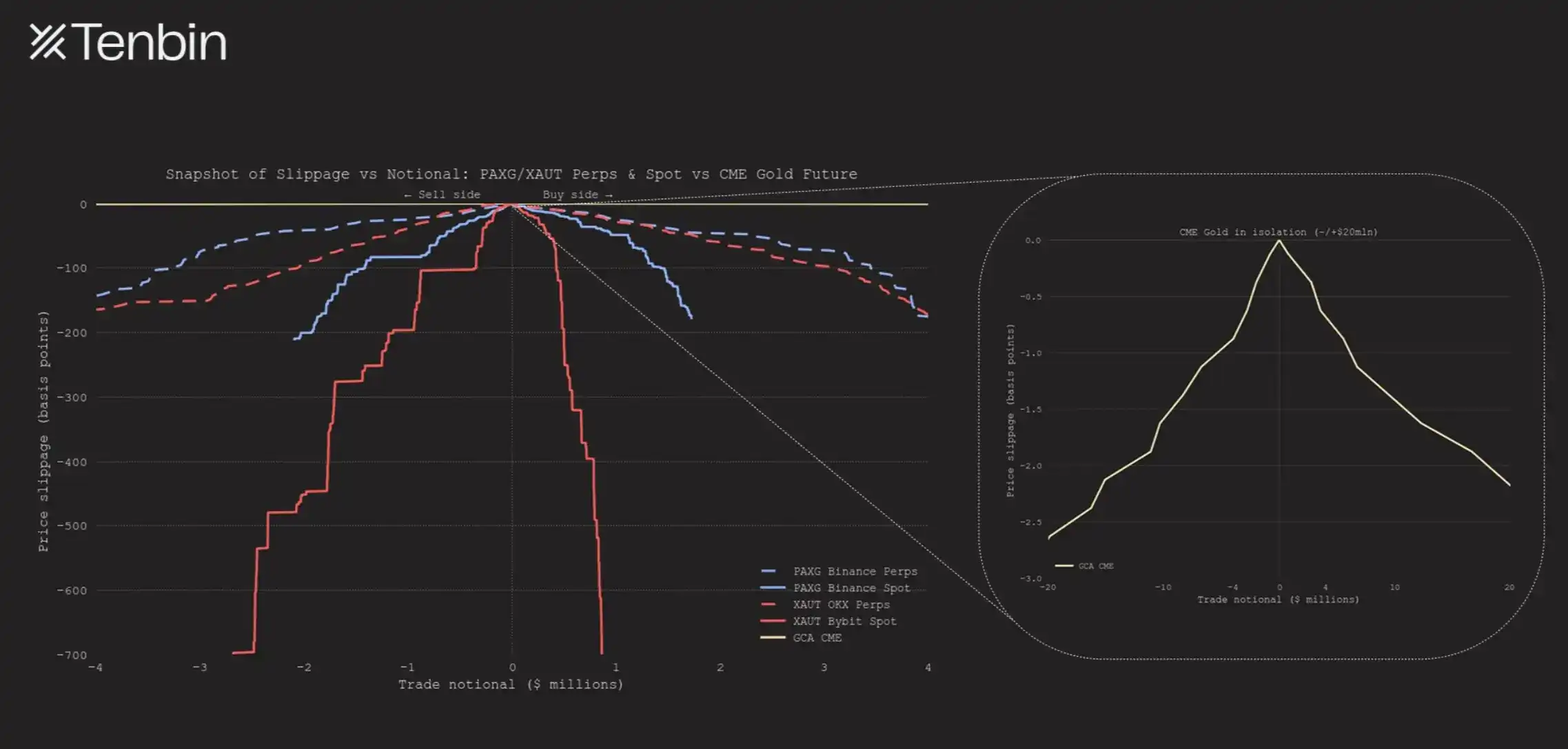
(Chart description: Slippage vs. trade size comparison for PAXG/XAUT perps & spot vs. CME Gold Futures (physical delivery contracts))

As trade size increases, the slippage for PAXG and XAUT perpetual contracts grows exponentially, reaching about 150 basis points (bps) at a notional value of approximately $4 million. In contrast, the slippage curve for the CME (Chicago Mercantile Exchange) is almost flat against the zero axis, barely distinguishable from the X-axis.

The spot markets for PAXG and XAUT are even more constrained. Although the chart shows the most liquid spot markets for each token, the depth on either side of the order book does not exceed $3 million. This limitation is evident from the early truncation of their curves.

Another chart on the right shows the CME curve separately, highlighting its near-flat liquidity profile. Even at notional values far exceeding $4 million, its slippage remains extremely stable. A $20 million gold futures trade would incur a price impact of less than 3 basis points. CME's liquidity is several orders of magnitude deeper than any cryptocurrency trading venue.

This difference has direct consequences. In deep traditional markets, price impact is negligible even for large trades. In shallow tokenized asset markets, the same trade incurs immediate costs and becomes increasingly difficult to unwind. The comparison of average daily trading volume below clearly shows the magnitude of this gap, which exists not only in the gold market but also for many other assets.
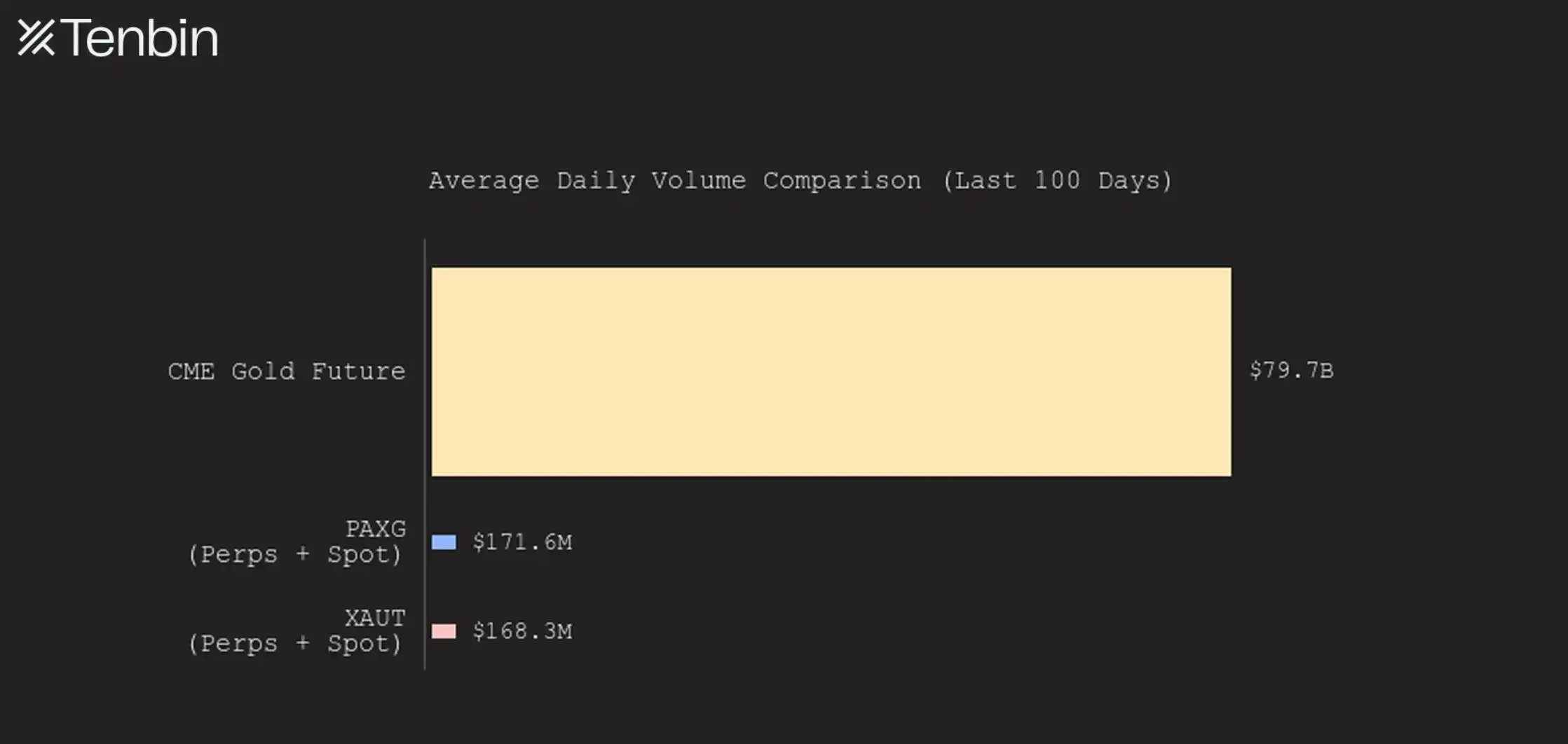
(Chart description: Average daily trading volume comparison: CME Gold Futures vs. PAXG/XAUT Perps & Spot)

So far, these examples have focused on centralized exchanges. What about AMMs (Automated Market Makers)? The short answer is: it's worse.

Look at this XAUT trade from February 2025. A user spent 2,912 USDT to receive only $1,731 worth of XAUT (at the real gold price at the time), paying a 68% premium.

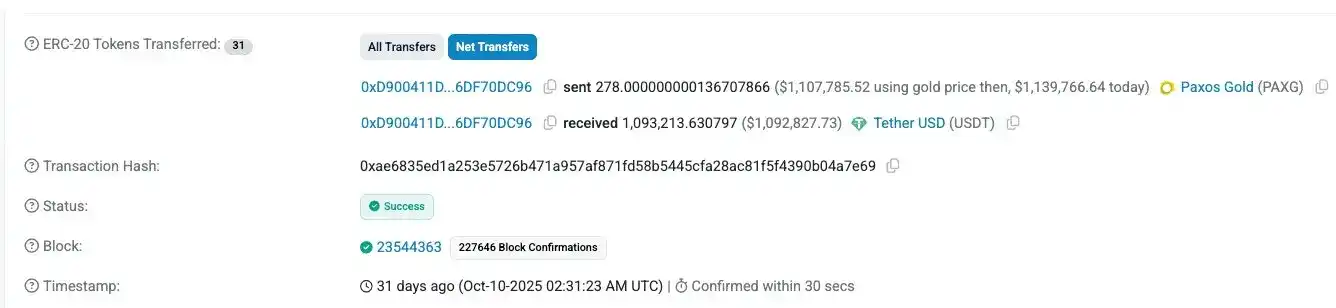
Another trade shows a user selling $1.107 million worth of PAXG (at the gold price at the time) and receiving only 1.093 million USDT, a slippage of about 1.3%. While less extreme, this level of slippage is still unacceptably high in the context of traditional markets, where price impact is typically measured in single-digit basis points, not percentages.
Furthermore, over the past six months, the average slippage for XAUT and PAXG trades on Uniswap has ranged between 25 and 35 basis points, occasionally even exceeding 0.5%.
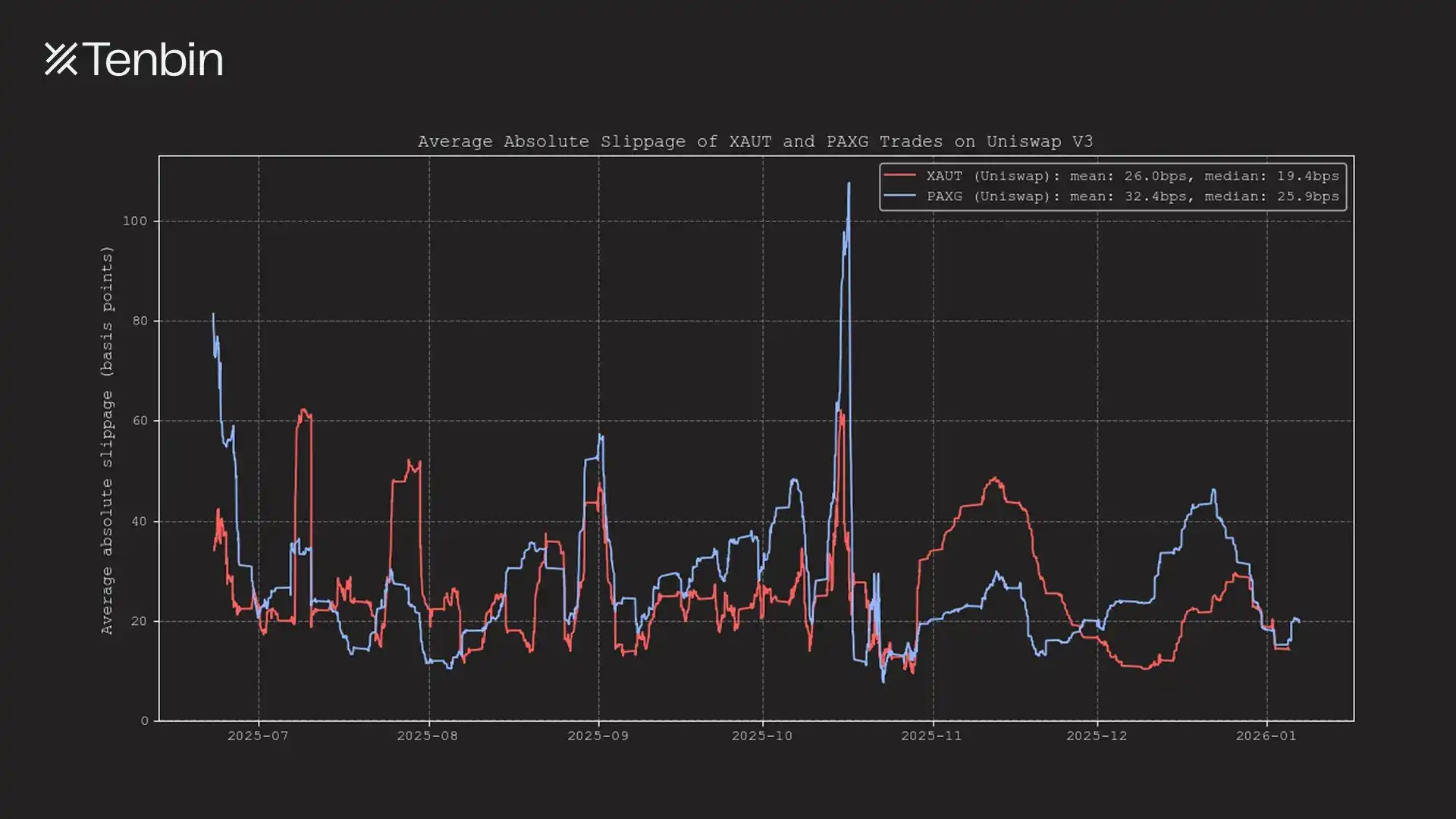
(Chart description: Average absolute slippage for XAUT and PAXG trades on Uniswap V3)

We use gold for this analysis because it is currently the largest non-dollar, non-credit tokenized asset on-chain. But the same pattern applies to tokenized stocks.
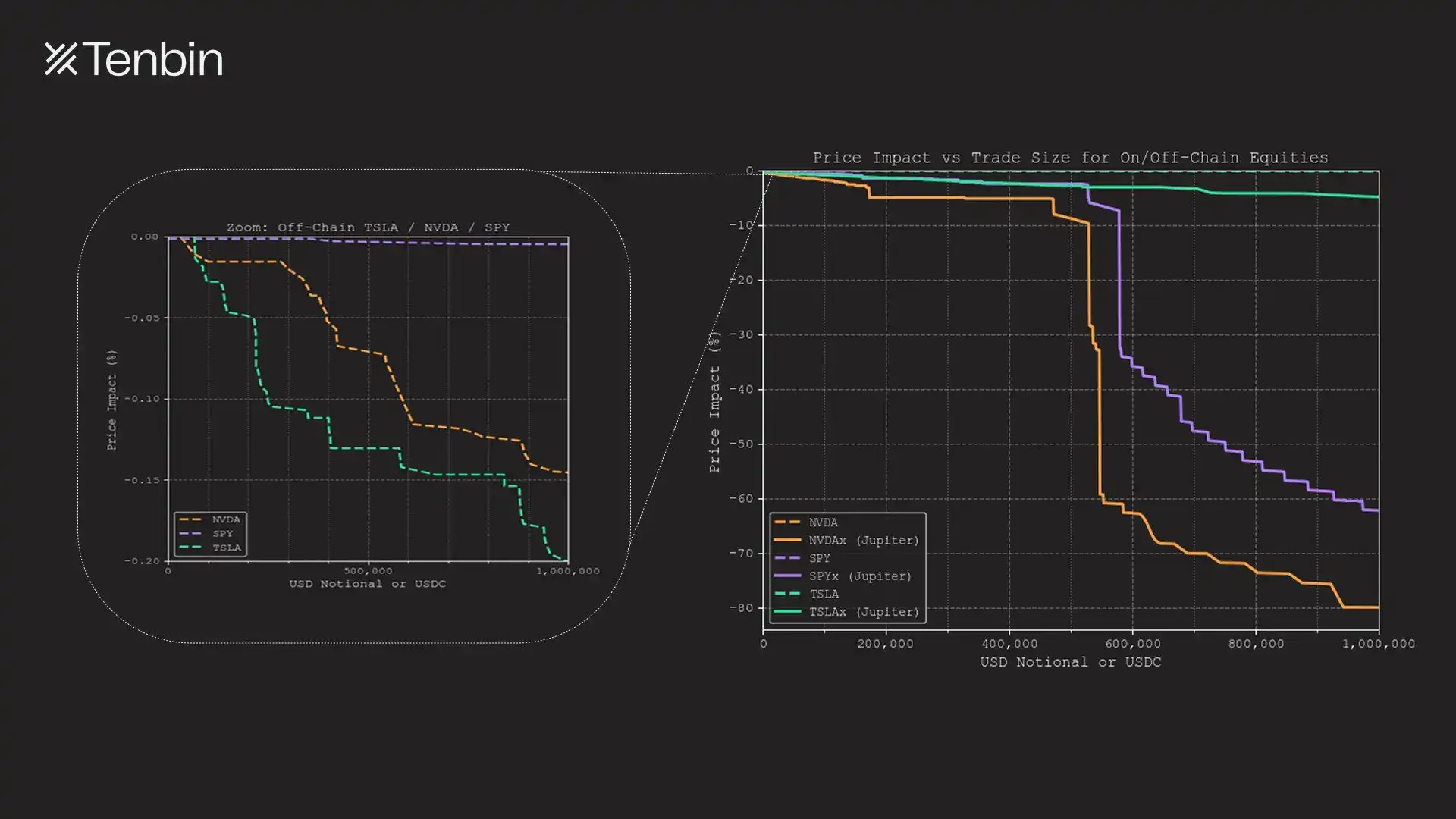
(Chart description: Slippage vs. trade size comparison: Nasdaq's NVDA/TSLA/SPY vs. NVDAx/TSLAx/SPYx)

TSLAx and NVDAx are currently two of the top ten single-name tokenized stocks. On Jupiter, a $1 million trade for TSLAx would incur about 5% slippage. NVDAx faces an insurmountable 80% slippage. In contrast, a $1 million trade for Tesla or Nvidia in the traditional market would incur a price impact of only 18 basis points and 14 basis points respectively (and this doesn't even include the liquidity from off-exchange venues like dark pools).

These costs are easily overlooked in small trades but become unavoidable once users attempt to scale. Illiquidity translates directly into real losses.

Are On-Chain Tokenized Markets Dangerous?

Illiquidity not only increases transaction costs but also disrupts market structure.

When liquidity is thin, pricing mechanisms are极易 distorted, order books are filled with noise, and oracle price feeds subsequently inherit this noise. Small trades can trigger chain reactions in interconnected systems.

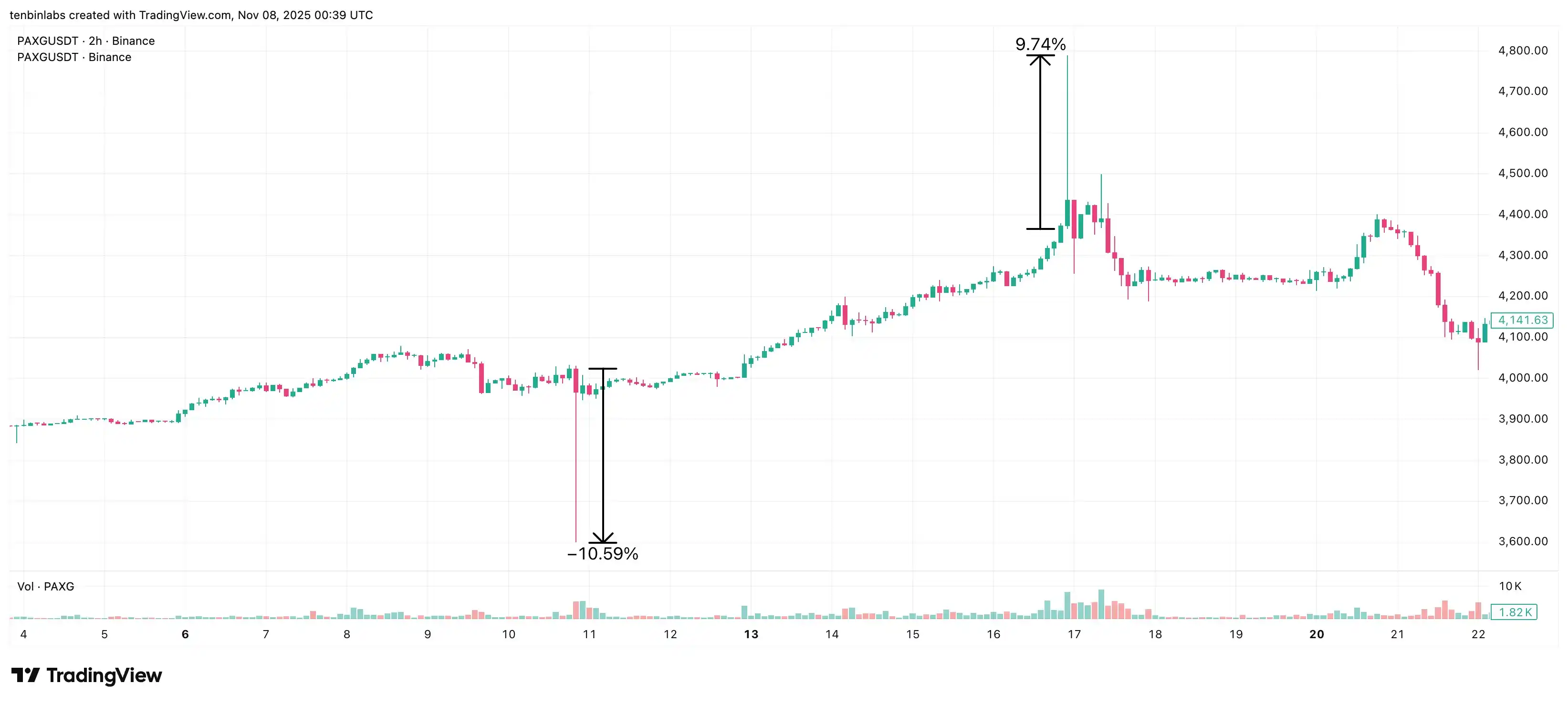
In mid-October 2025, Binance's PAXG spot market experienced two "flash crash" within a week. On October 10th, the price dropped 10.6%; on October 16th, it surged 9.7%. Both moves quickly reversed, indicating they were driven by order book fragility rather than fundamental changes.
Because the tokenized asset ecosystem is highly interconnected, instability in a major trading venue does not remain localized. Binance's spot price carries the highest weight in Hyperliquid's oracle construction. As a result, during these two events, $6.84 million in long positions and $2.37 million in short positions were liquidated on Hyperliquid—a figure that even exceeded the liquidation volume on Binance itself.

This outcome is disconcerting. It demonstrates how a single low-liquidity venue can propagate and amplify volatility across multiple markets. In extreme cases, this also increases the risk of oracle manipulation. Participants who never traded on the original spot market can still suffer losses through liquidations, price distortions, and widening spreads.

All of this traces back to the same root cause: a lack of true liquidity in the primary market.
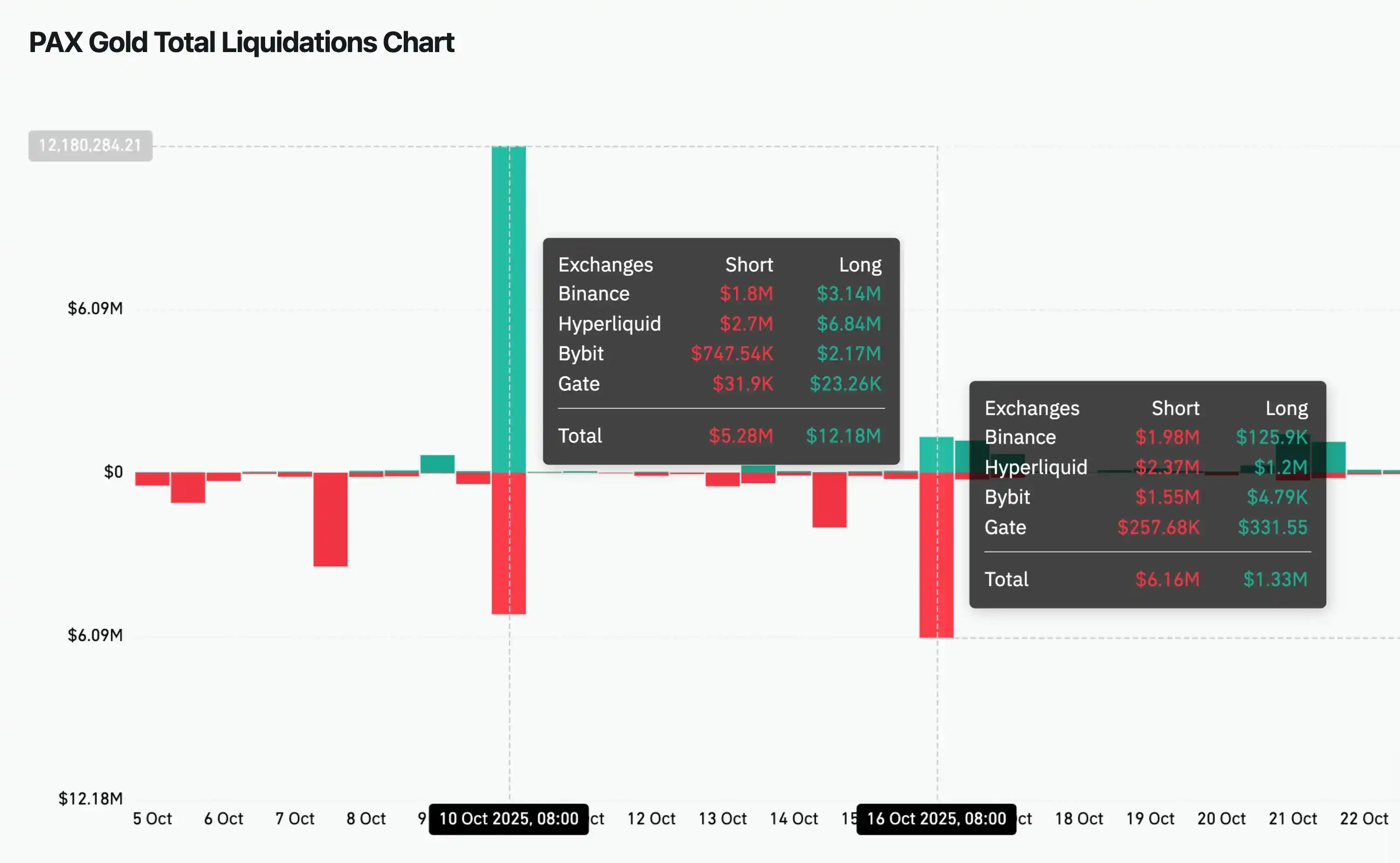
(Chart description: CoinGlass's PAXG liquidation chart)

The Structural Problem of Illiquidity

The illiquidity of tokenized assets is a structural problem.

Liquidity does not automatically appear once an asset is tokenized. It is provided by market makers, who are inherently capital-constrained. They allocate capital to places where inventory can be deployed efficiently, risk can be managed continuously, and where they can exit with minimal time and cost friction.

Most tokenized assets fail on these dimensions.

To provide liquidity, market makers must first mint the asset. In practice, minting involves not only explicit costs (issuers typically charge 10 to 50 basis points in minting and redemption fees) but also operational coordination, KYC, and settlement through custodians or brokers, rather than atomic on-chain execution. Market makers must deposit funds upfront and wait hours or days to receive the tokenized asset.

Once inventory is established, it cannot be redeemed. Redemption windows are typically measured in hours or days, not seconds. Many tokenized assets only allow redemption on a T+1 to T+5 basis, with daily or weekly limits. For larger positions, fully unwinding can take days or even longer.

From a market maker's perspective, this inventory is effectively illiquid and cannot be quickly recycled.

Market makers providing depth must hold inventory through market cycles, absorbing and hedging price risk while waiting for redemption. During this time, the same capital could have been deployed in other crypto markets, where inventory requirements are minimal, hedging is continuous, and positions can be closed instantly; this is why the opportunity cost for market makers in tokenized assets is extremely high.

Faced with this trade-off, rational liquidity providers allocate capital elsewhere.

The current market structure is not suited to solve this problem. AMMs shift inventory risk to liquidity providers while inheriting the same redemption constraints. Order book-based venues merely aggregate fragmented maker liquidity from various exchanges.

The result is a market stuck in a chronically shallow equilibrium. Limited liquidity discourages participation, and low participation further reduces liquidity. The entire tokenized asset ecosystem is trapped in this vicious cycle.

A New Market Structure

Illiquidity is a structural barrier to the growth of tokenized assets.

Insufficient depth hinders scaled positioning, fragile markets propagate instability across protocols and venues. Assets that cannot be reliably exited cannot serve as trustworthy collateral. In today's tokenized model, liquidity remains constrained, and capital efficiency remains low.

For tokenized assets to truly achieve scaled adoption, the market structure must change.

What if price and liquidity could be mapped directly from off-chain markets, rather than being rediscovered and cold-started on-chain? What if users could access tokenized assets at any scale without forcing market makers to hold illiquid inventory? What if redemption was fast, predictable, and unrestricted?

The failure of tokenization stems not from putting assets on-chain, but from never truly putting the markets that underpin them on-chain.


Perguntas relacionadas

QWhat is the main structural problem with tokenized assets discussed in the article?

AThe main structural problem is the lack of deep and robust liquidity in tokenized asset markets, which leads to high slippage, market fragility, and an inability to support large-scale transactions or function as reliable collateral.

QHow does the slippage for large trades in tokenized gold (like PAXG/XAUT) compare to traditional markets (like CME)?

ASlippage for large trades in tokenized gold markets increases exponentially, reaching around 150 basis points for a $4 million trade, whereas CME gold futures show nearly flat slippage, with less than 3 basis points even for a $20 million trade.

QWhat are some of the hidden costs and risks for market makers providing liquidity for tokenized assets?

AMarket makers face high opportunity costs, non-liquid inventory due to slow redemption times (T+1 to T+5), operational friction like KYC and settlement delays, and difficulty in hedging price risk efficiently compared to other crypto markets.

QHow did the low liquidity in Binance's PAXG spot market affect other platforms like Hyperliquid?

AThe low liquidity caused flash crashes on Binance, which were propagated to Hyperliquid through oracle price feeds, resulting in $6.84 million in long positions and $2.37 million in short positions being liquidated on Hyperliquid, exceeding Binance's own liquidations.

QWhat solution does the article suggest to overcome the liquidity problem in tokenized assets?

AThe article suggests a new market structure where price and liquidity are directly mapped from off-chain markets instead of being rediscovered on-chain, enabling fast, predictable, and unrestricted redemptions without requiring market makers to hold illiquid inventory.

Leituras Relacionadas

Must-Watch Events Next Week|CLARITY Act Could Face Senate Vote; SpaceX, Circle to Report Earnings (8.3-8.9)

**Summary: Key Events and Developments to Watch (August 3-9)** The upcoming week is marked by significant financial disclosures, key legislative deadlines, and notable product updates. **Major Financial Events:** Several companies are scheduled to release their Q2 2026 earnings. American Bitcoin (ABTC) will report on August 3, followed by SpaceX and Hut 8 Mining Corp. on August 4, and Circle on August 5. Notably, a significant portion of SpaceX shares (up to 12% of total shares) will be unlocked on August 6 following their earnings release. **Key Legislative Deadline:** The U.S. Senate faces an August 7 deadline to secure 60 votes for the CLARITY Act, a bipartisan bill aiming to establish a federal regulatory framework for cryptocurrencies. The Senate may hold a full vote on the bill during the week. **Economic Data:** The U.S. July Non-Farm Payrolls report will be released on August 7, providing crucial labor market data. **Technology & Product Updates:** * **Shutdowns:** DeFi portfolio tracker Zapper and wallet app Ctrl Wallet will cease operations on August 3. * **Upgrades:** LayerZero will deprecate its v1 relayers on August 3. XRP Ledger's new version 3.3.0, featuring five new functions, is expected next week. * **AI:** Elon Musk announced that the advanced Grok 4.6 AI model is set for release around August 7. * **Bitcoin:** The BIP-110 forced signaling for a potential Bitcoin network change is scheduled to begin around August 8. **Other Notable Events:** Chinese robotics firm Unitree Tech has set its preliminary price inquiry for its IPO for August 5. South Korean exchange Upbit will delist AQT and AERGO tokens on August 3.

marsbitHá 41m

Must-Watch Events Next Week|CLARITY Act Could Face Senate Vote; SpaceX, Circle to Report Earnings (8.3-8.9)

marsbitHá 41m

Stocks Are Plummeting More Sharply Than Cryptocurrencies. Where Has the Money Gone?

Stock Markets Plunge Deeper Than Cryptocurrencies: Where Did the Money Go? In late July, Seoul's Kospi index triggered circuit breakers for two consecutive days, plummeting over 40% from its June high. The collapse was led by heavyweight stocks like SK Hynix, whose record profits still disappointed investors, and devastating leveraged ETFs, with one major product losing over 83% of its value. This signaled a global, forced deleveraging targeting the most crowded trades. Interestingly, while stocks exhibited extreme volatility akin to crypto markets, Bitcoin rose nearly 15% in July after a prior steep drop. Analysis shows the money fleeing equities did not flow into Bitcoin. Instead, Bitcoin had already absorbed its sell-off in May-June, when U.S. spot Bitcoin ETFs saw historic outflows. The true safe-haven beneficiary was gold, whose price rose over 20% year-on-year, highlighting a decoupling between Bitcoin and gold as "digital gold." The sell-off was a targeted unwinding of leveraged positions in tech and semiconductors, accelerated by broker-dealer risk management and shifts in the AI narrative, including new competition from Chinese memory chipmakers. The retreat path was clear: from high-valuation tech stocks to cash and U.S. Treasuries, then to gold. For Bitcoin to attract sustained institutional inflows, conditions like eased global liquidity pressure, a "soft-landing" Fed rate cut, and U.S. regulatory clarity via legislation like the stalled CLARITY Act are needed. Currently, Bitcoin is not a safe haven but an already-cleared asset. Its low correlation with tech stocks, however, makes it a potential diversification play for institutional portfolios once the storm passes. The money isn't here yet, but the positioning is underway.

marsbitHá 41m

Stocks Are Plummeting More Sharply Than Cryptocurrencies. Where Has the Money Gone?

marsbitHá 41m

In Conversation with Ray Dalio: We Are Currently in an AI Bubble, with 1% of My Portfolio in Bitcoin

Ray Dalio, founder of Bridgewater Associates, warns in an interview that the current AI boom shows classic bubble characteristics, which could lead to significant economic downturns as seen in past cycles like 1929 or 2000. He explains that speculative enthusiasm, fueled by debt and overvaluation, often precedes a crash when rising rates or taxation force asset sales, causing widespread losses and recession. Dalio also outlines his "Big Cycle" theory, describing an approximate 80-year pattern where widening wealth gaps, massive government deficits, and shifting geopolitical power (like China's rise) create internal conflict and global instability. He emphasizes that we are in a late-cycle, transitional phase where traditional powers like the US and UK face decline. For personal wealth protection, Dalio advises diversification beyond cash into assets like stocks, bonds, real estate, and particularly gold, which he prefers over Bitcoin. While he holds about 1% of his portfolio in Bitcoin as a non-printable hard asset, he views gold as more secure from technological or governmental threats. Regarding AI's impact, Dalio believes it will disproportionately benefit capital owners, worsening inequality by replacing both physical and cognitive labor. He suggests that human intuition and emotional intelligence, combined with AI, will be key for future workers. On taxation, Dalio argues that wealth taxes are impractical and risk triggering asset sell-offs, reducing productive investment. He points to the UK as a cautionary example of debt, low productivity, and political strife. Geopolitically, Dalio foresees a more regionalized world, with the US showing weakness in prolonged conflicts like with Iran, akin to past imperial declines. The ideal outcome, he suggests, is coexisting powerful blocs (e.g., Americas, China-Asia Pacific) without major war.

marsbitHá 4h

In Conversation with Ray Dalio: We Are Currently in an AI Bubble, with 1% of My Portfolio in Bitcoin

marsbitHá 4h

Daily 7.2 Trillion KRW: Foreign Capital's Record Net Buying on Friday! Wall Street Says Headwinds for Korean Stock Fund Flows Have Subsided

South Korean stock market sees a dramatic shift in fund flows. On July 31, foreign investors made a record net purchase of approximately KRW 7.2 trillion in KOSPI stocks, marking a fundamental reversal from the persistent large-scale net outflows seen in previous months. This contributed to a significant narrowing of foreign net selling in July to KRW 9.8 trillion, down sharply from KRW 48.4 trillion in June and KRW 44.5 trillion in May. Simultaneously, domestic institutional pressure eased. South Korean pension funds and asset managers turned to a net buying position in July, purchasing KRW 1.0 trillion worth of KOSPI shares, contrasting with net sales in May and June. Market volatility is expected to be dampened by new financial regulations. Effective July 31, the Financial Services Commission tightened access for retail investors to single-stock leveraged ETFs by raising the minimum cash deposit requirement. Trading volumes for these products subsequently dropped to about 50% of their monthly average. Citigroup Research maintains its year-end KOSPI target of 10,000 points. The firm cites several supportive factors: the substantial easing of headwinds from capital outflows, a robust fundamental outlook for the semiconductor sector, historically low market valuations, strong economic fundamentals, and the potential for policy support from financial authorities if needed.

marsbitHá 4h

Daily 7.2 Trillion KRW: Foreign Capital's Record Net Buying on Friday! Wall Street Says Headwinds for Korean Stock Fund Flows Have Subsided

marsbitHá 4h

Trading

Spot
活动图片




