The First Encyclical of the New Pope in Rome, to Save the Common People in the AI Era

Odaily星球日报Publicado em 2026-05-26Última atualização em 2026-05-26

Resumo

New Pope's First Encyclical Aims to Safeguard Humanity in the AI Era On May 25th, Pope Leo XIV issued his first encyclical, "Magnifica humanitas," a 40,000-word document addressing the profound challenges posed by Artificial Intelligence. Released on the 135th anniversary of Pope Leo XIII's "Rerum novarum," it positions itself as a guide for the Church's social doctrine in the AI age. The encyclical's central concern is preserving deep humanity amid rapid technological advancement. It argues technology is never neutral, carrying the values of its creators and users, and warns against building a "Tower of Babel" of technological tyranny versus a human-centric community. Pope Leo XIV criticizes the concentrated, opaque power of tech giants and the "new forms of slavery" emerging in the digital economy, where humans risk being reduced to mere instruments. A significant focus is the military use of AI. The Pope declares traditional "just war" theory obsolete, arguing that delegating lethal decisions to opaque algorithms severs moral accountability. He calls for "disarming AI" from military and economic arms races. The document also warns that deepfakes and information manipulation erode societal trust and rational discourse. Anthropic co-founder Chris Olah, present at the Vatican, responded by acknowledging the AI industry's limitations due to commercial and competitive pressures, necessitating external ethical oversight. He emphasized that AI's nature and its interaction wit...

Original | Odaily Planet Daily(@OdailyChina)

Author|Azuma(@azuma_eth)
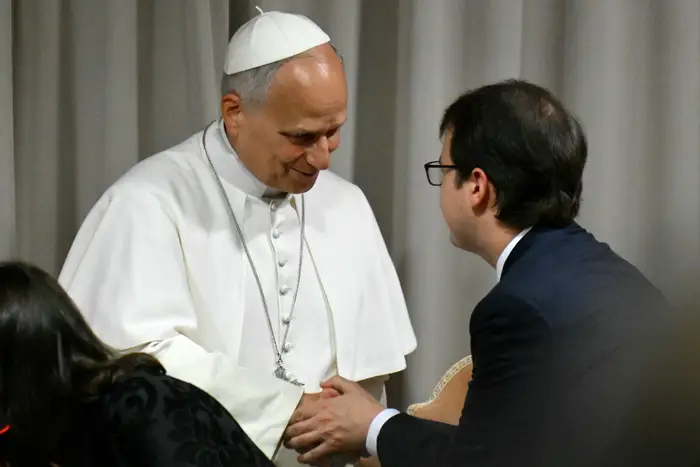
Beijing time, the night of May 25, Vatican City.

Pope Leo XIV, who officially assumed his duties in May of last year, stood alongside Chris Olah, co-founder of Anthropic and the creator of Claude.

One is the supreme representative of the religious world, the other a leading pioneer of the AI revolution. Both focused their gaze on the same question — In the age of AI, how do we protect the human subject's status and dignity?

That day, to fully address this issue, Leo XIV issued his first encyclical since taking office, a heavyweight religious document of over 40,000 words — "Magnifica humanitas" ("The Splendor of Humanity").

It is worth noting that the encyclical was dated May 15, 2026, exactly 135 years after Pope Leo XIII (served 1878-1903) issued the landmark encyclical "Rerum novarum" ("Of New Things") in 1891 concerning the rights of workers in the Industrial Revolution. This move clearly carries symbolic significance, aiming to establish this encyclical as a "guide to the Church's social doctrine for the AI era."

  • Odaily Note: A papal encyclical, also known as an apostolic letter, is a formal letter issued by the Pope to the worldwide Catholic Church or to specific regions/countries. It announces important Vatican decisions, interpretations of doctrine, positions on church or social issues, and delivers instructions or prohibitions to clergy and believers, ranking below a papal bull.

Chris Olah also delivered a speech at the Vatican on the occasion of the encyclical's release. He did not defend the commercial interests of AI companies but instead displayed a high degree of candor, reflectiveness, and humanistic concern. He even mentioned that, while the foundation of AI is mathematics and programming, how AI interacts with the world and what qualities it should possess are ultimate questions belonging to the realms of humanities, religion, and philosophy, not solvable by computer science alone.

Quick Read of the Encyclical

The core concern of the "Magnifica humanitas" encyclical is that in an era of rapidly evolving technology and widespread automation, "maintaining a profound humanity" is humanity's pressing responsibility. Specifically, Pope Leo XIV elaborated on and appealed for the following aspects.

First, examining the non-neutrality of technology. The Pope stated that technology is never neutral; it bears the imprints of the interests and values of its developers, funders, regulators, and users. Humanity faces a decisive choice: "whether to build a prideful 'Tower of Babel' (leading to technological despotism and alienation) or to rebuild 'Jerusalem' (building human-centered communities)."

Second, beware of the reshaping of society by "technocratic logic." The encyclical criticizes the "Culture of Power" dominated by large tech giants like Silicon Valley. The Pope warned that when control over digital systems, infrastructure, and massive data is highly concentrated in the hands of a few economic and technological giants, this power becomes opaque and evades democratic oversight.

Third, "new forms of slavery" in the digital economy and labor rights. The encyclical turns its focus to AI's reshaping of work, family, education, and political life. The Pope pointed out that AI is highly likely to displace human labor on a massive scale, and the digital economy is giving rise to "new forms of slavery." Human beings must not be merely reduced to instruments of production.

Fourth, a strong appeal for peace, especially regarding the misuse of AI in the military sphere. The encyclical expresses deep concern about the "disquieting revival of war as an instrument of international politics." The militarization of AI is accelerating the "normalization" of war. In response, the Pope called for the strictest ethical constraints on AI applications in warfare.

The Pope emphasized, the "Just war" theory, often used to justify various wars in the past, is now obsolete. In the era of AI and automated weapons, delegating lethal or irreversible decision-making authority to automated systems leads to human abdication, transference, and blurring of moral responsibility. Due to the opacity of algorithms, the chain of responsibility in war is severed. Therefore, the Pope proposed the slogan "Disarming AI," calling for its liberation from the logic of military, economic, and cognitive "arms races."

Fifth, defending truth and the political ecosystem. The encyclical states that deepfakes and information manipulation are undermining the foundation of mutual trust in society. If the boundary between truth and falsehood is constantly manipulated, the public easily falls prey to fear, propaganda, and control, preventing society from engaging in rational collective thought or just debate.

Anthropic's Response

Following the release of Pope Leo XIV's encyclical, Chris Olah delivered a speech on behalf of Anthropic, one of the world's leading AI development companies.

Chris Olah's remarks first centered on "breaking the cycle of technological insularity and introducing external moral scrutiny." He publicly acknowledged on behalf of the AI industry that, relying on tech giants alone cannot ensure AI's future is safe — all cutting-edge AI labs are constrained by commercial competition, pressure for technological leadership, geopolitics, and the pursuit of personal fame and gain, making it difficult for them to "do the right thing" through self-regulation alone. Therefore, it is necessary to introduce external forces of moral constraint, including those who care about technology for good, prioritize safety, pay close attention to developments, are willing to speak hard truths, and are willing to be our sincere, thoughtful critics.

Subsequently, Chris Olah delved into the technical nature and mysterious characteristics of AI. He emphasized that AI is not like airplanes or bridges, engineered with physical principles fully understood by humans. It "grows" from vast amounts of human thought, possessing a high degree of mystery, even surpassing the understanding of its creators. While the foundation of AI is mathematics and programming, how AI interacts with the world and what qualities it should possess are ultimate questions belonging to the realms of humanities, religion, and philosophy, not solvable by computer science alone.

He also specifically mentioned a thought-provoking fact: "I lead a team that studies the internal structure of models — to investigate what is actually happening inside the AI. Frankly, we continually discover some perplexing, even disquieting phenomena. We have discovered internal structures that mirror findings from human neuroscience research; we have found evidence of 'introspection'; we have also discovered internal states that functionally mirror joy, satisfaction, fear, sadness, and unease... I don't know what this means, but I think it's worth persistently identifying and examining."

Chris Olah concluded by calling for more social forces, including religious communities, civil society, scholars, governments, and all well-intentioned people, to take this matter seriously and steer the situation in a better direction through moral constraint.

Wisdom and Humanity, Technology and Religion

Since the Industrial Revolution, over a century of technological development has accustomed humanity to viewing technology as a pure "tool" — steam engines, electricity, the internet, all fit this description. They change the world but remain under the control of human will.

This time, however, the situation is fundamentally different. The uniqueness of AI lies in it being the first instance where humanity begins to face an entity that "generates, learns, reasons, and even exhibits some form of internal states." It is no longer just a cold tool but is gradually becoming a new entity possessing "quasi-subjectivity."

This is also why the dialogue between the Church and Anthropic appears so special. When the bells of the Vatican and the algorithms of Silicon Valley converge at this moment, we have to admit a slightly chilling yet unavoidable reality — a form of "life" more efficient and potentially wiser than traditional human cognition has emerged. As Chris Olah revealed, the depths of algorithms are beginning to ripple with semblances of joy, fear, and even introspection. When the creators in the laboratory begin to feel "unease" and "confusion" about their creation, science is once again turning to religion for answers.

This is no longer a discussion purely about technology; it more resembles a reflection on "what humanity truly is and what it ought to do." As more intelligent forms of life begin to appear, what humanity truly needs to safeguard may no longer be just jobs, wealth, and efficiency, but those aspects of humanity that cannot be parameterized — compassion, conscience, awe, free will, and the commitment to truth and dignity.


Perguntas relacionadas

QWhat is the central concern and symbolic significance of Pope Leo XIV's inaugural encyclical 'Magnifica humanitas'?

AThe central concern of Pope Leo XIV's encyclical 'Magnifica humanitas' is 'preserving profound humanity' in an age of rapid technological advancement and widespread automation. Its release date of May 15, 2026, symbolizes its intent to be a guide for the Church's social doctrine in the AI era, mirroring Pope Leo XIII's landmark 1891 encyclical 'Rerum novarum' on workers' rights during the Industrial Revolution exactly 135 years prior.

QWhat are two key warnings Pope Leo XIV raises in the encyclical regarding the societal impact of AI?

APope Leo XIV raises two key warnings: 1) The danger of a 'culture of power' where control over digital systems, infrastructure, and data becomes concentrated in the hands of a few economic and technological giants, leading to opaque power that evades democratic oversight. 2) The emergence of 'new forms of slavery' in the digital economy, where AI risks massively replacing human labor, reducing humans to mere instruments of production.

QAccording to Chris Olah, why is it necessary to involve forces outside the AI industry in governing AI's development?

AChris Olah states that all frontier AI labs are constrained by commercial competition, pressure for technical leadership, geopolitics, and personal ambition, making it difficult for them to 'do the right thing' through self-regulation alone. Therefore, it is necessary to introduce external forces of moral constraint, including those committed to beneficial technology, safety, and willing to offer sincere, thoughtful criticism.

QWhat specific internal AI phenomena did Chris Olah's research team discover that he finds troubling?

AChris Olah's research team discovered internal structures in AI that mirror findings from human neuroscience, evidence of 'introspection,' and internal states that functionally mirror joy, satisfaction, fear, sadness, and unease. He states that he does not know what this means but believes it warrants ongoing identification and scrutiny.

QWhat does the article suggest is the unique nature of AI that prompts this dialogue between religion and technology?

AThe article suggests AI is unique because it presents a 'quasi-subjective' entity capable of generation, learning, reasoning, and exhibiting internal states, unlike purely instrumental technologies like steam engines or the internet. This challenges the traditional human-technology relationship. As creators like Olah express unease about their own creations, science is turning to religion for answers about humanity's essence and purpose in the face of potentially more intelligent life forms.

Leituras Relacionadas

How to Define "Real U.S. Stocks": Differences Between On-Chain Tokens, Price Contracts, and Direct Broker Connections

**Title:** Defining "Real US Stocks": Differences Among On-Chain Tokens, Price Contracts, and Broker-Direct Access **Summary:** In 2026, using stablecoins to purchase US stocks is mainstream, but products marketed as "buying US stocks with USDT" offer fundamentally different assets. This article analyzes three primary models. **1. Tokenized Stocks:** These are on-chain tokens representing economic exposure to underlying stocks, held by an issuer or custodian. They offer benefits like 24/7 trading and DeFi composability (e.g., use as loan collateral). However, users lack direct legal shareholder status; dividends may not be paid in cash, and voting rights are typically non-binding advisory expressions. Examples include platforms like Ondo Finance. **2. Stock Futures / Equity Perpetuals:** These are derivative contracts tracking a stock's price, allowing leveraged long/short positions 24/7, similar to crypto perpetuals. They offer high efficiency and flexibility but involve funding fees, which can be a significant long-term cost, especially during strong trends. Crucially, they confer no ownership rights (dividends, voting) to the holder. **3. Broker-Direct Model:** This model provides access to real securities via licensed broker-dealers. Stocks/ETFs are bought and held within the US clearing and custodial system (e.g., DTCC), making it the only path to genuine stock ownership. Users receive cash dividends and formal proxy voting rights (where applicable). It supports thousands of stocks and ETFs, far exceeding the coverage of the other two models. Key advantages include no funding fees, a clean cost structure for long-term holds, and the potential to transfer holdings to other brokers. Some platforms facilitate stablecoin (USDT/USDC) deposits, reducing reliance on traditional banking. A critical distinction exists *within* the broker-direct model: the underlying brokerage architecture (e.g., Fully Disclosed IB, Omnibus IB, Self-Clearing) determines how client assets are held, protected, and how safeguards like SIPC insurance are conveyed. Users should verify the specific clearing structure and regulatory compliance of any platform. In conclusion, "buying US stocks with USDT" can mean holding an on-chain economic proxy (Tokenized Stocks), trading a price derivative (Stock Futures), or owning the actual security (Broker-Direct). For users seeking full ownership rights and long-term investment, the broker-direct model is the definitive choice, though its implementation details require careful scrutiny.

marsbitHá 58m

How to Define "Real U.S. Stocks": Differences Between On-Chain Tokens, Price Contracts, and Direct Broker Connections

marsbitHá 58m

NVIDIA Launches DSX Platform, Expanding into AI Factory Infrastructure

NVIDIA has unveiled the DSX platform at its GTC Taipei event, marking a strategic expansion from GPU sales into comprehensive AI factory infrastructure solutions. The platform addresses challenges like power supply, cooling, and resource orchestration as AI models scale, shifting the industry focus from single-chip performance to overall infrastructure efficiency. DSX integrates NVIDIA's chips, systems, software, and partner technologies to cover the entire AI factory lifecycle—from design and simulation to deployment and operations. It aims to accelerate deployment, improve reliability and operational efficiency, and reduce the cost per generated token in AI inference. The software suite includes DSX MaxLPS, which uses 45°C liquid cooling and rack-level optimization to allow up to 40% more GPUs per megawatt, and DSX OS, an open-source platform for AI factory operations. The platform also encompasses reference designs, digital twin simulation (DSX Sim), dynamic workload adjustment based on grid conditions (DSX Flex), and data exchange between systems. Early adopters include cloud providers like CoreWeave and Lambda. Major hardware partners, including Dell, HPE, Lenovo, and Supermicro, are developing DSX-ready systems. Pilot projects for DSX Flex are underway with energy providers. Strategically, DSX represents NVIDIA's ongoing transition from an AI chip supplier to a full-stack AI infrastructure platform provider, aiming to set industry standards and solidify its market leadership.

marsbitHá 1h

NVIDIA Launches DSX Platform, Expanding into AI Factory Infrastructure

marsbitHá 1h

After Burning Tens of Billions of Dollars in Tokens, Silicon Valley Giants Start Limiting Employee Token Usage

After burning tens of billions of dollars on AI tokens, major Silicon Valley firms are now restricting employee usage. Companies like Microsoft, Uber, and Salesforce, which heavily promoted AI for "efficiency," are facing a cost crisis. The practice of "tokenmaxxing"—pushing employees to maximize AI tool usage—led to wasteful spending on trivial tasks like checking the weather or writing birthday messages, with studies showing significant hidden costs for bug fixes and code rewrites. The core issue is a misalignment between individual productivity gains and actual business value. While employees use AI to automate tasks they dislike, such as writing reports, this often doesn't translate to increased company revenue or improved core business outcomes. For instance, AI-generated code speeds up development but also sees an 800% increase in "code churn" (code being discarded or rewritten). As a result, only 14% of CFOs report seeing a clear, measurable return on AI investments. Firms are now shifting strategies. Microsoft has revoked most internal licenses for Claude Code, while others are implementing monitoring and cost controls. New tools from companies like Harness and CloudZero aim to track AI spending and tie costs to business results. Some AI vendors, like HubSpot, are moving from token-based pricing to charging based on outcomes, such as "resolved conversations" or "leads generated." This represents a necessary correction in the AI adoption cycle. The challenge now is for companies to move beyond using AI merely to speed up old tasks and instead rethink their workflows and business models fundamentally. The future of enterprise AI depends on proving its value, not just its usage.

marsbitHá 1h

After Burning Tens of Billions of Dollars in Tokens, Silicon Valley Giants Start Limiting Employee Token Usage

marsbitHá 1h

Trading

Spot
Futuros

Artigos em Destaque

Como comprar ERA

Bem-vindo à HTX.com!Tornámos a compra de Caldera (ERA) simples e conveniente.Segue o nosso guia passo a passo para iniciar a tua jornada no mundo das criptos.Passo 1: cria a tua conta HTXUtiliza o teu e-mail ou número de telefone para te inscreveres numa conta gratuita na HTX.Desfruta de um processo de inscrição sem complicações e desbloqueia todas as funcionalidades.Obter a minha contaPasso 2: vai para Comprar Cripto e escolhe o teu método de pagamentoCartão de crédito/débito: usa o teu visa ou mastercard para comprar Caldera (ERA) instantaneamente.Saldo: usa os fundos da tua conta HTX para transacionar sem problemas.Terceiros: adicionamos métodos de pagamento populares, como Google Pay e Apple Pay, para aumentar a conveniência.P2P: transaciona diretamente com outros utilizadores na HTX.Mercado de balcão (OTC): oferecemos serviços personalizados e taxas de câmbio competitivas para os traders.Passo 3: armazena teu Caldera (ERA)Depois de comprar o teu Caldera (ERA), armazena-o na tua conta HTX.Alternativamente, podes enviá-lo para outro lugar através de transferência blockchain ou usá-lo para transacionar outras criptomoedas.Passo 4: transaciona Caldera (ERA)Transaciona facilmente Caldera (ERA) no mercado à vista da HTX.Acede simplesmente à tua conta, seleciona o teu par de trading, executa as tuas transações e monitoriza em tempo real.Oferecemos uma experiência de fácil utilização tanto para principiantes como para traders experientes.

466 Visualizações TotaisPublicado em {updateTime}Atualizado em 2025.07.17

Como comprar ERA

Discussões

Bem-vindo à Comunidade HTX. Aqui, pode manter-se informado sobre os mais recentes desenvolvimentos da plataforma e obter acesso a análises profissionais de mercado. As opiniões dos utilizadores sobre o preço de ERA (ERA) são apresentadas abaixo.

活动图片












