The Eve of the Storm: Powell Holds Rates, Trump Announces New Fed Chair?

Odaily星球日报Publicado em 2026-01-28Última atualização em 2026-01-28

Resumo

The Federal Reserve is widely expected to hold interest rates steady in its first policy decision of 2026, with markets pricing in a near-100% probability of no change. While this outcome is largely anticipated, the focus has shifted to future policy direction and the potential announcement of a new Fed Chair by former President Trump. Key uncertainties remain regarding the pace of potential rate cuts in 2026. Although the Fed began a rate-cutting cycle in late 2025 due to a softening labor market, persistent inflation at 2.8%—above the 2% target—has led to a more cautious stance. The composition of the voting members on the Federal Open Market Committee (FOMC) has also shifted, with two new "hawkish" regional bank presidents joining, which may influence future decisions. Chair Powell’s post-meeting remarks will be closely watched for signals on the duration of the pause and the likelihood of further easing. Simultaneously, Trump has indicated he may soon nominate a new Fed Chair, with candidates narrowed down to four individuals. Rick Rieder, BlackRock’s Global Chief Investment Officer of Fixed Income and a proponent of lower rates, is currently the betting favorite. Trump may choose to announce his nominee around the time of the FOMC meeting to shift market attention away from any potentially hawkish signals from Powell and instead emphasize a more dovish long-term outlook. The timing and choice of nominee could significantly influence market sentiment and expectations fo...

Original | Odaily Planet Daily (@OdailyChina)

Author | Golem (@web 3_golem)
At 3:00 AM Beijing time on January 29 (this Thursday), the Federal Reserve is set to announce its first interest rate decision of 2026; half an hour later, current Fed Chair Jerome Powell will hold a monetary policy press conference. However, there is little suspense surrounding this Fed rate decision, as the market widely expects the Fed to keep rates unchanged. Data from Polymarket shows that the probability of maintaining rates is close to 100%.
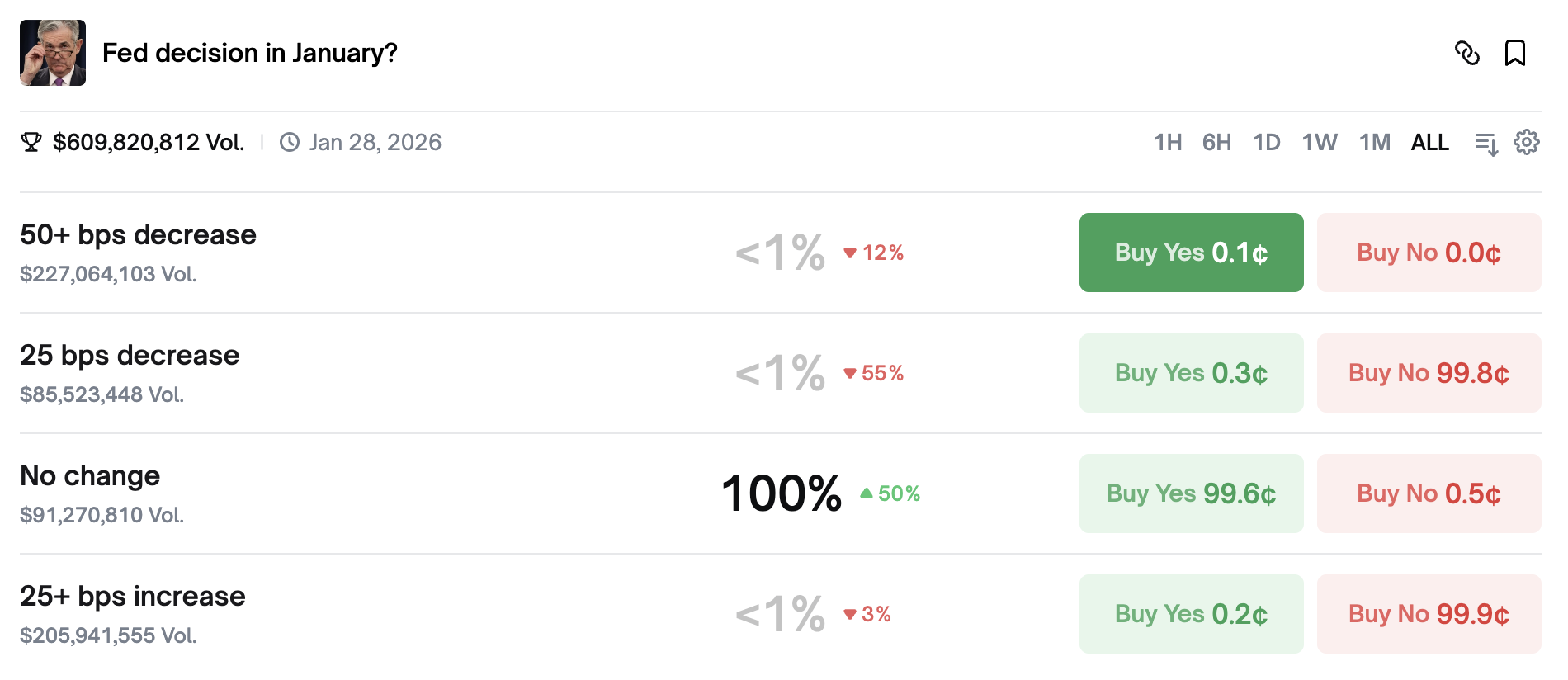
Such a high probability has allowed the market to digest in advance the negative impact of the Fed's announcement of "no rate cut" this time. OKX data shows that BTC has fallen by only 0.39% in the past 7 days, basically in a sideways trend, but this period of market "silence" may be broken tonight.

On one hand, although the market almost unanimously believes the Fed will keep rates unchanged this week, there is significant divergence regarding the fiscal path for the remainder of 2026, making this still an important meeting to watch. The Fed's future key policy tendencies, such as whether it will continue to cut rates in 2026 and the frequency of cuts, will affect the market. Should Powell make hawkish remarks like "further observation is needed" during his speech, the market might "drop in response."

On the other hand, the announcement of the successor to the Fed Chair will also have a long-term impact on the market. The shortlist has been narrowed down to four individuals. Trump previously stated he has a preferred candidate but is waiting for the right time to announce, and this right time could very well be tonight.

2026 Rate Cut Direction Remains Uncertain

Since last September, the Federal Reserve initiated a new rate-cutting cycle, implementing three consecutive rate cuts. If rates are held unchanged this week, it would be the first pause since the cycle began. At this point, the market is not concerned about the reasons for holding rates steady, but rather whether this is a brief pause to observe before continuing rate cuts, or the beginning of a prolonged pause, or even the start of a rate-hiking cycle?

Previously, the general market view was that 2026 would be a year of further quantitative easing by the Fed.

Reason one: From a data perspective, the US labor market indeed shows signs of weakness. Non-farm payrolls increased by only 50,000 in December 2025, with an unemployment rate of 4.4%. While there hasn't been "massive layoffs," it remains in a state of "low hiring and cooling demand." Reason two: The Fed might still believe that Trump's tariff policies will not have a long-term impact on inflation (Odaily: Powell cut rates in September 2025 based on this factor). Reason three: Trump has publicly stated that he would choose a "dovish" figure as the next Fed Chair.

However, some in the market believe there is uncertainty about the Fed continuing to cut rates in 2026. Some analysts argue that unless the job market deteriorates significantly, it will be difficult to see rate cuts before mid-year, as the pace of inflation decline is not sufficient to convince hawkish members.

The Fed's mandate, simply put, is to curb inflation and promote employment. However, in 2025, the US experienced a phenomenon of both a weak labor market and high inflation. The Fed ultimately chose to prioritize the employment issue, thus initiating the rate-cutting cycle. Yet, the reality is that the US inflation rate remains stuck at 2.8%, far above the Fed's 2% target, forcing the Fed to reconsider the impact of tariffs on inflation. Holding rates unchanged this week would also indicate the Fed is beginning to "observe."

Furthermore, although the next Fed Chair chosen by Trump is destined to be "dovish," the new rotating chairs of the Fed's rate-setting committee are predominantly "hawkish." At the beginning of each year, four of the 12 regional Fed presidents rotate onto the rate-setting committee and gain voting rights for the next eight policy meetings. This year's rotating members include Dallas Fed President Lorie Logan, Cleveland Fed President Loretta Mester (referred to as Hammack in the text, likely a reference to Mester's previous role or a mistranslation; Mester is known as a hawk), Philadelphia Fed President Patrick Harker (referred to as Paulson in the text, likely a mistranslation; Harker is considered moderate), and Minneapolis Fed President Neel Kashkari.

Among them, Logan and Mester are seen as "hawkish" figures, both having publicly stated that the Fed should focus on inflation. Harker is seen as "dovish," having expressed a "cautiously optimistic attitude" towards inflation. Kashkari's stance is relatively neutral. The addition of new "hawkish" members might disrupt the previous balance of policy inclinations within the Fed. Even if Trump chooses a "dovish" Chair, they may not be able to sway the entire rate-setting committee.

Moreover, the Fed Chair might not completely follow Trump's wishes in leading rate cuts. Years ago, Trump personally appointed Powell as Fed Chair, but last year, even though Trump promoted Powell, Powell did not "repay" Trump with sustained and significant rate cuts. Under US law, the Fed is independent and can make interest rate decisions based on the current economic situation, not government wishes. Therefore, even if the new Fed Chair promises Trump rate cuts, they might "go their own way" once in office.

This kind of meaningless "political promise" is also a concern for Trump. Last week, Trump said in a speech at the World Economic Forum in Davos, Switzerland, "It's amazing how people change once they get this job," meaning candidates say what sounds good during the interview but emphasize their independence once confirmed.

Considering these factors, Powell's speech after tonight's FOMC meeting will also be closely watched by investors for hints on how long the Fed might pause rate cuts.

This Week's FOMC Meeting Could Be One of the Best Times for Trump to Announce the Fed Chair Successor

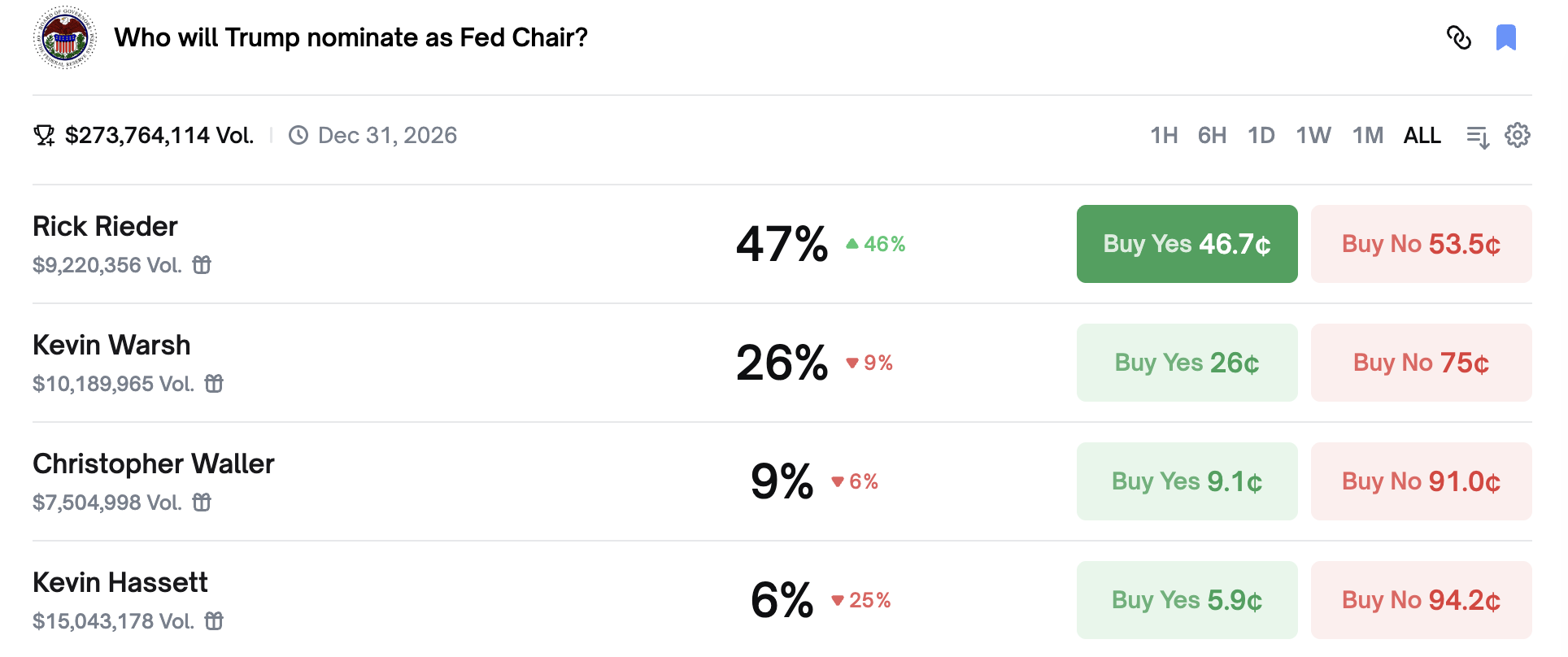
Besides this week's FOMC meeting, the successor to the Fed Chair is another macro event that can influence the market. The shortlist has been narrowed down to four: Kevin Hassett, Kevin Warsh, Rick Rieder, and Christopher Waller. According to Polymarket data, Rick Rieder currently has the highest probability of being nominated by Trump at 47%; Kevin Hassett has the lowest probability at 6%.
Rick Rieder is BlackRock's Chief Investment Officer of Global Fixed Income. Although he doesn't have much government experience, he has consistently advocated for supporting low interest rates based on his understanding of the market rather than politics. This resume might attract Trump, who is worried about the new Fed Chair becoming "disobedient" upon taking office. Economists at Evercore ISI, including Krishna Guha, even believe that "if Rick Rieder becomes the new Fed Chair, he might advocate for three rate cuts this year." (Odaily Note: For more information on Rick Rieder, read 《The Last Seat on the Fed Chair Candidate List, What is Rick Rieder's Attitude Towards Crypto?》)

Hassett was once considered the most likely candidate to become the new Fed Chair, with a probability一度 (once) over 80%. But Hassett is Trump's economic advisor, and there were外界 (external) concerns that nominating Hassett would damage the Fed's independence. Additionally, Trump publicly stated that he did not want to lose Hasset within his administration. Therefore, Hassett's probability of selection has declined, though some still believe his nomination probability is higher than 6%.

Trump has repeatedly publicly stated that he would announce his nominee in January. In late December 2025, Trump told reporters in Florida that he would announce the next Fed Chair人选 (candidate) sometime in January; On January 14, 2026, Trump said in an interview with Reuters that he would announce the candidate within the next few weeks; Two weeks later, on January 27, Trump said in a speech in Iowa that he would announce the new Fed Chair candidate soon, but has not done so yet.

Although Trump's answers have been vague each time, it is almost certain that the probability of an announcement in January is very high, and the best timing for the announcement could very well be during this week's FOMC meeting.

As mentioned earlier, Powell's speech tonight will be a key focus for investors. If Powell does not make dovish-leaning remarks, financial markets could suffer, a scenario Trump显然 (obviously) does not want to see. Therefore, if Trump wishes to shift market attention away from the uncertain Powell, he might announce his nominee for the next Fed Chair during tonight's FOMC meeting. This would release the positive news of a "dovish chair" to the market, reducing attention on Powell's speech or mitigating potential negative market impacts.

Tonight, let's wait and see!

Perguntas relacionadas

QWhat is the market's expectation for the Federal Reserve's interest rate decision on January 29, 2026, and why?

AThe market widely expects the Federal Reserve to maintain the current interest rate, with Polymarket data showing the probability of no rate change is close to 100%. This is because the decision is highly anticipated and already priced in by investors.

QWhat are the two main factors discussed in the article that could break the market's 'silent period'?

AThe two main factors are: 1) The future policy direction for the remainder of 2026, including the frequency of potential rate cuts, which could cause market volatility if Chair Powell's remarks are perceived as hawkish. 2) The announcement of the new Federal Reserve Chair nominee by former President Trump, which could have long-term market impacts.

QAccording to the article, who is the most likely candidate to be nominated as the next Federal Reserve Chair based on Polymarket data, and what is his background?

ABased on Polymarket data, Rick Rieder is the most likely candidate with a 47% probability. He is the Chief Investment Officer of Global Fixed Income at BlackRock, advocates for low interest rates based on market understanding rather than politics, and has limited government experience.

QWhy might the Federal Reserve's decision to pause rate cuts be more than just a temporary观望, according to the analysis in the article?

AThe pause might not be temporary due to persistent inflation at 2.8% (above the 2% target), leading the Fed reassessing the impact of tariffs on inflation. Additionally, new 'hawkish' members rotating into the利率决策委员会 could shift internal policy balance, making further rate cuts less likely.

QWhy does the article suggest that Trump might announce his Fed Chair nominee during the FOMC meeting?

ATrump might announce the nominee during the FOMC meeting to shift market attention away from any potentially hawkish or uncertain remarks by Chair Powell. This could release a 'dovish'利好 to the market, mitigating potential negative impacts and reducing focus on Powell's speech.

Leituras Relacionadas

From South Korea to the United States: Blue-Collar Jobs Are Becoming Increasingly Popular, Thanks to AI

AI is reshaping the labor market's value proposition. The traditional four-year college degree is losing its appeal as a guaranteed career path, while skilled blue-collar trades like electricians, welders, and plumbers are experiencing historic demand and wage premiums. This shift is driven by dual pressures: AI's displacement of certain white-collar roles and a booming need for physical infrastructure and data center construction. Data confirms the trend. In the U.S., vocational school revenue surged, and a significant portion of recent layoffs are AI-related. Surveys show a majority of Gen Z adults plan to pursue blue-collar work, citing better job security against AI automation. Vocational education interest has exploded recently. Experts cite a psychological shift as younger generations seek tangible, AI-resistant careers and avoid high student debt. In many cases, salaries for skilled trades now match or exceed those requiring a bachelor's degree. In South Korea, semiconductor vocational high schools boast near-total employment, with graduates securing high-paying roles at companies like Samsung. The shortage is structural, exacerbated by a retiring baby boomer workforce and massive infrastructure projects. Companies like JPMorgan Chase, Meta, and Lowe's are investing heavily in training programs. However, overcoming historical stigma and a "perception gap" around trade careers remains a key challenge to closing the talent gap.

marsbitHá 1h

From South Korea to the United States: Blue-Collar Jobs Are Becoming Increasingly Popular, Thanks to AI

marsbitHá 1h

Qualcomm: AI Hype Subsides, When Will Smartphones Emerge from the Gloom?

Qualcomm reported its Q3 FY2026 results (ending June 2026), with revenue of $9.95B, down 4% YoY but above expectations. Gross margin declined to 53.1%, pressured by rising costs across manufacturing and memory. Key business segments showed mixed performance: Handset revenue fell 19.6% YoY to $5.09B, dragged by an 11% decline in non-Apple Android shipments and weaker high-end mix. Conversely, Automotive revenue surged 61% to $1.59B, and IoT grew 9% to $1.83B. Core operating profit dropped 41% YoY due to margin compression and higher expenses. Management's Q4 FY2026 guidance projects revenue of $9.7B-$10.5B, in line with consensus, but Non-GAAP EPS guidance of $2.05-$2.25 fell short of expectations. Amidst persistent weakness in its core handset market, Qualcomm is pursuing growth in AI, focusing on Edge AI (smartphones, PCs, automotive) and Data Center AI. Its data center strategy includes four pillars: AI accelerators (e.g., AI200), commercial CPUs (Dragonfly C1000), custom silicon, and connectivity solutions. While these initiatives initially boosted its stock, concerns over AI capital expenditure sustainability have since erased those gains. The company targets $5B in data center revenue for FY2027 and $15B for FY2029. The report concludes that with the traditional handset business still under pressure, the data center opportunity is currently viewed as a longer-term option, and a more conservative valuation based on core operations may be warranted until AI contributions materialize.

marsbitHá 1h

Qualcomm: AI Hype Subsides, When Will Smartphones Emerge from the Gloom?

marsbitHá 1h

From TPU to Self-Evolving Agents: How Jeff Dean Predicts the Next Step in AI

At the 2026 YC Startup School, Jeff Dean outlined his vision for AI's next phase, shifting focus from simply scaling models to building intelligent, autonomous systems. He believes AI's progress is no longer just about creating smarter models, but about integrating them into systems capable of long-term, iterative work, automated experimentation, and continuous learning. This evolution moves the competition from "who has the bigger model" to "who can best organize intelligence." Dean suggests AI capabilities are now comparable to a junior engineer, enabling the automation of complex workflows. However, the true challenge and opportunity lie in managing these AI "workers" at scale. He emphasizes the importance of **context engineering**—structuring tools, memory, and feedback loops—over raw model power. For startups, this means building deep expertise in niche domains where general models currently fail (near 0-1% success rates), leveraging proprietary data, specialized tools, and domain-specific evaluators. A recurring theme is re-examining fundamental constraints. Dean's past work, like moving Google's search index to memory or creating the TPU, stemmed from questioning outdated assumptions about hardware and cost. He sees similar inflection points today, particularly in **specialized inference hardware** to drastically reduce latency and energy consumption for real-time Agent operation. Notably, he points out that in modern AI systems, the dominant cost is often not computation but **data movement**. Reliable, long-running Agents require robust system design, borrowing concepts from distributed computing like checkpointing, state management, and parallel exploration to handle failures and maintain progress over days or weeks. As AI automates execution, the scarcest human skills will shift to **defining clear specifications**, **judging what problems are worth solving** (taste), and designing effective feedback loops. Ultimately, Dean's framework prioritizes understanding the problem deeply, identifying the true bottlenecks, and systematically building closed-loop systems where AI can not only perform tasks but also improve AI itself.

marsbitHá 1h

From TPU to Self-Evolving Agents: How Jeff Dean Predicts the Next Step in AI

marsbitHá 1h

Trading

Spot
活动图片





