The Era of Population Deflation: The Future Belongs to 'Super Individuals + AI + Web3'

marsbitPublicado em 2026-01-20Última atualização em 2026-01-20

Resumo

The article "The Era of Population Deflation: The Future Belongs to 'Super Individuals + AI + Web3'" argues that global population decline is not merely a labor issue but a fundamental structural shift that will redefine economic and technological systems. Key points include: - Population collapse (e.g., China’s birth rate halving in 7 years) erodes labor supply, content creation, and long-term demand for assets like real estate and pensions. - AI is not just an efficiency tool but a structural solution to replace human labor, enable exponential productivity growth, and empower "super individuals" and solo creators. - Web3 provides the infrastructure for trustless collaboration, transparent value distribution, and programmable rules in a low-trust, low-human environment. - Together, AI and Web3 form a complete response: AI handles production, while Web3 enables decentralized coordination and economic participation for both humans and AI agents. The article advises investors to focus on AI, productivity tools, and Web3 infrastructure, and urges individuals to become AI-augmented, platform-independent, and self-sovereign economic units.

Author: Amelia I Biteye Content Team

Over the past century, almost all economic growth models have assumed one premise: the next generation will be larger than the current one.

More people mean a more abundant labor force, a larger consumer market, and more predictable long-term returns.

But this premise is failing globally.

China, Japan, South Korea, Europe, and even the United States - declining birth rates are shifting from "statistical data" to a structural reality.

And when "people" are no longer the most abundant, cheapest, and most replicable factor of production, the entire narrative of technology and institutions will be forced to rewrite.

The emergence of Web3 and AI is not an accidental technological wave but an inevitable response to the era of population deflation.

I. Population Cliff: The Underestimated Systemic Risk

When discussing population decline, many debates only focus on "labor shortage."

But if you only understand it as a "labor issue," you severely underestimate its destructive power.

What population deflation truly erodes are three deeper layers of structure.

Labor: From a Cyclical Problem to an Irreversible Structural Scarcity
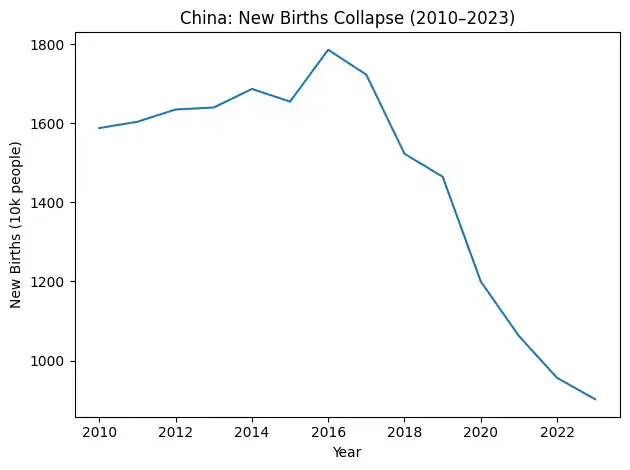
China's Birth Population Cliff (2010–2023)

Visually, what you see is not a "decline" but a clear cliff-like drop.

Taking China as an example:

  • 2016: approximately 17.86 million newborns

  • 2023: approximately 9 million newborns

  • 2025: expected to fall below 8 million

Halved in just 7 years.

What does this mean?

Those born in 2023 will enter the labor market around 2045: not "a bit fewer," but "half as many."

This is not a cyclical fluctuation but a structural collapse of the population.

More critically, this trend has been confirmed by long-term projections: according to the UN's "World Population Prospects 2022" report, China's working-age population (15–64 years) will decrease by approximately 170 million between 2020 and 2050.

In the past, business systems assumed: "People can always be hired; it's just a matter of price."

In the era of population deflation, the problem changes.

Delayed retirement, immigration, and birth subsidies are slow variables.

But business systems cannot wait twenty years.

This is precisely where all technological narratives begin to transform.

Attention and Creator Supply Shrink Simultaneously: Web2's Hidden Fatal Flaw

A declining young population brings not only a reduction in labor but also a more hidden, more fatal problem: Who will produce content, and who will consume it?

  • Declining number of content producers

  • Slower diffusion of new culture and narratives

  • Failure of platform traffic growth logic

Web2's reliance on the "user growth → traffic → advertising → commissions" model is essentially built on population expansion.

When new users no longer appear, platforms begin to compete internally, rules change frequently, and trust between creators and platforms collapses.

This is Web2's most difficult structural flaw to repair in the era of population deflation.

Systemic Collapse on the Long-Term Demand Side: Long-Termism Forced to Be Revalued

Real estate, education, long-term consumer goods, pension systems...

The commonality of these systems is: they all assume that there will be more people in the future.

When this assumption is broken, all "long-termist assets" will be repriced.

II. Why Is AI a Necessity in the Era of Population Deflation?
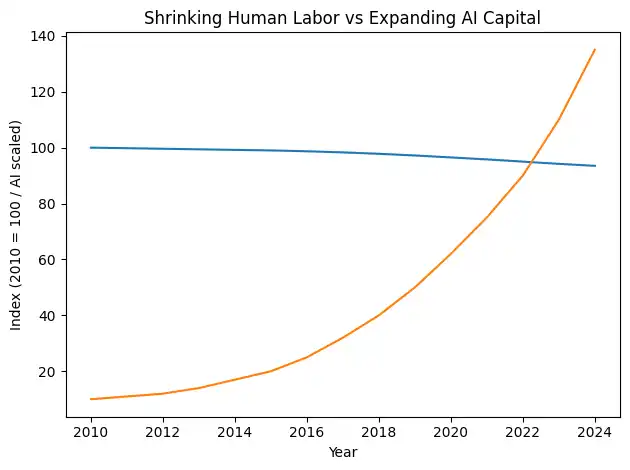
Human Labor Contraction vs. AI Capital Exponential Expansion

One side is a slow but certain decline, the other is exponential growth. The only "labor force" that can still expand is not human.

If population deflation changes the problem itself, then AI is becoming the only viable answer.

AI Is Not an Efficiency Tool but a "De-humanizing Tool"

We are accustomed to describing AI as an "efficiency tool."

But in the real world, it does not solve efficiency problems but a structural one: the system no longer needs so many people.

AI customer service, AI content generation, AI research assistants, AI trading systems - their significance is not to make people 20% faster but to remove "people" from the necessary conditions of the system.

In a population-deflated world, the real question is no longer: "Can we hire someone for this position?" but: "Does this环节 still require human participation?"

AI is not replacing inefficient people; it is rewriting the entire society's assumption of dependence on "human labor."

AI Is the Only Labor Force Capable of Exponential Growth

  • Population: Linear growth, even negative growth

  • AI: Computing power, models, data → Exponential expansion

This is also why, despite extreme macroeconomic uncertainty, capital still chooses to heavily invest in AI.

Because in the era of population deflation, only AI has the "ability to scale."

AI Allows the "Individual" to Become a Production Unit Again
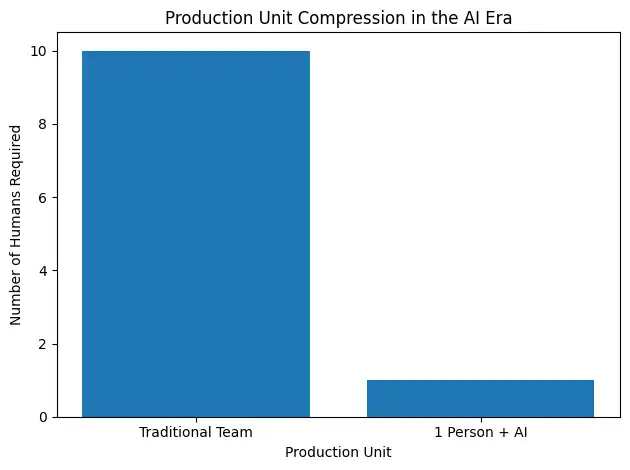
Production Unit Compression Diagram (Team → Individual + AI)

From a "10-person team" to "1 person + AI," production units are being rapidly compressed.

AI is giving rise to a new organizational form:

  • One-person companies

  • Super individuals

  • Solo Founders

  • AI Native creators

When society cannot mass-produce young people, the system can only choose to: amplify the individual.

III. What Role Does Web3 Play Here?

If AI solves "who will do the work," then Web3 solves a more fundamental problem:

In an era of fewer people, how do we collaborate, distribute, and build trust?

How to Collaborate at Low Cost in an Era of Fewer People?

DAOs, Permissionless collaboration, project-based contributions—

Web3 restructures "organizations" from long-term employment relationships into temporary, flexibly combinable collaboration networks.

When hiring people becomes increasingly expensive, trust and settlement must be automated.

How to Distribute Value in an Era of Fewer People?

In an era where labor becomes scarce, if value distribution is not transparent, the system will quickly lose participants.

Tokens, on-chain incentives, and instant settlement do not address "speculation" but a practical problem:

How to make scarce labor willing to stay and continue to build?

How to Build Long-Term Trust in an Era of Fewer People?

The younger generation's trust in long-term commitments is collapsing:

  • Distrust in pensions

  • Distrust that platforms won't change rules

  • Distrust in long-term incentives from centralized institutions

Smart contracts and on-chain rules essentially answer:

When there aren't enough people and not enough trust, can the rules execute themselves?

IV. Web3 + AI: The Complete Solution for the Era of Population Deflation

An increasingly clear judgment is forming: Web3 is not a competitor to AI but the institutional shell for the AI era.

What do AI Agents need?

  • Identity

  • Wallet

  • Autonomous transaction capability

  • Programmable rules

These are precisely the native capabilities of Web3.

In the near future, we may see:

  • AI-native companies

  • AI autonomous DAOs

  • AI-to-AI economic collaboration

In this system, humans may no longer be the largest group of economic participants.

V. Final Thoughts: What Does This Mean for the Individual?

For the individual, it is a harsh but real fact: you will no longer be lifted by the红利 of "population growth."

But it also意味着 new windows of opportunity:

  • AI amplifies individual productivity

  • Web3 allows individuals to directly participate in global systems

  • A world with fewer people is反而 more friendly to high-cognition, high-action individuals

If you are an investor/creator, here is actionable advice from Biteye:

For investors:

  • Population deflation is a 20–30 year-level certain variable, not macroeconomic noise

  • All business models relying on "population expansion" should be discounted valuations

  • Only three categories are truly worth long-term attention:

    • AI that can directly replace human labor

    • Tools that amplify individual productivity

    • Web3 infrastructure that operates in low-trust environments

For creators / individuals:

  • Stop assuming "the platform will give you long-term returns"

  • Try to turn yourself into:

    • A node that can be amplified by AI

    • A personal brand that can migrate across platforms

    • An independent production unit capable of direct settlement

After all, in the era of population deflation: the system will not take care of you, but the system needs you.

This is not an era of more and more people,

but an era where each individual must become stronger and stronger; and what you must rely on are AI and Web3.


Criptomoedas em alta

Leituras Relacionadas

Must-Watch Events Next Week|CLARITY Act Could Face Senate Vote; SpaceX, Circle to Report Earnings (8.3-8.9)

**Summary: Key Events and Developments to Watch (August 3-9)** The upcoming week is marked by significant financial disclosures, key legislative deadlines, and notable product updates. **Major Financial Events:** Several companies are scheduled to release their Q2 2026 earnings. American Bitcoin (ABTC) will report on August 3, followed by SpaceX and Hut 8 Mining Corp. on August 4, and Circle on August 5. Notably, a significant portion of SpaceX shares (up to 12% of total shares) will be unlocked on August 6 following their earnings release. **Key Legislative Deadline:** The U.S. Senate faces an August 7 deadline to secure 60 votes for the CLARITY Act, a bipartisan bill aiming to establish a federal regulatory framework for cryptocurrencies. The Senate may hold a full vote on the bill during the week. **Economic Data:** The U.S. July Non-Farm Payrolls report will be released on August 7, providing crucial labor market data. **Technology & Product Updates:** * **Shutdowns:** DeFi portfolio tracker Zapper and wallet app Ctrl Wallet will cease operations on August 3. * **Upgrades:** LayerZero will deprecate its v1 relayers on August 3. XRP Ledger's new version 3.3.0, featuring five new functions, is expected next week. * **AI:** Elon Musk announced that the advanced Grok 4.6 AI model is set for release around August 7. * **Bitcoin:** The BIP-110 forced signaling for a potential Bitcoin network change is scheduled to begin around August 8. **Other Notable Events:** Chinese robotics firm Unitree Tech has set its preliminary price inquiry for its IPO for August 5. South Korean exchange Upbit will delist AQT and AERGO tokens on August 3.

marsbitHá 1h

Must-Watch Events Next Week|CLARITY Act Could Face Senate Vote; SpaceX, Circle to Report Earnings (8.3-8.9)

marsbitHá 1h

Stocks Are Plummeting More Sharply Than Cryptocurrencies. Where Has the Money Gone?

Stock Markets Plunge Deeper Than Cryptocurrencies: Where Did the Money Go? In late July, Seoul's Kospi index triggered circuit breakers for two consecutive days, plummeting over 40% from its June high. The collapse was led by heavyweight stocks like SK Hynix, whose record profits still disappointed investors, and devastating leveraged ETFs, with one major product losing over 83% of its value. This signaled a global, forced deleveraging targeting the most crowded trades. Interestingly, while stocks exhibited extreme volatility akin to crypto markets, Bitcoin rose nearly 15% in July after a prior steep drop. Analysis shows the money fleeing equities did not flow into Bitcoin. Instead, Bitcoin had already absorbed its sell-off in May-June, when U.S. spot Bitcoin ETFs saw historic outflows. The true safe-haven beneficiary was gold, whose price rose over 20% year-on-year, highlighting a decoupling between Bitcoin and gold as "digital gold." The sell-off was a targeted unwinding of leveraged positions in tech and semiconductors, accelerated by broker-dealer risk management and shifts in the AI narrative, including new competition from Chinese memory chipmakers. The retreat path was clear: from high-valuation tech stocks to cash and U.S. Treasuries, then to gold. For Bitcoin to attract sustained institutional inflows, conditions like eased global liquidity pressure, a "soft-landing" Fed rate cut, and U.S. regulatory clarity via legislation like the stalled CLARITY Act are needed. Currently, Bitcoin is not a safe haven but an already-cleared asset. Its low correlation with tech stocks, however, makes it a potential diversification play for institutional portfolios once the storm passes. The money isn't here yet, but the positioning is underway.

marsbitHá 1h

Stocks Are Plummeting More Sharply Than Cryptocurrencies. Where Has the Money Gone?

marsbitHá 1h

In Conversation with Ray Dalio: We Are Currently in an AI Bubble, with 1% of My Portfolio in Bitcoin

Ray Dalio, founder of Bridgewater Associates, warns in an interview that the current AI boom shows classic bubble characteristics, which could lead to significant economic downturns as seen in past cycles like 1929 or 2000. He explains that speculative enthusiasm, fueled by debt and overvaluation, often precedes a crash when rising rates or taxation force asset sales, causing widespread losses and recession. Dalio also outlines his "Big Cycle" theory, describing an approximate 80-year pattern where widening wealth gaps, massive government deficits, and shifting geopolitical power (like China's rise) create internal conflict and global instability. He emphasizes that we are in a late-cycle, transitional phase where traditional powers like the US and UK face decline. For personal wealth protection, Dalio advises diversification beyond cash into assets like stocks, bonds, real estate, and particularly gold, which he prefers over Bitcoin. While he holds about 1% of his portfolio in Bitcoin as a non-printable hard asset, he views gold as more secure from technological or governmental threats. Regarding AI's impact, Dalio believes it will disproportionately benefit capital owners, worsening inequality by replacing both physical and cognitive labor. He suggests that human intuition and emotional intelligence, combined with AI, will be key for future workers. On taxation, Dalio argues that wealth taxes are impractical and risk triggering asset sell-offs, reducing productive investment. He points to the UK as a cautionary example of debt, low productivity, and political strife. Geopolitically, Dalio foresees a more regionalized world, with the US showing weakness in prolonged conflicts like with Iran, akin to past imperial declines. The ideal outcome, he suggests, is coexisting powerful blocs (e.g., Americas, China-Asia Pacific) without major war.

marsbitHá 5h

In Conversation with Ray Dalio: We Are Currently in an AI Bubble, with 1% of My Portfolio in Bitcoin

marsbitHá 5h

Trading

Spot

Artigos em Destaque

Como comprar ERA

Bem-vindo à HTX.com!Tornámos a compra de Caldera (ERA) simples e conveniente.Segue o nosso guia passo a passo para iniciar a tua jornada no mundo das criptos.Passo 1: cria a tua conta HTXUtiliza o teu e-mail ou número de telefone para te inscreveres numa conta gratuita na HTX.Desfruta de um processo de inscrição sem complicações e desbloqueia todas as funcionalidades.Obter a minha contaPasso 2: vai para Comprar Cripto e escolhe o teu método de pagamentoCartão de crédito/débito: usa o teu visa ou mastercard para comprar Caldera (ERA) instantaneamente.Saldo: usa os fundos da tua conta HTX para transacionar sem problemas.Terceiros: adicionamos métodos de pagamento populares, como Google Pay e Apple Pay, para aumentar a conveniência.P2P: transaciona diretamente com outros utilizadores na HTX.Mercado de balcão (OTC): oferecemos serviços personalizados e taxas de câmbio competitivas para os traders.Passo 3: armazena teu Caldera (ERA)Depois de comprar o teu Caldera (ERA), armazena-o na tua conta HTX.Alternativamente, podes enviá-lo para outro lugar através de transferência blockchain ou usá-lo para transacionar outras criptomoedas.Passo 4: transaciona Caldera (ERA)Transaciona facilmente Caldera (ERA) no mercado à vista da HTX.Acede simplesmente à tua conta, seleciona o teu par de trading, executa as tuas transações e monitoriza em tempo real.Oferecemos uma experiência de fácil utilização tanto para principiantes como para traders experientes.

548 Visualizações TotaisPublicado em {updateTime}Atualizado em 2026.06.02

Como comprar ERA

Discussões

Bem-vindo à Comunidade HTX. Aqui, pode manter-se informado sobre os mais recentes desenvolvimentos da plataforma e obter acesso a análises profissionais de mercado. As opiniões dos utilizadores sobre o preço de ERA (ERA) são apresentadas abaixo.

活动图片












