The Era of Population Deflation: The Future Belongs to 'Super Individuals + AI + Web3'

marsbitPublicado em 2026-01-20Última atualização em 2026-01-20

Resumo

The article "The Era of Population Deflation: The Future Belongs to 'Super Individuals + AI + Web3'" argues that global population decline is not merely a labor issue but a fundamental structural shift that will redefine economic and technological systems. Key points include: - Population collapse (e.g., China’s birth rate halving in 7 years) erodes labor supply, content creation, and long-term demand for assets like real estate and pensions. - AI is not just an efficiency tool but a structural solution to replace human labor, enable exponential productivity growth, and empower "super individuals" and solo creators. - Web3 provides the infrastructure for trustless collaboration, transparent value distribution, and programmable rules in a low-trust, low-human environment. - Together, AI and Web3 form a complete response: AI handles production, while Web3 enables decentralized coordination and economic participation for both humans and AI agents. The article advises investors to focus on AI, productivity tools, and Web3 infrastructure, and urges individuals to become AI-augmented, platform-independent, and self-sovereign economic units.

Author: Amelia I Biteye Content Team

Over the past century, almost all economic growth models have assumed one premise: the next generation will be larger than the current one.

More people mean a more abundant labor force, a larger consumer market, and more predictable long-term returns.

But this premise is failing globally.

China, Japan, South Korea, Europe, and even the United States - declining birth rates are shifting from "statistical data" to a structural reality.

And when "people" are no longer the most abundant, cheapest, and most replicable factor of production, the entire narrative of technology and institutions will be forced to rewrite.

The emergence of Web3 and AI is not an accidental technological wave but an inevitable response to the era of population deflation.

I. Population Cliff: The Underestimated Systemic Risk

When discussing population decline, many debates only focus on "labor shortage."

But if you only understand it as a "labor issue," you severely underestimate its destructive power.

What population deflation truly erodes are three deeper layers of structure.

Labor: From a Cyclical Problem to an Irreversible Structural Scarcity
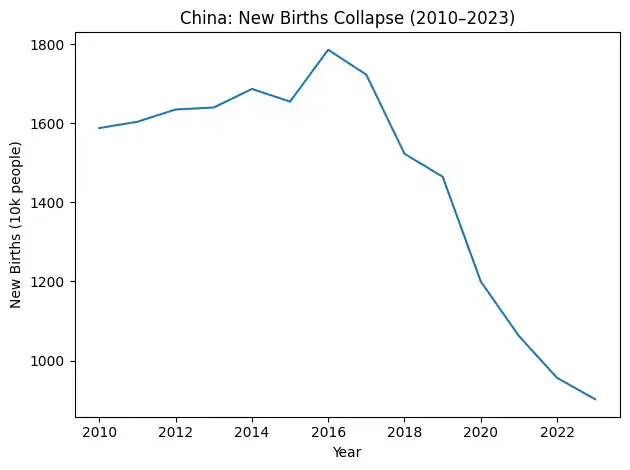
China's Birth Population Cliff (2010–2023)

Visually, what you see is not a "decline" but a clear cliff-like drop.

Taking China as an example:

  • 2016: approximately 17.86 million newborns

  • 2023: approximately 9 million newborns

  • 2025: expected to fall below 8 million

Halved in just 7 years.

What does this mean?

Those born in 2023 will enter the labor market around 2045: not "a bit fewer," but "half as many."

This is not a cyclical fluctuation but a structural collapse of the population.

More critically, this trend has been confirmed by long-term projections: according to the UN's "World Population Prospects 2022" report, China's working-age population (15–64 years) will decrease by approximately 170 million between 2020 and 2050.

In the past, business systems assumed: "People can always be hired; it's just a matter of price."

In the era of population deflation, the problem changes.

Delayed retirement, immigration, and birth subsidies are slow variables.

But business systems cannot wait twenty years.

This is precisely where all technological narratives begin to transform.

Attention and Creator Supply Shrink Simultaneously: Web2's Hidden Fatal Flaw

A declining young population brings not only a reduction in labor but also a more hidden, more fatal problem: Who will produce content, and who will consume it?

  • Declining number of content producers

  • Slower diffusion of new culture and narratives

  • Failure of platform traffic growth logic

Web2's reliance on the "user growth → traffic → advertising → commissions" model is essentially built on population expansion.

When new users no longer appear, platforms begin to compete internally, rules change frequently, and trust between creators and platforms collapses.

This is Web2's most difficult structural flaw to repair in the era of population deflation.

Systemic Collapse on the Long-Term Demand Side: Long-Termism Forced to Be Revalued

Real estate, education, long-term consumer goods, pension systems...

The commonality of these systems is: they all assume that there will be more people in the future.

When this assumption is broken, all "long-termist assets" will be repriced.

II. Why Is AI a Necessity in the Era of Population Deflation?
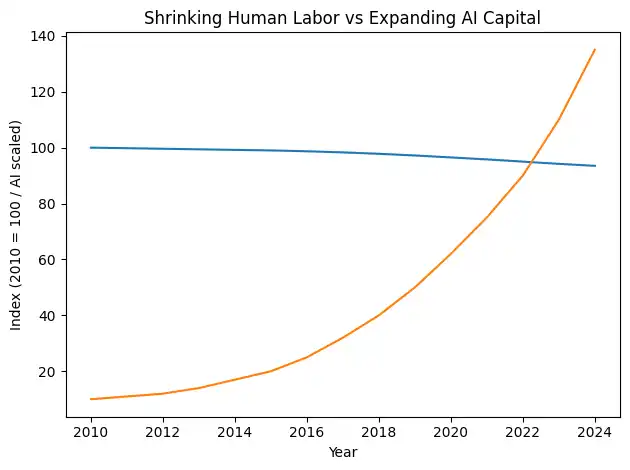
Human Labor Contraction vs. AI Capital Exponential Expansion

One side is a slow but certain decline, the other is exponential growth. The only "labor force" that can still expand is not human.

If population deflation changes the problem itself, then AI is becoming the only viable answer.

AI Is Not an Efficiency Tool but a "De-humanizing Tool"

We are accustomed to describing AI as an "efficiency tool."

But in the real world, it does not solve efficiency problems but a structural one: the system no longer needs so many people.

AI customer service, AI content generation, AI research assistants, AI trading systems - their significance is not to make people 20% faster but to remove "people" from the necessary conditions of the system.

In a population-deflated world, the real question is no longer: "Can we hire someone for this position?" but: "Does this环节 still require human participation?"

AI is not replacing inefficient people; it is rewriting the entire society's assumption of dependence on "human labor."

AI Is the Only Labor Force Capable of Exponential Growth

  • Population: Linear growth, even negative growth

  • AI: Computing power, models, data → Exponential expansion

This is also why, despite extreme macroeconomic uncertainty, capital still chooses to heavily invest in AI.

Because in the era of population deflation, only AI has the "ability to scale."

AI Allows the "Individual" to Become a Production Unit Again
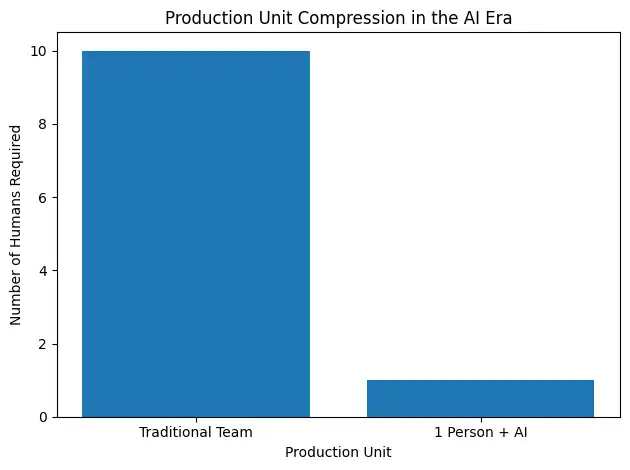
Production Unit Compression Diagram (Team → Individual + AI)

From a "10-person team" to "1 person + AI," production units are being rapidly compressed.

AI is giving rise to a new organizational form:

  • One-person companies

  • Super individuals

  • Solo Founders

  • AI Native creators

When society cannot mass-produce young people, the system can only choose to: amplify the individual.

III. What Role Does Web3 Play Here?

If AI solves "who will do the work," then Web3 solves a more fundamental problem:

In an era of fewer people, how do we collaborate, distribute, and build trust?

How to Collaborate at Low Cost in an Era of Fewer People?

DAOs, Permissionless collaboration, project-based contributions—

Web3 restructures "organizations" from long-term employment relationships into temporary, flexibly combinable collaboration networks.

When hiring people becomes increasingly expensive, trust and settlement must be automated.

How to Distribute Value in an Era of Fewer People?

In an era where labor becomes scarce, if value distribution is not transparent, the system will quickly lose participants.

Tokens, on-chain incentives, and instant settlement do not address "speculation" but a practical problem:

How to make scarce labor willing to stay and continue to build?

How to Build Long-Term Trust in an Era of Fewer People?

The younger generation's trust in long-term commitments is collapsing:

  • Distrust in pensions

  • Distrust that platforms won't change rules

  • Distrust in long-term incentives from centralized institutions

Smart contracts and on-chain rules essentially answer:

When there aren't enough people and not enough trust, can the rules execute themselves?

IV. Web3 + AI: The Complete Solution for the Era of Population Deflation

An increasingly clear judgment is forming: Web3 is not a competitor to AI but the institutional shell for the AI era.

What do AI Agents need?

  • Identity

  • Wallet

  • Autonomous transaction capability

  • Programmable rules

These are precisely the native capabilities of Web3.

In the near future, we may see:

  • AI-native companies

  • AI autonomous DAOs

  • AI-to-AI economic collaboration

In this system, humans may no longer be the largest group of economic participants.

V. Final Thoughts: What Does This Mean for the Individual?

For the individual, it is a harsh but real fact: you will no longer be lifted by the红利 of "population growth."

But it also意味着 new windows of opportunity:

  • AI amplifies individual productivity

  • Web3 allows individuals to directly participate in global systems

  • A world with fewer people is反而 more friendly to high-cognition, high-action individuals

If you are an investor/creator, here is actionable advice from Biteye:

For investors:

  • Population deflation is a 20–30 year-level certain variable, not macroeconomic noise

  • All business models relying on "population expansion" should be discounted valuations

  • Only three categories are truly worth long-term attention:

    • AI that can directly replace human labor

    • Tools that amplify individual productivity

    • Web3 infrastructure that operates in low-trust environments

For creators / individuals:

  • Stop assuming "the platform will give you long-term returns"

  • Try to turn yourself into:

    • A node that can be amplified by AI

    • A personal brand that can migrate across platforms

    • An independent production unit capable of direct settlement

After all, in the era of population deflation: the system will not take care of you, but the system needs you.

This is not an era of more and more people,

but an era where each individual must become stronger and stronger; and what you must rely on are AI and Web3.


Leituras Relacionadas

Three Months, 35 Billion Yuan: Investors Rush to Grab the OpenAI of the Physical World

Investors flock to a physical AI startup as the race for the "OpenAI of the physical world" heats up. Ji Jia Shi Jie (GigaWorld), a company dedicated to developing Artificial General Intelligence (AGI) for the physical world, has raised 3.5 billion RMB (approximately $490 million) in just three months, according to a report from investment media outlet Touzijie. The latest B2 funding round of 1 billion RMB attracted a wide range of top-tier investors, including sovereign wealth funds, industrial capital, and financial institutions. This brings the total funding for the young company, now valued over 10 billion RMB, to 3.5 billion RMB across three recent rounds. The company is led by Huang Guan, a post-90s Tsinghua University PhD with extensive experience in AI, autonomous driving, and entrepreneurship. Its core innovation is a "dual-pyramid" system comprising a five-layer data pyramid (from internet videos to real-world robot data) and a three-layer algorithm pyramid focused on world simulation, action alignment, and reinforcement learning. This system underpins its key models: the "World Action Model" (e.g., GigaBrain series for robot control) and the "World Generation Model" (e.g., GigaWorld series for simulating and understanding the physical world). Its models have reportedly achieved top rankings in global robotics benchmarks. Ji Jia Shi Jie argues that while current digital AGI excels in information processing, the next frontier is physical AGI—systems that can understand and interact with the real world. The company believes the field is approaching its "GPT-3 moment," a key inflection point in capability scaling. To achieve this, the company is pursuing a dual-market strategy. For the consumer (C) market, it launched the "SeeLight" brand and its S1 general-purpose humanoid robot, which has secured initial orders for deployment in real homes. For the business (B) market, it focuses on industrial automation with its Maker series robots, having signed agreements for large-scale deployment in factories, and its DriveDreamer world model for autonomous driving, which is already in use with over 30 automakers and tech companies. The report concludes that by bridging the gap between digital intelligence and physical action, Ji Jia Shi Jie aims to unlock a new wave of productivity, ultimately bringing physical AGI into everyday life.

marsbitHá 22m

Three Months, 35 Billion Yuan: Investors Rush to Grab the OpenAI of the Physical World

marsbitHá 22m

What's the Connection Between Pinduoduo's Huang Zheng and Blockchain?

This text explores the unexpected connection between Pinduoduo founder Colin Huang and blockchain, as suggested in his article *Turning Capitalism Upside Down*. Huang argues Pinduoduo's core business is about managing "uncertainty." He posits that wealth flows to the rich because they absorb life's uncertainties (e.g., illness, job loss) that devastate the poor, who pay a premium for certainty through insurance or stable prices. Pinduoduo's model attempts a "reverse insurance": by aggregating consumer demand via group-buying and flash sales, it creates a large, predictable order for manufacturers. This certainty allows factories to remove risk premiums, passing savings back as lower prices, thus partially reversing the wealth flow. The key obstacle, Huang notes, is that an individual's buying intent is an unreliable promise. He then asks if blockchain is the natural solution for this "reverse insurance." The text elaborates that blockchain, through smart contracts with binding deposits, could transform casual intent into a costly-to-break, enforceable commitment. This replaces interpersonal trust with coded rules, making promises credible, pricable, and resistant to fraud. Finally, the author draws a parallel to Bitcoin, framing two paths to creating certainty: the "Pinduoduo path" of aggregating decentralized will into scale, and the "Bitcoin path" of locking rules into immutable code. Both sacrifice something—personal freedom or system flexibility—to manufacture trust and predictability.

链捕手Há 1h

What's the Connection Between Pinduoduo's Huang Zheng and Blockchain?

链捕手Há 1h

The Storage Magnate Who Conquered a Trillion-Dollar Kingdom, Yet Ultimately Could Not Become the Richest

**Summary:** "The Memory Magnate Who Built a Trillion-Dollar Empire, Yet Never Became the Richest" explores the journey of Zhu Yiming, founder of GigaDevice (603986) and co-founder of the soon-to-IPO ChangXin Memory Technologies (CXMT). The article positions GigaDevice, a fabless chip designer now valued at ~¥340 billion, as a prequel to the massive IDM (Integrated Device Manufacturer) venture, CXMT. Starting in 2005 with minimal capital, Zhu strategically "picked up the pieces" by focusing on niche markets like NOR Flash and microcontrollers (MCUs), areas major players were exiting. This allowed GigaDevice to grow into a diversified semiconductor company, maintaining robust profitability even during industry downturns by controlling costs. However, the piece argues that in the highly cyclical and capital-intensive memory chip industry, the fabless model has limits. True resilience and scale require the ability for "counter-cyclical expansion" – investing heavily during downturns – a tactic only possible for IDMs like Samsung or SK Hynix. This insight led Zhu to partner with the Hefei city government in 2016 to establish CXMT, an IDM focused on DRAM. Zhu's symbolic moves, like forfeiting salary and diluting his equity, were crucial in securing the massive state and bank funding needed. CXMT's equipment base is now valued even higher than that of BYD's vast auto manufacturing empire. Despite the potential for CXMT to reach a market cap of ¥1-2 trillion upon its IPO, Zhu's indirect stake in both companies is estimated below 3%, placing his personal wealth far below that of China's top billionaires. The article concludes that his strategic vision built a trillion-yuan memory landscape, but the capital structure necessary to achieve it precluded a personal fortune of similar scale.

marsbitHá 1h

The Storage Magnate Who Conquered a Trillion-Dollar Kingdom, Yet Ultimately Could Not Become the Richest

marsbitHá 1h

XRP Ledger Daily Fees Drop Below $400 As Network Activity Question Returns

The XRP Ledger is drawing attention as daily network fees have fallen below $400. While low fees align with XRPL's design for affordable transactions and are often seen as a strength, the metric can also serve as an indicator of network demand and paid transaction volume. This data point of around $3,100 in weekly fee burn highlights the stark contrast with higher-fee chains like Ethereum and Bitcoin. The development fuels an ongoing debate. Proponents view low fees as a sign of efficiency and accessibility, while critics may question if the network is generating sufficient high-value activity relative to its market cap and payments-focused narrative. The article cautions against overstating the finding, noting a single low-fee day does not signify network failure. It instead adds context to discussions about XRPL's usage, especially alongside Ripple's broader initiatives in stablecoins (RLUSD), AI payments, and enterprise infrastructure. The report recommends monitoring for a fee rebound, checking transaction counts for a fuller picture, and confirming the trend via native explorers like Bithomp. It frames the story within a larger market shift where on-chain data, protocol updates, and infrastructure developments are becoming crucial alongside price action. The editorial stance is to present the verified data, explain its significance for assessing network activity, and avoid hype, positioning it as part of the daily crypto conversation.

bitcoinistHá 6h

XRP Ledger Daily Fees Drop Below $400 As Network Activity Question Returns

bitcoinistHá 6h

Trading

Spot
Futuros

Artigos em Destaque

Como comprar ERA

Bem-vindo à HTX.com!Tornámos a compra de Caldera (ERA) simples e conveniente.Segue o nosso guia passo a passo para iniciar a tua jornada no mundo das criptos.Passo 1: cria a tua conta HTXUtiliza o teu e-mail ou número de telefone para te inscreveres numa conta gratuita na HTX.Desfruta de um processo de inscrição sem complicações e desbloqueia todas as funcionalidades.Obter a minha contaPasso 2: vai para Comprar Cripto e escolhe o teu método de pagamentoCartão de crédito/débito: usa o teu visa ou mastercard para comprar Caldera (ERA) instantaneamente.Saldo: usa os fundos da tua conta HTX para transacionar sem problemas.Terceiros: adicionamos métodos de pagamento populares, como Google Pay e Apple Pay, para aumentar a conveniência.P2P: transaciona diretamente com outros utilizadores na HTX.Mercado de balcão (OTC): oferecemos serviços personalizados e taxas de câmbio competitivas para os traders.Passo 3: armazena teu Caldera (ERA)Depois de comprar o teu Caldera (ERA), armazena-o na tua conta HTX.Alternativamente, podes enviá-lo para outro lugar através de transferência blockchain ou usá-lo para transacionar outras criptomoedas.Passo 4: transaciona Caldera (ERA)Transaciona facilmente Caldera (ERA) no mercado à vista da HTX.Acede simplesmente à tua conta, seleciona o teu par de trading, executa as tuas transações e monitoriza em tempo real.Oferecemos uma experiência de fácil utilização tanto para principiantes como para traders experientes.

484 Visualizações TotaisPublicado em {updateTime}Atualizado em 2026.06.02

Como comprar ERA

Discussões

Bem-vindo à Comunidade HTX. Aqui, pode manter-se informado sobre os mais recentes desenvolvimentos da plataforma e obter acesso a análises profissionais de mercado. As opiniões dos utilizadores sobre o preço de ERA (ERA) são apresentadas abaixo.

活动图片












