The Era of On-Chain Voting Is Here: Do Your Stocks Truly 'Belong' to You?

marsbitPublicado em 2026-04-10Última atualização em 2026-04-10

Resumo

The era of on-chain shareholder voting is approaching, as Galaxy Digital (GLXY) pioneers the first-ever on-chain voting for a public company, scheduled for its 2026 annual meeting. This initiative, developed in partnership with fintech firm Broadridge on the Avalanche blockchain, aims to transform tokenized stocks from mere "digital IOUs" into full-fledged equity with complete voting and dividend rights. The move addresses a critical flaw in traditional finance exposed during the 2021 GameStop saga: the disconnect between nominal ownership and actual shareholder rights due to multi-layered intermediation. Broadridge’s solution enables direct, transparent, and immutable voting via digital wallets, eliminating inefficiencies and opacity in the current proxy system. Key features include multi-chain auditability, a streamlined voting interface, and real-time transparency, which could empower retail and institutional investors alike. While this innovation promises greater shareholder engagement and governance transparency, the IMF warns of potential risks, such as accelerated crisis propagation due to blockchain’s settlement speed. Widespread adoption still faces hurdles, including regulatory uncertainty, resistance from traditional financial intermediaries, and technical barriers for users. However, with major players like Nasdaq and Blackrock advancing tokenization efforts, on-chain voting could mark a significant step toward authentic ownership and shareholder-centric cap...

Remember the轰轰烈烈的"GameStop (GME) retail investors versus Wall Street" battle in 2021? At that time, countless retail investors bought GME through platforms like Robinhood, aiming to counter short-selling institutions. But a dramatic scene unfolded: multiple brokerages temporarily restricted buying, allowing only selling. Many angry investors questioned: I paid for these stocks, why can't I decide how to trade them? This exposed the rights gap between retail investors as "nominal holders" and "actual beneficiaries" in the traditional financial system.

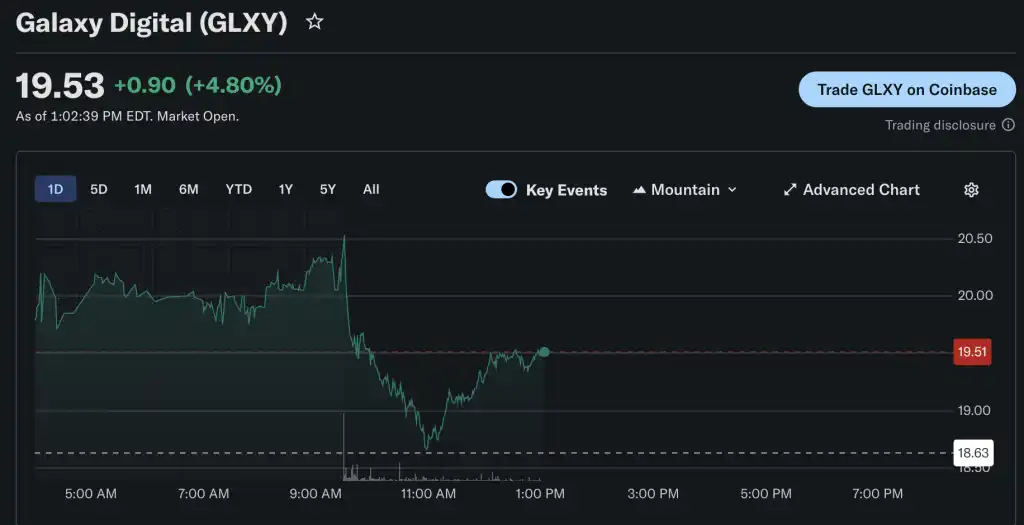
Today, a deeper transformation is taking place, one that could fundamentally solve this problem. Recently, led by cryptocurrency investment bank Galaxy Digital (GLXY), the world's first on-chain shareholder voting for a publicly traded company is set to occur at its annual meeting in May 2026. This is not just a technical experiment; it signifies that tokenized stocks are evolving from "digital replicas" into "true equity" with full shareholder rights, potentially reshaping the corporate governance landscape for decades to come.
From "Digital IOU" to "True Equity": The Coming of Age for Tokenized Assets

Over the past few years, we have witnessed the evolution of tokenized real-world assets (RWA) from concept to infrastructure. From U.S. Treasury bonds to real estate funds, various assets have been "moved" onto the blockchain. But tokenized stocks have long had an awkward "original sin": many were more like "digital IOUs" tracking stock prices or synthetic derivatives, with holders not enjoying core shareholder rights such as voting rights and dividend rights.

This might be unimportant for retail investors seeking stable returns, but for institutional investors bound by fiduciary duties (such as pension funds, mutual funds), it is a fatal flaw. They cannot invest client funds into a "pseudo-equity" without a voice. Therefore, tokenized stocks have long remained in niche trading scenarios, struggling to gain favor from mainstream institutions.

Galaxy Digital's collaboration with fintech giant Broadridge aims to pierce through this layer. Through a dedicated platform built on the Avalanche blockchain, holders of tokenized GLXY stock will be able to receive meeting materials and submit votes directly from their digital wallets. As Galaxy CEO and Wall Street legend Mike Novogratz stated: "Proxy voting is a core function of equity ownership. Enabling on-chain proxy voting for public companies is no longer a theoretical discussion."

This reminds me of my experience investing in certain Stock Connect (Hong Kong) targets. As a mainland investor, the process for participating in shareholder meeting votes was so cumbersome that it made one give up. The directness, transparency, and immutability brought by on-chain voting are the perfect remedy for such pain points.

Dissecting the "On-Chain Voting" Engine: How Transparency Defeats the "Black Box"?

Broadridge's solution is crucial because it directly addresses the core chronic problems of the traditional proxy voting system: opacity and inefficiency.

Under the current "street name" holding system centered around the Depository Trust Company (DTC), your stock may pass through multiple intermediaries like brokers, custodian banks, and clearinghouses before being registered. Your voting instruction is like a letter needing to be forwarded through multiple post offices; delays or losses at any point could prevent your voice from being heard at the shareholder meeting. Historically, cases of "vote reconciliation failure" due to this are not uncommon.

Broadridge's on-chain platform does three smart things:

  1. Direct Wallet Voting: Voting materials go directly to your digital wallet, and the voting action is completed on-chain. The path is the shortest, with no intermediaries to "cause trouble".
  2. Multi-Chain Auditing: Voting records are not stored on a single chain but are distributed across multiple chains for auditing. This is like storing meeting minutes simultaneously in a bank vault, a court archive, and the cloud. Anyone can trace and verify, greatly enhancing credibility.
  3. Unified Interface: Regardless of whether your stock is held via direct registration, through a broker, or in tokenized form, all voting data is aggregated in one interface. This solves the problem of rights fragmentation due to different holding methods.

According to data disclosed by Broadridge, its platform currently handles a monthly volume of tokenized assets reaching $8 trillion, processing over 70 billion investor communications annually. This is no longer a "small-scale test" but financial-grade infrastructure tested by massive transaction volumes. Its CEO Tim Gokey views precise and low-cost governance tools as a prerequisite for the large-scale institutional adoption of tokenized stocks, not an afterthought.

Opportunities and Undercurrents: When Corporate Governance Enters the "Live Broadcast Era"

The proliferation of on-chain voting will push corporate governance from "black box meetings" towards "transparent live broadcasts." Imagine the voting process for all major resolutions (like board elections, M&A deals, executive compensation) being real-time queryable and immutable. This would greatly reduce the information asymmetry that currently exists between registered shareholders and beneficial owners.

For active investors and activist shareholders, this is undoubtedly good news. They can more precisely aggregate voting power to drive strategic changes in companies. For listed companies, this is also a spur, forcing management to pay more attention to communication with all shareholders (especially small shareholders).

However, the International Monetary Fund (IMF) issued a sober warning in a recent report. It pointed out that tokenized finance could amplify financial crises by accelerating the transmission of market stress, as blockchain settlement speeds could outpace regulators' response times. This risk channel becomes more relevant when both governance and settlement functions migrate to shared blockchain infrastructure.

This is not alarmist. If a company's controversial resolution is quickly passed and executed via on-chain voting, market panic and selling could also spread at the speed of light. Therefore, programmable regulation (such as setting voting cooling-off periods, delayed settlement for large transactions) must develop in sync with technological innovation.

Future Outlook: Who Will Follow? What Are the Obstacles?

Galaxy Digital fired the first shot, but who is next? This is key to determining whether this transformation will be a "solo performance" or a "grand chorus."

Broadridge's platform is designed from the outset to support multiple issuers; it's not tailor-made for Galaxy. Nasdaq has received SEC approval to pilot a tokenized securities trading program, and the New York Stock Exchange is also partnering with Securitize to prepare for launching a digital trading platform. The infrastructure is falling into place.

But widespread adoption still faces obstacles:

  • Regulatory Clarity: Despite pilots, a comprehensive regulatory framework for on-chain securities issuance, trading, and governance is still under construction.
  • Traditional Interest Structures: The existing proxy voting, clearing, and settlement systems involve vast networks of interests, and change will inevitably meet resistance.
  • Technical Threshold and Security: Ordinary investors still need to learn to manage private keys and use wallets; security risks like smart contract vulnerabilities and wallet theft cannot be ignored.

From my personal market observation, since 2024, the scale of tokenized funds issued by asset management giants like BlackRock and Fidelity has continued to grow, indicating institutional capital is quietly entering the market in the form of "asset tokenization." This paves the way for "equity tokenization." Once a few benchmark tech or financial companies follow Galaxy's lead, creating a cluster effect, a tipping point could arrive quickly.

Conclusion: Your Investment, Your Rights

Ultimately, Galaxy Digital's on-chain voting experiment is about a most fundamental principle: the authenticity of ownership. In the digital age, what we invest in is not just a string of price codes, but should also be a clear, complete, and executable certificate of rights.

This transformation will not happen overnight; it will advance amidst applause, controversy, and磨合. But for every investor, it means that in the future, we might truly be able to participate more directly in the fate of the companies we invest in, as "owners." When every vote you cast is clearly recorded on-chain like an inscription, the capital market will have taken a major step towards the ideal of "shareholder primacy." Of course, while embracing new technology, we must also remain清醒 about the new risks that come with it—this is always the unerring rule of investing.


Criptomoedas em alta

Perguntas relacionadas

QWhat is the core issue exposed by the GameStop (GME) event in 2021 regarding retail investors?

AThe event exposed the rights gap between retail investors as 'nominal holders' and 'beneficial owners' in the traditional financial system, where their ability to trade was restricted despite owning the shares.

QWhat significant milestone is Galaxy Digital (GLXY) achieving in 2026, and why is it important?

AGalaxy Digital is conducting the world's first on-chain shareholder voting for a public company in May 2026. This is important because it evolves tokenized stocks from mere 'digital replicas' into 'true equity' with full shareholder rights, potentially reshaping corporate governance.

QHow does Broadridge's on-chain voting platform address the problems of traditional proxy voting systems?

AIt addresses opacity and inefficiency by enabling direct voting from digital wallets (shortest path, no intermediaries), distributing voting records across multiple chains for auditability, and providing a unified interface to aggregate votes from different holding methods.

QWhat potential downside or risk does the IMF report highlight regarding tokenized finance and on-chain governance?

AThe IMF warns that tokenized finance could amplify financial crises by accelerating the transmission of market stress, as blockchain settlement speeds may outpace regulatory responses, especially when governance and settlement functions share the same infrastructure.

QWhat are some key obstacles to the widespread adoption of on-chain voting and tokenized securities?

AKey obstacles include the need for clearer comprehensive regulatory frameworks, resistance from existing traditional financial利益格局 (interest networks), and challenges like technical barriers for investors (e.g., managing private keys) and security risks (e.g., smart contract vulnerabilities).

Leituras Relacionadas

In Conversation with Ray Dalio: We Are Currently in an AI Bubble, with 1% of My Portfolio in Bitcoin

Ray Dalio, founder of Bridgewater Associates, warns in an interview that the current AI boom shows classic bubble characteristics, which could lead to significant economic downturns as seen in past cycles like 1929 or 2000. He explains that speculative enthusiasm, fueled by debt and overvaluation, often precedes a crash when rising rates or taxation force asset sales, causing widespread losses and recession. Dalio also outlines his "Big Cycle" theory, describing an approximate 80-year pattern where widening wealth gaps, massive government deficits, and shifting geopolitical power (like China's rise) create internal conflict and global instability. He emphasizes that we are in a late-cycle, transitional phase where traditional powers like the US and UK face decline. For personal wealth protection, Dalio advises diversification beyond cash into assets like stocks, bonds, real estate, and particularly gold, which he prefers over Bitcoin. While he holds about 1% of his portfolio in Bitcoin as a non-printable hard asset, he views gold as more secure from technological or governmental threats. Regarding AI's impact, Dalio believes it will disproportionately benefit capital owners, worsening inequality by replacing both physical and cognitive labor. He suggests that human intuition and emotional intelligence, combined with AI, will be key for future workers. On taxation, Dalio argues that wealth taxes are impractical and risk triggering asset sell-offs, reducing productive investment. He points to the UK as a cautionary example of debt, low productivity, and political strife. Geopolitically, Dalio foresees a more regionalized world, with the US showing weakness in prolonged conflicts like with Iran, akin to past imperial declines. The ideal outcome, he suggests, is coexisting powerful blocs (e.g., Americas, China-Asia Pacific) without major war.

marsbitHá 3h

In Conversation with Ray Dalio: We Are Currently in an AI Bubble, with 1% of My Portfolio in Bitcoin

marsbitHá 3h

Daily 7.2 Trillion KRW: Foreign Capital's Record Net Buying on Friday! Wall Street Says Headwinds for Korean Stock Fund Flows Have Subsided

South Korean stock market sees a dramatic shift in fund flows. On July 31, foreign investors made a record net purchase of approximately KRW 7.2 trillion in KOSPI stocks, marking a fundamental reversal from the persistent large-scale net outflows seen in previous months. This contributed to a significant narrowing of foreign net selling in July to KRW 9.8 trillion, down sharply from KRW 48.4 trillion in June and KRW 44.5 trillion in May. Simultaneously, domestic institutional pressure eased. South Korean pension funds and asset managers turned to a net buying position in July, purchasing KRW 1.0 trillion worth of KOSPI shares, contrasting with net sales in May and June. Market volatility is expected to be dampened by new financial regulations. Effective July 31, the Financial Services Commission tightened access for retail investors to single-stock leveraged ETFs by raising the minimum cash deposit requirement. Trading volumes for these products subsequently dropped to about 50% of their monthly average. Citigroup Research maintains its year-end KOSPI target of 10,000 points. The firm cites several supportive factors: the substantial easing of headwinds from capital outflows, a robust fundamental outlook for the semiconductor sector, historically low market valuations, strong economic fundamentals, and the potential for policy support from financial authorities if needed.

marsbitHá 3h

Daily 7.2 Trillion KRW: Foreign Capital's Record Net Buying on Friday! Wall Street Says Headwinds for Korean Stock Fund Flows Have Subsided

marsbitHá 3h

Thanks to Dice Rolls, Bitcoin Keys Are Stored Offline, But Not Everyone Will Do It

The article discusses using dice rolls to generate secure Bitcoin wallet seeds, providing entropy independent of potentially flawed hardware random number generators. It explains that each fair dice roll offers about 2.585 bits of entropy, with around 50 rolls needed for a standard 12-word seed phrase and 99+ recommended for higher security. This method gained attention after a vulnerability was revealed in some Coldcard hardware wallets, where a faulty firmware RNG (dating back to 2021) compromised generated keys. The analysis notes that while a dice-generated main seed was safe from this specific flaw, other Coldcard functions (like creating paper wallets, backup keys, or passwords) could still be vulnerable if they used the defective RNG. The piece argues that while dice-based entropy is technically robust, the manual process is error-prone, tedious, and unrealistic for most new users, who might make mistakes in recording or inputting rolls. It concludes that while manual entropy generation should remain an option for advanced users, the long-term goal is to develop reliable, user-friendly hardware and software that securely generates randomness without requiring specialized knowledge. Coldcard users are advised to check their firmware version and replace any secondary secrets (like paper wallet keys) created with vulnerable devices, while also considering multi-signature setups with devices from different manufacturers for added security.

cryptonews.ruHá 8h

Thanks to Dice Rolls, Bitcoin Keys Are Stored Offline, But Not Everyone Will Do It

cryptonews.ruHá 8h

Trading

Spot

Artigos em Destaque

Como comprar ERA

Bem-vindo à HTX.com!Tornámos a compra de Caldera (ERA) simples e conveniente.Segue o nosso guia passo a passo para iniciar a tua jornada no mundo das criptos.Passo 1: cria a tua conta HTXUtiliza o teu e-mail ou número de telefone para te inscreveres numa conta gratuita na HTX.Desfruta de um processo de inscrição sem complicações e desbloqueia todas as funcionalidades.Obter a minha contaPasso 2: vai para Comprar Cripto e escolhe o teu método de pagamentoCartão de crédito/débito: usa o teu visa ou mastercard para comprar Caldera (ERA) instantaneamente.Saldo: usa os fundos da tua conta HTX para transacionar sem problemas.Terceiros: adicionamos métodos de pagamento populares, como Google Pay e Apple Pay, para aumentar a conveniência.P2P: transaciona diretamente com outros utilizadores na HTX.Mercado de balcão (OTC): oferecemos serviços personalizados e taxas de câmbio competitivas para os traders.Passo 3: armazena teu Caldera (ERA)Depois de comprar o teu Caldera (ERA), armazena-o na tua conta HTX.Alternativamente, podes enviá-lo para outro lugar através de transferência blockchain ou usá-lo para transacionar outras criptomoedas.Passo 4: transaciona Caldera (ERA)Transaciona facilmente Caldera (ERA) no mercado à vista da HTX.Acede simplesmente à tua conta, seleciona o teu par de trading, executa as tuas transações e monitoriza em tempo real.Oferecemos uma experiência de fácil utilização tanto para principiantes como para traders experientes.

546 Visualizações TotaisPublicado em {updateTime}Atualizado em 2026.06.02

Como comprar ERA

Discussões

Bem-vindo à Comunidade HTX. Aqui, pode manter-se informado sobre os mais recentes desenvolvimentos da plataforma e obter acesso a análises profissionais de mercado. As opiniões dos utilizadores sobre o preço de ERA (ERA) são apresentadas abaixo.

活动图片












