The Dollar Teeters, ECB Economist Reveals the Truth About Bitcoin as a Safe Haven

marsbitPublicado em 2026-01-20Última atualização em 2026-01-20

Resumo

European Central Bank Chief Economist Philip Lane warns that political pressure on the Federal Reserve could undermine the U.S. dollar's global standing by driving up U.S. term premiums and triggering a reassessment of dollar-denominated assets. This could destabilize global markets through key channels like real yields, dollar liquidity, and institutional credibility. While recent geopolitical tensions initially drove oil and inflation expectations higher, Lane highlights a deeper risk: a "governance discount" on U.S. assets that could cause term premiums to spike even without Fed rate changes. Bitcoin, highly sensitive to liquidity and discount rates, faces two potential macro scenarios: in a traditional "yield differential" paradigm, higher U.S. rates strengthen the dollar and pressure risk assets like Bitcoin; in a "credibility risk" paradigm, dollar weakness coupled with rising term premiums could position Bitcoin as a monetary escape valve. The crypto ecosystem’s reliance on dollar-backed stablecoins ties it directly to U.S. Treasury dynamics, meaning term premium shocks could affect stablecoin yields and on-chain liquidity. Key indicators to watch include term premiums, TIPS yields, inflation expectations, DXY movements, Bitcoin ETF flows, and options positioning. Lane’s warning underscores that a repricing of dollar risk could create a regime shift, with Bitcoin reacting more sharply than traditional assets.

Author: Gino Matos

Compiled by: Deep Tide TechFlow

Deep Tide Introduction: Against the backdrop of global macroeconomic volatility and escalating geopolitical tensions, Philip Lane, Chief Economist of the European Central Bank (ECB), has issued a rare warning: the "tussle" between the Federal Reserve and political forces could jeopardize the international status of the US dollar.

This article delves into how this political pressure is transmitted to global financial markets through the term premium and explains why, at this moment of a shaking credit system, Bitcoin might become the last safe haven for investors.

The author combines multi-dimensional data, including US Treasury yields, inflation expectations, and the stablecoin ecosystem, to break down the two截然不同的 (distinctly different) macro paradigms that Bitcoin may face in the future.

Full Text Below:

European Central Bank (ECB) Chief Economist Philip Lane issued a warning that most market participants initially viewed merely as European "housekeeping": while the ECB can currently maintain its easing path, the "tussle" around the Federal Reserve's mandate independence could lead to global market turbulence by pushing up US term premiums and triggering a reassessment of the dollar's role.

Lane's framing is crucial because it identifies several specific transmission channels that most significantly impact Bitcoin: real yields, dollar liquidity, and the credibility framework underpinning the current macro system.

The immediate trigger for the recent market cool-down was geopolitics. As concerns about a US strike on Iran subsided, the risk premium on crude oil weakened. At the time of writing, Brent crude fell to around $63.55, and West Texas Intermediate (WTI) fell to around $59.64, down about 4.5% from the high on January 14th.

This at least temporarily severed the chain reaction from geopolitics to inflation expectations to the bond market.

However, Lane's comments point to another risk: not a supply shock or growth data, but political pressure imposed on the Fed, which could force the market to reassess US assets based on governance factors rather than fundamentals.

The International Monetary Fund (IMF) has also emphasized in recent weeks that the Fed's independence is crucial, noting that a weakening of independence would have a "negative impact on credit ratings." This type of institutional risk often manifests in term premiums and foreign exchange risk premiums before it makes headlines.

The term premium is the component of long-term yield that compensates investors for uncertainty and duration risk, independent of expected future short-term rates.

As of mid-January, the New York Fed's ACM term premium remained around 0.70%, while the St. Louis Fed's (FRED) 10-year zero-coupon valuation was approximately 0.59%. On January 14th, the 10-year Treasury nominal yield was about 4.15%, the 10-year TIPS real yield was 1.86%, and the 5-year breakeven inflation expectation (January 15th) was 2.36%.

By recent standards, these figures are in a stable range. But Lane's core point is that this stability could quickly unravel if the market begins to price a "governance discount" into US assets. A term premium shock doesn't require the Fed to raise rates; it can occur when credibility is damaged, pulling long-end yields higher even if policy rates remain unchanged.
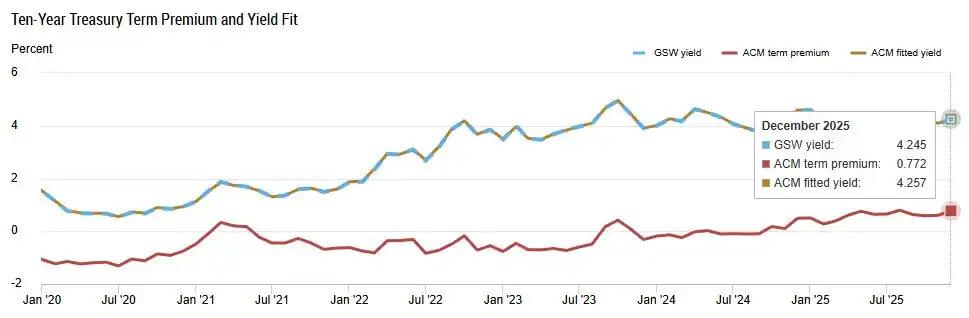
Caption: The 10-year US Treasury term premium rose to 0.772% in December 2025, its highest level since 2020, while the yield reached 4.245%.

The Term Premium Channel is the Discount Rate Channel

Bitcoin exists in the same "discount rate universe" as stocks and other duration-sensitive assets.

When the term premium rises, long-end yields climb, financial conditions tighten, and liquidity premiums compress. ECB research documents how the dollar exchange rate appreciates with Fed tightening across multiple policy dimensions, making US rates the core pricing kernel for global pricing.

Bitcoin's historical upward momentum has often come from the expansion of liquidity premiums: when real yields are low, discount rates are easy, and risk appetite is high.

A term premium shock reverses this dynamic without the Fed changing the federal funds rate. This is why Lane's argument is significant for cryptocurrencies, even though he was speaking to European policymakers at the time.

On January 16th, the US Dollar Index (DXY) was around 99.29, near the low end of its recent trading range. But the "reassessment of the dollar's role" mentioned by Lane opens up two截然不同的 (distinctly different) scenarios, not a single outcome.

In the traditional "yield differential" paradigm, higher US yields strengthen the dollar, tighten global liquidity, and pressure risk assets, including Bitcoin. Research shows that post-2020, cryptocurrency correlation with macro assets is stronger, and in some samples, it shows a negative correlation with the DXY.

But in the credibility risk paradigm, the outcome diverges: if investors demand a premium for US assets due to governance risk, the term premium could rise even as the dollar weakens or fluctuates. In this case, Bitcoin would trade more like a "release valve" or alternative monetary asset, especially if inflation expectations rise alongside credibility concerns.

Furthermore, Bitcoin is now more connected to equities, AI narratives, and Fed signals than in previous cycles.

According to Farside Investors data, Bitcoin ETFs saw net inflows again in January, totaling over $1.6 billion. Coin Metrics notes that open interest in spot options is concentrated near the $100,000 strike price expiring at the end of January.

This positioning means a macro shock could be amplified through leverage and Gamma dynamics, turning the abstract "term premium" concern mentioned into a concrete catalyst for market volatility.
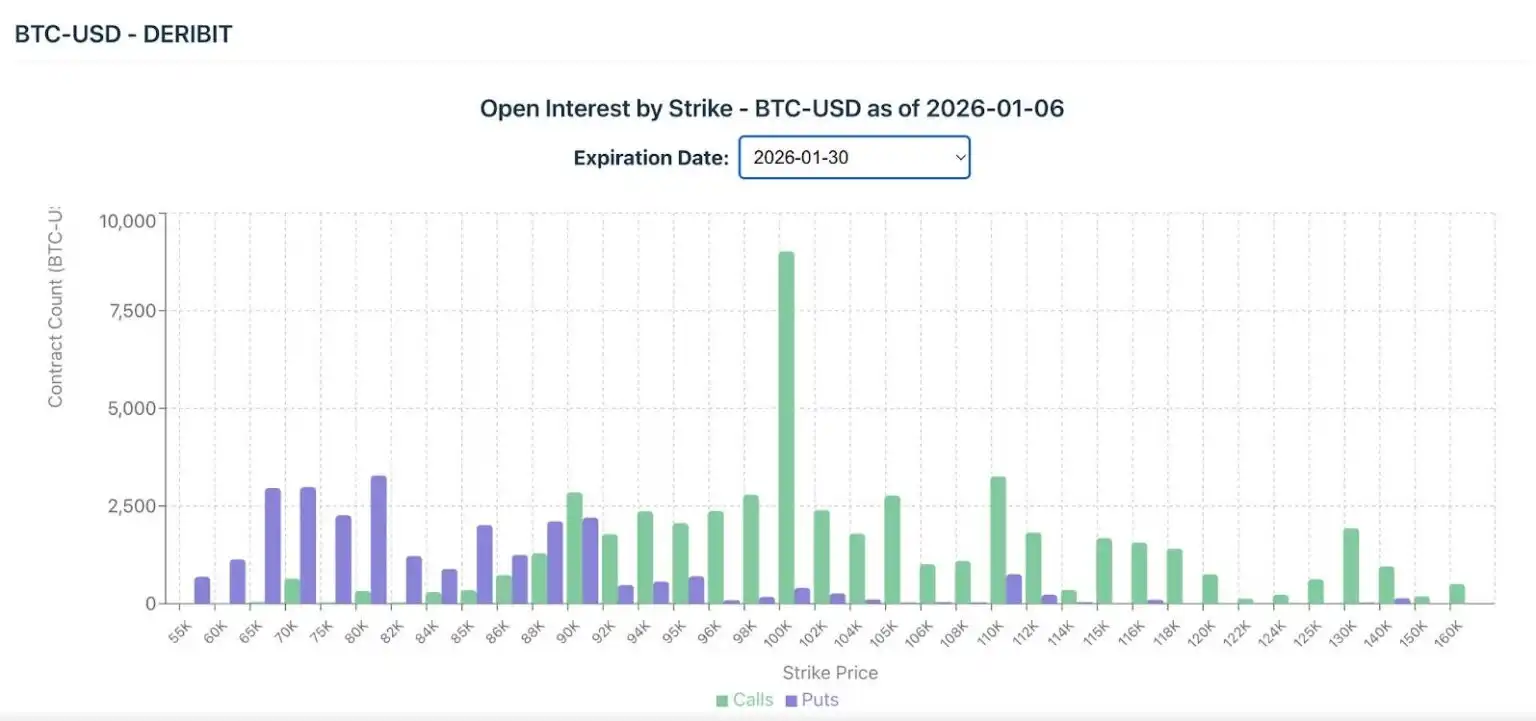
Caption: Open interest for Bitcoin options expiring January 30, 2026, shows over 9,000 call contracts concentrated at the $100,000 strike price.

Stablecoin Infrastructure Makes Dollar Risk "Crypto-Native"

A significant portion of the cryptocurrency trading layer operates on dollar-denominated stablecoins, which are backed by safe assets (typically US Treasuries).

Research from the Bank for International Settlements (BIS) links stablecoins to the pricing dynamics of safe assets. This means a term premium shock is not just some "macro vibe"; it directly permeates stablecoin yields, demand, and on-chain liquidity conditions.

When the term premium rises, the cost of holding duration increases, which could affect stablecoin reserve management and alter the liquidity available for risk trades. Bitcoin might not be a direct substitute for US Treasuries, but it exists in an ecosystem where Treasury pricing sets the benchmark for the definition of "risk-free."

Currently, the market sees about a 95% chance the Fed holds rates steady at its January meeting, with major banks pushing expected rate cuts into 2026.

This consensus reflects confidence in near-term policy continuity, thereby anchoring term premiums. But Lane's warning is forward-looking: if this confidence cracks, the term premium could jump 25 to 75 basis points within weeks, without any change in the funds rate.

A mechanical example: if the term premium rises 50 basis points and expected short-term rates hold steady, the 10-year nominal yield could drift from 4.15% towards 4.65%, with real yields repricing in sync.

For Bitcoin, this implies tighter financial conditions and brings downside risk through the same channels that squeeze high-duration stocks.

However, if triggered by a credibility shock causing dollar weakness, the risk profile becomes completely different.

If global investors begin reducing US asset holdings based on governance grounds, the dollar could weaken even as the term premium rises. In this scenario, Bitcoin's volatility would spike dramatically, and its direction would depend on whether the yield differential paradigm or the credibility risk paradigm dominates at that time.

While academia still debates Bitcoin's "inflation hedge" properties, the dominant channel in most risk regimes remains real yields and liquidity, not simply breakeven inflation expectations.

Philip Lane's argument forces us to consider both possibilities simultaneously. This is why a "dollar repricing" is not a one-way bet but a fork in the regime road.

Watchlist

The checklist for tracking this development is clear:

At the Macro Level:

  • Term Premiums
  • 10-year TIPS Real Yields
  • 5-Year Breakeven Inflation Expectations
  • US Dollar Index (DXY) Level and its Volatility

At the Crypto Level:

  • Bitcoin Spot ETF Flows
  • Options Open Interest around Key Strikes (e.g., $100,000)
  • Changes in Skew around Major Macro Events

These indicators link Lane's warning to Bitcoin's price action without speculating on the Fed's future policy decisions.

Lane's signal was initially sent to European markets, but the "pipes" he describes are the very logic that determines Bitcoin's macro environment. The oil premium has faded, but the "governance risk" he pinpointed remains.

If the market begins pricing in the Fed's political tussle, this shock will by no means be confined to the US. It will be传导 (transmitted) globally through the Dollar and the Yield Curve, and Bitcoin's reaction to such a shock is often sharper and earlier than that of most traditional assets.


Perguntas relacionadas

QWhat warning did European Central Bank (ECB) chief economist Philip Lane issue regarding the US Federal Reserve?

APhilip Lane warned that the 'tussle' over the Federal Reserve's mandate independence could lead to global market turbulence by pushing up US term premiums and triggering a reassessment of the dollar's role.

QHow might a rise in term premiums affect Bitcoin according to the article?

AA rise in term premiums could tighten financial conditions, compress liquidity premiums, and create downward pressure on Bitcoin, as it exists in the same 'discount rate universe' as other duration-sensitive assets.

QWhat are the two different scenarios for Bitcoin if investors demand a premium for US assets due to governance risks?

AIn a credibility risk paradigm, Bitcoin could trade more like a 'release valve' or alternative monetary asset, especially if inflation expectations rise alongside governance concerns, potentially leading to volatility and a different risk profile compared to the yield differential paradigm.

QHow do stablecoins relate to US Treasury pricing and term premium shocks?

AStablecoins, which are largely dollar-denominated and backed by safe assets like US Treasuries, are linked to the pricing dynamics of these assets. A term premium shock could affect stablecoin yields, demand, and on-chain liquidity conditions.

QWhat key indicators should be monitored to assess the impact of Lane's warning on Bitcoin?

AKey indicators include term premiums, 10-year TIPS real yields, 5-year breakeven inflation expectations, the Dollar Index (DXY), Bitcoin spot ETF flows, options open interest around key strike prices like $100,000, and changes in skew around major macro events.

Leituras Relacionadas

From Gold to Bitcoin: Fixed Supply + Institutional Frenzy, Might It Repeat the 'Explosive' Price Trend?

"From Gold to Bitcoin: Fixed Supply and Institutional Frenzy May Lead to 'Explosive' Price Rally Analysts suggest Bitcoin's price action could mirror gold's over the past two decades, following the launch of spot Bitcoin ETFs. Gold ETFs, introduced in 2004, drove gold's price surge to a current market cap near $28 trillion. Both gold and Bitcoin are non-yielding stores of value, with prices driven purely by investor sentiment rather than cash flows or credit. Gold ETFs experienced dramatic cycles: explosive growth, painful drawdowns, and slow recoveries, with each cycle reaching higher peaks. Bitcoin ETFs, approved in early 2024, saw rapid institutional adoption but are now facing similar volatility. Recent warnings highlight the risk of significant ETF outflows disrupting the current rebound. BlackRock's IBIT, a leading Bitcoin ETF, has sold nearly 100,000 BTC to meet redemptions while still holding over 733,000. The core parallel is fixed supply: when demand surges, prices explode, but demand is often volatile and wave-like, not steady. Institutional interest, through ETFs and corporate adoption, remains a key support pillar, helping to cushion sell-offs. If Bitcoin captures even a fraction of gold's role as a store of value, its upside potential is immense, though the path will be marked by high volatility. For investors, focusing on long-term trends and managing risk is crucial as this 'price explosion' narrative unfolds."

Foresight NewsHá 15m

From Gold to Bitcoin: Fixed Supply + Institutional Frenzy, Might It Repeat the 'Explosive' Price Trend?

Foresight NewsHá 15m

Why Is AI Agent Shopping Hard to Popularize?

The article argues that the popular narrative of "AI agent shopping" – equipping AI with a wallet to autonomously handle purchases – is fundamentally flawed and oversimplifies the complexity of shopping. It deconstructs shopping into two core actions: **information retrieval** (standardized, easily automated) and **value judgment** (deeply subjective and human-centric). The narrative mistakenly assumes AI can fully handle both. Value judgment itself has two layers: **evaluation** (assessing options against criteria) and **demand definition** (setting the criteria, weights, and values). The latter is inherently human and dynamic, as preferences are not fixed but constructed during the decision-making process ("constructive preferences"). The real dividing line for automation is not product standardization, but whether the **act of choosing** itself holds experiential value. For mundane purchases (e.g., printer paper), full AI delegation works. For experiential goods (e.g., wine, furniture), the joy of selection is core to consumption, so AI should act as an assistant that narrows options, leaving the final choice to humans. The "AI wallet" concept confuses three separate elements: decision-making, execution, and fund custody. Current payment industry solutions (e.g., from Stripe, Mastercard, Google, Visa) show that limited, scoped payment authorization tokens are sufficient for most consumer scenarios, not full fund custody. The true use case for autonomous AI wallets is in **B2B procurement** and **machine-to-machine (M2M) settlements** for standardized, high-frequency, low-value transactions. The real bottlenecks for AI shopping are not payment technology, but **1) the lack of trusted data sources** (e.g., fake reviews, counterfeit goods) and **2) the impossibility of automating human demand definition**. The conclusion is that the focus should be on safely automating the assessment and filtering process while reserving for humans the rights to define their criteria and enjoy the final act of choice. For experiential goods, the platform's competitive advantage shifts to providing a superior selection experience.

Foresight NewsHá 1h

Why Is AI Agent Shopping Hard to Popularize?

Foresight NewsHá 1h

After Nine Months of Shorting, a Full Turn to Long: Renowned Trader Opens Bitcoin Positions Around 64K, Crypto Market Long-Short Divergence Intensifies

After nine months of being short, prominent crypto trader Doctor Profit has closed all his bearish positions and started buying Bitcoin near $64,000, signaling a complete bullish reversal. He argues that structural market changes—such as impending U.S. regulation (CLARITY Act) and institutional adoption via securities tokenization—are rewriting the traditional four-year cycle script, potentially bringing the market bottom forward from the widely expected September/October timeframe. This view finds some technical support from on-chain analyst gumsays, who notes a bullish divergence on Bitcoin's weekly chart has persisted for 147 days, nearing the 161-day duration seen before the 2022 cycle low. However, cycle researcher Jake Pahor presents a counter-argument based on historical data. Analyzing patterns since 2014, he identifies three common features of past bear market bottoms: a ~12-month duration from peak to trough, a sustained period of extreme fear (with a proprietary risk score below 20), and the price falling below Bitcoin's realized price (~$53,000 currently). The current cycle, only nine months from its October 2025 peak, meets none of these conditions. The debate highlights a market torn between "front-running" a potential early bottom driven by new fundamentals and waiting for confirmation through traditional on-chain and sentiment metrics. While Doctor Profit opts for aggressive buying, Pahor maintains a disciplined, tiered accumulation strategy, continuing weekly buys at current risk levels but reserving larger orders for if more extreme fear emerges.

marsbitHá 1h

After Nine Months of Shorting, a Full Turn to Long: Renowned Trader Opens Bitcoin Positions Around 64K, Crypto Market Long-Short Divergence Intensifies

marsbitHá 1h

Senior Trader's Confession: How to Trade Market's False Expectations?

Veteran trader's case study: trading the market's "wrong expectations". This trade centered on a textbook "expectation error" after a weak CPI report. While the market initially priced in broad monetary easing (sending Nasdaq to 30,060), the crucial 30-year real yield hit a 20-year high. This signaled a fractured transmission mechanism: short-term rates eased, but long-term funding costs (vital for tech valuations) refused to fall. The trader executed five short positions on the Nasdaq (NQ) as it fell from 30,060 to 28,768. The core methodology: don't just trade the data, but analyze the market's implied causal chain and identify where it breaks. In this case, the chain was: Weak CPI → Policy Easing → Lower Long-Term Funding Costs → NQ Valuation Expansion. The break occurred between policy easing and long-term rates. The "veto variable" – long-term real yields – refused to confirm the bullish narrative. Trades were structured around "fast variables" (price) temporarily repairing while "slow variables" (funding conditions) remained broken. The article outlines a repeatable framework: 1) Map the market's implied causal chain. 2) Identify the veto variable. 3) Observe if it rejects the narrative. 4) Enter when price still follows the old script. 5) Choose the cleanest asset expression (e.g., short NQ, not broad S&P). 6) Define both invalidation and fulfillment exit conditions. The key insight: Alpha often comes not from an information edge, but from a "reaction function edge" – recognizing when the market is applying an outdated causal logic to new data. The critical question: What causal chain is the market's first reaction relying on, and is that chain still valid today?

marsbitHá 2h

Senior Trader's Confession: How to Trade Market's False Expectations?

marsbitHá 2h

Trading

Spot
活动图片