The dollar is weakening – The next crypto rally might start from Japan

ambcryptoPublicado em 2026-04-07Última atualização em 2026-04-07

Resumo

The article discusses how the weakening US dollar, combined with Japan's rising bond yields, could trigger the next cryptocurrency rally. Japan's 10-year bond yield has reached a multi-decade high of 2.42%, signaling persistent inflation and potential monetary tightening by the Bank of Japan. This has caused the yen to stabilize after a period of weakness, impacting the JPY/USD pair. Concurrently, cooling US Treasury yields are contributing to a softer US Dollar Index (DXY). Historically, a weaker dollar leads investors to rotate capital from traditional safe-haven assets into riskier ones like crypto, seeking higher returns. Analysts, including Peter Schiff, suggest an overvalued dollar could be a key catalyst for capital flowing into crypto markets. The convergence of these factors—rising Japanese yields reshaping global capital flows and a softening dollar—creates a favorable macro environment for a potential crypto market rally.

The ongoing West Asia crisis is still creating ripple effects across global markets. And Japan is becoming a clear case study.

Data from Trading Economics shows Japan’s 10-year bond yield climbing to 2.42%, the highest level in nearly three decades.

Rising yields point to persistent inflation pressure, leaving the Bank of Japan with little room to cut rates. Instead, markets are slowly starting to price in the possibility of further tightening.

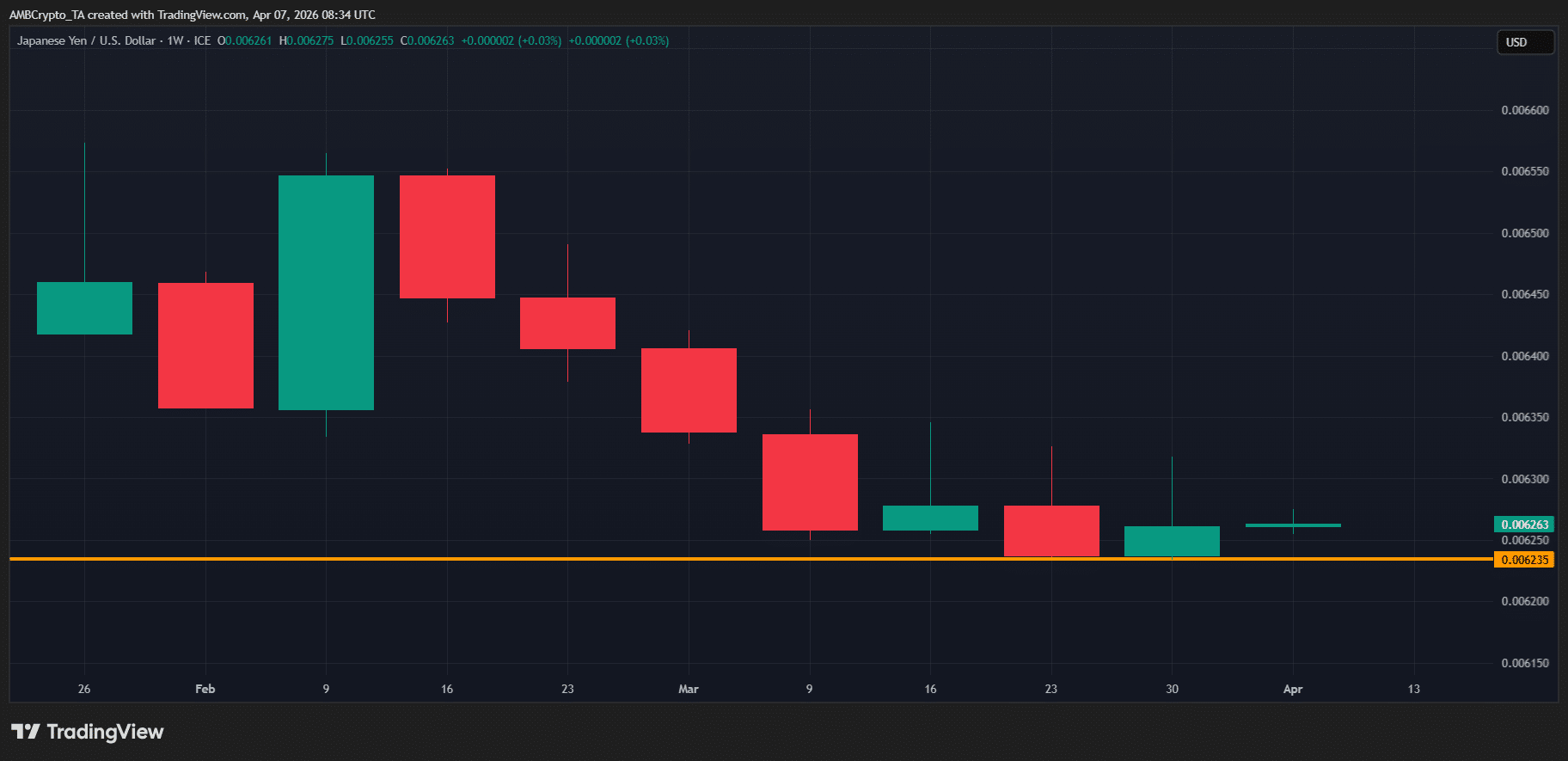
Notably, the currency market is already reacting. Throughout most of March, the JPY/USD pair moved into consolidation, and a similar structure is now forming in April, potentially signaling a local bottom.

For crypto markets, this is a macro signal worth paying attention to.
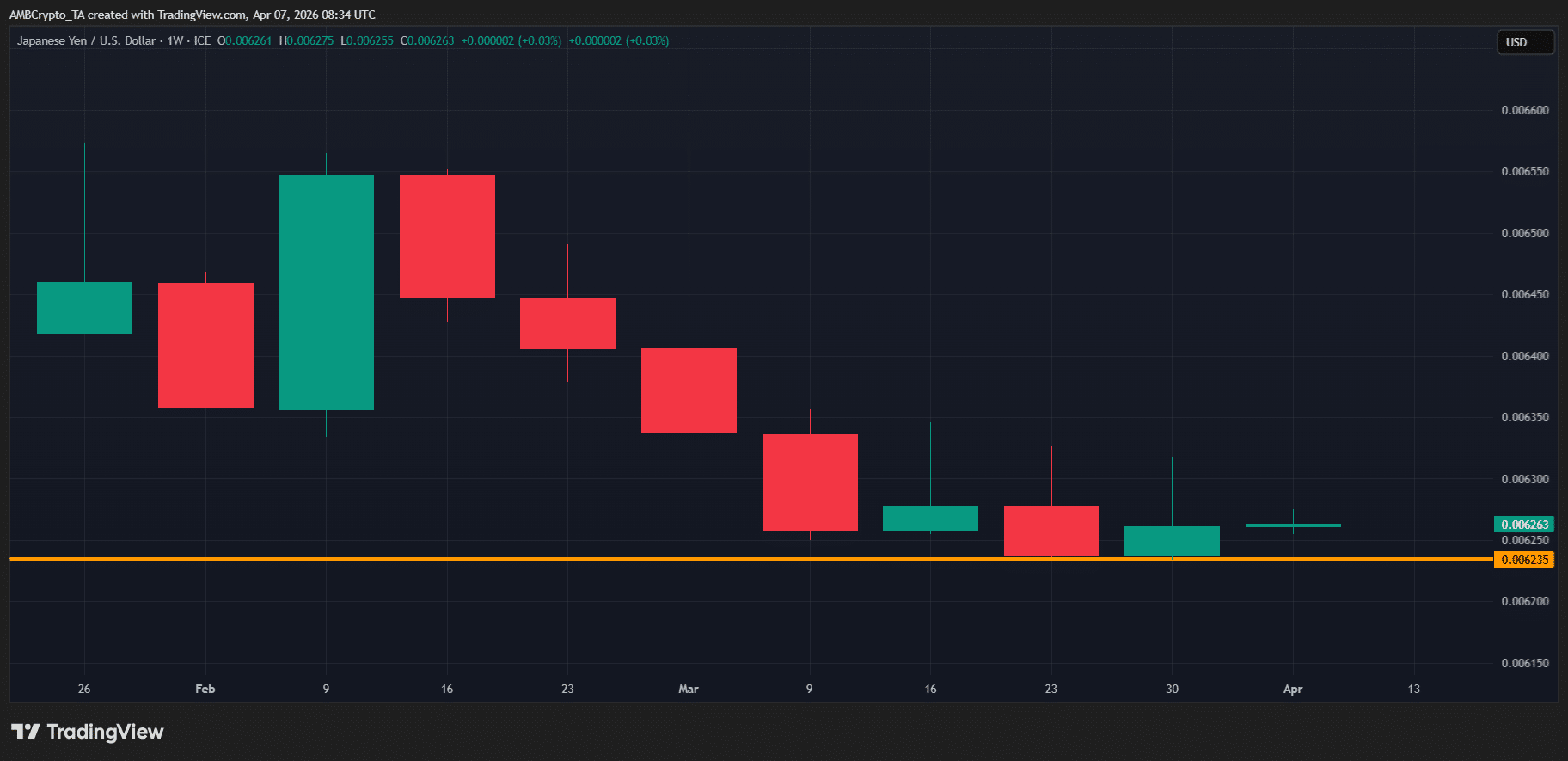
Source: TradingView (JPY/USD)

From a technical standpoint, rising bond yields usually point to capital rotating toward traditional safe-haven assets as investors prepare for tighter monetary conditions and the possibility of further rate hikes.

At the same time, the choppy behavior in the JPY/USD pair reflects the aftereffect of this adjustment phase.

In simple terms, the yen appears to be transitioning from sustained weakness into a stabilization phase. However, the bigger takeaway for crypto is what this means for the U.S. Dollar Index (DXY).

Historically, periods of dollar weakness have triggered capital rotation into risk assets, as yields from traditional safe havens become less competitive compared to the faster upside potential seen in equities and crypto.

Naturally, that raises a key question: Could a weaker dollar give crypto the macro tailwind it needs to break through the current FUD?

Analysts point to an overvalued dollar as crypto’s catalyst

U.S. Treasury yields are cooling off, and the dollar is starting to reflect it.

According to Trading Economics, the 10-year U.S. Treasury yield has dropped nearly 3% from its late-March peak of 4.43%, the highest level since July 2025.

This pullback highlights how ongoing geopolitical tensions have weighed on inflation and put the Fed in a tricky spot. The cooldown, however, now points to a shift in market expectations, with investors starting to price in a softer monetary stance.

Notably, the impact is showing up in markets. The DXY is down 0.35% this week after topping 100, while the total crypto market cap has rallied 3.5% since kicking off April’s run.

Taken together, this reinforces Peter Schiff’s point: An overvalued dollar can act as a catalyst for capital rotation into risk assets, including crypto.
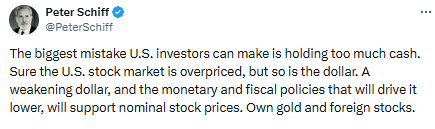
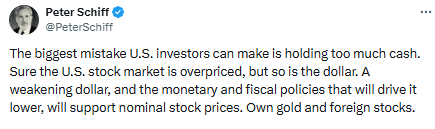
Source: X

In this context, Japan’s yield jumping to a multi-year high starts to carry real weight. Economically, rising Japanese yields are starting to shift global capital flows, as investors rotate into the yen and Japanese bonds, reshaping liquidity patterns.

When combined with a softening dollar, this setup becomes even more significant, creating conditions that could support inflows into risk assets like crypto.

For investors, this is a key macro signal to watch closely, highlighting where capital might flow next.


Final Summary

  • Japan’s multi-year high yields are reshaping capital flows, creating favorable conditions for crypto.
  • An overvalued dollar, as Peter Schiff highlights, can act as a key catalyst driving crypto inflows.


Perguntas relacionadas

QWhat is the significance of Japan's 10-year bond yield reaching 2.42%?

AJapan's 10-year bond yield climbing to 2.42% is the highest level in nearly three decades, indicating persistent inflation pressure and limiting the Bank of Japan's ability to cut rates, with markets starting to price in further monetary tightening.

QHow is the currency market, specifically the JPY/USD pair, reacting to these economic conditions?

AThe JPY/USD pair moved into consolidation throughout most of March and is forming a similar structure in April, which potentially signals a local bottom and a transition of the yen from sustained weakness into a stabilization phase.

QAccording to the article, what historical relationship exists between the U.S. dollar and risk assets like crypto?

AHistorically, periods of dollar weakness have triggered capital rotation into risk assets, as yields from traditional safe havens become less competitive compared to the faster upside potential seen in equities and crypto.

QWho is cited as pointing out that an overvalued dollar can act as a catalyst for crypto, and what evidence supports this view?

APeter Schiff is cited, and the evidence includes the DXY dropping 0.35% after topping 100 while the total crypto market cap rallied 3.5%, indicating a shift in capital flows.

QWhat is the combined effect of Japan's rising yields and a softening U.S. dollar, according to the analysis?

AThe combination of Japan's multi-year high yields shifting global capital flows and a softening U.S. dollar creates significant conditions that could support inflows into risk assets like cryptocurrency.

Leituras Relacionadas

Arbitrum Pretends to Be the Hacker, 'Steals' Back the Money Lost by KelpDAO

Title: Arbitrum Poses as Hacker to Recover Stolen Funds from KelpDAO Last week, KelpDAO suffered a hack resulting in nearly $300 million in losses, marking the largest DeFi security incident this year. Approximately 30,765 ETH (worth over $70 million) remained on an Arbitrum address controlled by the attacker. In an unprecedented move, Arbitrum’s Security Council utilized its emergency authority to upgrade the Inbox bridge contract, adding a function that allowed them to impersonate the hacker’s address and initiate a transfer without access to its private key. The council’s action, approved by 9 of its 12 members, moved the stolen ETH to a frozen address in a single transaction before reverting the contract to its original state. The operation was coordinated with law enforcement, which attributed the attack to North Korea’s Lazarus Group. Community reactions are divided: some praise the recovery of funds, while others question the centralization of power, as the council can upgrade core contracts without governance votes. However, such emergency mechanisms are common among major L2s. Despite the partial recovery, over $292 million was stolen in total, with more than $100 million in bad debt on Aave and remaining funds scattered across other chains. The incident highlights escalating security challenges in DeFi, with state-sponsored hackers employing advanced tactics and L2s responding with elevated countermeasures.

marsbitHá 5m

Arbitrum Pretends to Be the Hacker, 'Steals' Back the Money Lost by KelpDAO

marsbitHá 5m

iQiyi Is Too Impatient

The article "iQiyi Is Too Impatient" discusses the controversy surrounding the Chinese streaming platform IQiyi's recent announcement of an "AI Actor Library" during its 2026 World Conference. IQiyi claimed over 100 actors, including well-known names like Zhang Ruoyun and Yu Hewei, had joined the initiative. CEO Gong Yu suggested AI could enable actors to "star in 14 dramas a year instead of 4" and that "live-action filming might become a world cultural heritage." The announcement quickly sparked backlash. Multiple actors named in the list issued urgent statements denying they had signed any AI-related authorization agreements. This forced IQiyi to clarify that inclusion in the library only indicated a willingness to *consider* AI projects, with separate negotiations required for any specific role. The incident, which trended on social media with hashtags like "IQiyi is crazy," is presented as a sign of the company's growing desperation. Facing intense competition from short-video platforms like Douyin and Kuaishou, as well as Bilibili and Xiaohongshu, IQiyi's financial performance has weakened, with revenues declining for two consecutive years. The author argues that IQiyi is "too impatient" to tell a compelling AI story to reassure the market, especially as it pursues a listing on the Hong Kong stock exchange. The piece concludes by outlining three key "AI questions" IQiyi must answer: defining its role as a tool provider versus a content creator, balancing the "coldness" of AI with the human element audiences desire, and properly managing the interests of platforms, actors, and viewers. The core dilemma is that while AI can reduce costs and increase efficiency, it risks creating homogenized, formulaic content and devaluing human performers.

marsbitHá 58m

iQiyi Is Too Impatient

marsbitHá 58m

Trading

Spot
Futuros
活动图片