The DAO Returns After a Decade, Establishes a $220 Million Security Fund

marsbitPublicado em 2026-02-02Última atualização em 2026-02-02

Resumo

The DAO, the record-breaking 2016 Ethereum crowdfunding project that led to a major hack and the Ethereum Classic split, is making a symbolic return a decade later. Over 75,109 ETH (worth approximately $220 million) from the incident’s unresolved funds will be used to establish The DAO Security Fund. This fund, managed by a multisig group including key figures like Vitalik Buterin and Taylor Monahan, will focus entirely on enhancing Ethereum’s security. The majority of the ETH (around 69,420) will be staked to create a perpetual endowment, with staking yields and remaining assets funding security efforts such as smart contract audits, core protocol upgrades, and wallet safety improvements. While the initiative aims to turn a historic failure into long-term ecosystem protection, it remains controversial. Questions persist around the legitimacy of repurposing what some consider original token holders' assets and the degree of decentralization in the fund’s governance. Nonetheless, The DAO’s evolution reflects Ethereum’s maturation and the resilience of its community.

In the history of Ethereum's development, nothing is more iconic than the "The DAO" incident in 2016. It was not only the most astonishing crowdfunding project in Ethereum's history but also the protagonist of the hacker attack that led to the split of the Ethereum community and the birth of "Ethereum Classic (ETC)".

After a decade, this name that once nearly destroyed Ethereum—The DAO—is making a comeback in another form. It will launch "TheDAO Security Fund," transforming the remaining over 75,109 ETH (worth more than $220 million) from the incident into a long-term fund focused on Ethereum's security development.

Historical Retrospective: A Crowdfunding Myth That Led to an Ecosystem Crisis

Rewind to 2016. At that time, TheDAO set a crowdfunding record with $150 million in financing, attracting a staggering 14% of Ethereum's total supply.

The vision of this decentralized autonomous organization excited the entire crypto ecosystem, but it soon encountered a catastrophic attack. Hackers exploited a recursive call vulnerability in the smart contract to steal a large amount of funds, prompting the Ethereum community to make a highly controversial decision—implement a hard fork to recover the stolen assets. This move directly led to a split in the community's philosophy, giving birth to Ethereum Classic (ETC).

But fund recovery was never simple. Although the hard fork resolved the redemption of standard DAO tokens, it could not handle all edge cases. Thus, a group of veteran Ethereum community members voluntarily formed the "TheDAO Curator Multisig Wallet" to take on the responsibility of resolving these complex legacy issues.

TheDAO Security Fund Emerges

Griff Green, who served as TheDAO's community manager and is now a co-founder of Giveth, was one of the core members of the "TheDAO Curator Multisig Wallet" back then. According to the official announcement, as early as August 2016, these core administrators clearly stated an important plan: if the leftover funds from these edge cases remained unclaimed after January 31, 2017, they would be used to support Ethereum smart contract security development.

Then, these funds lay "dormant" for nearly a decade. Griff Green said in an interview with Unchained: "As of 2026, we have never touched these funds, and the rise in Ethereum's price has led to substantial appreciation. This is an extremely dramatic turn of events—the 'leftover funds' from back then are now worth far more than TheDAO's original $150 million crowdfunding total."

The DAO Fund's Goal: Safeguarding Ethereum Security

According to the official announcement, the funding sources for TheDAO Security Fund are mainly divided into two parts, totaling over 75,109 ETH (worth $220 million):

· Approximately 70,500 ETH in the ExtraBalance contract, which can still be claimed by eligible individuals.

· Approximately 4,600 ETH and some DAO tokens in TheDAO Curator Multisig, worth about $13.5 million, for which there are no clear claimants.
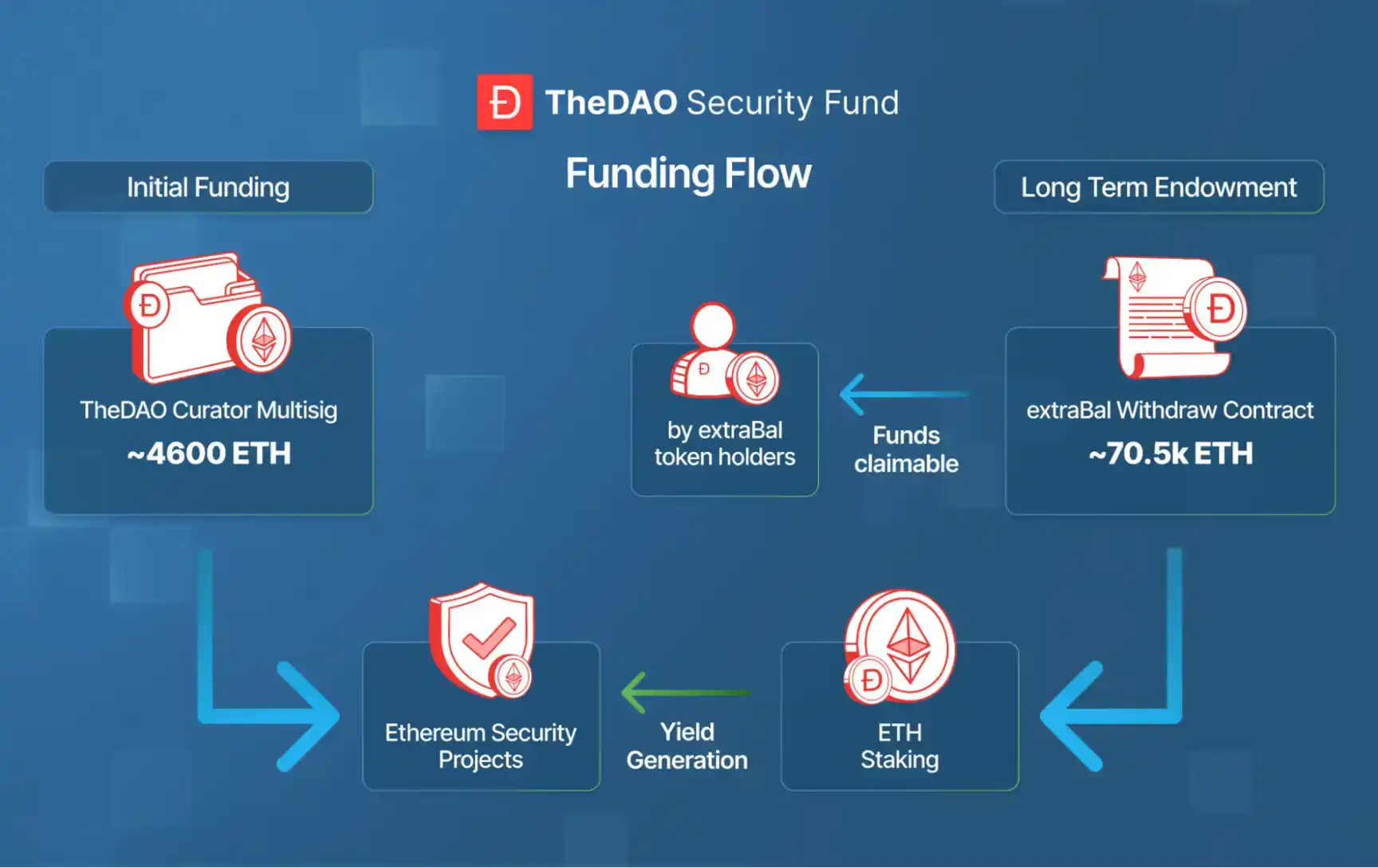
The operation and usage plan for TheDAO Security Fund's funds are clear and specific: 69,420 ETH allocated from the ExtraBalance contract will be staked, generating staking rewards to form a perpetual endowment fund, providing long-term financial support for Ethereum security development. The staking rewards will be combined with the 4,600 ETH from TheDAO Curator Multisig to jointly fund various Ethereum security-related projects. Simultaneously, the ExtraBalance withdrawal contract will retain a portion of ETH to ensure the rights of legitimate claimants are unaffected.

Regarding the scope of funding, TheDAO Security Fund's core objective is very specific—prioritizing the security of the entire Ethereum ecosystem, covering all dimensions of security development: from wallet user experience optimization and smart contract security audits, to emergency response for security incidents and security upgrades for the Ethereum core protocol, to security protection for Layer 2 networks and cross-chain bridge ecosystems. All work contributing to enhancing Ethereum's security level falls within the fund's funding scope.
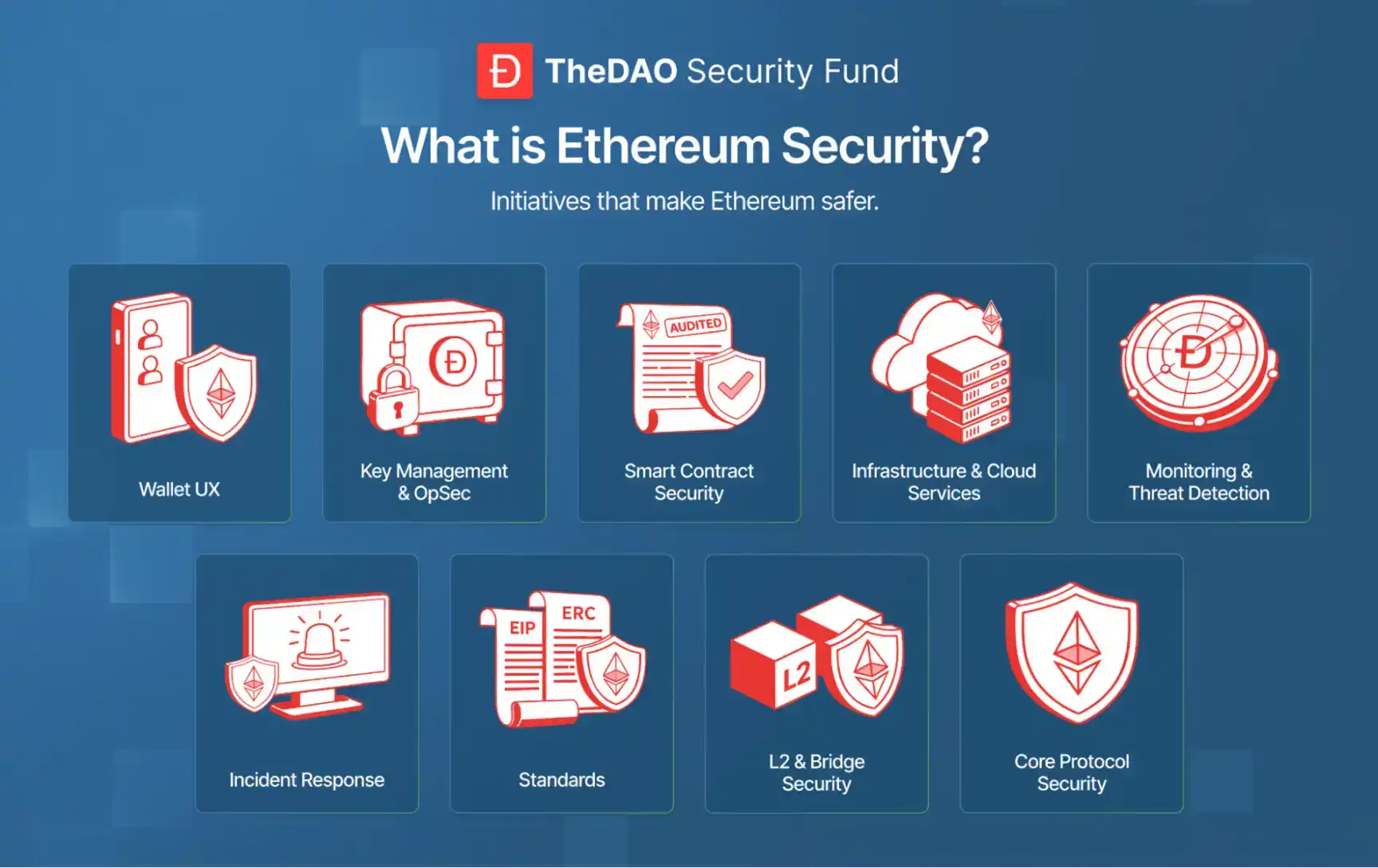
Additionally, the fund will rely on the optimization directions and opportunities in the current security landscape outlined by the Ethereum Foundation's Trillion Dollar Security initiative, combined with ongoing communication with ecosystem partners, to determine the specific scope and focus of each funding round.

In terms of the fund allocation mechanism, TheDAO Security Fund adheres to open, bottom-up governance principles. It will employ diverse methods such as quadratic funding, retroactive funding, and request for proposal (RFP)-based ranking votes to carry out funding work in rounds, allowing ecosystem participants to jointly participate in fund allocation decisions.

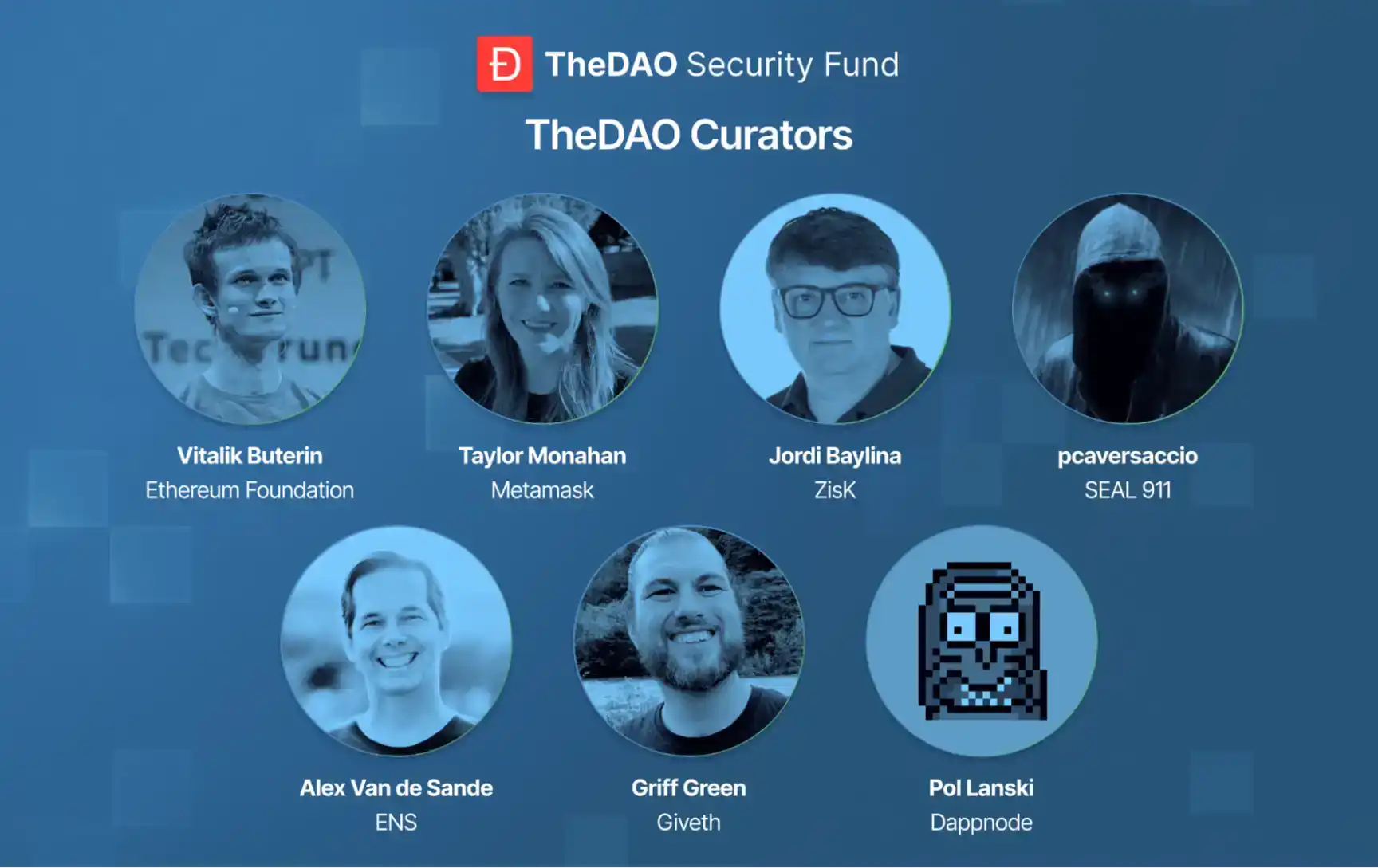
Currently, the fund has assembled a professional curator team to provide expert guidance and supervision for the fund's operation and funding decisions. Team members are all veteran practitioners and security experts in the crypto ecosystem: including Ethereum founder Vitalik Buterin, MetaMask security engineer Taylor Monahan, Zisk, Giveth co-founder Jordi Baylina, security expert pcaversaccio, ENS co-founder Alex Van de Sande, and Dappnode CEO Pol Lanski.
Summary

TheDAO Security Fund is not without controversy. Its core disputes still revolve around two main issues: first, the "legitimacy of the purpose" of using these leftover funds for a security fund, and second, the "degree of decentralization" of the fund's governance mechanism.

Should this huge asset be considered the "private property" of all original token holders, or has it already been deemed ownerless property to be used for the "public good"?

These controversies not only continue the philosophical divide within the Ethereum community sparked by the 2016 The DAO incident but also reflect the deep-seated contradictions in the current crypto ecosystem at the governance level—the balance between the ideal of decentralization and the efficiency of actual operations, as well as the compliance of asset disposal, remains a subject that the entire industry needs to continuously explore.

But setting aside the controversies, from the 2016 crowdfunding myth and ecosystem crisis to the 2026 security fund and ecosystem safeguarding, the decade-long cycle of The DAO is itself a microcosm of Ethereum's ecosystem development. It witnesses Ethereum's growth from immaturity to maturity and confirms the resilience and community strength of the crypto ecosystem.


Perguntas relacionadas

QWhat was the original purpose of The DAO in 2016 and what major event occurred?

AThe DAO was a decentralized autonomous organization launched in 2016 that raised a record $150 million in crowdfunding, attracting 14% of the total Ethereum supply. However, it suffered a catastrophic hack where attackers exploited a recursive call vulnerability in its smart contract, leading to a major theft of funds.

QHow is The DAO returning after ten years and what is the value of the new initiative?

AThe DAO is returning through the launch of 'The DAO Security Fund,' which repurposes over 75,109 ETH (worth more than $220 million) from the 2016 incident into a long-term fund dedicated to Ethereum security development.

QWhat are the two main sources of funding for The DAO Security Fund?

AThe funding comes from two sources: approximately 70,500 ETH from the ExtraBalance contract (which can still be claimed by eligible individuals) and about 4,600 ETH and some DAO tokens from The DAO Curator Multisig (valued around $13.5 million, with no clear claimants).

QHow will The DAO Security Fund allocate and use its resources to support Ethereum security?

AThe fund will stake 69,420 ETH from the ExtraBalance to generate yield for a perpetual endowment, while the staking rewards and the 4,600 ETH from the multisig will be used to fund Ethereum security projects. It will support areas like wallet UX, smart contract audits, emergency response, core protocol upgrades, and L2/cross-chain security.

QWho are some of the key members of the guardian team overseeing The DAO Security Fund?

AThe guardian team includes Ethereum founder Vitalik Buterin, MetaMask security engineer Taylor Monahan, Zisk, Giveth co-founder Jordi Baylina, security expert pcaversaccio, ENS co-founder Alex Van de Sande, and Dappnode CEO Pol Lanski.

Leituras Relacionadas

Apple's Desired On-Device AI Sees a Dark Horse Emerge: The First Cognitive Model is Born, 4B Matches GPT-5.4

A Chinese company, Tomorrow's Journey (Nextie), has introduced what it is calling the industry's first "cognitive model" for edge devices. Named New Journey Alpha, this 4-billion-parameter model reportedly matches the performance of trillion-parameter giants like GPT-5.4 in group intelligence tasks such as debate and collective decision-making. The development follows Andrej Karpathy's vision of stripping vast factual knowledge from large language models to retain only a smaller "cognitive core" capable of reasoning, planning, and knowing its own limits. This approach directly addresses the soaring computational costs and token expenses hindering AI's widespread deployment, as highlighted by incidents like Amazon shutting down an internal AI tool due to prohibitive costs. Trained via reinforcement learning on a corpus of academic papers from 1800-2020 to enhance generalization, the model enables three key advancements: 1) Improved decision quality in multi-agent systems, 2) Drastically reduced compute costs, allowing for cost-effective cloud or on-device (e.g., MacBook) deployment, and 3) The feasibility of "proactive" AI agents that act autonomously without user prompts, unlocking new commercial possibilities beyond today's reactive models. Built by the former Microsoft Xiaoice team—known for creating a 3.6B model that outperformed a 65B Llama model—the company is now focusing on the multi-agent systems sector, a field gaining significant investor interest. The model's economic impact is profound; by achieving high-level performance with minimal parameters, it fundamentally alters the cost structure of AI services, challenging the prevailing model of ever-larger parameter counts.

marsbitHá 45m

Apple's Desired On-Device AI Sees a Dark Horse Emerge: The First Cognitive Model is Born, 4B Matches GPT-5.4

marsbitHá 45m

OpenAI's 'Blueprint for the Future': Making AI Beneficial for Every Person on the Planet

A new transformative technology emerges every few generations. OpenAI draws a parallel with the advent of electricity in the 1920s, which initially brought convenience but ultimately enabled unprecedented progress in medicine, engineering, and living standards by empowering people to create new possibilities. AI is poised to recreate this phenomenon. Its true significance lies not in the technology itself, but in what people can achieve with it—from understanding a medical bill or starting a business to aiding scientific discovery. OpenAI believes AI should be universally accessible, allowing everyone to use it according to their own needs. This future, however, is not guaranteed. While transformative tech can centralize power, OpenAI's philosophy is that AI must serve humanity, augmenting human capabilities and broadly distributing its benefits. The company's first commitment is to build AI for human service, aiming to empower the many rather than concentrate power in a few. Safety, alignment with human intent, and oversight are paramount. OpenAI is optimistic about AI's potential to expand human welfare but remains clear-eyed about risks. The goal is to help people achieve more, not to replace them. Full automation is not the desired future; human judgment, values, and direction will become even more critical. OpenAI outlines three core goals: 1. Build automated AI researchers to accelerate and increasingly automate the research process itself, maintaining close human collaboration. The internal projection is that by March 2028, a significant portion of their research will be conducted by AI systems working alongside human researchers. 2. Accelerate economic development by advancing science, boosting productivity, and fostering growth, while ensuring the fruits are widely shared. 3. Provide a personal AGI for everyone on Earth, allowing individuals to benefit from this transformative technology in their own way. The company is entering its third phase, moving from foundational AGI research (Phase 1) to product deployment and learning from real-world use (Phase 2). The current challenge is making advanced AI abundant, affordable, safe, practical, and usable for all individuals and organizations. OpenAI concludes that a widely distributed power structure leads to a more resilient, adaptable, and free society. A positive AI future should not be controlled by a handful of entities but built, benefited from, and owned by many. If realized correctly, AI can become a cornerstone for enhancing global productivity, creativity, scientific advancement, and economic opportunity, fulfilling the mission to ensure AGI benefits all of humanity.

marsbitHá 1h

OpenAI's 'Blueprint for the Future': Making AI Beneficial for Every Person on the Planet

marsbitHá 1h

Arthur Hayes' New Article: AI Bubble Nears Bursting, Crypto Market Faces Short-Term Pressure

In a new essay, Arthur Hayes argues that the AI market bubble is approaching a rupture, which will place significant short-term pressure on crypto assets. He identifies rising oil prices, a trio of massive tech IPOs (SpaceX, Anthropic, OpenAI), and potential anti-AI political rhetoric from Trump as the three key catalysts for a correction. Hayes posits that the prolonged blockage of the Strait of Hormuz will drive energy prices higher, increasing operational costs for data centers and squeezing AI company profits. Simultaneously, the market may struggle to absorb the upcoming wave of multi-trillion dollar tech IPOs. Furthermore, with high inflation hurting his election chances, Trump could pivot to attacking the AI sector with proposals for heavy taxation and regulation to win over voters, spooking the market. Hayes notes that nearly all new dollar liquidity since 2022 has flowed into the AI sector, leaving little for Bitcoin, explaining its recent underperformance. He believes an AI stock crash would trigger a broad risk-off sentiment and credit contraction, dragging down crypto in the near term. Consequently, his fund, Maelstrom, has sold all AI-related stocks and non-core cryptocurrencies, retaining only Bitcoin and Ethereum while building positions in traditional energy stocks. He anticipates Bitcoin will bottom and resume its bull run only after the AI bubble pops and a new monetary easing cycle begins.

marsbitHá 1h

Arthur Hayes' New Article: AI Bubble Nears Bursting, Crypto Market Faces Short-Term Pressure

marsbitHá 1h

Trading

Spot
Futuros

Artigos em Destaque

Como comprar DAO

Bem-vindo à HTX.com!Tornámos a compra de DAO Maker (DAO) simples e conveniente.Segue o nosso guia passo a passo para iniciar a tua jornada no mundo das criptos.Passo 1: cria a tua conta HTXUtiliza o teu e-mail ou número de telefone para te inscreveres numa conta gratuita na HTX.Desfruta de um processo de inscrição sem complicações e desbloqueia todas as funcionalidades.Obter a minha contaPasso 2: vai para Comprar Cripto e escolhe o teu método de pagamentoCartão de crédito/débito: usa o teu visa ou mastercard para comprar DAO Maker (DAO) instantaneamente.Saldo: usa os fundos da tua conta HTX para transacionar sem problemas.Terceiros: adicionamos métodos de pagamento populares, como Google Pay e Apple Pay, para aumentar a conveniência.P2P: transaciona diretamente com outros utilizadores na HTX.Mercado de balcão (OTC): oferecemos serviços personalizados e taxas de câmbio competitivas para os traders.Passo 3: armazena teu DAO Maker (DAO)Depois de comprar o teu DAO Maker (DAO), armazena-o na tua conta HTX.Alternativamente, podes enviá-lo para outro lugar através de transferência blockchain ou usá-lo para transacionar outras criptomoedas.Passo 4: transaciona DAO Maker (DAO)Transaciona facilmente DAO Maker (DAO) no mercado à vista da HTX.Acede simplesmente à tua conta, seleciona o teu par de trading, executa as tuas transações e monitoriza em tempo real.Oferecemos uma experiência de fácil utilização tanto para principiantes como para traders experientes.

189 Visualizações TotaisPublicado em {updateTime}Atualizado em 2026.06.02

Como comprar DAO

Discussões

Bem-vindo à Comunidade HTX. Aqui, pode manter-se informado sobre os mais recentes desenvolvimentos da plataforma e obter acesso a análises profissionais de mercado. As opiniões dos utilizadores sobre o preço de DAO (DAO) são apresentadas abaixo.

活动图片