The Cost of an 11.5% Annualized Return: Will MicroStrategy's STRC Face a Moment of Reckoning?

marsbitPublicado em 2026-04-23Última atualização em 2026-04-23

Resumo

This article analyzes the potential risks associated with MicroStrategy's (MSTR) use of structured financial products like STRC to leverage its BTC exposure. While these tools have enabled impressive returns (e.g., 11.5% annualized) and fueled significant capital inflows ($13.5B outstanding), they also create substantial annual dividend obligations (~$400M). The author argues that this structure, while effective in a bull market, could become a liability if BTC price stagnates or declines. The core risk is a potential negative feedback loop: the growing dividend burden from continued STRC issuance may eventually outweigh the benefits of increased BTC holdings. To meet these obligations, MicroStrategy might need to use new issuance proceeds for dividends instead of buying more BTC, which could disappoint equity investors. If the market capitalization (mNAV) falls below the value of its BTC holdings, the company could be forced to sell BTC instead of issuing new shares, potentially triggering a panic. The author estimates a potential inflection point in 6 months, where annual dividend costs reach $3-4B. At that stage, CEO Michael Saylor might face a difficult choice: sell BTC to meet obligations or sacrifice the credibility of the preferred shares by halting dividends. The article concludes that this financial engineering, while powerful, could ultimately "backfire" on MicroStrategy if market conditions turn.

Editor's Note: As Michael Saylor continues to amplify his company's exposure to Bitcoin through tools like STRC, a seemingly efficient financial structure is simultaneously accumulating dividend pressure and potential risks. In the short term, it drives capital inflows and price increases; but once the market turns, this mechanism reliant on continuous financing could quickly backfire on the company itself. This article explores this structure, attempting to outline its operational boundaries and potential chain reactions under extreme scenarios.

Below is the original text:

Through STRC, Saylor has created a "Frankenstein's monster."

Victor Frankenstein created this monster out of arrogance—he was confident he could play God and challenge death. But after the monster successively destroyed his family and friends, it ultimately dragged him into ruin as well.

Through STRC, Saylor has designed an "idealized" BTC-linked instrument, allowing retail investors to capture Bitcoin's excess returns in a manner similar to a "risk-free rate." It is this financial engineering capability that enables him to claim unprecedented Sharpe ratios and an 11.5% return with just 1 basis point of volatility—but ultimately, this mechanism could also crush MSTR.

Note: The following analysis is based on one premise—BTC trades sideways or declines. If BTC can achieve the 20–25%+ compound growth rate assumed in Strategy's internal model, then many of these assumptions would no longer hold (though not all would be invalidated).

In just the past two weeks, STRC has attracted nearly $3.5 billion in inflows, with total issuance reaching $8.5 billion. Combined with other preferred instruments from Strategy, the outstanding amount is currently about $13.5 billion (excluding convertible bonds here). These financing proceeds have supported the corresponding scale of BTC purchases and were likely a major driver behind last week's price surge to $78,000; but at the same time, they also bring an annual dividend obligation of approximately $400 million.

Previously, Saylor maintained a dividend reserve of about $2.25 billion. Before the April issuance round, this reserve could cover about 25 months of dividends. But the new issuances in just the last two weeks have already compressed the coverage period to 18 months. To restore it to 25 months, he would need to raise about $500 million through ATM (at-the-market) offerings.

Currently, MSTR's mNAV has fallen back to 1.25–1.30 times the annual high range, which has also prompted the crypto community (CT) to call for large-scale BTC purchases again this week. However, the issue is that I believe about 50–70% of this week's new issuances will be used to replenish the dividend reserve, rather than directly for buying BTC.

More importantly, it is worth considering STRC's performance in "extreme scenarios." MSTR's current market cap is approximately $55–60 billion. The practical question is: How much more STRC can Saylor issue before the dividend burden puts substantial pressure on mNAV?

A simple estimation method: the annual issuance scale could be controlled at 1–2% of MSTR's average daily volume (ADV). Based on the current daily trading volume of about $2–3 billion and 252 trading days per year, this roughly corresponds to an issuance space of $5–15 billion—equivalent to 3–10 times the current annual dividend/coupon payments.

However, I tend to believe this range represents the "upper limit," not the常态 level. In fact, for shareholders holding only common stock, the structural cost of this trade is already becoming apparent: STRC's success is actually suppressing MSTR's mNAV—and in the震荡区间 since 2023, this metric was closer to 1.5 times (though one could argue the current environment is more like mid-early 2022).
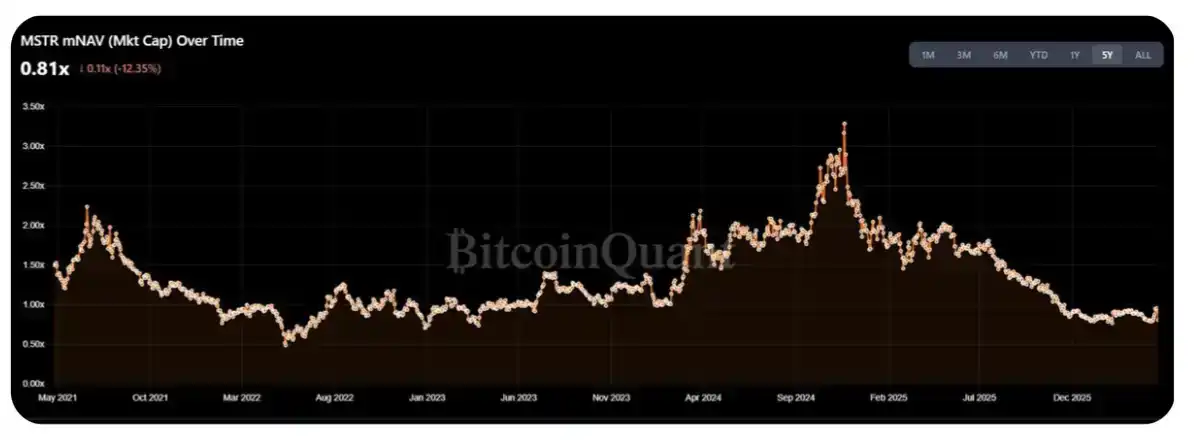
On the surface, for common stockholders, continuing to support these "yields" that do not translate into their own upside gains seems irrational—under continuous issuance, the BTC holdings per share have not substantially increased (though this is largely due to Strategy's already massive size).
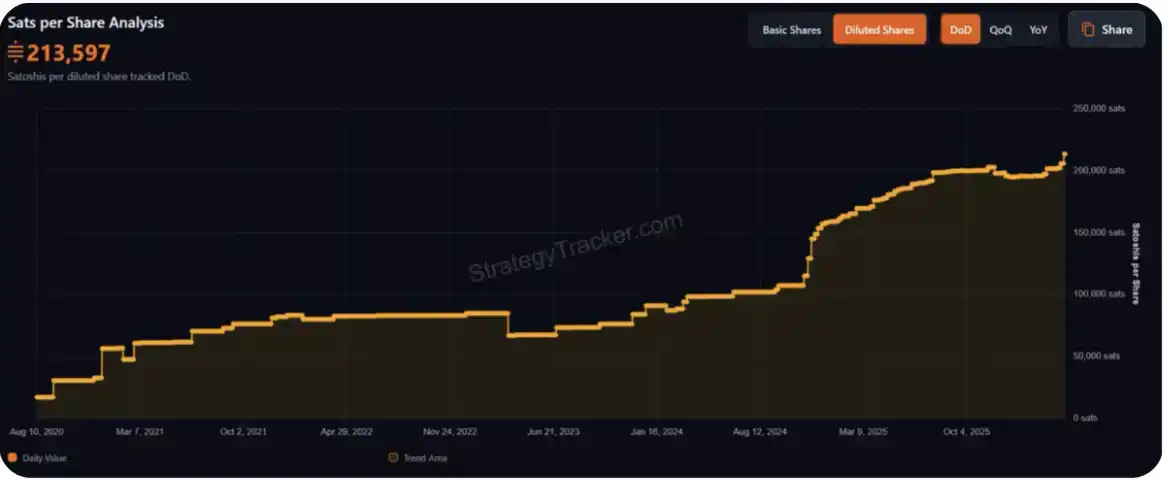
That said, DAT shareholders are a rather "special" group, and I can imagine they can withstand such pressure, at least for the next year, without necessarily adopting this view.

Additionally, the above analysis implies a key premise: MSTR can maintain an mNAV above 1 times for the foreseeable future. If it falls below 1 times, then compared to directly issuing stock, selling BTC would result in less dilution for shareholders. This would open the floodgates of supply, pushing the market into a phase of "DAT reflexivity dominating in a downturn"—a point I discussed last year (see original post).

To briefly summarize this logical chain:

STRC continues to expand;

As the scale grows, Saylor needs to pay越来越多的 dividends;

MSTR buyers gradually realize that the stock they are buying is actually financing dividends, not用于增持 BTC;

Buyers find this is not the交易结构 they initially expected and start exiting;

Once new buying dries up, mNAV falls below 1 times;

mNAV < 1 times → Saylor is forced to sell BTC instead of issuing more stock;

The market enters a panic state.

In my view, the correct way to judge STRC's maximum supply scale is to find a "tipping point": where the dividend burden from new issuances begins to exceed the marginal benefit of per-share BTC growth. A rough estimate suggests this tipping point corresponds to an annual dividend支出 of $3–4 billion, equivalent to issuing about $10–20 billion more STRC. At the current pace, it could be reached within 6 months.

Of course, Saylor still has room to maneuver. The dividend reserve does help stabilize prices and market confidence, but if the震荡 or downtrend continues, holders are essentially playing a game of "musical chairs." When the dividend reserve is down to 6 to 9 months, the rational choice might become: exiting early in the 90–95 price range, rather than bearing the downside risk of Saylor suspending dividends (another option he has).

Although STRC dividends are "cumulative," in extreme cases, I believe Saylor is more likely to choose "com sacrificing preferred stock credit" rather than being forced to大规模 sell BTC. Essentially, he faces this arithmetic problem: "If I fulfill preferred stock obligations and give up future issuance space, how much more BTC can I buy" - "the amount of BTC I have to sell to maintain preferred stock" = result

If the result is positive, choose to sell BTC; otherwise, "sacrifice" preferred stockholders

The main argument against this judgment is: once it really reaches the stage where this calculation is needed, the market has likely already turned, and MSTR's mNAV has most likely fallen below 1 times.

Thank you for reading, even if the beginning was somewhat "sensational." Also welcome any different views or criticisms. (Acknowledgments to @TraderBot888, the first person to discuss this idea with me back in the day.)


Perguntas relacionadas

QWhat is the core risk that the article highlights regarding MicroStrategy's STRC (Structured Tokenized Return Certificate)?

AThe core risk is that the STRC, while providing a high annualized return of 11.5% and attracting massive capital inflows, creates a massive and growing dividend obligation for MicroStrategy. If the Bitcoin market turns bearish or remains stagnant, this reliance on continuous financing to pay these dividends could quickly deplete the company's dividend reserve, potentially forcing it to sell its Bitcoin holdings or default on its obligations, leading to a downward spiral for the company.

QAccording to the article, what is the estimated annual dividend obligation created by STRC and other preferred instruments?

AThe article states that the outstanding scale of STRC and other preferred instruments is approximately $13.5 billion, which creates an annual dividend obligation of about $400 million.

QWhat is the 'inflection point' or 'tipping point' mentioned in the analysis for the STRC structure?

AThe 'inflection point' is the point at which the dividend burden from new STRC issuances begins to exceed the marginal benefit of the increase in Bitcoin holdings per share. A rough estimate places this point at an annual dividend expenditure of $3-4 billion, which would be equivalent to issuing an additional $100-200 billion in STRC.

QWhat critical scenario would force MicroStrategy to sell its Bitcoin holdings instead of issuing more stock?

AThe critical scenario is if MicroStrategy's market capitalization falls below its metric Net Asset Value (mNAV), specifically if mNAV drops below 1x. In this case, selling Bitcoin would be less dilutive to shareholders than issuing more stock, potentially opening the floodgates to a panic-driven market.

QWhat is one potential extreme action Michael Saylor might take if the dividend burden becomes unsustainable, according to the author's analysis?

AThe author suggests that in an extreme scenario, Michael Saylor might choose to 'sacrifice the credit of the preferred shares' entirely—meaning he would likely suspend dividend payments to STRC holders—rather than be forced into a large-scale sell-off of MicroStrategy's Bitcoin treasury.

Leituras Relacionadas

A Nation Blocks Chips, a Giant Buys a Nuclear Power Plant: Why It's Time to Seriously Consider DeAI

**Title: Great Powers Blockade Chips, Giants Buy Nuclear Plants: Why It's Time to Seriously Consider DeAI** In May 2026, the US closed loopholes for Chinese firms to acquire advanced NVIDIA chips via overseas subsidiaries. That same month, Kenya halted a $1B geothermal data center project involving Microsoft, fearing its immense energy consumption. Meanwhile, Huawei announced mass production of its Ascend AI chip. These disparate events underscore a new reality: the competition for computing power ("compute") has escalated beyond the tech industry, becoming a geopolitical and infrastructural battleground. A new era of oligopoly is forming, with control over the AI stack—from GPU chips (NVIDIA) and cloud platforms (AWS, Azure, Google Cloud) to foundational models (OpenAI, Anthropic)—concentrating in a few Western "AI Octopus" corporations. This centralization creates systemic risks: pricing power and platform lock-in for users, infrastructure fragility, and a widening "compute divide" that threatens to marginalize nations without independent AI capacity. An "AI Iron Curtain" is deepening through export controls. In response, some nations like Saudi Arabia and the UAE are investing heavily to buy compute power, aiming to transition from oil to AI economies. The EU seeks to triple its compute capacity by 2030 to reduce dependency. However, the spending gap is vast, with four US tech giants alone planning ~$750B in AI capex for 2026. The race is increasingly constrained by energy, with AI tasks consuming up to 1000x more power than web searches, pushing firms to even acquire nuclear plants. This landscape is fueling interest in Decentralized AI (DeAI). It proposes a third way: using open protocols to coordinate a global network of idle GPUs, independent developers, and data centers, creating an AI infrastructure without a single controlling entity. Leveraging blockchain and cryptographic verification, DeAI aims to break market concentration, disperse energy demands, reduce geopolitical dependencies, and enhance transparency. While still nascent in performance and stability, DeAI's core promise is not immediate superiority but providing a crucial alternative architecture to resist monopoly, censorship, and centralized power. As specialized AI hardware costs fall and open-source models flourish, the window to build this foundation is open. The very existence of such competition serves as a vital check against the inevitable abuse of concentrated power.

marsbitHá 4m

A Nation Blocks Chips, a Giant Buys a Nuclear Power Plant: Why It's Time to Seriously Consider DeAI

marsbitHá 4m

Outpoll Review: A Prediction Market Platform Built for Active Traders

Outpoll Review: A Prediction Market Platform Built for Active Traders In recent years, prediction markets have grown from a niche sector to a mainstream arena, attracting billions in trading volume and institutional capital. However, the user experience and tools for traders have not kept pace. Outpoll, a new global prediction market platform, aims to fill this gap by providing enhanced trading infrastructure for active and professional traders. Built on standard prediction market principles, Outpoll allows users to trade on the outcome of specific events. It uses fully collateralized contracts with USDC settlement, charges a competitive 0.1% fee per trade, and provides clear settlement rules upfront to minimize disputes. A key focus for Outpoll is its professional-grade trading tools. The platform supports limit and market orders, as well as take-profit and stop-loss orders for open positions—features uncommon in prediction markets. For automated trading, Outpoll offers comprehensive REST and WebSocket APIs, enabling portfolio management, price arbitrage, and integration with existing tools. The platform also features a creator-led market model, where approved experts and community leaders can create and manage markets for niche topics under platform supervision. Its integrated interface combines news feeds directly with trading functions, allowing users to monitor events and manage positions seamlessly. Outpoll launched with a native Android app (available on Google Play) and plans an iOS version later this year. In summary, Outpoll distinguishes itself with trader-focused tools, practical APIs, transparent and collateralized markets, integrated news, and an expanding creator program. For active traders, its advanced order types and API access alone make it a platform worth watching. Outpoll is now globally accessible via outpoll.com and Google Play.

marsbitHá 12m

Outpoll Review: A Prediction Market Platform Built for Active Traders

marsbitHá 12m

Bitwise: Crypto Becomes a Contrarian Investment, Three Logics to Understand the Current Market

**Summary** Matt Hougan, Bitwise's CIO, analyzes the current crypto market through three key lenses, arguing it has shifted from a momentum-driven to a contrarian investment. **1) Crypto Becomes a Contrarian Play:** The market is weak, with major assets like Bitcoin and Ethereum down significantly. Capital has moved to hot sectors like AI, leaving crypto as an "unloved" asset class. This transforms crypto investing from trend-following to a test of patience and fundamental analysis. Investors now favor projects with solid fundamentals (e.g., Hyperliquid) over speculative ones. **2) Regulatory Overhang:** The uncertain fate of the U.S. CLARITY Act, a major crypto regulatory framework, is a key headwind. With its passage in 2024 seen as far from guaranteed (estimates range from 30-55%), institutional capital remains on the sidelines, choosing less risky alternatives like AI stocks. The market needs clarity—whether the bill passes or fails—more than any specific outcome to move decisively. **3) Capital Rotates to New Fundamentals:** This cycle differs from past bear markets where money fled to Bitcoin. Now, capital seeks smaller assets with strong use cases. While major cryptos fell in May 2024, tokens like Hyperliquid (+72%), Zcash (+50%), and XLM (+44%) rallied on their specific fundamentals. This rotation confirms the new contrarian, fundamentals-driven logic and signals the bear market may be in its later stages. **Conclusion:** Short-term pressure persists due to regulatory uncertainty and competition from AI narratives. Investing in crypto now requires a contrarian mindset—acting against the crowd and focusing on fundamental value. Patience and targeting high-quality projects based on their merits are essential for capturing long-term gains.

marsbitHá 55m

Bitwise: Crypto Becomes a Contrarian Investment, Three Logics to Understand the Current Market

marsbitHá 55m

ChatGPT Might Be Disappearing Soon

OpenAI announced at its "Intelligence at Work" event that its coding assistant, Codex, will be fully integrated into the ChatGPT app within weeks. This move marks a strategic shift from a conversational AI (Chat) towards a unified "agentic" platform capable of execution. Codex, originally launched to compete with Anthropic's Claude Code, has grown rapidly to 5 million weekly active users, with 20% being non-developers like analysts and designers. Its enterprise revenue now constitutes 40% of OpenAI's total. The integration is the first step in creating a super-app combining ChatGPT (interface), Codex (execution engine), and the Atlas browser (web access). OpenAI also unveiled new Codex features: specialized Agent plugins for six professional roles, an "Annotations" tool for direct document editing, and a "Sites" function to turn work into shareable web apps. Internally, this reflects a power shift; the Codex team now leads core product strategy. While the ChatGPT brand remains for its vast user base, the platform's future is focused on autonomous agents that perform tasks, not just chat. The article notes that competition with Claude Code pushed OpenAI's development, with Codex competing on cost-effectiveness and accessibility rather than raw coding quality. It concludes that the essence of "ChatGPT" is evolving from a chatbot into an AI agent platform, with the name potentially becoming a legacy symbol of its original function.

marsbitHá 1h

ChatGPT Might Be Disappearing Soon

marsbitHá 1h

Trading

Spot
Futuros
活动图片