The Code Was Fine, But It Was Still Hacked: What Is the 'DVN Configuration Vulnerability' Behind the Biggest Hack of 2026?

marsbitPublicado em 2026-04-19Última atualização em 2026-04-19

Resumo

Title: Code Was Secure, Yet $293M Stolen: The 2026 DVN Configuration Breach Explained On April 18, 2026, Kelp DAO’s restaking protocol was exploited, losing 116,500 rsETH (worth $293M at the time) due to a configuration flaw—not a smart contract vulnerability. The attacker used a forged cross-chain message to drain funds via LayerZero’s bridge, then dispersed the stolen rsETH across Aave V3, Compound V3, and Euler to borrow real assets, ultimately escaping with $236M in WETH. The root cause was a critical misconfiguration in Kelp’s LayerZero V2 setup: the protocol used a 1-of-1 Decentralized Verifier Network (DVN) threshold, meaning only one node approval was needed to validate cross-chain messages. The attacker compromised that single node, allowing unauthorized minting of rsETH on Ethereum. This configuration choice—permitted by LayerZero but highly risky—left zero fault tolerance. In contrast, protocols like ApeChain using multi-node validation (e.g., 2-of-3 or 5-of-9) remained secure. This incident highlights a blind spot in DeFi security audits: tools like Slither and Mythril scan code for logic flaws but ignore configuration parameters. The 2022 Nomad hack ($190M loss) also stemmed from a config error, bringing total losses from such issues to ~$482M—rivaling private key breaches. The Kelp exploit underscores the need for standardized config audits and higher baseline security in cross-chain designs.

On April 18, 2026, attackers drained 116,500 rsETH, worth approximately $293 million at the time, from the cross-chain bridge of Kelp DAO's liquid restaking protocol within hours. The entire process was unusually efficient—from forging cross-chain messages to dispersing the stolen funds across three lending protocols, Aave V3, Compound V3, and Euler, to borrow real assets. The attackers exited the same day with $236 million in WETH. Aave, SparkLend, and Fluid promptly froze all rsETH markets.

This was the largest DeFi attack incident of 2026 to date.

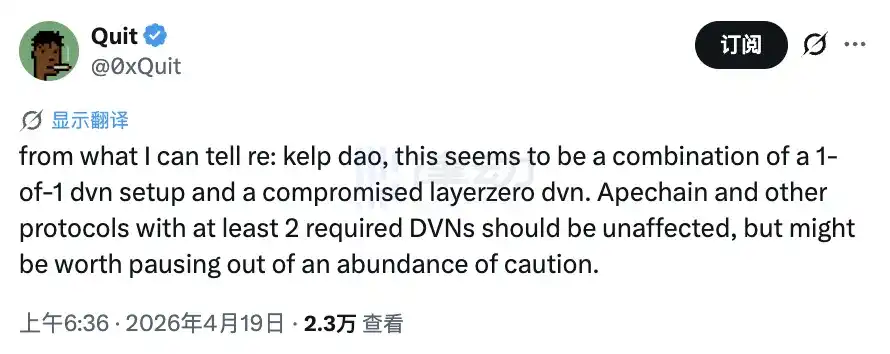
But one thing set this attack apart from most hacking incidents. Kelp DAO's smart contract code had no vulnerabilities. Security researcher @0xQuit, who participated in the investigation, wrote on X, "From what I've gathered so far, this is the result of two issues叠加: a 1-of-1 DVN configuration and the DVN node itself being compromised." LayerZero's official statement also did not mention contract code, framing the issue as an "rsETH vulnerability" rather than a "LayerZero vulnerability."
$293 million, not found in a single line of code. It was hidden in a configuration parameter filled in incorrectly during deployment.

The general logic of DeFi security auditing is: find the contract, read the code, find the vulnerability. This logic works quite smoothly when dealing with code logic vulnerabilities; tools like Slither and Mythril have mature detection capabilities for known patterns like reentrancy attacks and integer overflows. LLM-assisted code auditing, heavily promoted in recent years, also has some capability against business logic vulnerabilities (such as flash loan arbitrage paths).
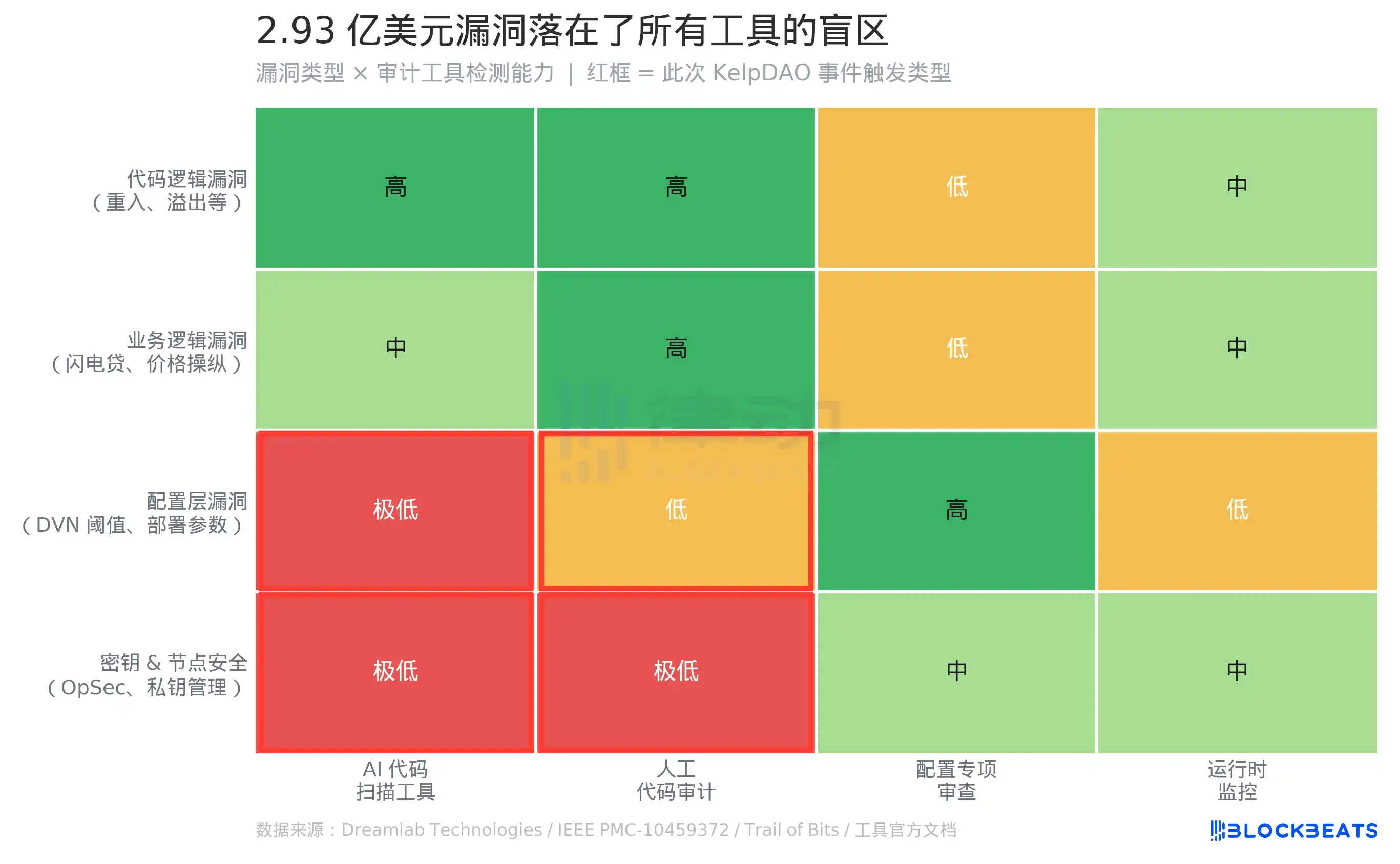
But two rows in this matrix are red.

Configuration-layer vulnerabilities are a structural blind spot in tool-based auditing. The problem with Kelp DAO was not in the .sol files, but in a parameter written during protocol deployment—the DVN threshold. This parameter determines how many validator nodes need to confirm a cross-chain message before it is deemed legitimate. It doesn't enter the code, doesn't enter Slither's scan range, and doesn't enter Mythril's symbolic execution path. According to comparative research by Dreamlab Technologies, Slither and Mythril detected 5/10 and 6/10 vulnerabilities in the tested contracts, respectively, but this achievement is based on the premise that "the vulnerability is in the code." According to IEEE research, even at the code level, existing tools can only detect 8%-20% of exploitable vulnerabilities.

From the perspective of current auditing paradigms, there is no tool that can "detect whether the DVN threshold is reasonable." To detect such configuration risks, what is needed is not a code analyzer, but a specialized configuration checklist: "Number of DVNs used by the cross-chain protocol ≥ N?", "Is there a minimum threshold requirement?" Such questions currently have no standardized tool coverage, nor even widely accepted industry standards.

Also in the red zone are key and node security. @0xQuit's description mentioned the DVN node being "compromised," which falls under operational security (OpSec), beyond the detection boundaries of any static analysis tool. Neither any first-tier auditing firm nor AI scanning tools have the ability to predict whether a node operator's private key will be leaked.

This attack triggered both red zones in the matrix simultaneously.
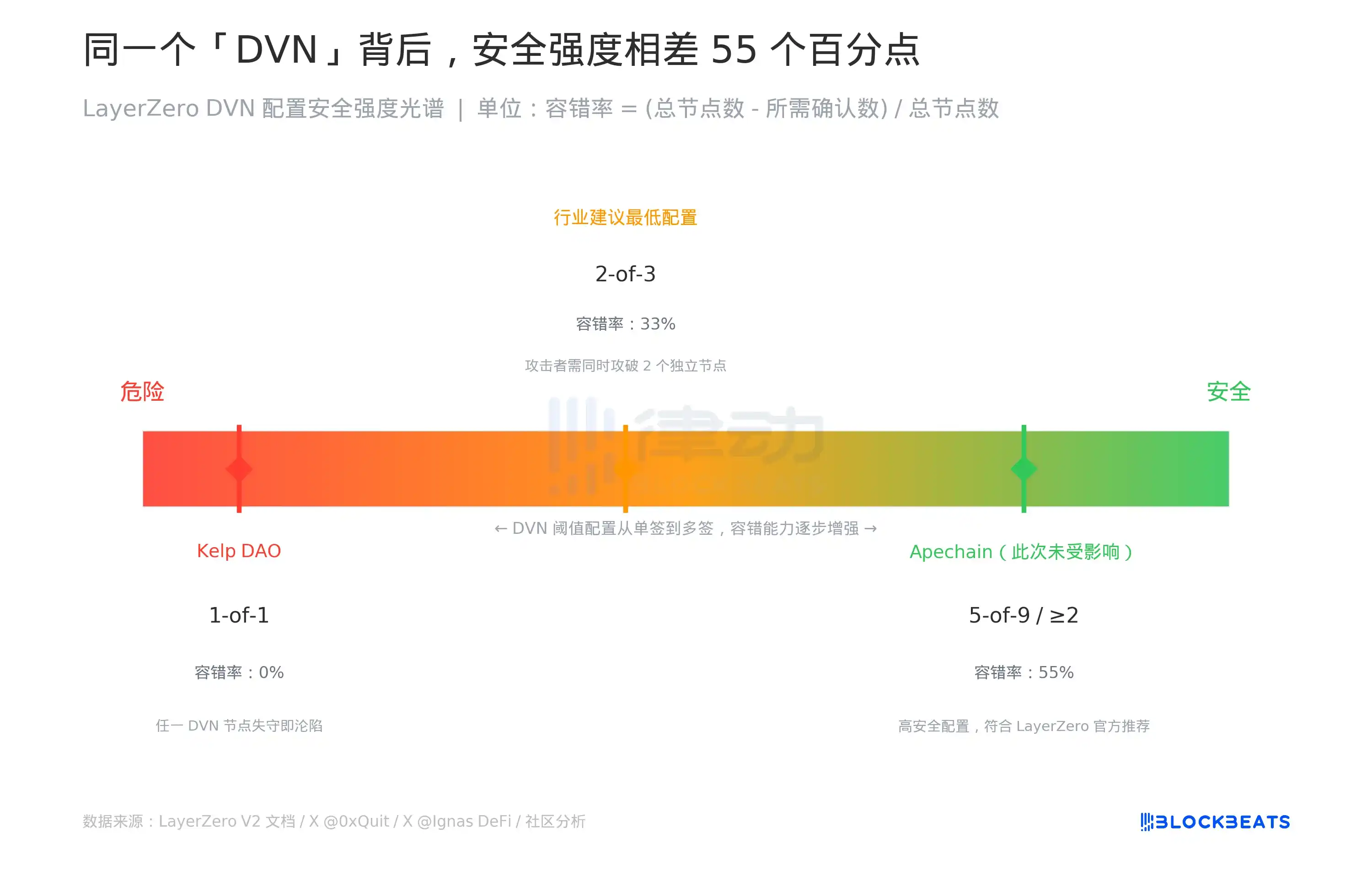
DVN is LayerZero V2's cross-chain message verification mechanism, short for Decentralized Verifier Network. Its design philosophy is to give security decision-making power to the application layer: each protocol integrated with LayerZero can choose how many DVN nodes need to confirm simultaneously before allowing a cross-chain message to pass.

This "freedom" creates a spectrum.

Kelp DAO chose the far left end of the spectrum: 1-of-1, requiring confirmation from only one DVN node. This meant a fault tolerance of zero; the attacker only needed to compromise that one node to forge any cross-chain message. In contrast, Apechain, also integrated with LayerZero, configured more than two required DVNs and was unaffected in this incident. LayerZero's official statement used the wording "all other applications remain secure," the subtext of which is: security depends on which configuration you chose.

The normal industry recommendation is at least 2-of-3, requiring an attacker to compromise two independent DVN nodes simultaneously to forge a message, increasing fault tolerance to 33%. High-security configurations like 5-of-9 can achieve 55% fault tolerance.

The problem is, external observers and users cannot see this configuration. Both might be called "powered by LayerZero," but behind it could be 0% fault tolerance or 55% fault tolerance. Both are called DVN in the documentation.

Veteran crypto investor Dovey Wan, who experienced the Anyswap incident, wrote directly on X: "LayerZero's DVN is actually 1/1 validator...... All cross-chain bridges should immediately conduct a comprehensive security review."
In August 2022, a vulnerability was discovered in the Nomad cross-chain bridge. Someone copied the first attack transaction, made slight modifications, found it also worked—so hundreds of addresses successively began copying, draining $190 million within hours.

Nomad's post-mortem wrote that the vulnerability source was "initializing the trusted root to 0x00 during a routine upgrade." This was a configuration error that occurred during the deployment phase. The Merkle proof verification logic was fine, the code itself was fine; the problem was an initial value filled in incorrectly.

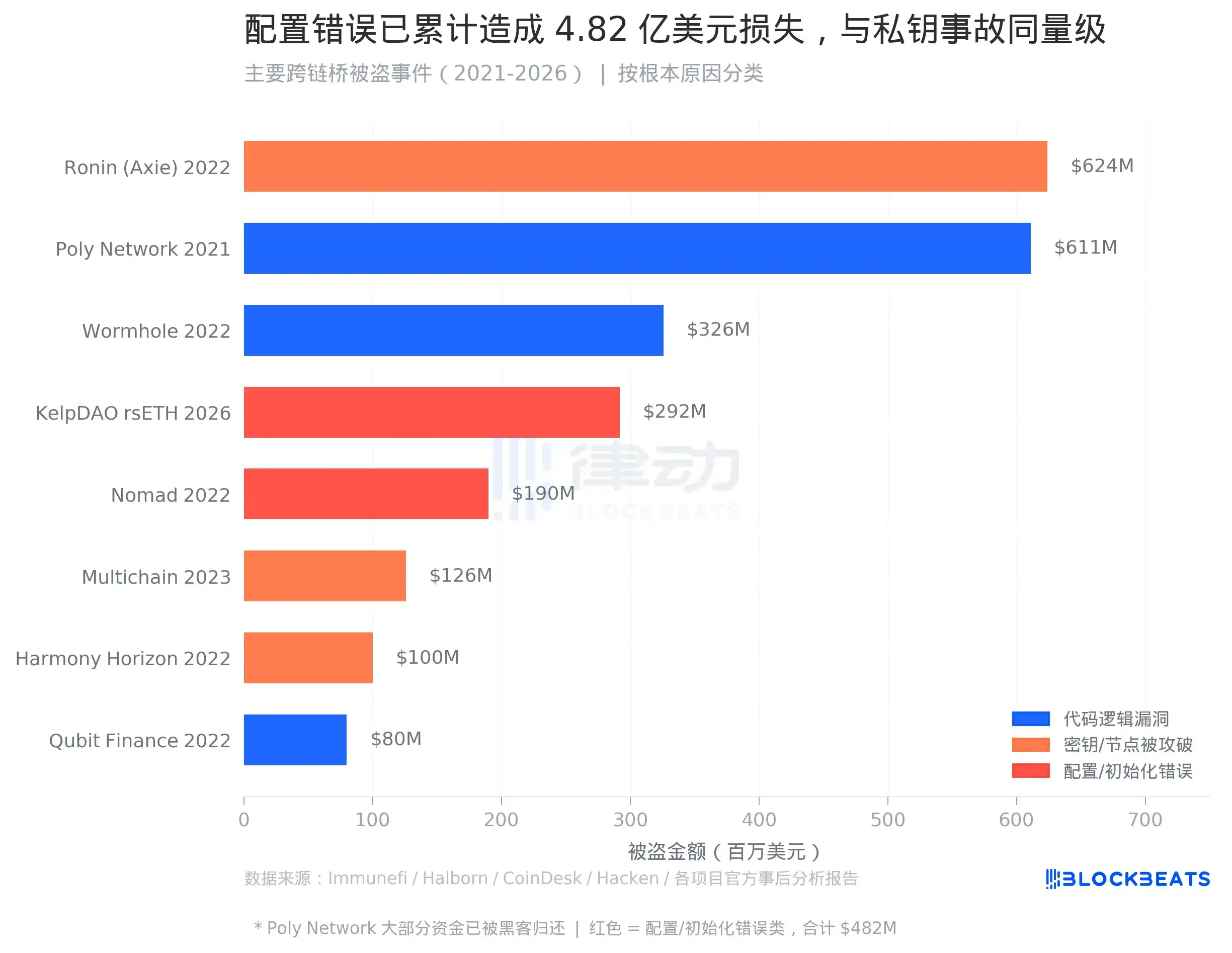
This time, combined with Nomad, configuration/initialization class vulnerabilities have caused approximately $482 million in losses. In the entire history of cross-chain bridge thefts, this category's scale is now comparable to key leak class (Ronin $624 million, Harmony $100 million, Multichain $126 million, totaling approximately $850 million).

But the product design of the code auditing industry has never been targeted at this category.

The most discussed topics in the industry are still code logic vulnerabilities. Wormhole's $326 million hack due to signature verification bypass, Qubit Finance's $80 million theft due to fake deposit events. These cases have complete vulnerability analysis, CVE number analogies, reproducible PoCs, suitable for the training and optimization of auditing tools. Configuration-layer problems are not written in the code and struggle to enter this production cycle.

A noteworthy detail is that the triggering methods of the two configuration-class events were completely different. Nomad accidentally filled in a wrong initial value during a routine upgrade, a mistake. Kelp DAO's 1-of-1 was an active configuration choice—the LayerZero protocol did not prohibit this option, and Kelp DAO did not violate any protocol rules. A "compliant" configuration choice and a "mistaken" initial value ultimately led to the same consequence.
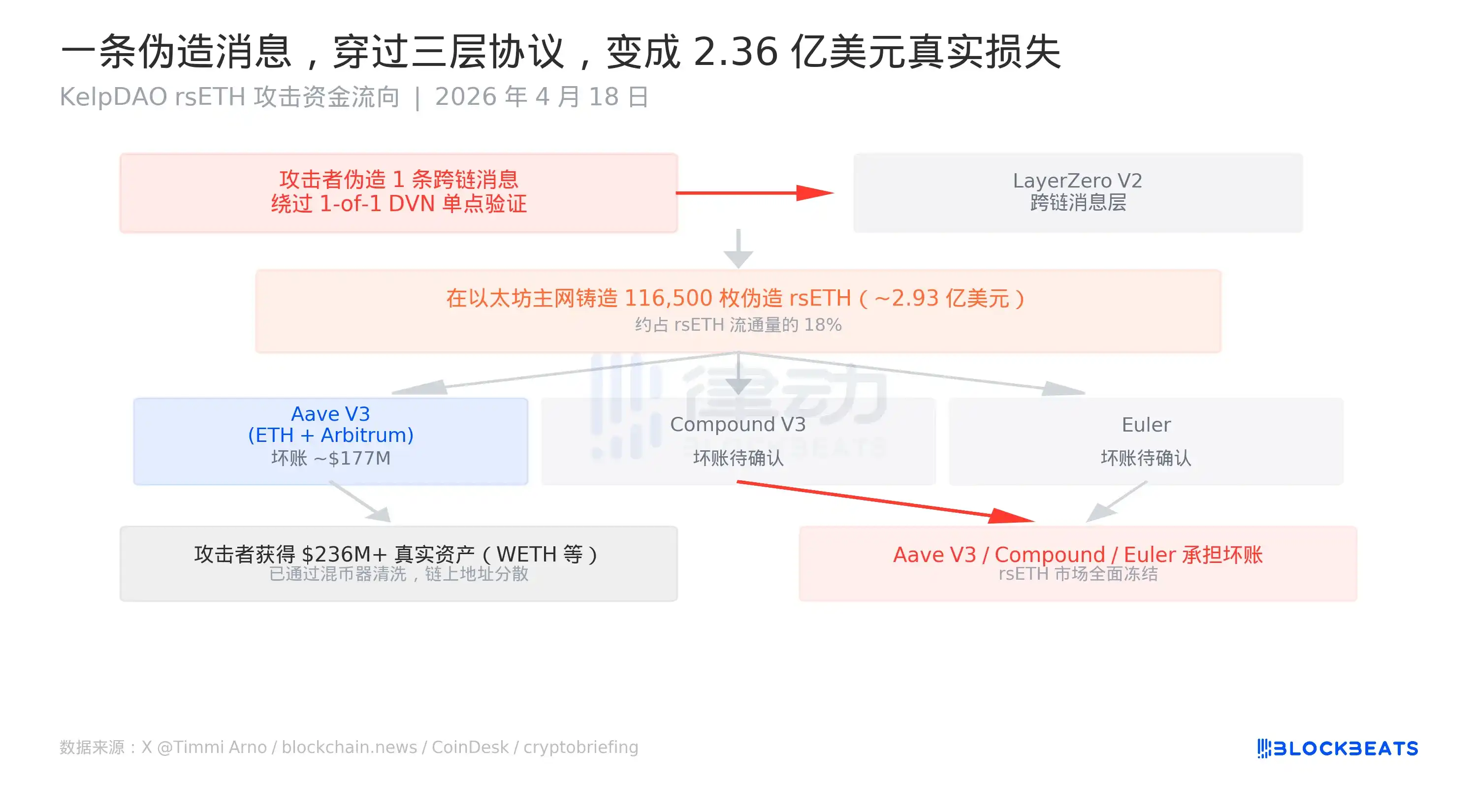
The execution logic of this attack was simple: a forged cross-chain message told the Ethereum mainnet that "equivalent assets have been locked on another chain," triggering the minting of rsETH on the mainnet. The minted rsETH itself had no actual backing, but its on-chain record was "legitimate" and could be accepted as collateral by lending protocols.

The attacker then dispersed the 116,500 rsETH into Aave V3 (Ethereum and Arbitrum), Compound V3, and Euler, borrowing over $236 million in real assets. According to multiple reports, Aave V3 alone faced an estimated bad debt of approximately $177 million. Aave's safety module, Umbrella, has a WETH reserve of about $50 million available to absorb bad debt, covering less than 30%, with the remaining portion to be borne by aWETH stakers.

This bill ultimately fell on those who just wanted to earn a little WETH interest.

LayerZero officials, as of writing, are still jointly investigating with the security emergency response organization SEAL Org, stating they will release a post-mortem report with Kelp DAO after obtaining all information. Kelp DAO stated it is conducting "active remediation."

The $293 million vulnerability was not in the code. The phrase "audit passed" did not cover the location of that parameter.


Perguntas relacionadas

QWhat was the root cause of the Kelp DAO hack in April 2026, and why was it unusual?

AThe root cause was a configuration vulnerability, specifically a 1-of-1 DVN (Decentralized Verifier Network) threshold setting chosen by Kelp DAO, combined with the compromise of that single DVN node. It was unusual because the smart contract code itself had no vulnerabilities; the flaw was entirely in a deployment configuration choice.

QWhat is a DVN in the context of LayerZero V2, and what security risk did Kelp DAO's configuration introduce?

AA DVN (Decentralized Verifier Network) is LayerZero V2's mechanism for verifying cross-chain messages. It allows applications to choose how many independent DVN nodes must confirm a message for it to be considered valid. Kelp DAO's configuration of a 1-of-1 threshold meant it had zero fault tolerance. An attacker only needed to compromise that one specific node to forge any cross-chain message, creating a critical single point of failure.

QHow do configuration vulnerabilities like the one at Kelp DAO differ from code logic vulnerabilities, and why are they hard to detect with standard auditing tools?

AConfiguration vulnerabilities exist in deployment parameters and initial settings (e.g., DVN threshold), not in the smart contract code itself. Standard auditing tools like Slither and Mythril are designed to scan .sol files for code logic flaws (e.g., reentrancy attacks) but are structurally blind to configuration choices made outside the code during deployment. There are no widely adopted standardized tools or industry norms for auditing these types of risks.

QWhat was the financial impact of the attack on the broader DeFi ecosystem, particularly on lending protocols?

AThe attacker stole 116,500 rsETH (worth ~$293M at the time) by forging a cross-chain message. They then used this unbacked rsETH as collateral to borrow over $236 million in real assets (WETH) from Aave V3, Compound V3, and Euler. Aave V3 faced an estimated $177 million in bad debt, which its safety module could not fully cover, meaning losses were ultimately borne by aWETH stakers.

QHow does the Kelp DAO incident compare to the 2022 Nomad hack, and what do they reveal about a growing category of DeFi risks?

ABoth the Kelp DAO (2026, $293M) and Nomad (2022, $190M) hacks were caused by configuration/initialization vulnerabilities, not code bugs. Together, they represent nearly $4.82 billion in losses from this category. This highlights a significant blind spot in DeFi security, as traditional code audits are not designed to catch misconfigurations or poor parameter choices made during protocol deployment, making them a major and growing risk class alongside key leaks and code exploits.

Leituras Relacionadas

ByteDance Adopts Arm CPUs, Jensen Huang: So Sad I Didn't Buy Arm

**Summary:** At Computex 2026, Arm CEO Rene Haas announced that ByteDance and Oracle have adopted Arm's self-designed Arm AGI data center CPU. The company expects significant revenue growth from this product, projecting $20 billion in demand for the 2027/2028 fiscal years. Haas noted that restricting AI-capable CPUs from the US to China is nearly impossible due to their widespread applications. Arm's stock has surged dramatically this year, notably rising 16% after NVIDIA's Arm-based Vera CPU and RTX Spark announcements. A highlight was the informal, humorous on-stage conversation between Haas and NVIDIA CEO Jensen Huang. Huang joked about NVIDIA's failed attempt to acquire Arm and playfully lamented selling his Arm shares. Both executives showed a clear sense of camaraderie and shared regret over the missed merger. Key technical topics were discussed: 1. **AI PC Design:** Huang explained NVIDIA's RTX Spark superchip (with a 20-core Arm CPU) is designed for future AI agents that will autonomously run and use tools on PCs, blending local and cloud processing. 2. **Agent vs. OS:** Huang emphasized the operating system remains crucial, as AI agents rely on its APIs and tools to function. 3. **Growth Constraints:** He identified the shift to "useful AI" that generates profitable tokens as a primary driver for immense, almost limitless, computational demand. Haas outlined Arm's strategy across PC and data centers. For PCs, Arm collaborates with partners like NVIDIA and MediaTek, offering its compute subsystem (CSS) for custom SoCs. In data centers, its Arm AGI CPU (built on TSMC's 3nm process) has gained major partners including OpenAI, Meta, and now ByteDance and Oracle. Arm presented a multi-year roadmap for its in-house CPU line. The article concludes that while GPUs dominated the AI training race, the explosion of AI agents is shifting significant focus to CPUs for inference, state management, and tool orchestration. The industry is trending towards vertical integration, with companies like cloud providers designing chips and chip/IP firms offering full solutions, all competing to deliver more efficient computing per watt.

marsbitHá 2m

ByteDance Adopts Arm CPUs, Jensen Huang: So Sad I Didn't Buy Arm

marsbitHá 2m

New Wall Street Play: Yen Shorts Still Adding, But Japan Stocks Don't Rely on Carry Trade Unwinding

On June 3rd, USD/JPY hit 160.44, its highest level since July 2024, while the Nikkei 225 surged past 68,000 points. Contrary to popular narratives of an imminent "carry trade unwind" akin to August 2024, data reveals a more complex picture. Speculative net short positions in yen futures have actually increased, reaching -114,667 contracts by late May, suggesting traders are doubling down rather than retreating. Meanwhile, Japan's Finance Ministry conducted its largest-ever single-round FX intervention (11.73 trillion yen) in April-May but failed to hold the 160 yen line. The Nikkei's rally is not driven by carry trade dynamics. Foreign investors are aggressively buying Japanese stocks, with net purchases in 2026 running nearly 16 times higher than 2025 levels. This inflow is concentrated in AI and semiconductor-related stocks like SoftBank and Socionext, fueled by positive sector outlooks, rather than being a flight from unwinding yen shorts. Furthermore, the Nikkei has continued climbing despite the Bank of Japan's (BOJ) rate hikes to 0.75%. This disconnect exists because the current equity boom is fueled by AI-driven foreign investment, not reliant on cheap yen funding. However, this relationship remains fragile. Should the BOJ hike rates further (e.g., to 1.0%) while dollar weakness increases carry trade costs, the trajectories of the yen and Japanese stocks could reconverge, potentially triggering volatility.

marsbitHá 6m

New Wall Street Play: Yen Shorts Still Adding, But Japan Stocks Don't Rely on Carry Trade Unwinding

marsbitHá 6m

Broadcom's Q3 Guidance Misses Expectations by $12 Billion, After-Hours Trading Plummets Over 13%, AI Narrative "Cooling"?

On June 3, Broadcom released record Q2 FY26 results with revenue of $22.19B, up 48% YoY, and AI chip sales of $10.8B, up 143%. Adjusted EPS of $2.44 beat estimates. However, its Q3 AI semiconductor revenue guidance of $16B, while up over 200% YoY, fell roughly $1.2B (7%) short of analyst consensus expectations of $17.2B. This miss, coupled with slightly weaker-than-expected software revenue, triggered a severe market reaction. CEO Hock Tan maintained the FY26 AI revenue outlook of over $100B but did not raise it, disappointing investors who had priced in more robust growth. The stock plummeted over 13% in after-hours trading, erasing roughly $270B in market cap. The sell-off extended to peers like Marvell. A key concern for markets, particularly for Chinese optical module suppliers, was Tan's comment that the contribution of AI networking (e.g., Ethernet switches, optical interconnect chips) to AI revenue, currently near 40%, is expected to normalize to around 30% over time, signaling a potential peak in growth for that segment. Despite the guidance shortfall, Tan reiterated that AI demand remains "insatiable" and reaffirmed the long-term target of exceeding $100B in AI revenue by FY27. The reaction highlights the heightened sensitivity and premium valuation placed on AI-exposed stocks, where anything less than stellar guidance can prompt significant profit-taking. The broader question is whether this represents a cooling AI narrative or a correction in overstretched valuations.

marsbitHá 6m

Broadcom's Q3 Guidance Misses Expectations by $12 Billion, After-Hours Trading Plummets Over 13%, AI Narrative "Cooling"?

marsbitHá 6m

Trading

Spot
Futuros
活动图片