The CLARITY Act Enters a Critical Review Today: What You Should Focus On?

marsbitPublicado em 2026-05-14Última atualização em 2026-05-14

Resumo

The CLARITY Act (Digital Asset Market Clarity Act), a landmark bill to establish a regulatory framework for cryptocurrencies, enters a crucial committee markup in the U.S. Senate Banking Committee. While it has a significant chance of advancing to a full Senate vote, its path is narrowing with over 130 proposed amendments. Key tensions surround the bill: whether stablecoin rewards constitute unfair competition for bank deposits, if the legislation genuinely protects investors or merely enables industry expansion, and the push from Democrats to include ethics provisions related to the Trump family's crypto dealings. Banking lobbyists strongly oppose the stablecoin reward compromise, and with the summer recess and midterm elections approaching, the window for passage is tightening. Prediction markets currently assign about a 60% probability of the bill becoming law this year.

Editor's Note: On May 14th, at 10:30 AM Eastern Time (10:30 PM Beijing Time) today, the U.S. Senate Banking Committee will conduct a committee review of the "Cryptocurrency Market Structure Act" (known as the CLARITY Act). This is a critical step in the legislative process. If passed, the CLARITY Act will advance to a full Senate vote.

The committee's official website shows that this Executive Session has been scheduled on the agenda. Previously, Senate Banking Committee Chairman Tim Scott, along with Cynthia Lummis and Thom Tillis, released the latest version of the market structure bill text on May 12th. They stated its goal is to provide "clear rules" for digital assets, protect ordinary investors, combat illicit financial activities, and keep financial innovation within the United States.

This article is from Fortune, focusing on the political maneuvers on the eve of the CLARITY Act's review by the Senate Banking Committee. The most noteworthy aspect is not whether the bill is "pro-crypto," but how, as it nears passage, it exposes three key tensions in U.S. crypto regulation: First, whether stablecoin yields are payment incentives or de facto deposit competition; Second, whether the crypto market structure legislation is protecting investors or opening an institutional pathway for industry expansion; Third, given the deep involvement of the Trump family in crypto businesses, whether ethical constraints must be simultaneously incorporated into the market structure reforms.

From the current situation, the CLARITY Act still has a relatively good chance of entering a full Senate vote, but its margin for error is narrowing. Fortune reports that members of the Senate Banking Committee have already submitted over 130 amendments before the review, with Elizabeth Warren alone proposing 44. Meanwhile, the banking industry is concerned that stablecoin reward mechanisms could siphon off bank deposits and has sent a large number of opposition letters to Senate offices.

Although the key Republican swing vote John Kennedy has indicated a tendency to support it, and the chance of the bill entering full Senate consideration remains high, with the summer recess and midterm elections approaching, the window for the CLARITY Act's passage is narrowing. Prediction markets have also lowered its probability of passing this year to about 60%.

Below is the original text:
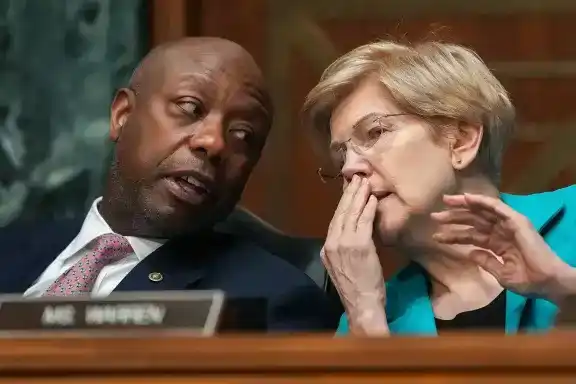
The CLARITY Act is a landmark bill aimed at establishing a regulatory framework for the U.S. crypto industry. The bill will begin its markup review process in a Senate committee starting Thursday. Its passing prospects have boosted investor sentiment, but there remain several significant hurdles to cross before Congress can send the bill to President Trump's desk.

CLARITY is short for the "Digital Asset Market Clarity Act." The bill passed the House of Representatives last year but encountered resistance in the Senate Banking Committee due to disputes between banks and stablecoin companies over whether and when rewards can be paid on stablecoin balances. Now, as senators prepare to propose amendments, Democrats are pushing to include ethical constraint clauses related to the Trump family's crypto businesses.

According to a copy of proposed amendments reviewed by Fortune, members of the Senate Banking Committee have submitted over 130 proposed amendments ahead of Thursday's markup, with Senator Elizabeth Warren alone submitting 44.

Some of the proposed amendments are minor, but others aim to advance the positions of the bill's opponents. These opponents include banking interests concerned that stablecoins could weaken the deposit base of banks, as well as those worried about ethical and national security risks accompanying the crypto industry's expansion.

"I think it will pass, based on the progress made in both chambers of Congress so far and the White House's support for this bill," Steve Yelderman, general counsel for the Ethereum-focused initiative Etherealize, told Fortune. "Having said that, this is Washington, and anything can happen."

Earlier this year, the CLARITY Act came close to entering a Senate Banking Committee markup, but Coinbase withdrew its support for the bill over a proposed ban on stablecoin rewards. Since then, Senator Thom Tillis (R-N.C.) and Senator Angela Alsobrooks (D-Md.) reached an agreement on the stablecoin yield issue. However, banking lobbying groups now complain that this compromise is too friendly to stablecoin companies. Reportedly, members of the American Bankers Association have sent over 8,000 letters to Senate offices criticizing this yield compromise.

A Senate aide told Fortune that during tomorrow's markup, Senate Banking Committee Chairman Tim Scott (R-S.C.) is expected to emphasize protecting "ordinary people," safeguarding national security, and keeping crypto innovation in the United States as the main goals of the CLARITY Act. Another Senate aide said Democrats are expected to focus on the ethical issues raised by President Trump's numerous crypto connections.

"Democrats are increasingly concerned that if ethics provisions are not included in the version of the bill marked up by the Banking Committee, they may not be included later," the staffer said. They added that Democrats are focused on addressing the issue of the Trump family profiting from cryptocurrencies within the market structure legislation. Republicans and Democrats have met several times this week to discuss how to add ethics clauses to the CLARITY Act.

For now, the bill's chances of reaching a full Senate vote remain significant. A key Republican who had previously been hesitant about the CLARITY Act in the Banking Committee, Senator John Kennedy of Louisiana, told Semafor he plans to support the bill. However, with the summer recess and midterm elections approaching, the margin for error for the CLARITY Act remains quite limited. Traders on Polymarket have become less optimistic about the bill's prospects this week. The prediction market currently puts the probability of the bill passing this year at 60%.


Perguntas relacionadas

QWhat is the CLARITY Act and what is its primary goal?

AThe CLARITY Act refers to the 'Digital Asset Market Clarity Act'. It is a landmark bill aimed at establishing a regulatory framework for the crypto industry in the U.S., with the primary goal of providing clear rules for digital assets while protecting retail investors, combating illicit finance, and keeping financial innovation in the United States.

QWhy was the progression of the CLARITY Act in the Senate Banking Committee previously stalled?

AThe bill's progress in the Senate Banking Committee was previously stalled due to disputes between banks and stablecoin companies over the question of whether and when stablecoin balances could pay rewards.

QWhat are the key tensions in U.S. crypto regulation highlighted by the CLARITY Act's progress?

AThe article highlights three key tensions: 1) Whether stablecoin rewards are a payment incentive or a form of indirect deposit competition; 2) Whether the crypto market structure legislation protects investors or opens a regulatory pathway for industry expansion; 3) Whether market structure reform must incorporate ethical constraints given the deep involvement of the Trump family in crypto businesses.

QWhat is one major concern Democrats are trying to address with proposed amendments to the CLARITY Act?

ADemocrats are trying to address ethical concerns by pushing to incorporate ethical constraint clauses related to the Trump family's crypto business profits into the market structure legislation.

QAccording to prediction markets, what is the current estimated probability of the CLARITY Act passing in 2025?

AAccording to the prediction market Polymarket, the estimated probability of the CLARITY Act passing in 2025 is currently around 60%.

Leituras Relacionadas

ByteDance Adopts Arm CPUs, Jensen Huang: So Sad I Didn't Buy Arm

**Summary:** At Computex 2026, Arm CEO Rene Haas announced that ByteDance and Oracle have adopted Arm's self-designed Arm AGI data center CPU. The company expects significant revenue growth from this product, projecting $20 billion in demand for the 2027/2028 fiscal years. Haas noted that restricting AI-capable CPUs from the US to China is nearly impossible due to their widespread applications. Arm's stock has surged dramatically this year, notably rising 16% after NVIDIA's Arm-based Vera CPU and RTX Spark announcements. A highlight was the informal, humorous on-stage conversation between Haas and NVIDIA CEO Jensen Huang. Huang joked about NVIDIA's failed attempt to acquire Arm and playfully lamented selling his Arm shares. Both executives showed a clear sense of camaraderie and shared regret over the missed merger. Key technical topics were discussed: 1. **AI PC Design:** Huang explained NVIDIA's RTX Spark superchip (with a 20-core Arm CPU) is designed for future AI agents that will autonomously run and use tools on PCs, blending local and cloud processing. 2. **Agent vs. OS:** Huang emphasized the operating system remains crucial, as AI agents rely on its APIs and tools to function. 3. **Growth Constraints:** He identified the shift to "useful AI" that generates profitable tokens as a primary driver for immense, almost limitless, computational demand. Haas outlined Arm's strategy across PC and data centers. For PCs, Arm collaborates with partners like NVIDIA and MediaTek, offering its compute subsystem (CSS) for custom SoCs. In data centers, its Arm AGI CPU (built on TSMC's 3nm process) has gained major partners including OpenAI, Meta, and now ByteDance and Oracle. Arm presented a multi-year roadmap for its in-house CPU line. The article concludes that while GPUs dominated the AI training race, the explosion of AI agents is shifting significant focus to CPUs for inference, state management, and tool orchestration. The industry is trending towards vertical integration, with companies like cloud providers designing chips and chip/IP firms offering full solutions, all competing to deliver more efficient computing per watt.

marsbitHá 20m

ByteDance Adopts Arm CPUs, Jensen Huang: So Sad I Didn't Buy Arm

marsbitHá 20m

New Wall Street Play: Yen Shorts Still Adding, But Japan Stocks Don't Rely on Carry Trade Unwinding

On June 3rd, USD/JPY hit 160.44, its highest level since July 2024, while the Nikkei 225 surged past 68,000 points. Contrary to popular narratives of an imminent "carry trade unwind" akin to August 2024, data reveals a more complex picture. Speculative net short positions in yen futures have actually increased, reaching -114,667 contracts by late May, suggesting traders are doubling down rather than retreating. Meanwhile, Japan's Finance Ministry conducted its largest-ever single-round FX intervention (11.73 trillion yen) in April-May but failed to hold the 160 yen line. The Nikkei's rally is not driven by carry trade dynamics. Foreign investors are aggressively buying Japanese stocks, with net purchases in 2026 running nearly 16 times higher than 2025 levels. This inflow is concentrated in AI and semiconductor-related stocks like SoftBank and Socionext, fueled by positive sector outlooks, rather than being a flight from unwinding yen shorts. Furthermore, the Nikkei has continued climbing despite the Bank of Japan's (BOJ) rate hikes to 0.75%. This disconnect exists because the current equity boom is fueled by AI-driven foreign investment, not reliant on cheap yen funding. However, this relationship remains fragile. Should the BOJ hike rates further (e.g., to 1.0%) while dollar weakness increases carry trade costs, the trajectories of the yen and Japanese stocks could reconverge, potentially triggering volatility.

marsbitHá 24m

New Wall Street Play: Yen Shorts Still Adding, But Japan Stocks Don't Rely on Carry Trade Unwinding

marsbitHá 24m

Broadcom's Q3 Guidance Misses Expectations by $12 Billion, After-Hours Trading Plummets Over 13%, AI Narrative "Cooling"?

On June 3, Broadcom released record Q2 FY26 results with revenue of $22.19B, up 48% YoY, and AI chip sales of $10.8B, up 143%. Adjusted EPS of $2.44 beat estimates. However, its Q3 AI semiconductor revenue guidance of $16B, while up over 200% YoY, fell roughly $1.2B (7%) short of analyst consensus expectations of $17.2B. This miss, coupled with slightly weaker-than-expected software revenue, triggered a severe market reaction. CEO Hock Tan maintained the FY26 AI revenue outlook of over $100B but did not raise it, disappointing investors who had priced in more robust growth. The stock plummeted over 13% in after-hours trading, erasing roughly $270B in market cap. The sell-off extended to peers like Marvell. A key concern for markets, particularly for Chinese optical module suppliers, was Tan's comment that the contribution of AI networking (e.g., Ethernet switches, optical interconnect chips) to AI revenue, currently near 40%, is expected to normalize to around 30% over time, signaling a potential peak in growth for that segment. Despite the guidance shortfall, Tan reiterated that AI demand remains "insatiable" and reaffirmed the long-term target of exceeding $100B in AI revenue by FY27. The reaction highlights the heightened sensitivity and premium valuation placed on AI-exposed stocks, where anything less than stellar guidance can prompt significant profit-taking. The broader question is whether this represents a cooling AI narrative or a correction in overstretched valuations.

marsbitHá 24m

Broadcom's Q3 Guidance Misses Expectations by $12 Billion, After-Hours Trading Plummets Over 13%, AI Narrative "Cooling"?

marsbitHá 24m

Trading

Spot
Futuros
活动图片




