The Catfish Effect Emerges: Stablecoins Are Forcing the Banking System to Improve Efficiency and Interest Rates

比推Publicado em 2025-12-19Última atualização em 2025-12-19

Resumo

The article "The Catfish Effect: Stablecoins Are Forcing Banks to Improve Efficiency and Interest Rates" challenges the initial fear that stablecoins would trigger massive bank deposit outflows. Instead, research indicates that due to the "stickiness" of deposits—where traditional checking accounts remain central for interoperability with mortgages, credit cards, and salaries—no significant correlation exists between stablecoin growth and bank disintermediation. Rather than being a threat, stablecoins act as a competitive force, compelling banks to offer higher deposit rates and improve operational efficiency. Proper regulation, like the GENIUS Act which mandates full reserve backing with safe assets, addresses risks such as runs and liquidity issues. Ultimately, stablecoins complement the traditional system, promising efficiency gains through atomic settlement and faster cross-border payments, potentially upgrading the dollar's infrastructure and fostering greater financial inclusion.

Author: Christian Catalini, Forbes

Compiled by: Peggy, BlockBeats

Original Title: The Catfish Effect? Stablecoins Are Truly Not the Enemy of Bank Deposits


Editor's Note: Whether stablecoins would impact the banking system was one of the core debates in recent years. However, as data, research, and regulatory frameworks gradually become clearer, the answer is becoming more measured: stablecoins have not triggered large-scale deposit outflows. Instead, constrained by the reality of "deposit stickiness," they have become a competitive force that compels banks to improve interest rates and efficiency.

This article reexamines stablecoins from the perspective of banks. They may not be a threat but rather a catalyst forcing the financial system to renew itself.

Below is the original text:

A dollar sign flashing on an IBM computer monitor in 1983.

Back in 2019, when we announced the launch of Libra, the global financial system's reaction was, to put it mildly, quite intense. The near-existential fear was: once stablecoins become instantly accessible to billions of people, would the banking system's control over deposits and payment systems be completely broken? If you could hold a "digital dollar" in your phone that transfers instantly, why would you keep your money in a checking account that offers zero interest, charges numerous fees, and essentially shuts down on weekends?

At the time, this was a perfectly reasonable question. For years, the mainstream narrative has been that stablecoins are "stealing the banks' business." There were concerns that "deposit flight" was imminent.

Once consumers realized they could directly hold a form of digital cash backed by Treasury-grade assets, the foundation providing low-cost funding for the U.S. banking system would quickly crumble.

But a rigorous research paper recently published by Professor Will Cong of Cornell University suggests the industry may have panicked too soon. By examining real evidence rather than emotional judgments, Cong presents a counterintuitive conclusion: when properly regulated, stablecoins are not disruptors draining bank deposits but rather a complement to the traditional banking system.

The "Sticky Deposits" Theory

The traditional banking model is essentially a bet built on "friction."

Since the checking account is the only true interoperable hub for funds, almost any transfer of value between external services must go through the bank. The entire system is designed on the logic that as long as you don't use a checking account, operations become more cumbersome—the bank controls the only bridge connecting the isolated "islands" of your financial life.

Consumers are willing to accept this "toll" not because checking accounts are superior, but because of the power of the "bundling effect." You keep money in your checking account not because it's the best place for funds, but because it's a central node: mortgages, credit cards, direct deposit salaries all interface and operate together here.

If the assertion that "banks are dying" were true, we should have seen massive bank deposits flowing into stablecoins. But reality is different. As Cong points out, despite the explosive growth in stablecoin market capitalization, "existing empirical research has found little evidence of a clear correlation between the emergence of stablecoins and the outflow of bank deposits." The friction mechanism remains effective. So far, the adoption of stablecoins has not caused substantial outflows from traditional bank deposits.

It turns out that those warnings about "mass deposit flight" were more panic-driven rhetoric from incumbents based on their own positions, ignoring the most basic economic "laws of physics" in the real world. The stickiness of deposits is an incredibly powerful force. For most users, the convenience value of the "bundled service" is too high—too high to move their life savings into a digital wallet just for a few extra basis points of yield.

Competition is a Feature, Not a System Bug

But real change is happening here. Stablecoins may not "kill banks," but they will almost certainly make banks uncomfortable and force them to become better. The Cornell study points out that even the mere existence of stablecoins already acts as a disciplinary constraint, forcing banks to no longer rely solely on user inertia but to start offering higher deposit interest rates and more efficient, sophisticated operational systems.

When banks truly face a credible alternative, the cost of sticking to the old ways rises rapidly. They can no longer take it for granted that your funds are "locked in," but are forced to attract deposits with more competitive pricing.

Under this framework, stablecoins do not "shrink the pie"; instead, they promote "more credit extension and broader financial intermediation, ultimately enhancing consumer welfare." As Professor Cong states: "Stablecoins are not meant to replace traditional intermediaries but can serve as a complementary tool to expand the boundaries of what banks are good at."

It turns out that the "threat of exit" itself is a powerful motivator for incumbents to improve their services.

Regulatory "Unlocking"

Of course, regulators have good reason to worry about so-called "run risk"—the possibility that if market confidence wavers, the reserve assets backing stablecoins could be forced into fire sales, triggering a systemic crisis.

But as the paper points out, this is not some unprecedented new risk; it is a standard risk profile long inherent in financial intermediation, highly similar in nature to the risks faced by other financial institutions. We already have a mature set of frameworks for managing liquidity and operational risks. The real challenge is not "inventing new physical laws" but correctly applying existing financial engineering to a new technological form.

This is where the GENIUS Act plays a key role. By explicitly requiring stablecoins to be fully backed by reserves of cash, short-term U.S. Treasuries, or insured deposits, the act mandates safety at the institutional level. As the paper states, these regulatory guardrails "appear to cover the core vulnerabilities identified in academic research, including run risk and liquidity risk."

The legislation sets minimum statutory standards for the industry—full reserve backing and enforceable redemption rights—but leaves the specific operational details to be implemented by bank regulators. Next, the Federal Reserve and the Office of the Comptroller of the Currency (OCC) will be responsible for translating these principles into enforceable rules, ensuring stablecoin issuers adequately account for operational risks, the possibility of custody failures, and the unique challenges involved in large-scale reserve management and integration with blockchain systems.
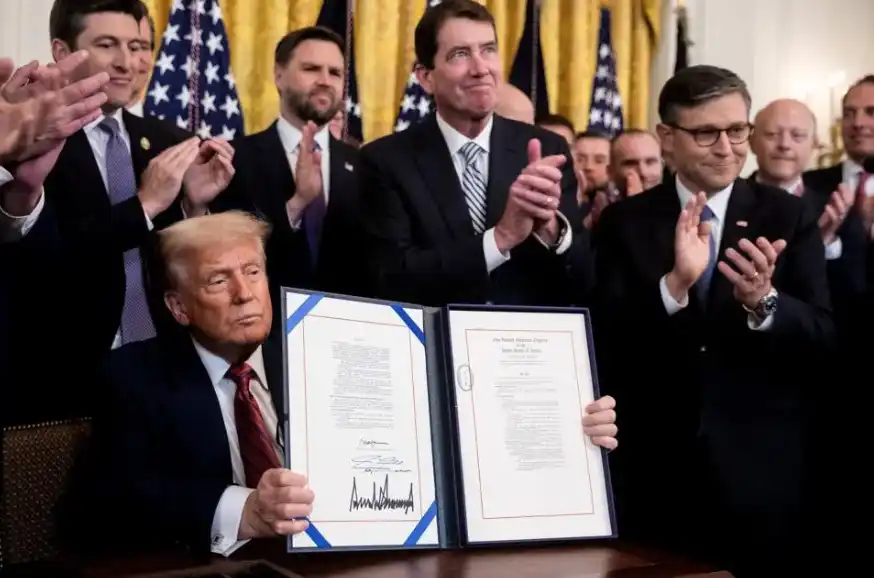
July 18, 2025 (Friday): U.S. President Donald Trump displays the newly signed GENIUS Act during a signing ceremony in the East Room of the White House in Washington.

Efficiency Dividend

Once we move beyond the defensive mindset of "deposit diversion," the real upside becomes apparent: the "underlying plumbing" of the financial system itself has reached a point where it must be restructured.

The true value of tokenization is not just 24/7 availability, but "atomic settlement"—the instant transfer of value across borders without counterparty risk, a problem the current financial system has long failed to solve.

The current cross-border payment system is costly and slow, with funds often needing to pass through multiple intermediaries for days before final settlement. Stablecoins compress this process into a single on-chain, final, and irreversible transaction.

This has profound implications for global cash management: funds are no longer trapped "in transit" for days but can be moved across borders instantly, releasing liquidity currently tied up long-term in the correspondent banking system. In domestic markets, the same efficiency gains promise lower-cost, faster merchant payments. For the banking industry, this is a rare opportunity to update the traditional clearing infrastructure that has long been held together with tape and COBOL.

The Upgrade of the Dollar

Ultimately, the U.S. faces a binary choice: either lead the development of this technology or watch the future of finance take shape in offshore jurisdictions. The U.S. dollar remains the world's most popular financial product, but the "rails" supporting it are clearly aging.

The GENIUS Act provides a truly competitive institutional framework. It "domesticates" this field: by bringing stablecoins within the regulatory perimeter, the U.S. transforms what was an不安 element of the shadow banking system into a transparent, robust "global dollar upgrade," shaping an offshore novelty into a core component of domestic financial infrastructure.

Banks should stop fixating on competition itself and start thinking about how to leverage this technology to their advantage. Just as the music industry was forced to move from the CD era to the streaming era—initially resistant but ultimately discovering a goldmine—banks are resisting a transformation that will ultimately save them. When they realize they can charge for "speed" rather than profit from "delay," they will truly learn to embrace this change.

A New York University student downloads music files from the Napster website in New York. On September 8, 2003, the Recording Industry Association of America (RIAA) filed lawsuits against 261 file-sharers who downloaded music files over the internet; additionally, the RIAA issued over 1,500 subpoenas to internet service providers.


Twitter:https://twitter.com/BitpushNewsCN

Bitpush TG Discussion Group:https://t.me/BitPushCommunity

Bitpush TG Subscription: https://t.me/bitpush

Original article link:https://www.bitpush.news/articles/7597093

Perguntas relacionadas

QWhat is the main argument presented in the article regarding stablecoins and the banking system?

AThe article argues that stablecoins are not a threat that will drain bank deposits, but rather a competitive force that is pushing the traditional banking system to become more efficient and offer higher deposit rates, acting as a catalyst for self-renewal within the financial system.

QAccording to the research by Professor Will Cong, what was the relationship between the growth of stablecoins and bank deposits?

AProfessor Will Cong's research found that despite the explosive growth in stablecoin market value, there is almost no clear correlation between the emergence of stablecoins and an outflow of bank deposits, indicating that deposit 'stickiness' is a powerful force.

QHow does the article suggest the GENIUS Act impacts the stablecoin industry?

AThe GENIUS Act provides a regulatory framework by mandating that stablecoins must be fully backed by reserves like cash, short-term U.S. Treasuries, or insured deposits. It sets minimum legal standards and brings the industry under regulatory oversight, transforming it into a transparent and robust 'global dollar upgrade方案'.

QWhat efficiency advantages do stablecoins offer over the traditional financial system, as mentioned in the article?

AStablecoins offer 'atomic settlement,' enabling instant, cross-border value transfer without counterparty risk. This compresses a process that traditionally takes days through multiple intermediaries into a single, irreversible on-chain transaction, freeing up liquidity and enabling lower-cost, faster payments.

QWhat historical analogy does the article use to describe the banking industry's potential journey with stablecoin technology?

AThe article uses the analogy of the music industry's transition from CDs to streaming. It suggests that banks, initially resistant to stablecoins, may eventually discover that this technology represents a golden opportunity, allowing them to charge for 'speed' rather than profit from 'delay'.

Leituras Relacionadas

A Clod of Chinese Soil Chokes Two Japanese Giants

"Chinese Soil Chokes Japanese Giants" The production of a key electronic specialty gas, tungsten hexafluoride (WF6), vital for manufacturing AI chips, was halted by two leading Japanese producers—Kanto Denka and Central Glass. Their shutdown was not due to a technological failure but a sudden, critical shortage of a raw material they had long taken for granted: ultra-high-purity (6N-grade) tungsten powder, which is almost entirely sourced from China. Following a quiet Chinese export announcement in January 2026, tungsten powder shipments to Japan dropped to zero for months. Despite frantic efforts, Japanese companies found no viable alternative; imported powder was three times more expensive and lacked the required purity. Their existing stockpiles were exhausted by mid-2026. WF6 is essential for depositing tungsten into the microscopic contact holes of High Bandwidth Memory (HBM) chips, which are crucial for advanced processors like those from Nvidia. While Japanese firms had mastered producing ultra-pure WF6 gas, their entire supply chain relied on China's 6N tungsten powder—a dependency now revealed as a fatal vulnerability. China's dominance in this "soil" results from decades of painstaking R&D by companies like Xiamen Tungsten and China Tungsten & Hightech. They overcame immense technical hurdles, such as separating chemically similar molybdenum from tungsten, to achieve mass production of the world's purest tungsten powder. With their primary suppliers gone, Kanto Denka and Central Glass announced a permanent halt to WF6 production starting July 1, 2026. This immediately created a supply crisis for major semiconductor manufacturers like Samsung and SK Hynix, forcing them to urgently seek and certify new Chinese suppliers for WF6 itself. The reversal marks a dramatic shift: China has moved from exporting low-value raw materials to controlling the high-purity foundation of a critical global tech supply chain, upending a long-established industrial hierarchy.

marsbitHá 9m

A Clod of Chinese Soil Chokes Two Japanese Giants

marsbitHá 9m

Without Tencent, What's Left for Suiyuan?

The article centers on the crucial question posed in the title: what is Seyond Technology really worth if its dominant customer, Tencent, were to stop purchasing its AI chips? As the last of China's "Four AI Chip Dragons" to secure approval for a public listing, Seyond's IPO filing reveals a profound and controversial dependency. In 2025, 74.9% to over 80% of its revenue came from Tencent. The piece argues that this extreme customer concentration is not merely a vulnerability but a strategic outcome of China's AI industry evolution. It contrasts Seyond's path with its peers (Moore Thread, Biren Technology, and MetaX), noting that while others raced to market with ambitious stories, Seyond focused first on securing and delivering for a major client. Its explosive revenue growth—with Q1 2026 up 1474.85% year-on-year—is driven by concentrated orders from Tencent, which itself faces massive, escalating AI compute demands for products like its Yuanbao and Hunyuan models. The relationship is framed as a deliberate, symbiotic cultivation of a supply chain. As both a major shareholder (20.26%) and primary client, Tencent is actively fostering Seyond to build a controllable, stable alternative to NVIDIA, similar to how global tech giants historically nurtured key suppliers. The high switching costs—involving software stacks and deployed systems—create a deep "ecological moat" for Seyond within Tencent's ecosystem. The analysis positions the AI chip landscape in three tiers: NVIDIA as the global leader, Huawei's Ascend as the state-backed player, and commercial firms like Seyond competing for market orders. Seyond is increasingly seen as "Tencent's compute foundation," with its product roadmap closely aligned with the tech giant's needs. The conclusion is that the industry's metric for success is shifting from fundraising and technical specs to real orders, delivery capability, and ecosystem binding. Seyond's value, therefore, lies not just in its chips but in holding a massive, multi-year procurement order from China's largest internet company—a tangible asset arguably more telling than any technical whitepaper in the current climate. The core insight is that for domestic chips, the ultimate challenge isn't just catching up technologically with NVIDIA, but earning the trust, scenarios, and recurring orders from a major anchor client.

marsbitHá 1h

Without Tencent, What's Left for Suiyuan?

marsbitHá 1h

War Trade Unwinding | TradeXYZ Weekend Observations

Weekend markets saw a clear return of risk appetite. Major indices rose broadly, with significant gains in tech and precious metals, while energy sectors fell sharply on the "end of war" narrative. On June 14, oil prices initially rose on reports Iran had not yet finalized a memorandum of understanding. Later, YNET reported Trump might immediately lift the maritime blockade on Iran and the Strait of Hormuz. At 21:30, Trump confirmed on Truth Terminal that a deal with Iran was done, authorizing an immediate end to the US blockade and toll-free opening of the Strait. Iran's deputy foreign minister simultaneously announced an immediate and permanent halt to military actions on multiple fronts. Oil prices had already fallen to weekend boundaries, pre-pricing the news. The S&P 500 subsequently touched 7530. Markets will likely remain in a waiting period until the formal peace deal signing on June 19. At the moment of the deal announcement, gold jumped from ~4,221 to a high of 4,337, and silver from ~67.85 to 70.83, before stabilizing at higher levels. Individual stocks and ETFs like NBIS, RKLB, and LITE performed strongly. NBIS, added to the Nasdaq index, saw a target price increase due to strong AI cloud growth. RKLB, also added to the index, benefited from positive SpaceX valuation sentiment. LITE received a $1,130 target from JPMorgan. SPCX rose quickly after Musk tweeted SpaceX could potentially reach ~$1 trillion in revenue by 2030. In summary, the market shock from the multi-month war is beginning to dissipate. Israel's actions remain the key variable before the June 19 signing. Upcoming events like Fed Chair Warsh's debut and BoJ rate hike expectations will also significantly impact markets this week.

marsbitHá 1h

War Trade Unwinding | TradeXYZ Weekend Observations

marsbitHá 1h

Trading

Spot
Futuros
活动图片