The Bitcoin Inheritance Challenge: How to Help Your Family Recover Your Assets?

比推Publicado em 2026-03-18Última atualização em 2026-03-18

Resumo

Self-custody of Bitcoin fundamentally changes estate planning. A robust inheritance plan must protect assets during the owner’s lifetime while ensuring designated individuals can recover them after death. Bitcoin’s key advantage—bypassing banks and custodians—also complicates inheritance, as the network only recognizes cryptographic keys, not legal documents. Key challenges include balancing security and accessibility, managing technical complexity for non-expert heirs, preserving privacy, and ensuring long-term viability. Common solutions include: 1. Custodial Inheritance: Relies on exchanges or institutions, sacrificing self-custody benefits for familiar legal processes. 2. DIY Inheritance: Ranges from simple seed-phrase handovers to complex multisig setups. High autonomy but requires technical competence from heirs. 3. Assisted Custody: Uses a service provider for multisig setup and recovery guidance, improving usability but depending on the provider’s longevity. 4. On-Chain Collaborative Inheritance: Combines assisted recovery with on-chain fallbacks (e.g., timelocks), ensuring access even if the provider fails. The strongest plans integrate a smooth, guided recovery path with a durable on-chain backup. Regular testing and updates are crucial. Inheritance isn’t just a technical issue—it must align with legal frameworks and family circumstances. Ultimately, a well-designed Bitcoin inheritance plan ensures assets remain secure, private, and recoverable for generati...

Author: Nunchuk

Compiled by: AididiaoJP, Foresight News

Original title: "After You're Gone": How Should Bitcoin Be Inherited?


Self-custody is changing the way we plan for inheritance. A good Bitcoin inheritance plan must: protect your Bitcoin during your lifetime, while also ensuring that designated individuals can successfully recover these assets after you pass away.

Bitcoin grants individuals a rare ability: to hold wealth without relying on banks, brokerages, or custodial institutions. This is one of its greatest advantages.

But it is precisely this feature that makes inheritance exceptionally difficult.

For traditional assets, there is usually an intermediary institution. Banks can freeze accounts, verify documents, cooperate with courts, and transfer control. Bitcoin is completely different. The network does not recognize heirs, death certificates, probate documents, nor does it handle customer service requests. It only recognizes keys and spending conditions.

This leads to a simple but severe problem: the very characteristics that make Bitcoin difficult to steal also make it difficult to inherit.

Why Bitcoin is Different

Bitcoin inheritance is essentially a "recovery design" problem: who can access the Bitcoin, under what conditions, and through what safeguards.

The first challenge is the contradiction between security and accessibility. During your life, you need strong protection against theft, coercion, and operational errors; after you die or become incapacitated, you want trusted individuals to have a clear path to recovery. These two goals are often in conflict.

The second challenge is complexity. Many powerful Bitcoin setups (especially multisig) might be clear to the designer, but they can be completely incomprehensible to a spouse, children, trustees, or executors who don't regularly use Bitcoin. A plan that only a calm, technical person can operate is likely to fail when recovery is truly needed.

The third challenge is privacy. Inheritance planning exposes sensitive information: who owns Bitcoin, roughly how much, and who will inherit it. A poorly designed plan creates unnecessary risks for both the owner and the heirs.

The fourth challenge is time. A true inheritance plan might need to remain effective for years or even decades. This means evaluating a solution not just on whether it works today, but on whether it can outlast devices, assumptions, and even the companies involved in its setup.

This is more important than many realize. An inheritance plan that relies on a specific company existing forever might be convenient, but it is certainly not durable.

Six Questions to Ask Yourself

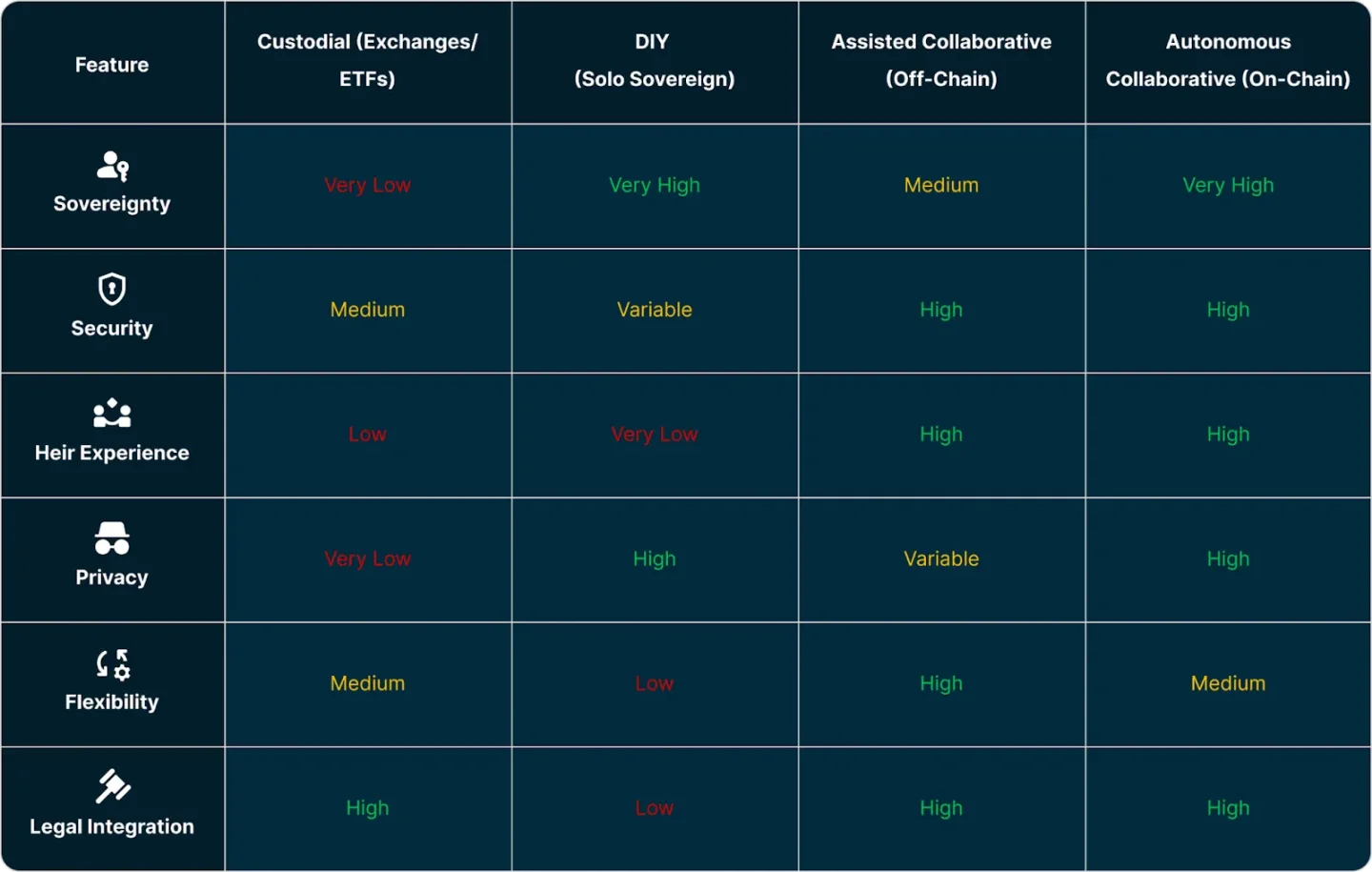
Every Bitcoin inheritance solution involves trade-offs. The simplest way to compare them is to ask six questions:

  • Autonomy: Does it preserve your full control over the assets, or does it rely on a company, custodian, trustee, or legal process to function?

  • Security: During your lifetime, does it effectively prevent Bitcoin from being stolen, coerced, or accidentally misplaced?

  • Heir Experience: Can your designated heirs actually recover the funds without confusion or making fatal mistakes?

  • Privacy: How much sensitive information about you or your family does this solution expose?

  • Flexibility: Is it easy to update the plan when beneficiaries, timelines, or family circumstances change?

  • Legal Compatibility: If needed, can it work alongside wills, trusts, or trustee systems?

No single solution excels in all dimensions, but these six questions make the trade-offs clear.

Four Common Solutions

1. Custodial Inheritance

The most traditional method is to keep Bitcoin on an exchange, in an ETF, with a brokerage, or with another custodian, and let the traditional legal system handle the transfer.

Its appeal is obvious: accounts are tied to identity, there are statements, customer support, and a relatively clear legal process for heirs.

But the cost is also clear: the institution holds the private keys. This means whether the assets can be withdrawn depends on the institution's policies, compliance processes, jurisdiction, and its ability to survive long-term. Heirs might face the dual hurdles of both the legal system and the trading platform. The concentration of vast amounts of sensitive customer data in one place also introduces privacy and security risks that don't exist with self-custody.

This approach is feasible, but its way of solving the inheritance problem essentially abandons the core value proposition of self-custodying Bitcoin.

2. DIY Inheritance

DIY inheritance covers a broad spectrum. At the simplest end is single-signature handover: directly leaving the seed phrase, hardware wallet, or a complete recovery backup to heirs. At the complex end are multisig and timelock setups built with open-source tools.

These should not be conflated.

From a security perspective, the most vulnerable is the simple single-signature handover. Each additional seed phrase backup is another target for theft, especially when a single person or location can unlock the entire wallet. Leaving complete recovery materials in a home safe, office drawer, or bank safety deposit box with no additional protection is even riskier.

Adding a BIP39 passphrase can improve this situation, but it brings new risks: there's no checksum to detect transcription errors; short passphrases can be brute-forced; long and complex passphrases might be impossible for the owner or heirs to accurately reproduce years later, locking them out of the wallet.

On the other end, well-designed DIY multisig or timelock scheme can be extremely robust. Many experienced Bitcoin users choose this path for good reason. But the cost is operational: the responsibility for setup, maintenance, and recovery falls entirely on the owner and their heirs, with often no one to ask for help if something goes wrong.

If executed properly, DIY can offer极强的 (extremely strong) autonomy and security, but it demands more from everyone involved.

3. Service-Assisted Collaborative Custody

There is a middle path: collaborative custody. In this model, the owner still uses a multisig setup, but a service provider assists with account setup, key management, recovery operations, and the inheritance process.

Compared to pure custody or pure DIY, this is a definite step forward. The owner retains more control, while heirs get assistance when needed.

Most of these services handle the inheritance logic off-chain: waiting periods, proof of life checks, beneficiary arrangements, and recovery processes are coordinated through the service provider's systems, rather than being directly encoded into the Bitcoin chain's spending conditions.

This has clear benefits. Off-chain inheritance is easier to update. If the owner wants to change beneficiaries, adjust waiting periods, or set up more complex phased distribution plans, off-chain operations are usually much more convenient than fully on-chain solutions.

The cost is the reliability of the recovery path. Whether inheritance can be realized still depends on whether the service provider exists and is willing to cooperate when the heirs make a request.

For many families, this is still a good choice, especially when guided recovery and operational flexibility are important.

4. On-Chain Collaborative Inheritance

A newer model builds on collaborative support by adding an on-chain fallback option.

The owner still gets the security of multisig and the guidance of a service provider, but the recovery path for inheritance is also written into the Bitcoin chain's spending rules. For example, using a timelock to set a deadline, after which the spending conditions automatically change, allowing heirs to recover the funds on their own even if the service provider is unavailable.

This is an important change in risk control: the recovery path is anchored in Bitcoin's rules, not just dependent on the continued cooperation of a single service provider.

This model, of course, also has costs. Because part of the plan is enforced on-chain, it is less convenient to adjust. Modifying inheritance timing or plan structure might require moving funds and paying network fees.

But for holders who want collaborative support while also having a long-term reliable backup, on-chain inheritance is a significant advancement.
Where the Real Trade-offs Lie

When comparing modern inheritance solutions, the most meaningful question isn't "which is best," but "what are you most trying to optimize for?"

Off-chain collaborative solutions often excel in flexibility: easy to update, adaptable to family changes, and simple to adjust over time.

On-chain collaborative solutions often excel in durability: the fallback path is designed to work even if the service provider fails, which is crucial for inheritance plans that need to remain effective for decades.

Many families could reasonably choose either. The key is what matters most to you.

If you view Bitcoin as generational wealth, then durability should be a core consideration.

Smooth Path + Last Line of Defense

Most Bitcoin inheritance solutions tend to lean towards two extremes.

One end sacrifices autonomy for convenience: easy to understand, but heavily reliant on institutions, identity verification, or service provider cooperation.

The other end sacrifices usability for autonomy: reduces trust in third parties, but places the complex technical burden on the heirs, and at their most vulnerable time.

The most robust方案 (solution) combines both paths.

The first is the smooth path: when the service provider is available and everything is normal, heirs recover the assets through a guided process that is smooth, low-stress, and error-resistant.

The second is the last line of defense: a recovery path enforced by the Bitcoin network, executable even if the service provider disappears.

This combination is important because it aligns with real inheritance scenarios: most people want their families to receive help, not face complex technical operations alone; simultaneously, very few are willing to entrust their legacy to a company that "must exist forever."

Estate Planning is Still Important

A common misconception is that Bitcoin inheritance must either completely脱离 (break away from) the traditional system or be fully integrated into the traditional financial system.

In reality, many families need a hybrid model.

Some holders want Bitcoin transferred directly and privately to their families. Others want trustee involvement, for example, for phased distribution, protecting minor children, or integrating with existing trusts. Some want to clarify their intentions with legal documents, while keeping the actual recovery path out of public probate records.

A good Bitcoin inheritance solution should support these different choices.

Therefore, it helps to think about two questions separately: Who should receive these assets? Who can actually recover these assets?

A will or trust can clarify intentions, define beneficiaries, and set legal obligations, but it doesn't itself solve the "how to recover" problem. Conversely, a purely technical recovery solution cannot bypass tax, reporting, and inheritance law requirements.

The most comprehensive plans consider both levels clearly.

Common Mistakes

Many inheritance plans fail for very ordinary reasons.

One mistake is assuming a spouse, child, or executor will "figure it out." Possessing a hardware wallet does not equate to understanding the recovery process.

Another mistake is concentrating too much power in a single point: one document, one device, one envelope that can completely unlock the funds. This certainly facilitates inheritance, but it also facilitates theft.

Another mistake is overestimating the security of a "passphrase" without thinking through the human factors in recovery. A passphrase can indeed enhance the security of a single-signature setup, but only if there is true operational discipline in every step of creation, storage, and communication.

Finally, many people make a plan once and never revisit it. Beneficiaries may change, devices may fail, family relationships may shift. A Bitcoin inheritance plan is not a static object, but a system that needs regular review.

A Simple Action List

Inheritance planning can start simple, as long as each step is intentional and regularly revisited.

  • Step 1: Determine who should inherit your Bitcoin, and whether these individuals have the ability to handle self-custody directly. Some can receive Bitcoin directly, others might need a trustee, phased handover, or guided assistance.

  • Step 2: Choose an appropriate security model based on the size of the assets and the situation of the heirs. The larger the amount, the more important multisig and formal inheritance design become.

  • Step 3: Store secrets and instructions separately. Private keys, hardware devices, and "instruction manuals" (explaining how to recover) are best kept separate, and preferably not given to the same person.

  • Step 4: Clarify what you value most. Some families are better suited for flexible off-chain coordination, others need an on-chain fallback that can outlive the service provider.

  • Step 5: Test the plan. Not with all assets, but enough to verify that the recovery path is actually usable. A plan never rehearsed is just a theory.

  • Step 6: Review your plan after major life events and periodically. Marriage, divorce, childbirth, death, moving, service providers changing – all can affect whether the original plan remains sound.

The Final Question: The True Test of Self-Custody

It's easy to think of inheritance as something to deal with "later." But in reality, it is the ultimate test of whether a custody solution is truly robust.

Custodial solutions offer familiarity, but at the cost of reintroducing reliance on institutions. DIY solutions can be excellent if technically sound, but demand more from both the owner and the heirs. Off-chain collaborative inheritance improves usability and flexibility. On-chain collaborative inheritance adds a robust long-term backup.

The most important recent advancement in this field is inheritance design that combines guided recovery with autonomous on-chain fallbacks.

For holders who want Bitcoin to become generational wealth, this shift in direction makes a lot of sense. The goal is no longer just "leaving instructions," but "leaving a recovery path that is secure, private, and operable in the long term."


Twitter:https://twitter.com/BitpushNewsCN

Bitpush TG Discussion Group:https://t.me/BitPushCommunity

Bitpush TG Subscription: https://t.me/bitpush

Original link:https://www.bitpush.news/articles/7620845

Perguntas relacionadas

QWhat is the core challenge of Bitcoin inheritance according to the article?

AThe core challenge is the conflict between security and accessibility: Bitcoin's design makes it difficult to steal, but this same feature also makes it difficult for intended heirs to recover the assets after the owner's death or incapacitation.

QWhat are the four common solutions for Bitcoin inheritance mentioned in the article?

AThe four common solutions are: 1. Custodial Inheritance, 2. DIY Inheritance, 3. Service-Assisted Collaborative Custody, and 4. On-Chain Collaborative Inheritance.

QWhat key advantage does an On-Chain Collaborative Inheritance model provide?

AIt provides a robust, permanent backup recovery path that is enforced by the Bitcoin network's rules, ensuring the inheritance plan remains executable even if the service provider goes out of business or is unavailable.

QWhat is a major pitfall of relying solely on a 'passphrase' for security in a DIY inheritance plan?

AIt introduces new risks: there is no checksum to detect transcription errors; a short passphrase could be brute-forced; and a long, complex one might be impossible for the owner or heirs to accurately reproduce years later, potentially locking them out of the wallet.

QWhat is the recommended first step in creating a Bitcoin inheritance plan?

AThe first step is to determine who should inherit the Bitcoin and assess whether those individuals have the capability to handle self-custody directly, or if they would require a trustee, a staged handover, or guided assistance.

Leituras Relacionadas

Trading

Spot
Futuros

Artigos em Destaque

O que é BITCOIN

Compreender o HarryPotterObamaSonic10Inu (ERC-20) e a Sua Posição no Espaço Cripto Nos últimos anos, o mercado de criptomoedas assistiu a um aumento na popularidade das moedas meme, cativando não apenas os traders, mas também aqueles que procuram envolvimento comunitário e valor de entretenimento. Entre estes tokens únicos está o HarryPotterObamaSonic10Inu (ERC-20), um projeto intrigante que mistura referências culturais no tecido das criptomoedas. Este artigo explora os principais aspetos do HarryPotterObamaSonic10Inu, examinando os seus mecanismos, a sua ética orientada pela comunidade e o seu envolvimento com o vasto panorama cripto. O que é o HarryPotterObamaSonic10Inu (ERC-20)? Como o nome sugere, o HarryPotterObamaSonic10Inu é uma moeda meme construída na blockchain Ethereum, classificada sob o padrão ERC-20. Ao contrário das criptomoedas tradicionais, que podem enfatizar a utilidade prática ou o potencial de investimento, este token prospera no valor de entretenimento e na força da sua comunidade. O projeto visa promover um ambiente onde utilizadores envolvidos possam reunir-se, partilhar ideias e participar em atividades inspiradas por diversos fenómenos culturais. Uma característica notável do HarryPotterObamaSonic10Inu é a zero taxa sobre transações. Este elemento atraente visa encorajar a negociação e o envolvimento da comunidade, isento de encargos adicionais que podem desencorajar os traders de pequena escala. A oferta total da moeda está fixada em mil milhões de tokens, uma cifra que marca a sua intenção de manter uma circulação substancial dentro da comunidade. Criador do HarryPotterObamaSonic10Inu (ERC-20) As origens do HarryPotterObamaSonic10Inu estão um pouco envoltas em mistério; os detalhes sobre o criador permanecem desconhecidos. O desenvolvimento deste token carece de uma equipa identificável ou de um plano explícito, o que não é raro no setor das moedas meme. Em vez disso, o projeto surgiu de forma orgânica, com o seu progresso a depender fortemente do entusiasmo e da participação da sua comunidade. Investidores do HarryPotterObamaSonic10Inu (ERC-20) No que diz respeito a investimentos externos e apoios, o HarryPotterObamaSonic10Inu também permanece ambíguo. O token não lista quaisquer fundações de investimento conhecidas ou apoio organizacional significativo. Em vez disso, o “sangue vital” do projeto é a sua comunidade de base, que informa o seu crescimento e sustentabilidade através da ação coletiva e do envolvimento no espaço cripto. Como Funciona o HarryPotterObamaSonic10Inu (ERC-20)? Como uma moeda meme, o HarryPotterObamaSonic10Inu opera principalmente fora dos quadros tradicionais que muitas vezes governam o valor dos ativos. Existem vários aspetos distintivos que definem como o projeto funciona: Transações Sem Taxas: Sem taxas sobre transações, os utilizadores podem comprar e vender o token livremente, sem a preocupação de custos ocultos. Envolvimento da Comunidade: O projeto prospera na interação da comunidade, aproveitando plataformas de redes sociais para criar entusiasmo e facilitar a participação. Discussões, partilha de conteúdo e envolvimento são elementos cruciais que ajudam a expandir o seu alcance e a fomentar a lealdade entre os apoiantes. Sem Utilidade Prática: Deve ser notado que o HarryPotterObamaSonic10Inu não oferece utilidade concreta dentro do ecossistema financeiro. Em vez disso, é classificado como um token principalmente para entretenimento e atividades comunitárias. Referência Cultural: O token incorpora de forma inteligente elementos da cultura popular para atrair interesse, conectando-se tanto com entusiastas de memes como com seguidores de criptomoedas. HarryPotterObamaSonic10Inu exemplifica como as moedas meme operam de forma diferente de projetos de criptomoedas mais tradicionais, entrando no mercado como construções sociais inovadoras em vez de ativos utilitários. Linha do Tempo do HarryPotterObamaSonic10Inu (ERC-20) A história do HarryPotterObamaSonic10Inu é marcada por vários marcos notáveis: Criação: O token surgiu de um meme viral, capturando a imaginação de muitos entusiastas de criptomoedas. Datas específicas de criação não estão disponíveis, sublinhando a sua ascensão orgânica. Listagem em Exchanges: O HarryPotterObamaSonic10Inu conseguiu entrar em várias exchanges, permitindo um acesso e negociação mais fáceis pela comunidade. Iniciativas de Envolvimento da Comunidade: Atividades contínuas direcionadas a melhorar a interação comunitária, incluindo concursos, campanhas em redes sociais e geração de conteúdo por fãs e defensores. Planos de Expansão Futura: O roteiro do projeto inclui o lançamento de uma coleção de NFTs, mercadorias e um site de eCommerce relacionado aos seus temas culturais, envolvendo ainda mais a comunidade e tentando adicionar mais dimensões ao seu ecossistema. Pontos-Chave sobre o HarryPotterObamaSonic10Inu (ERC-20) Natureza Orientada pela Comunidade: O projeto prioriza a contribuição coletiva e a criatividade, assegurando que o envolvimento dos utilizadores está na vanguarda do seu desenvolvimento. Classificação como Moeda Meme: Representa o epítome da criptomoeda baseada em entretenimento, destacando-se dos veículos de investimento tradicionais. Sem Afiliação Direta com o Bitcoin: Apesar da semelhança no nome do ticker, o HarryPotterObamaSonic10Inu é distinto e não tem qualquer relação com o Bitcoin ou outras criptomoedas estabelecidas. Foco na Colaboração: O HarryPotterObamaSonic10Inu é projetado para criar um espaço de colaboração e partilha de histórias entre os seus detentores, proporcionando uma via para a criatividade e o fortalecimento da comunidade. Perspectivas Futuras: A ambição de expandir além da sua premissa inicial para NFTs e mercadorias delineia um caminho para o projeto potencialmente entrar em avenidas mais mainstream dentro da cultura digital. À medida que as moedas meme continuam a capturar a imaginação da comunidade cripto, HarryPotterObamaSonic10Inu (ERC-20) destaca-se devido aos seus laços culturais e abordagem centrada na comunidade. Embora possa não se encaixar no molde típico de um token orientado para utilidade, a sua essência reside na alegria e camaradagem fomentadas entre os seus apoiantes, destacando a natureza em evolução das criptomoedas em uma era cada vez mais digital. À medida que o projeto continua a desenvolver-se, será importante observar como as dinâmicas comunitárias influenciam a sua trajetória no panorama em constante mudança da tecnologia blockchain.

1.2k Visualizações TotaisPublicado em {updateTime}Atualizado em 2024.12.03

O que é BITCOIN

Como comprar BTC

Bem-vindo à HTX.com!Tornámos a compra de Bitcoin (BTC) simples e conveniente.Segue o nosso guia passo a passo para iniciar a tua jornada no mundo das criptos.Passo 1: cria a tua conta HTXUtiliza o teu e-mail ou número de telefone para te inscreveres numa conta gratuita na HTX.Desfruta de um processo de inscrição sem complicações e desbloqueia todas as funcionalidades.Obter a minha contaPasso 2: vai para Comprar Cripto e escolhe o teu método de pagamentoCartão de crédito/débito: usa o teu visa ou mastercard para comprar Bitcoin (BTC) instantaneamente.Saldo: usa os fundos da tua conta HTX para transacionar sem problemas.Terceiros: adicionamos métodos de pagamento populares, como Google Pay e Apple Pay, para aumentar a conveniência.P2P: transaciona diretamente com outros utilizadores na HTX.Mercado de balcão (OTC): oferecemos serviços personalizados e taxas de câmbio competitivas para os traders.Passo 3: armazena teu Bitcoin (BTC)Depois de comprar o teu Bitcoin (BTC), armazena-o na tua conta HTX.Alternativamente, podes enviá-lo para outro lugar através de transferência blockchain ou usá-lo para transacionar outras criptomoedas.Passo 4: transaciona Bitcoin (BTC)Transaciona facilmente Bitcoin (BTC) no mercado à vista da HTX.Acede simplesmente à tua conta, seleciona o teu par de trading, executa as tuas transações e monitoriza em tempo real.Oferecemos uma experiência de fácil utilização tanto para principiantes como para traders experientes.

3.8k Visualizações TotaisPublicado em {updateTime}Atualizado em 2025.03.21

Como comprar BTC

O que é $BITCOIN

OURO DIGITAL ($BITCOIN): Uma Análise Abrangente Introdução ao OURO DIGITAL ($BITCOIN) OURO DIGITAL ($BITCOIN) é um projeto baseado em blockchain que opera na rede Solana, com o objetivo de combinar as características dos metais preciosos tradicionais com a inovação das tecnologias descentralizadas. Embora partilhe um nome com o Bitcoin, frequentemente referido como “ouro digital” devido à sua percepção como uma reserva de valor, o OURO DIGITAL é um token separado projetado para criar um ecossistema único dentro da paisagem Web3. O seu objetivo é posicionar-se como um ativo digital alternativo viável, embora os detalhes sobre as suas aplicações e funcionalidades ainda estejam em desenvolvimento. O que é o OURO DIGITAL ($BITCOIN)? OURO DIGITAL ($BITCOIN) é um token de criptomoeda explicitamente projetado para uso na blockchain Solana. Em contraste com o Bitcoin, que fornece um papel amplamente reconhecido como armazenamento de valor, este token parece focar em aplicações e características mais amplas. Aspectos notáveis incluem: Infraestrutura Blockchain: O token é construído na blockchain Solana, conhecida pela sua capacidade de lidar com transações de alta velocidade e baixo custo. Dinâmicas de Oferta: O OURO DIGITAL tem um fornecimento máximo limitado a 100 quatrilhões de tokens (100P $BITCOIN), embora os detalhes sobre o seu fornecimento circulante ainda não tenham sido divulgados. Utilidade: Embora as funcionalidades precisas não estejam explicitamente delineadas, existem indicações de que o token poderia ser utilizado para várias aplicações, potencialmente envolvendo aplicações descentralizadas (dApps) ou estratégias de tokenização de ativos. Quem é o Criador do OURO DIGITAL ($BITCOIN)? Neste momento, a identidade dos criadores e da equipa de desenvolvimento por trás do OURO DIGITAL ($BITCOIN) permanece desconhecida. Esta situação é típica entre muitos projetos inovadores no espaço da blockchain, particularmente aqueles alinhados com finanças descentralizadas e fenómenos de moedas meme. Embora tal anonimato possa fomentar uma cultura orientada pela comunidade, intensifica as preocupações sobre governança e responsabilidade. Quem são os Investidores do OURO DIGITAL ($BITCOIN)? As informações disponíveis indicam que o OURO DIGITAL ($BITCOIN) não tem apoiantes institucionais conhecidos ou investimentos proeminentes de capital de risco. O projeto parece operar num modelo peer-to-peer focado no apoio e adoção da comunidade, em vez de rotas de financiamento tradicionais. A sua atividade e liquidez estão principalmente situadas em exchanges descentralizadas (DEXs), como a PumpSwap, em vez de plataformas de negociação centralizadas estabelecidas, destacando ainda mais a sua abordagem de base. Como Funciona o OURO DIGITAL ($BITCOIN) A mecânica operacional do OURO DIGITAL ($BITCOIN) pode ser elaborada com base no seu design de blockchain e nas características da rede: Mecanismo de Consenso: Ao aproveitar o exclusivo proof-of-history (PoH) da Solana combinado com um modelo de proof-of-stake (PoS), o projeto assegura uma validação eficiente das transações, contribuindo para o alto desempenho da rede. Tokenomics: Embora mecanismos deflacionários específicos não tenham sido extensivamente detalhados, o vasto fornecimento máximo de tokens implica que pode atender a microtransações ou casos de uso de nicho que ainda estão por definir. Interoperabilidade: Existe o potencial para integração com o ecossistema mais amplo da Solana, incluindo várias plataformas de finanças descentralizadas (DeFi). No entanto, os detalhes sobre integrações específicas permanecem não especificados. Cronologia de Eventos Chave Aqui está uma cronologia que destaca marcos significativos relacionados ao OURO DIGITAL ($BITCOIN): 2023: O lançamento inicial do token ocorre na blockchain Solana, marcado pelo seu endereço de contrato. 2024: O OURO DIGITAL ganha visibilidade ao tornar-se disponível para negociação em exchanges descentralizadas como a PumpSwap, permitindo que os utilizadores o negociem contra SOL. 2025: O projeto testemunha atividade de negociação esporádica e potencial interesse em envolvimentos liderados pela comunidade, embora não tenham sido documentadas parcerias ou avanços técnicos notáveis até ao momento. Análise Crítica Forças Escalabilidade: A infraestrutura subjacente da Solana suporta altos volumes de transações, o que pode aumentar a utilidade do $BITCOIN em vários cenários de transação. Acessibilidade: O potencial preço de negociação baixo por token pode atrair investidores de retalho, facilitando uma participação mais ampla devido a oportunidades de propriedade fracionada. Riscos Falta de Transparência: A ausência de apoiantes, desenvolvedores ou um processo de auditoria publicamente conhecidos pode gerar ceticismo em relação à sustentabilidade e confiabilidade do projeto. Volatilidade do Mercado: A atividade de negociação depende fortemente do comportamento especulativo, o que pode resultar em volatilidade significativa dos preços e incerteza para os investidores. Conclusão O OURO DIGITAL ($BITCOIN) surge como um projeto intrigante, mas ambíguo, dentro do ecossistema em rápida evolução da Solana. Embora tente aproveitar a narrativa do “ouro digital”, a sua divergência do papel estabelecido do Bitcoin como reserva de valor sublinha a necessidade de uma diferenciação mais clara da sua utilidade pretendida e estrutura de governança. A aceitação e adoção futuras dependerão provavelmente da abordagem da atual opacidade e da definição mais explícita das suas estratégias operacionais e económicas. Nota: Este relatório abrange informações sintetizadas disponíveis até outubro de 2023, e desenvolvimentos podem ter ocorrido além do período de pesquisa.

92 Visualizações TotaisPublicado em {updateTime}Atualizado em 2025.05.13

O que é $BITCOIN

Discussões

Bem-vindo à Comunidade HTX. Aqui, pode manter-se informado sobre os mais recentes desenvolvimentos da plataforma e obter acesso a análises profissionais de mercado. As opiniões dos utilizadores sobre o preço de BTC (BTC) são apresentadas abaixo.

活动图片