The AI Investment Landscape Is Being Reshaped: Beyond the 'Magnificent Seven', What Opportunities Lie in the Semiconductor Supply Chain?

marsbitPublicado em 2026-05-12Última atualização em 2026-05-12

Resumo

AI Investment Map is Reshaping: Opportunities Beyond the 'Magnificent Seven' Since ChatGPT ignited the AI wave, investment initially focused on the "Magnificent Seven" tech giants dominating cloud infrastructure. However, the rise of DeepSeek and debates on AI capital expenditure effectiveness are shifting this dynamic. Investors now recognize opportunities deeper in the supply chain—the companies providing the essential "picks and shovels." Early concerns about an AI investment "arms race" and potential low returns were partly alleviated by strong Q1 earnings from cloud providers, validating robust compute demand. This has highlighted a more certain investment thesis: regardless of which AI applications ultimately win, massive capital expenditure will first fuel demand for semiconductors and related components. This "pick-and-shovel" logic has driven semiconductor ETFs to record highs. Key beneficiaries include: * **Memory Chipmakers (e.g., SK Hynix, Samsung, Micron)**: High Bandwidth Memory (HBM) is a critical bottleneck for AI training. * **Photonics Companies**: Crucial for high-speed data transfer within AI data centers. * **The Broader "AI-11" Semiconductor Ecosystem**: This encompasses foundries & lithography (TSMC, ASML), logic & custom chips (AMD, Broadcom, Intel, Marvell), and enterprise storage (SanDisk, Western Digital). Every dollar of AI infrastructure spending flows through this chain. While the "Magnificent Seven" remain dominant in market size, thei...

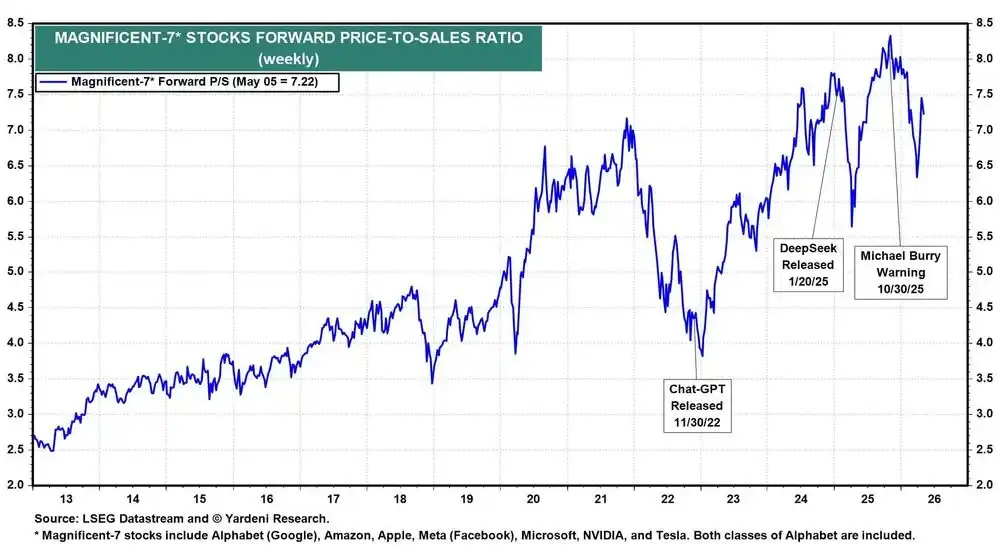
Since ChatGPT ignited the artificial intelligence wave at the end of 2022, the market's investment logic for AI has consistently revolved around the "Magnificent Seven," especially those "hyperscale" companies dominating cloud computing infrastructure. However, the debut of China's DeepSeek in early 2025 and the subsequent intense debate over the effectiveness of AI capital expenditures are quietly altering this landscape. Investors are beginning to realize that the real "gold rush" may not be confined to those giants, but lies deeper within the industrial chain that provides them with "shovels" and "tools."

From Doubts of an "Arms Race" to Validation by Performance

In the second half of last year, concerns about the return on investment for AI once permeated the market. Prominent investor Michael Burry publicly warned that the massive AI capital expenditures by hyperscale companies might not generate expected profits for various reasons, heightening fears of an AI bubble. At that time, the stock prices of the "Magnificent Seven" were under pressure, and market sentiment turned cautious.

But the earnings season this April provided a strong rebuttal. The cloud computing revenues of hyperscale companies continued to exceed expectations, and robust demand for "computing power" seemed to be justifying all the previous massive investments. In my professional experience, I have observed that shifts in market sentiment often occur after the release of key data. This time was no exception; the "hard data" from earnings quickly quelled the debate over whether capital expenditures were excessive.
The "Certainty" Dividend of Capital Expenditures: The Explosion of the Semiconductor Industry Chain

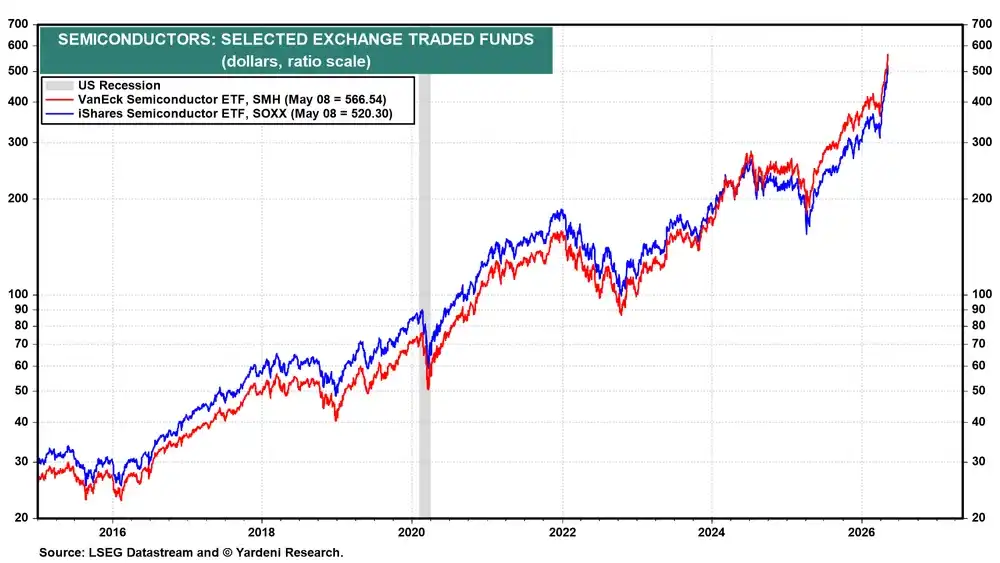
Although discussions continue about whether AI capital expenditures will ultimately bring huge profits to the hyperscale companies themselves, a more deterministic logic has emerged: Regardless of who the ultimate winner in AI applications might be, this massive capital expenditure will first translate into strong demand for semiconductors and AI-related components.

This judgment directly contributed to semiconductor-related ETFs hitting record highs in April. From a professional perspective, this is a classic "pick-and-shovel" logic—when a gold rush begins, those selling the shovels are often the first and most certain to reap profits.
Memory Chips: The Real Bottleneck in AI Training

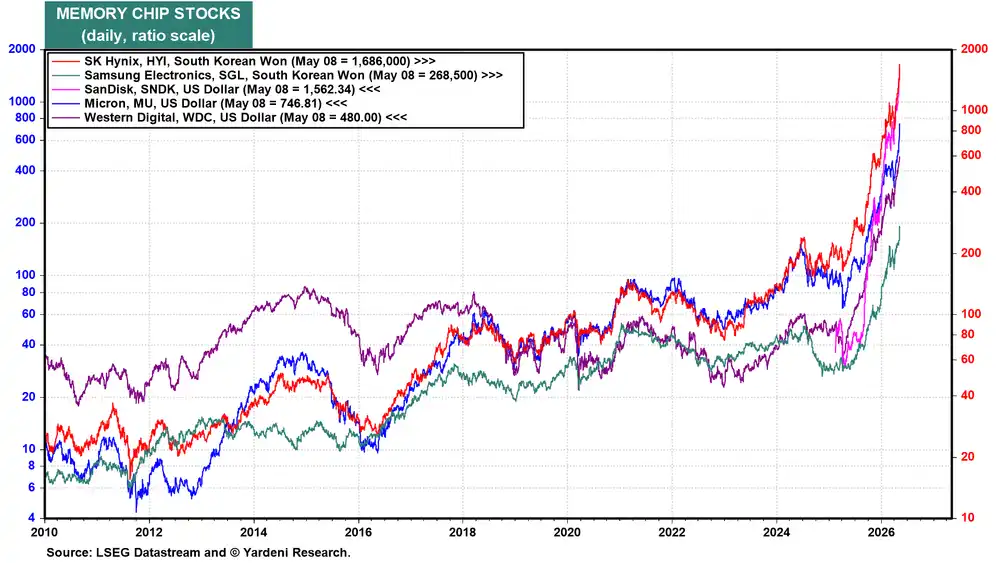
In this semiconductor rally, memory chip companies have performed exceptionally well. Memory giants from the US and South Korea—SK Hynix, Samsung, SanDisk, Micron Technology, and Western Digital—all saw their stock prices surge significantly. I wrote in March that High Bandwidth Memory (HBM) is the real "bottleneck" in the AI training process. As long as the demand for AI computing power continues to outpace supply, the growth momentum of these companies will be hard to shake.
Photonics and the Broader Semiconductor Ecosystem

In addition to memory chips, photonics companies have also performed strongly. Photonics interconnect technology plays a key role in high-speed data transmission within AI data centers, and its importance is being repriced by the market.
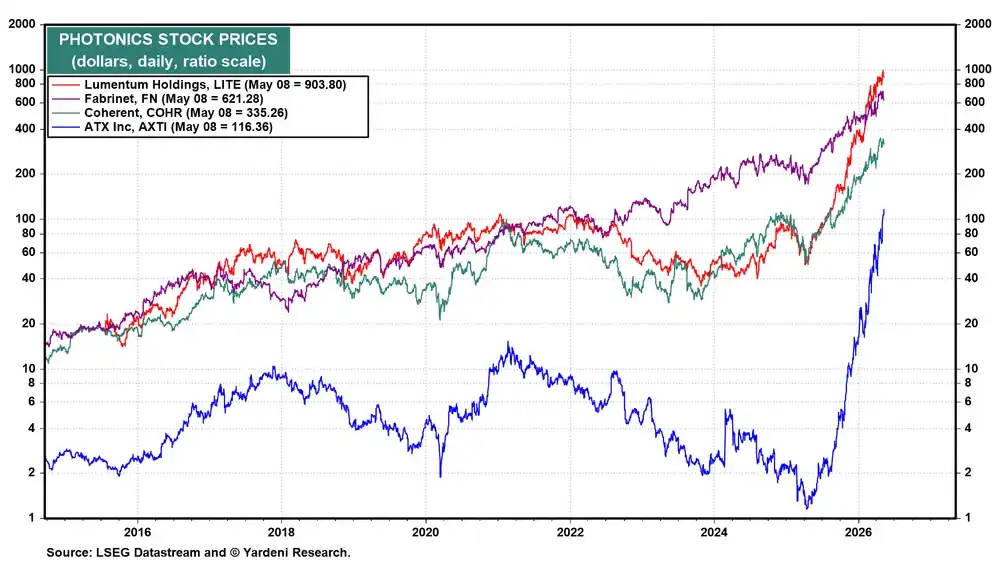
Investors have clearly concluded that AI investment opportunities are by no means limited to the "Magnificent Seven." So far this year, almost every stock in the "AI-11" semiconductor group we track has outperformed every member of the "Magnificent Seven" except for Broadcom.
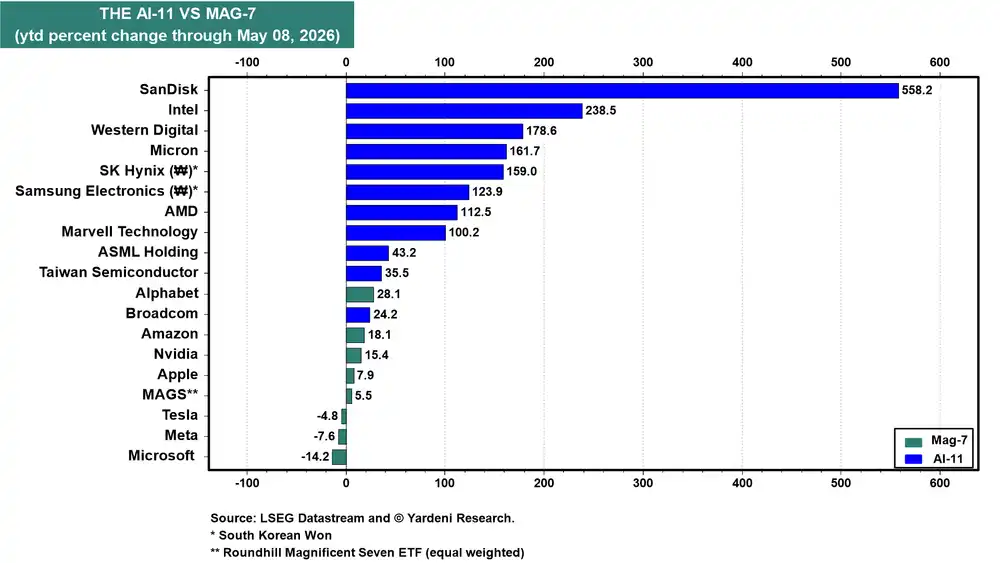
Deciphering the "AI-11" Supply Chain: Where Every Dollar Flows

Understanding the next opportunity in AI investment hinges on seeing how capital flows through this supply chain. Below is the "AI-11" core segments I have summarized:

1. Foundry & Lithography (TSMC, ASML)

TSMC provides foundry services for all leading logic chips, serving as the undisputed cornerstone of the industry. ASML monopolizes the supply of Extreme Ultraviolet (EUV) lithography equipment, the essential "chokepoint" for manufacturing cutting-edge chips.

2. Logic & Custom Chips (AMD, Broadcom, Intel)

AMD is rapidly gaining market share in the AI inference space. Broadcom is the core partner for hyperscale companies in custom ASIC chips and holds a dominant position in networking chips. Marvell complements the landscape in custom chips, networking, and optical connectivity. Intel is telling a "foundry comeback" story and benefits from CPU demand driven by the AI server cycle.

3. Memory Chips (Micron, SK Hynix, Samsung)

These three giants supply the real "hard currency" of AI training—High Bandwidth Memory. SK Hynix currently holds a leading position in the global HBM market.

4. Enterprise NAND & Storage (SanDisk, Western Digital)

SanDisk has become a pure-play beneficiary of enterprise NAND flash and solid-state drives (SSDs). Western Digital provides complementary high-capacity Hard Disk Drives (HDDs).

Every dollar of hyperscale AI infrastructure capital expenditure must flow through this complete supply chain before reaching the server racks. This explains why the technology sector now accounts for a record 55% of U.S. corporate capital expenditures.
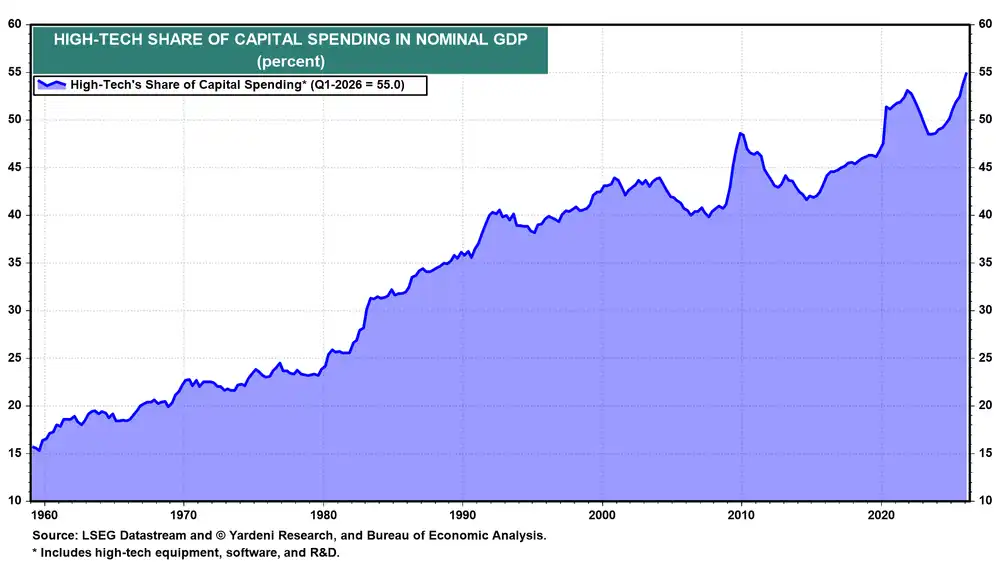
The Dominance of the "Magnificent Seven" Remains, but Marginal Growth Is Shifting

It is undeniable that the "Magnificent Seven" still hold a dominant position in the S&P 500 index. They collectively account for 30.6% of the index's market capitalization, 25.1% of its forward earnings, and 13.7% of its forward revenue. The strong fundamentals represented by this label persist.
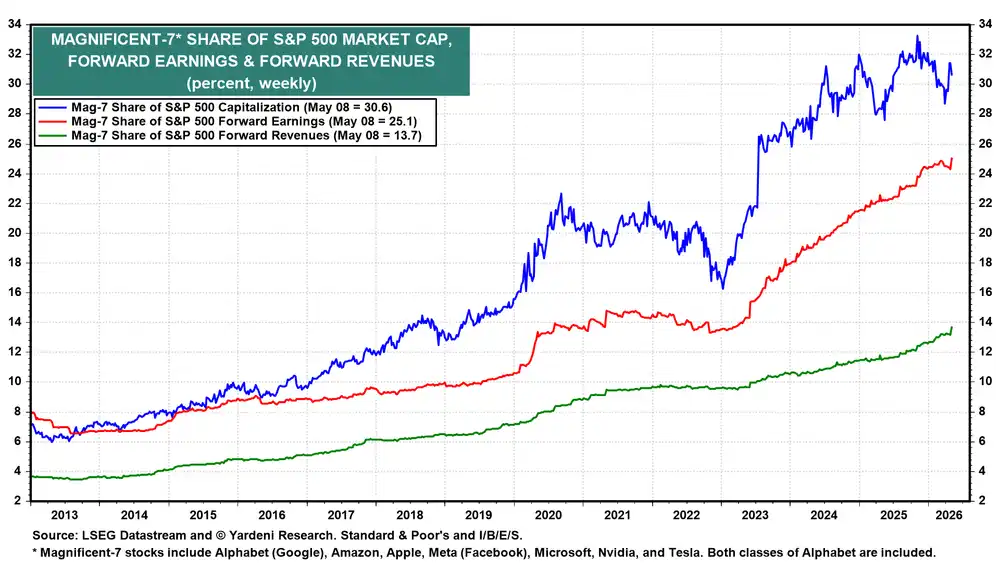
However, a marginal change is underway. The current forward earnings growth rate for the "Magnificent Seven" is 25.4%, while it is 17.9% for the S&P 500 excluding the "Magnificent Seven" (the "S&P 493"). This gap has narrowed significantly compared to a year ago. The "S&P 493" is catching up in this growth race. The premium once accorded to the "Magnificent Seven" due to the scarcity of their earnings growth is becoming less pronounced as growth becomes more widespread.
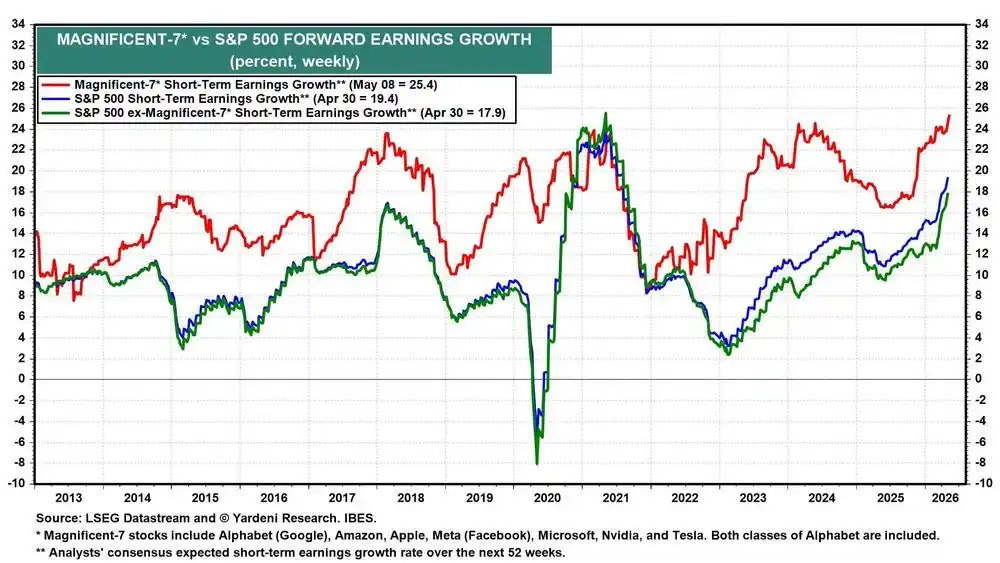
In my view, the market has fully priced in the dominance of the "Magnificent Seven." The marginal funds that investors are focusing on are now shifting towards areas that can extend the AI narrative beyond the initial seven companies.

Conclusion: From "Betting on Winners" to "Investing in Certainty"

Reviewing the evolution of AI investment logic in this cycle, we can clearly see a main theme: shifting from the initial "betting on which giant will win" to "investing in the most certain links of the industrial chain." The certainty of AI capital expenditures has brought unprecedented prosperity to the semiconductor supply chain. For investors, understanding this shift from the "demand side" to the "supply side" may be key to grasping AI investment opportunities in the coming years. Of course, any investment decision needs to be made in consideration of one's own risk tolerance. Uncertainty always exists in the market, but understanding the industrial logic is the first step towards making an informed judgment.


Perguntas relacionadas

QAccording to the article, what major shift is occurring in the AI investment landscape beyond the 'Magnificent 7'?

AThe investment focus is shifting from the leading cloud infrastructure giants (the 'Magnificent 7') to the semiconductor supply chain that provides the essential components (the 'picks and shovels') for AI development. Investors are moving towards 'investing in certainty' within the industry chain.

QWhat event in April 2025 helped dispel market doubts about AI capital expenditure returns?

AThe April 2025 earnings season, where the cloud computing revenue of the hyperscaler companies consistently exceeded expectations. The strong demand for 'computing power' provided concrete data validating the massive AI investments.

QWhy are memory chip companies, particularly HBM suppliers, highlighted as crucial players in the AI semiconductor boom?

AHigh-Bandwidth Memory (HBM) is identified as the real bottleneck in the AI training process. As long as the demand for AI computing power outpaces supply, the growth of companies like SK Hynix, Samsung, and Micron, which supply this 'hard currency' for training, is considered highly secure.

QWhat are the four core categories of the 'AI-11' semiconductor supply chain outlined in the article?

A1. Foundry & Lithography (e.g., TSMC, ASML). 2. Logic & Custom Chips (e.g., AMD, Broadcom, Intel, Marvell). 3. Memory Chips (e.g., Micron, SK Hynix, Samsung). 4. Enterprise NAND & Storage (e.g., SanDisk, Western Digital).

QWhat key marginal change does the article point out regarding the growth dynamics of the 'Magnificent 7' versus the rest of the S&P 500?

AThe forward earnings growth gap between the 'Magnificent 7' (25.4%) and the rest of the S&P 500 (the 'S&P 493' at 17.9%) has narrowed significantly compared to a year ago. This indicates that growth is becoming more widespread, reducing the scarcity premium once afforded to the top seven companies.

Leituras Relacionadas

AI Relay Stations Spark Heated Debate on Zhihu: Behind Cheap Tokens, What Are Users Really Worried About?

A discussion on Zhihu about "AI relay stations" shifted the niche developer topic of "cheap tokens" into broader user awareness. Users moved beyond simply questioning the legitimacy of these services to focus on practical concerns: Where do cheap tokens truly come from? Is the model being accessed the real one? Can relay stations see prompts, code, and API keys? For occasional users, are the risks worth it? The core debate centered less on price and more on trust. A primary worry is model authenticity—the risk of "model swapping," where users paying for a premium model might be routed to a cheaper one, creating an information asymmetry. Others argued that cost comparisons matter; while cheaper than official pay-as-you-go APIs, relay stations may not be the lowest-cost option versus subscriptions, domestic models, or free tiers, making user needs assessment crucial. Speculation about token sources ranged from legitimate bulk discounts to gray-area methods like account sharing or exploiting regional pricing. This opacity makes risk assessment difficult for users. Data security emerged as a critical concern, especially for enterprise use. When processing sensitive information like code, contracts, or client data, the inability to verify a relay station's data handling, retention, or access policies poses significant compliance and confidentiality risks. The evolving consensus suggests relay stations can be used cautiously for low-sensitivity, disposable tasks (e.g., summarizing public info, simple translation). However, they should not be the default for sensitive, professional, or production workflows involving proprietary data, Agents, or automated systems. Recommendations include avoiding large prepayments, not relying on a single service, using test prompts to monitor quality, anonymizing data where possible, and keeping official channels as backups. Ultimately, the discussion framed tokens not just as a billing unit but as a measure of real cost encompassing price, model integrity, data security, and service stability. The popularity of relay stations highlights user demand for affordable access, but the debate underscores a key trade-off: the savings from cheap tokens may come at the price of trust, transparency, and control over one's data and AI experience.

marsbitHá 20m

AI Relay Stations Spark Heated Debate on Zhihu: Behind Cheap Tokens, What Are Users Really Worried About?

marsbitHá 20m

In-Depth Research Report on TradFi: The Convergence Wave of Crypto and Traditional Finance

In 2026, the crypto industry is undergoing a profound infrastructure-level transformation—TradFi assets are migrating on-chain at an unprecedented pace. According to CoinGecko's Q1 2026 report, the total value locked (TVL) of tokenized real-world assets (RWA) has surpassed $31 billion, a nearly 4x increase from $7.8 billion at the beginning of 2025, with the sector’s aggregate market capitalization reaching $19.3 billion. Among these, the market cap of tokenized stocks surged from $2 million to $486 million, with Q1 spot trading volume reaching $15.1 billion—a single quarter already surpassing the entire second half of 2025. RWA perpetual contract Q1 trading volume reached a staggering $524.8 billion, far exceeding the $313 billion for all of 2025. Meanwhile, BlackRock's BUIDL fund has reached $2.3 billion in scale and has filed for two new tokenized funds, signaling that the world's largest asset manager's tokenization strategy is evolving from pilot to product suite expansion. HTX, as a core participant in the crypto exchange sector, officially launched TradFi perpetual futures products including NVDA, AAPL, MSFT, META, and SPY in 2026, enabling crypto users to gain 24/7 trading access to core U.S. equities. Boston Consulting Group predicts that global tokenized asset scale could reach $16 trillion by 2030, while McKinsey offers a conservative estimate of approximately $2 trillion. The on-chain migration of TradFi assets is no longer a "future narrative" but a structural transformation unfolding in real time, as crypto exchanges evolve from single crypto asset trading platforms toward "multi-asset-class trading infrastructure."

HTX LearnHá 23m

In-Depth Research Report on TradFi: The Convergence Wave of Crypto and Traditional Finance

HTX LearnHá 23m

Blocked Its Own Treasure, WeChat AI Steps Up

Tencent's stock surged over 10% on June 2nd amid reports that WeChat, with 1.43 billion monthly users, is finalizing tests for a native AI Agent. The reported feature, accessible by swiping right from the main interface, allows users to issue commands in natural language. The AI then decomposes tasks and automatically calls upon relevant Mini Programs within WeChat to complete actions like ordering food, booking tickets, or making payments, creating a closed-loop service execution system. This strategic shift follows the internal conflict and subsequent "blocking" of Tencent's standalone AI app, Yuanbao, by WeChat for violating sharing rules during a 2026 Spring Festival promotion. The incident highlighted a lack of internal consensus and exposed the weakness of competing in the standalone AI assistant arena against rivals like ByteDance's Doubao (345M MAU) and Alibaba's Qianwen. The new WeChat AI Agent aims to leverage WeChat's unique assets—its massive user base, standardized Mini Program APIs, WeChat Pay, and identity system—to move from simple content generation to actual task execution. Analysts note this changes the competitive landscape from model benchmarks to which AI can connect to more real-world services. However, success depends on key variables: the capability of Tencent's underlying Hunyuan model, managing massive inference costs, and redesigning incentives for Mini Program developers whose traffic might be bypassed. The move is seen as an attempt to keep user service intent within WeChat's ecosystem as AI begins to redefine how users access services.

marsbitHá 1h

Blocked Its Own Treasure, WeChat AI Steps Up

marsbitHá 1h

ByteDance Adopts Arm CPUs, Jensen Huang: So Sad I Didn't Buy Arm

**Summary:** At Computex 2026, Arm CEO Rene Haas announced that ByteDance and Oracle have adopted Arm's self-designed Arm AGI data center CPU. The company expects significant revenue growth from this product, projecting $20 billion in demand for the 2027/2028 fiscal years. Haas noted that restricting AI-capable CPUs from the US to China is nearly impossible due to their widespread applications. Arm's stock has surged dramatically this year, notably rising 16% after NVIDIA's Arm-based Vera CPU and RTX Spark announcements. A highlight was the informal, humorous on-stage conversation between Haas and NVIDIA CEO Jensen Huang. Huang joked about NVIDIA's failed attempt to acquire Arm and playfully lamented selling his Arm shares. Both executives showed a clear sense of camaraderie and shared regret over the missed merger. Key technical topics were discussed: 1. **AI PC Design:** Huang explained NVIDIA's RTX Spark superchip (with a 20-core Arm CPU) is designed for future AI agents that will autonomously run and use tools on PCs, blending local and cloud processing. 2. **Agent vs. OS:** Huang emphasized the operating system remains crucial, as AI agents rely on its APIs and tools to function. 3. **Growth Constraints:** He identified the shift to "useful AI" that generates profitable tokens as a primary driver for immense, almost limitless, computational demand. Haas outlined Arm's strategy across PC and data centers. For PCs, Arm collaborates with partners like NVIDIA and MediaTek, offering its compute subsystem (CSS) for custom SoCs. In data centers, its Arm AGI CPU (built on TSMC's 3nm process) has gained major partners including OpenAI, Meta, and now ByteDance and Oracle. Arm presented a multi-year roadmap for its in-house CPU line. The article concludes that while GPUs dominated the AI training race, the explosion of AI agents is shifting significant focus to CPUs for inference, state management, and tool orchestration. The industry is trending towards vertical integration, with companies like cloud providers designing chips and chip/IP firms offering full solutions, all competing to deliver more efficient computing per watt.

marsbitHá 1h

ByteDance Adopts Arm CPUs, Jensen Huang: So Sad I Didn't Buy Arm

marsbitHá 1h

Trading

Spot
Futuros

Artigos em Destaque

O que é DOGE M

Doge Matrix ($doge m): A Nova Raça de Criptomoeda Orientada pela Comunidade Introdução No panorama em constante evolução das criptomoedas, novos projetos surgem constantemente, cada um visando captar o interesse de investidores e entusiastas. Um dos mais recentes entrantes neste domínio é o Doge Matrix, representado pelo símbolo de ticker $doge m. Este projeto atraiu atenção graças às suas raízes na popular cultura de memes em torno do Dogecoin, estabelecendo o seu lugar dentro do espaço web3. Este artigo visa fornecer uma análise abrangente do Doge Matrix, cobrindo a sua visão geral, criador, investidores, funcionalidade, cronologia e aspetos notáveis. O que é o Doge Matrix ($doge m)? O Doge Matrix é um projeto de criptomoeda orientado pela comunidade que aparentemente se baseia no apelo generalizado do Dogecoin, uma moeda digital conhecida pelo seu mascote Shiba Inu e pelas suas origens em memes. Embora os objetivos gerais do Doge Matrix não estejam extensivamente definidos, caracteriza-se por um compromisso em aproveitar o envolvimento e o apoio da comunidade. Ao contrário das criptomoedas tradicionais que muitas vezes enfatizam a utilidade ou o valor intrínseco através de tecnologias subjacentes, o Doge Matrix posiciona-se dentro de um espaço que abraça o fenómeno cultural das criptomoedas, apelando particularmente àqueles que se identificam com a ética dos ativos baseados em memes. Aproveitando as forças da comunidade Dogecoin, o Doge Matrix opera como parte de um ecossistema mais amplo, convidando à participação e ao envolvimento de utilizadores que partilham um interesse pela criptomoeda e pelo espaço digital. Quem é o Criador do Doge Matrix ($doge m)? A identidade do criador do Doge Matrix permanece desconhecida. Esta falta de transparência não é uma ocorrência incomum no espaço das criptomoedas, onde alguns projetos são lançados sem revelar as identidades dos seus fundadores. A ausência de informação sobre a equipa fundadora pode levantar questões entre potenciais investidores sobre a responsabilidade e a direção do projeto. Quem são os Investidores do Doge Matrix ($doge m)? Atualmente, não há informações disponíveis publicamente que detalhem os investidores ou as fundações de investimento que apoiam o Doge Matrix. O projeto parece depender principalmente do apoio da comunidade em vez de investimento institucional. Este modelo alinha-se com a natureza orientada pela comunidade da iniciativa, promovendo um ambiente onde a direção do projeto é moldada pelos seus participantes em vez de ser ditada por um pequeno grupo de financiadores. Como Funciona o Doge Matrix ($doge m)? Os detalhes sobre os mecanismos operacionais do Doge Matrix são um tanto vagos, refletindo uma tendência mais ampla de projetos no espaço das moedas meme, onde funcionalidades inovadoras nem sempre são claramente articuladas. No entanto, o Doge Matrix parece ser projetado para aproveitar o ecossistema existente de criptomoedas, incentivando a participação dos utilizadores enquanto se liga às referências culturais familiares associadas ao Dogecoin. As suas características potencialmente únicas derivam das interações da comunidade em vez de avanços tecnológicos, enfatizando experiências partilhadas e colaboração entre os detentores de tokens. Embora as inovações exatas não tenham sido explicitamente delineadas, o projeto parece criar um espaço onde os membros da comunidade podem interagir, partilhar ideias e impulsionar o potencial do projeto para a frente. Cronologia do Doge Matrix ($doge m) Refletir sobre a cronologia do projeto revela eventos notáveis que definiram a sua jornada até agora: 25 de Novembro de 2024: O Doge Matrix alcançou o seu valor máximo histórico, marcando um marco significativo na sua história inicial. 1 de Janeiro de 2025: Por outro lado, o Doge Matrix atingiu o seu valor mínimo histórico, ilustrando a volatilidade frequentemente associada às criptomoedas, especialmente nas fases iniciais do ciclo de vida de um projeto. Em Curso: O projeto continua a ser ativamente negociado e apoiado pela sua comunidade, embora marcos ou objetivos futuros específicos ainda não tenham sido divulgados. Pontos Chave Sobre o Doge Matrix ($doge m) Foco na Comunidade No coração do Doge Matrix está um compromisso com o envolvimento da comunidade. O projeto prospera na premissa de colaboração e objetivos partilhados entre os seus membros, enfatizando a importância do esforço coletivo. Ao contrário de projetos centralizados que muitas vezes têm uma estrutura de liderança definida, o Doge Matrix apresenta atualmente uma abordagem mais fluida à governança, onde a voz de cada membro da comunidade importa. Volatilidade O mercado de criptomoedas é notório pela sua volatilidade, e o Doge Matrix não é exceção. A sua história de preços reflete flutuações significativas entre valores altos e baixos, o que é típico de muitas novas criptomoedas, mas sublinha os riscos associados ao investimento em tokens emergentes. Falta de Informação Detalhada Uma das características mais marcantes do Doge Matrix é a escassez de informação detalhada sobre os seus fundamentos tecnológicos e mecanismos operacionais. Esta ambiguidade exige que potenciais investidores realizem uma diligência prévia minuciosa antes de se envolverem com o projeto. Conclusão Em resumo, o Doge Matrix ($doge m) ilustra uma nova onda de projetos de criptomoeda que dependem fortemente do envolvimento da comunidade e da relevância cultural. Embora falte em certos pormenores—como liderança clara, objetivos definidos e funcionalidade detalhada—o projeto conseguiu gerar interesse dentro da comunidade cripto, aproveitando o apelo estabelecido da cultura de memes. Como em qualquer investimento no espaço das criptomoedas, compreender os riscos inerentes e realizar uma pesquisa abrangente é essencial para potenciais participantes. O Doge Matrix serve como um lembrete da natureza dinâmica, por vezes imprevisível, da indústria cripto, marcada por uma evolução constante e entusiasmo por iniciativas orientadas pela comunidade.

454 Visualizações TotaisPublicado em {updateTime}Atualizado em 2025.02.03

O que é DOGE M

O que é $M

Compreender o Mantis ($M): Uma Nova Era na Interoperabilidade entre Cadeias No panorama em constante evolução do Web3 e das criptomoedas, novos projetos esforçam-se por oferecer soluções inovadoras destinadas a melhorar a experiência do utilizador e expandir as possibilidades funcionais dentro do ecossistema financeiro descentralizado. Um desses projetos que está a ganhar atenção é o Mantis ($M), um protocolo pioneiro fundado nos princípios da interoperabilidade entre cadeias e liquidações baseadas em intenções. Este artigo explora os aspetos essenciais do Mantis, incluindo a sua funcionalidade central, criadores, apoio ao investimento, características inovadoras e marcos críticos. O que é o Mantis ($M)? O Mantis é descrito como um protocolo de liquidação de intenções multi-domínio que simplifica as interações entre cadeias, permitindo que os utilizadores executem transações financeiras complexas em várias plataformas de blockchain de forma contínua. O protocolo opera através de três camadas principais: Expressão de Intenção: Os utilizadores podem articular os seus objetivos de transação utilizando linguagem natural facilitada pelo DISE LLM, um modelo avançado de linguagem de IA. Por exemplo, um utilizador pode expressar o desejo de trocar Ethereum (ETH) por Solana (SOL) com uma tolerância de slippage específica de 1%. Execução: Esta camada utiliza uma rede de solucionadores que competem para satisfazer as intenções dos utilizadores. As transações são executadas utilizando mecanismos como Coincidência de Vontades (CoWs) e Leilões de Fluxo de Ordens (OFAs), que garantem que as exigências dos utilizadores sejam atendidas de forma otimizada. Liquidação: Aproveitando o protocolo de Comunicação Inter-Blockchain (IBC), o Mantis permite transações atómicas entre cadeias, permitindo que os utilizadores operem em várias cadeias suportadas, incluindo Ethereum, Solana e Cosmos. O Mantis é projetado para introduzir geração de rendimento nativa para ativos inativos, utilizando provas criptográficas para manter a integridade das transações ao longo de todo o processo. Criadores e Equipa de Desenvolvimento O Mantis foi concebido pela Composable Foundation, uma organização orientada para a pesquisa notável pela sua ênfase em soluções de interoperabilidade de blockchain. Esta fundação colabora com instituições académicas de prestígio, incluindo a Universidade de Harvard e a Universidade de Lisboa, contribuindo para extensos esforços de pesquisa e desenvolvimento que informam a arquitetura e funcionalidade do Mantis. O compromisso da Composable Foundation em fomentar a inovação no espaço da blockchain posiciona o Mantis como uma solução robusta para a crescente demanda por interoperabilidade entre várias redes de blockchain. Investidores e Apoio Embora detalhes específicos sobre investidores individuais não tenham sido divulgados publicamente, o Mantis conta com um apoio substancial de várias entidades, incluindo: Subsídios de ecossistemas de cadeias habilitadas para IBC, que apoiam o crescimento e integração do protocolo dentro dos ecossistemas de finanças descentralizadas. Parcerias estratégicas com fornecedores de infraestrutura que melhoram as capacidades de rede do Mantis e as estratégias de implementação. Financiamento através do tesouro da Composable Foundation, garantindo apoio financeiro sustentado para o desenvolvimento contínuo e custos operacionais. Esses esforços colaborativos refletem um consenso entre as partes interessadas sobre a importância de melhorar a funcionalidade entre cadeias e o potencial utilitário das inovações infraestruturais do Mantis. Inovações Chave O Mantis distingue-se através de várias inovações pioneiras que melhoram a sua funcionalidade e utilidade: Intenções Agnósticas em Relação à Cadeia: Os utilizadores podem iniciar transações a partir de qualquer cadeia suportada enquanto liquidam em outra. Esta flexibilidade empodera os utilizadores, promovendo uma maior interação entre diferentes plataformas. Interface Potenciada por IA: A integração do DISE LLM permite que os utilizadores realizem operações DeFi complexas utilizando linguagem natural, simplificando assim as interações e tornando a tecnologia blockchain acessível a um público mais amplo. Captura de MEV Inter-Domínio: O Mantis cria um mercado interno para valor máximo extraível (MEV) através de competições entre solucionadores. Esta abordagem inovadora permite uma maior eficiência e extração de valor em transações complexas. Camada de Liquidação Modular: O protocolo suporta vários métodos de verificação, incluindo provas de conhecimento nulo e rollups otimistas, proporcionando uma estrutura versátil que pode adaptar-se a tecnologias de blockchain emergentes. Cronologia Histórica O desenvolvimento do Mantis é marcado por vários marcos críticos que traçam a sua trajetória e crescimento: | Ano | Marco | |————|————————————————————————| | 2022 | Desenvolvimento do conceito inicial dentro da divisão de pesquisa da Composable Foundation. | | Q3 2024 | Lançamento da testnet com capacidades de ponte entre Solana e Ethereum. | | Q1 2025 | Evento de Geração de Token (TGE) antecipado juntamente com o lançamento da mainnet. | | Q2 2025 | Integração esperada do DISE LLM e expansão das capacidades entre cadeias. | | 2025 H2 | Apoio planeado para mais de 15 cadeias através de mais atualizações do IBC. | Esta cronologia delineia a evolução do Mantis, desde discussões conceituais até à implementação ativa e fases de crescimento futuro. Estratégia de Crescimento do Ecossistema A estratégia do Mantis para o crescimento do ecossistema inclui várias iniciativas destinadas a incentivar a participação dos utilizadores e o envolvimento dos desenvolvedores: Sistema de Créditos: Os utilizadores podem ganhar créditos do protocolo ao fornecer liquidez e participar em programas de referência. Esses créditos são resgatáveis por incentivos no futuro, promovendo uma comunidade de utilizadores robusta. Kit de Desenvolvimento de Software Modular (SDK): Este kit de ferramentas capacita os desenvolvedores a criar aplicações baseadas em modelos orientados por intenções utilizando a infraestrutura do Mantis, promovendo assim a inovação dentro do seu ecossistema. Modelo de Governança: À medida que o protocolo amadurece, os detentores de tokens $M terão voz na governança do protocolo, permitindo-lhes votar em atualizações e alterações propostas, aumentando assim o envolvimento da comunidade e a descentralização. O Mantis representa um avanço significativo no domínio da arquitetura entre cadeias. Ao integrar de forma contínua algoritmos avançados de IA com uma estrutura de liquidação robusta, o Mantis procura abordar os problemas de fragmentação dentro de ecossistemas multi-cadeia. A sua abordagem inovadora prioriza a melhoria das experiências dos utilizadores, enquanto adere aos princípios fundamentais de descentralização e segurança, estabelecendo um novo padrão para a futura interoperabilidade das tecnologias blockchain. À medida que o Mantis continua a sua jornada de crescimento e implementação, promete ser um projeto a observar de perto no competitivo panorama do Web3 e das finanças descentralizadas. Com o seu foco em ultrapassar fronteiras e elevar o envolvimento dos utilizadores, o Mantis está posicionado para ser uma parte integral dos desenvolvimentos futuros no espaço das criptomoedas.

78 Visualizações TotaisPublicado em {updateTime}Atualizado em 2025.03.18

O que é $M

Como comprar M

Bem-vindo à HTX.com!Tornámos a compra de MemeCore (M) simples e conveniente.Segue o nosso guia passo a passo para iniciar a tua jornada no mundo das criptos.Passo 1: cria a tua conta HTXUtiliza o teu e-mail ou número de telefone para te inscreveres numa conta gratuita na HTX.Desfruta de um processo de inscrição sem complicações e desbloqueia todas as funcionalidades.Obter a minha contaPasso 2: vai para Comprar Cripto e escolhe o teu método de pagamentoCartão de crédito/débito: usa o teu visa ou mastercard para comprar MemeCore (M) instantaneamente.Saldo: usa os fundos da tua conta HTX para transacionar sem problemas.Terceiros: adicionamos métodos de pagamento populares, como Google Pay e Apple Pay, para aumentar a conveniência.P2P: transaciona diretamente com outros utilizadores na HTX.Mercado de balcão (OTC): oferecemos serviços personalizados e taxas de câmbio competitivas para os traders.Passo 3: armazena teu MemeCore (M)Depois de comprar o teu MemeCore (M), armazena-o na tua conta HTX.Alternativamente, podes enviá-lo para outro lugar através de transferência blockchain ou usá-lo para transacionar outras criptomoedas.Passo 4: transaciona MemeCore (M)Transaciona facilmente MemeCore (M) no mercado à vista da HTX.Acede simplesmente à tua conta, seleciona o teu par de trading, executa as tuas transações e monitoriza em tempo real.Oferecemos uma experiência de fácil utilização tanto para principiantes como para traders experientes.

599 Visualizações TotaisPublicado em {updateTime}Atualizado em 2026.06.02

Como comprar M

Discussões

Bem-vindo à Comunidade HTX. Aqui, pode manter-se informado sobre os mais recentes desenvolvimentos da plataforma e obter acesso a análises profissionais de mercado. As opiniões dos utilizadores sobre o preço de M (M) são apresentadas abaixo.

活动图片













