Predictions from an artificial intelligence are not certainties; they mainly reflect the narratives that already dominate the market. But they provide a good starting point for analyzing projects. In several financial contents that attribute choices or assumptions to Claude, three names keep coming up: XRP, HYPER, and TAO. This article offers an in-depth look at the catalysts and risks.
Ripple with XRP, Betting on Regulatory Normalization
The first argument is the end of a long legal fog. In August 2025, the U.S. Securities and Exchange Commission confirmed the closure of the appeal case, while upholding the final judgment, which included a $125 million civil penalty and an injunction. This clarification made XRP a symbol of stabilizing regulation, a central topic for finance and cryptocurrencies in 2026.
The other angle is utility. Ripple is pushing XRP as a tool for value transfer, particularly for low-cost, fast-settlement cross-border payments. In AI scenarios, the recurring theme remains adoption by financial players, more than pure speculation. A dynamic that could grow actively with RLUSD.
The point of caution remains simple: the thesis only holds if usage actually progresses. If XRP remains primarily a trading asset, the gap between promise and reality can close quickly, especially in a cycle where narratives can reverse abruptly.
Bitcoin Hyper with HYPER, The Promise of a Layer 2 for the Bitcoin Ecosystem
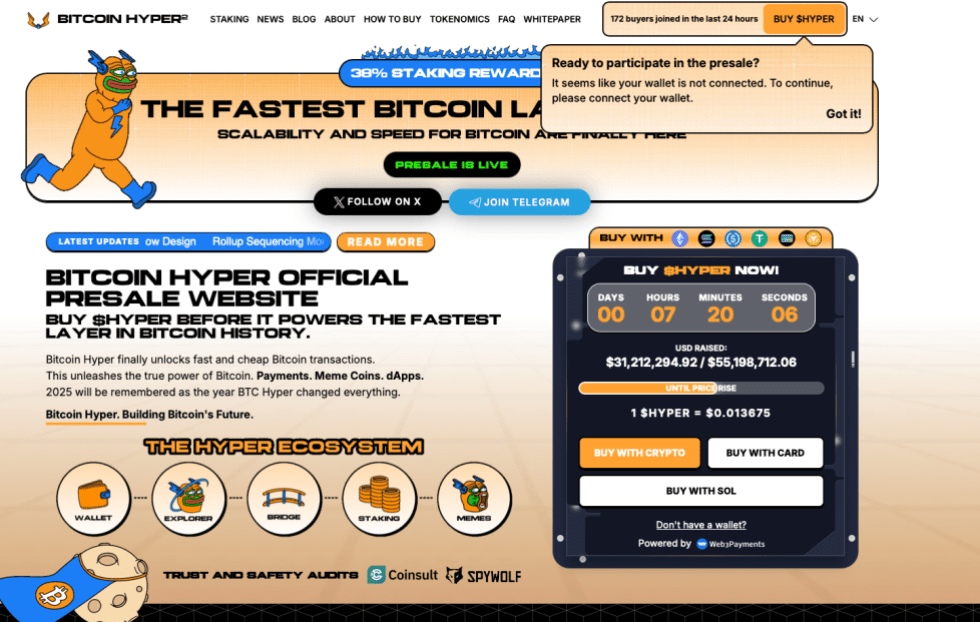
Bitcoin Hyper presents itself as a Layer 2 aiming to make Bitcoin more fluid, via faster transactions and smart contracts, relying on a virtual machine inspired by Solana. According to Claude AI, HYPER is often sold as the best current bet in presale, supposed to capture the next wave of decentralized finance backed by Bitcoin.
But this is also the case where caution must be maximum. Still in presale and not having conducted its TGE, volatility is likely to be extreme at launch, which could appeal to the most seasoned traders.
TAO from Bittensor, Betting on Decentralized AI Long-Term
With TAO, the thesis is more structural. Bittensor aims to create competition among artificial intelligence models, remunerated according to their contribution, a positioning that aligns with 2026 keywords: decentralized AI, infrastructure, and usage monetization. Market analyses highlight the rise of specialized subnets, capable of providing inference or agent services, and thus creating more organic demand.
The clearest catalyst is the emission mechanism. In mid-December 2025, the first halving reduced the daily emission of TAO, mechanically increasing scarcity if demand holds, much like bitcoin.
Oscillating like altcoins towards new support levels, the whole challenge lies in TAO's ability to break through resistances and return above $500. A scenario essential to put sellers on the sidelines and restore on-chain optimism.
This article does not constitute investment advice. The information provided here should not be used as a basis for making financial decisions. Cryptocurrency investments involve risks and can lead to significant losses. You should only invest what you can afford to lose and conduct your own research before making any investment decision.



















