The 24/7 Takeover: How Crypto’s $130B TradFi Surge Is Absorbing The Global Commodities Trade

bitcoinistPublicado em 2026-03-07Última atualização em 2026-03-07

Resumo

Cryptocurrency exchanges are expanding beyond digital assets to become major hubs for traditional financial derivatives, particularly perpetual futures tied to commodities and equities. A CryptoQuant report highlights that this shift is accelerating as TradFi participants leverage crypto infrastructure for 24/7 trading access. Binance’s TradFi perpetual futures have seen cumulative volumes exceed $130 billion, with over 90 million trades. Gold and silver contracts dominate, reaching daily volumes of nearly $4 billion each during strong market rallies. This reflects a broader convergence between traditional finance and crypto trading platforms, enabling continuous global market exposure outside conventional hours.

Cryptocurrency exchanges are increasingly evolving beyond digital asset trading platforms, gradually becoming global venues for traditional financial derivatives. A recent CryptoQuant report highlights how this shift is accelerating as market participants from traditional finance begin to utilize crypto-native infrastructure to trade assets outside the typical cryptocurrency universe.

One of the clearest signals of this transformation is the rapid rise of perpetual futures tied to traditional assets. These instruments allow traders to gain exposure to commodities, equities, and other macro assets through crypto exchanges while benefiting from continuous, 24/7 market access. Unlike conventional financial markets that operate within fixed trading hours, crypto platforms provide uninterrupted liquidity, making them particularly attractive during periods of strong price momentum.

The trend has become especially visible during recent rallies in commodities such as gold and silver. As prices moved sharply, traders increasingly turned to crypto exchanges offering TradFi perpetual contracts to maintain exposure around the clock. This structure enables market participants to respond immediately to global developments rather than waiting for traditional markets to reopen.

According to CryptoQuant, the growth of these instruments reflects a broader structural shift in financial markets. The boundary between traditional finance and crypto-native trading infrastructure is gradually fading, with digital asset exchanges emerging as hybrid platforms capable of supporting both crypto assets and traditional financial products within a unified trading environment.

TradFi Perpetual Futures See Rapid Growth On Crypto Exchanges

The report also highlights the rapid expansion of trading activity in Binance’s TradFi perpetual futures market. Since launch, cumulative trading volume across these contracts has surpassed $130 billion, with more than 90 million trades recorded. Notably, total volume exceeded $100 billion by February 24, just two months after the product’s introduction, underscoring strong demand from traders seeking continuous exposure to traditional assets through crypto-native platforms.
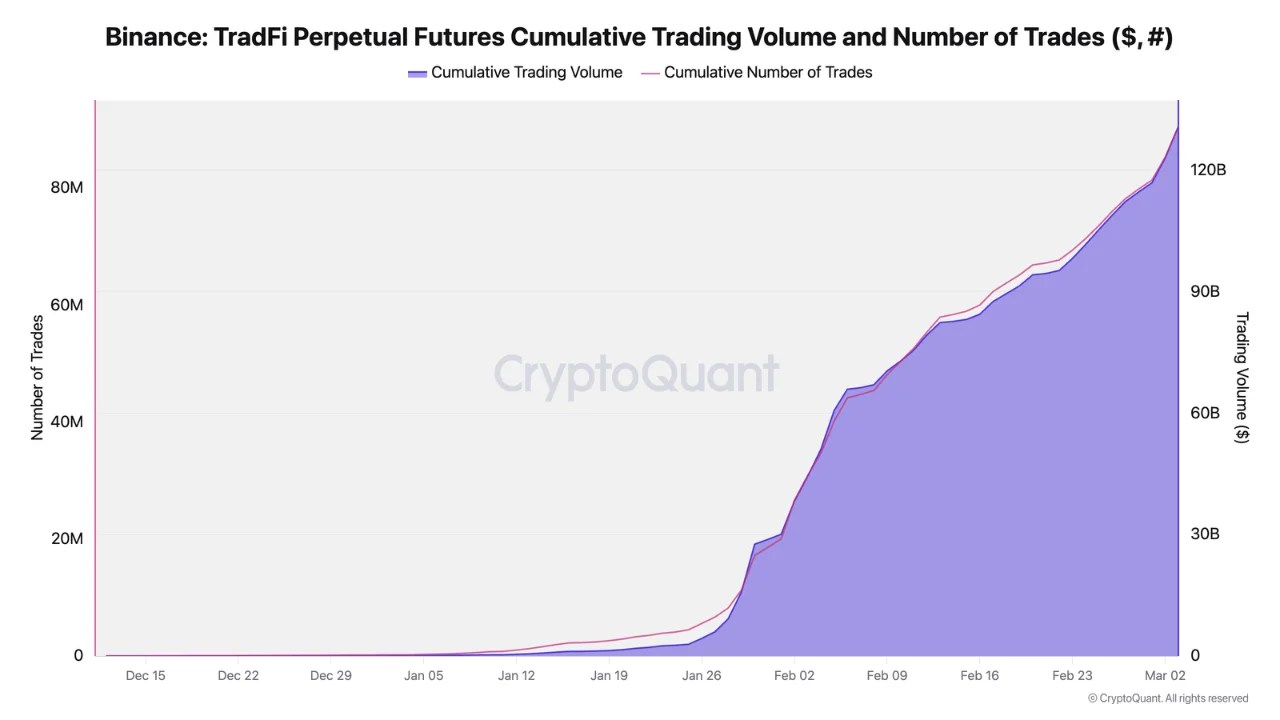
Binance TradFi Perpetual Futures Cumulative Trading Volume and Number of Trades | Source: CryptoQuant

Binance’s TradFi perpetual futures allow users to trade a wide range of instruments, including precious metals and major equities. Available contracts include gold, silver, palladium, and platinum, alongside stocks such as AMZN, COIN, CIRCL, HOOD, INTC, MSTR, PLTR, and TSLA. These products replicate the economic exposure of traditional derivatives while benefiting from the global accessibility and near-continuous trading environment of crypto exchanges.

Precious metals dominate activity within this segment. Daily trading volume is heavily concentrated in gold and silver contracts, which reached approximately $3.77 billion and $3.75 billion, respectively, on March 3. Trading tends to accelerate during strong price trends in metals markets. For example, record daily volumes of roughly $4 billion in gold and $7 billion in silver were observed on January 30, 2025.

High participation levels further illustrate this momentum. TradFi perpetual futures recently recorded around 4.4 million daily trades, with gold accounting for roughly 2.0 million and silver for 1.9 million transactions.


Perguntas relacionadas

QWhat is the main trend highlighted in the CryptoQuant report regarding cryptocurrency exchanges?

ACryptocurrency exchanges are evolving beyond digital asset trading platforms and becoming global venues for traditional financial derivatives, as market participants from traditional finance begin to use crypto-native infrastructure to trade assets outside the typical cryptocurrency universe.

QWhat key advantage do perpetual futures on crypto exchanges offer compared to traditional financial markets?

AThey provide continuous, 24/7 market access and uninterrupted liquidity, allowing traders to respond immediately to global developments rather than waiting for traditional markets to reopen.

QHow much cumulative trading volume have Binance's TradFi perpetual futures reached since their launch?

ACumulative trading volume has surpassed $130 billion, with more than 90 million trades recorded.

QWhich traditional assets are most actively traded through Binance's TradFi perpetual futures?

APrecious metals, particularly gold and silver, dominate trading activity, with daily volumes reaching approximately $3.77 billion for gold and $3.75 billion for silver on March 3.

QWhat does the growth of TradFi perpetual futures on crypto exchanges signify according to the report?

AIt reflects a broader structural shift in financial markets where the boundary between traditional finance and crypto-native trading infrastructure is fading, with digital asset exchanges emerging as hybrid platforms supporting both crypto and traditional financial products.

Leituras Relacionadas

Interview with Robinhood Executive: Meme + Tokenized US Stocks as "Barbell" Customer Acquisition Strategy, All Business Lines Achieve Hundreds of Millions in Revenue

Interview with Robinhood executive Johann Kerbrat reveals the company's "barbell" customer acquisition strategy for its new Robinhood Chain, combining meme tokens with tokenized stocks. Three weeks after mainnet launch, the chain has seen over $3B in weekly DEX volume and 105M transactions. Kerbrat explains the logic behind the permissionless chain: meme tokens attract DeFi users, while tokenized real-world assets (RWA), currently over 90 US stocks and ETFs accessible in 120+ countries, serve global users. The goal is to bring Robinhood's 27 million funded accounts on-chain by simplifying DeFi with a user-friendly interface, exemplified by features like Robinhood Earn which offers yield without requiring wallet management. Built on Arbitrum's technology stack for its speed, low cost, and Ethereum's security, the chain focuses on financial products like Earn, spot trading, and perpetuals. Kerbrat downplays direct competition with platforms like Base, emphasizing the goal of expanding the overall market for on-chain assets. He details selective partnerships (e.g., Morpho, Lighter) based on compliance, unique UX, and differentiation. While regulatory clarity is pending for US perpetuals, the expansion continues via Bitstamp in Europe. Finally, Kerbrat positions Robinhood as a "super app" integrating stocks, options, crypto, banking, and AI trading, with all major business lines generating hundreds of millions in revenue. For the chain, current priority is driving adoption over maximizing gas fee revenue.

marsbitHá 2h

Interview with Robinhood Executive: Meme + Tokenized US Stocks as "Barbell" Customer Acquisition Strategy, All Business Lines Achieve Hundreds of Millions in Revenue

marsbitHá 2h

Fidelity Q3 Report: BTC, ETH, and SOL Continue to Build Bottoms; How Much Further Will This Crypto Bear Market Go?

Fidelity's Q3 Crypto Signal Report analyzes the current bear market, noting Bitcoin (BTC), Ethereum (ETH), and Solana (SOL) are in a prolonged bottoming phase. Key indicators like the weighted Net Unrealized Profit/Loss (NUPL) have turned negative (-0.01), signaling the market is slightly below its aggregate cost basis, with BTC acting as the primary stabilizing asset. BTC's dominance has risen to 68%, indicating a lack of capital rotation to other digital assets. Performance has been weak across the board, with BTC, ETH, and SOL down significantly year-to-date. Market sentiment is depressed, exacerbated by substantial outflows from spot ETPs and a challenging macro environment. The report compares the current ~203-day downtrend to historical ~300-day bottoming cycles, suggesting the process may be two-thirds complete, with late 2026 as a potential timeframe to monitor. For Bitcoin, NUPL at 0.09 indicates cautious sentiment, while momentum signals remain negative. The Yardstick metric points to potential undervaluation relative to network security (hashrate). Ethereum's NUPL is deep in the "capitulation" zone at -0.43, a historically positive signal for future returns, though its momentum and network fee revenue are negative. Solana shows the deepest NUPL at -0.72 but demonstrates relative resilience in on-chain activity and stablecoin transfer volume. The report concludes that while several metrics are near historical capitulation levels, a definitive market bottom has not yet been established. The path forward likely involves continued consolidation, with BTC's relative strength and fundamental on-chain usage for ETH and SOL providing key areas for investor observation.

marsbitHá 2h

Fidelity Q3 Report: BTC, ETH, and SOL Continue to Build Bottoms; How Much Further Will This Crypto Bear Market Go?

marsbitHá 2h

Trading

Spot
活动图片




