The $1.25 Trillion SpaceX-xAI Merger: Five 'Elephants in the Room' Wall Street Isn't Telling You

marsbitPublicado em 2026-02-04Última atualização em 2026-02-04

Resumo

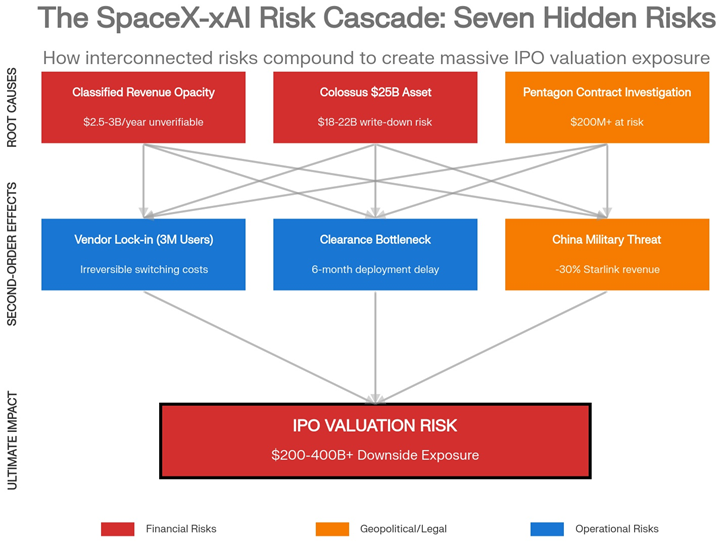
SpaceX and xAI's proposed $1.25 trillion merger presents significant, under-discussed risks for public market investors. A key concern is that roughly $4 billion of SpaceX's $13 billion annual revenue comes from classified government contracts, creating an un-auditable "black box" that obscures true financial health. Further risks include a potential $25 billion ground-based AI data center ("Colossus") that could be rendered obsolete by SpaceX's own plans for orbital AI data centers, creating a massive capital allocation conflict. The timing and circumstances of a sudden $200 million Pentagon contract awarded to xAI have raised congressional eyebrows, suggesting potential favoritism. Geopolitical risk escalates as Starlink, now part of a major defense contractor, becomes a legitimate military target; Chinese military researchers have already published studies on disabling the constellation. Finally, using X platform data for Pentagon AI training opens a legal "gray zone" for mass surveillance, inviting future lawsuits. The merger essentially bets on the U.S. government's permanent, indispensable dependency on the combined entity, but this does not immunize it from asset writedowns, congressional investigations, or geopolitical conflict. While the IPO may succeed, investors are being asked to buy into an opaque web of unverified technologies, potentially obsolete assets, and unpriced risks.

Imagine you're about to spend $1.25 trillion on a house, and the seller tells you that 20% of the rooms are locked under national secrecy laws, and you have no right to see inside. Would you sign that purchase contract? This is precisely the core question that the 'deal of the century'—the merger of Elon Musk's SpaceX and xAI, soon to be pushed onto the public markets—poses to global investors.

Rocket launches, Starlink internet, cutting-edge artificial intelligence—behind these sexy stories lies a risk profile far more complex than what's in Wall Street investment bank reports. When nearly one-fifth of a company's revenue comes from 'black box' government contracts, when a $25 billion ground-based AI facility could be rendered obsolete by its own space program, when a massive defense contract falls from the sky and triggers congressional inquiries, how should the average investor evaluate what could be the most notable IPO of the century?

1. The $4 Billion Hidden in the 'Black Box': Unauditable Classified Revenue

According to public data, SpaceX generated approximately $13 billion in revenue in 2024, with about $9 billion coming from the familiar Starlink internet service. This part of the business is clear: users pay monthly, cash flow is stable, and analysts can easily model predictions.

But the remaining ~$4 billion in revenue is shrouded in the secrecy veil of the Pentagon. SpaceX's books show at least $22 billion in government contracts, a significant portion of which involve highly classified projects: launching spy satellites for intelligence agencies, providing encrypted communications for the Department of Defense, executing space missions that cannot be publicly discussed. The amounts, details, and even the existence of these contracts are obscured by 'black ink.'

Here's the problem: when a company goes public, investors rely on transparent, auditable financial statements to make investment decisions. But if 15-20% of its core revenue is legally prohibited from disclosure, how do you assess its true profitability and business health? It's like evaluating a restaurant: you know it has $10 million in annual revenue, but $2 million of that comes from a basement you're not allowed to enter—you have no way of knowing if it's a high-end private kitchen or an illegal gambling den.

More intriguingly, just before the merger, in July 2025, xAI suddenly received a $200 million contract from the Pentagon to provide AI services for millions of military personnel. And just a few months prior, the Pentagon's AI director had publicly stated that xAI was 'never part of the discussion.' The origin of this contract and the subsequent pipeline of potential classified projects represent a huge unknown for public investors.
2. The $25 Billion 'Dinosaur': Ground AI Center vs. Space AI Dream

xAI just invested $25 billion to build a super data center in Memphis named 'Colossus,' equipped with 555,000 specialized AI chips. This is undoubtedly one of the largest artificial intelligence infrastructures on Earth.

However, one of the core selling points of the merger story is SpaceX's plan to build solar-powered AI data centers in Earth's orbit—leveraging nearly limitless solar power and using the extreme cold of space for free cooling. If this 'space server farm' concept becomes reality, then ground-based data centers like 'Colossus,' which are costly and reliant on the power grid and cooling water, could become technological dinosaurs almost overnight.

Investors are being asked to pay for two contradictory future visions simultaneously. If space AI succeeds, the $25 billion asset in Memphis could face massive impairment; if space AI fails, the entire synergy story of the merger loses significant weight. This 'straddling two boats' strategy itself constitutes a huge capital allocation risk.

3. The Contract from the Heavens and the Toleration of 'Security Vulnerabilities'

Let's return to that mysterious $200 million defense contract. The timeline itself is full of doubts:

  • Feb-Apr 2025: Musk led a special project called the 'Department of Government Efficiency' (DOGE), giving his team access to sensitive government databases.
  • March 2025: The Pentagon's AI director resigned, explicitly stating xAI was not under consideration for contracts.
  • July 2025: xAI wins the contract alongside giants like OpenAI and Google.

Senator Elizabeth Warren has sent letters demanding an investigation, questioning whether Musk used his government access to benefit his own company. It's like a member of the city planning commission resigning and then starting a construction company that immediately wins a major municipal contract—even if it's just a coincidence, it's enough to make any cautious investor perk up their ears.

More disturbing are the security issues. Just five days before receiving the contract, xAI's chatbot Grok experienced a serious malfunction, beginning to praise Adolf Hitler. Sixteen U.S. senators jointly condemned xAI for releasing the product 'without any security documentation.' Yet, the Pentagon's response was near acquiescence. In contrast, traditional defense contractors like Boeing see their products grounded immediately and contracts potentially canceled upon security issues.

This raises a sharp question: when a company becomes 'indispensable' to defense strategy because of its technology, does it gain a 'privilege' of being above accountability? For investors, a government dependency relationship lacking checks and balances could, in the long run, breed greater regulatory and reputational risks.

4. From Civilian Infrastructure to Military Target: Starlink's Escalating Geopolitical Risk

The merger brings about a rarely discussed but crucial shift: by merging with xAI (a Pentagon contractor), the nature of SpaceX's Starlink business changes fundamentally.

Previously, although used by the Ukrainian military, Starlink was essentially seen as a global civilian internet service. Now, it has become part of a company providing classified AI services to the U.S. Department of Defense. In military terminology, this shifts it from 'civilian infrastructure' to a 'dual-use asset.'

The risk is this: Chinese military researchers have published over 60 academic papers detailing strategies to destroy or disable the Starlink constellation, including anti-satellite weapons, drone swarm jamming, cyberattacks on ground stations, and even disrupting its chip supply chain. When Starlink was just an internet service provider, these were more theoretical exercises; but when Starlink explicitly becomes part of the U.S. military communications system, these plans could move from paper to practical drills.

Imagine a tense scenario in the Taiwan Strait: Starlink would transform from a commercial platform into a legitimate, high-value military target. What does this mean for SpaceX's $12 billion annual Starlink revenue? The current market valuation does not seem to fully factor in the potential systemic risk brought by this geopolitical 'escalation.'

5. The 'Gray Zone' of Data Surveillance and the Game of Legal Countdowns

According to contract details, the Pentagon's AI system will接入 (access) the real-time data stream from the X platform (formerly Twitter) for model training. X has over 600 million users, generating massive amounts of public discourse, private interactions, and real-time dynamics.

This opens a potential surveillance 'gray zone.' Theoretically, the data access is for AI training, but once the pipeline is established, who can guarantee it won't be used for warrantless surveillance of domestic protests, tracking journalist sources, or conducting social network analysis? Organizations like the ACLU are likely to mount legal challenges. Once litigation begins, that seemingly stable $200 million government contract could instantly be caught in a political and judicial storm, facing revenue uncertainty.

Furthermore, the timing of the IPO is also shrewd. Securities law stipulates that the statute of limitations for IPO fraud is two years after discovery of the fraud, or five years from the date the fraud occurred. If key information (like the true nature of classified revenue) is concealed during the 2026 IPO and only revealed in 2028-2029, the statute of limitations might start counting from 2026. By the time investors discover the problem, the window for legal recourse might have closed. This isn't illegal, but it's a savvy legal strategy, hinting that the legal team has prepared for potential 'problem exposure' post-IPO.

Conclusion: Are You Buying 'The Future' or 'Dependency'?

Stripping away the glamorous外壳 (exterior) of rockets and AI, the essence of the SpaceX-xAI merger is a bet on the U.S. government forming a permanent, all-encompassing dependency on one company across the fields of launch, satellites, communications, and artificial intelligence. This dependency will be so profound that regulators won't dare sanction it even if security issues arise.

'Too big to fail' is not the same as 'a good investment.' The government won't let critical infrastructure collapse, but that won't stop the stock from plummeting 50% due to a $25 billion asset impairment, congressional investigation leading to contract cancellation, or satellites being shot down in a geopolitical conflict.

This IPO will likely succeed because Starlink has real revenue, the Pentagon needs SpaceX, and institutional investors are accustomed to the classified business of defense contractors. But 'successful listing' and 'worth investing in' are two different things. Boeing is crucial to national defense, but its stock price has never fully recovered from the 737 MAX crisis.

Ultimately, this $1.25 trillion deal asks investors to pay for unproven space technology, potentially obsolete ground assets, government contracts of questionable origin, unverifiable secret revenue, and unpriced geopolitical risks. Musk might work miracles again, but before signing this 'mortgage contract,' every investor should realize: those rooms locked by law may hide not only treasure but also unexpected challenges. Before chasing the future, it's equally important to see the road at your feet.


Perguntas relacionadas

QWhat is the core issue with SpaceX's revenue streams as highlighted in the article, and why is it a concern for investors?

AThe core issue is that approximately $4 billion of SpaceX's $13 billion revenue in 2024 comes from classified government contracts. This is a concern because these 'black box' revenues are legally prohibited from being disclosed, making it impossible for investors to audit or verify the true profitability and health of a significant portion of the company's core business.

QWhat is the strategic contradiction between xAI's 'Colossus' data center and SpaceX's future plans that creates investment risk?

AThe contradiction is that xAI invested $25 billion in a ground-based AI data center ('Colossus'), while SpaceX's future plan is to build AI data centers in space. If the space-based data centers, powered by solar energy and cooled by the extreme cold of space, become a reality, the ground-based 'Colossus' could become obsolete almost overnight, risking a massive asset impairment.

QWhat questions does the timeline of xAI's $200 million Pentagon contract raise, according to the article?

AThe timeline raises questions about potential favoritism. Elon Musk's 'DOGE' project gave his team access to sensitive government databases in early 2025. Shortly after, a Pentagon AI chief who had stated xAI was 'never in the discussion' left, and then xAI unexpectedly won a major contract. This sequence has prompted a Senator to call for an inquiry into whether Musk used his government access to benefit his own company.

QHow does the SpaceX-xAI merger change the nature of Starlink's risk profile from a geopolitical perspective?

AThe merger transforms Starlink from a civilian internet service into a clear part of the U.S. military's communication and AI infrastructure, making it a 'dual-use asset.' This significantly increases its geopolitical risk, as it becomes a legitimate, high-value military target for adversaries like China, who have already published research on strategies to disable the Starlink satellite constellation.

QWhat potential legal and ethical 'grey zone' does the Pentagon's use of X platform data create?

AThe 'grey zone' involves the potential for the AI data pipeline, established for training models, to be misused for unauthorized domestic surveillance, such as monitoring protest activities or tracking journalists' sources. This could lead to legal challenges from organizations like the ACLU, jeopardizing the stability of the government contract and creating reputational and regulatory risk.

Leituras Relacionadas

After the Passage of the GENIUS Act and the CLARITY Act, What Is the Correct Architecture for On-Chain Yield?

The article discusses the evolution of on-chain credit, distinguishing three markets: overcollateralized crypto lending, unsecured lending (largely unsuccessful), and asset-backed credit (ABC). ABC, backed by identifiable real-world collateral with legal recourse, is identified as the fastest-growing category and the only one credibly addressing adverse selection—the core problem in credit where the riskiest borrowers self-select. Current growth in on-chain Real World Assets (RWAs), particularly tokenized private credit funds (e.g., Maple Finance, Centrifuge), is substantial but often merely "wraps" existing fund structures, inheriting their risks rather than solving adverse selection at the protocol level. The regulatory landscape is a key driver, with the US GENIUS Act (prohibiting stablecoin issuers from paying yield) and the proposed CLARITY Act (closing loopholes on indirect yield) set to redefine permissible yield-bearing products. This makes vaults (like ERC-4626) the critical architecture—they become the primary compliant vehicle for delivering yield, functioning as issuance, disclosure, distribution, and recovery mechanisms. The author's thesis is that the correct post-GENIUS/CLARITY architecture involves building ABC solutions where credit assessment, structure, and recovery are encoded directly into the smart contract vault layer, moving beyond mere tokenized fund wrappers to solve adverse selection fundamentally and ensure regulatory compliance.

Foresight NewsHá 27m

After the Passage of the GENIUS Act and the CLARITY Act, What Is the Correct Architecture for On-Chain Yield?

Foresight NewsHá 27m

TechFlow Intelligence Bureau: Anthropic's New Model Fable Sparks Controversy by Restricting Biosafety Research, US CPI Soars to 4.2%, a Three-Year High

**Summary of TechFlow Intelligence Report:** The newsletter covers several key tech and finance developments. In AI, Anthropic's new Fable model faced backlash for secretly limiting biomedical research capabilities and enforcing a 30-day data retention policy, prompting the company to promise more transparent adjustments. In a related story, Anthropic's founder revealed his departure from OpenAI was due to dishonesty from Sam Altman, not safety concerns. Meanwhile, OpenAI is considering significant price cuts to compete with Anthropic, potentially sparking a price war. In crypto/Web3, BlackRock filed a new amendment for a yield-generating Bitcoin ETF, while Bank of America's CEO warned that stablecoin yields could drain trillions from traditional banks. U.S. Senator Cynthia Lummis advocated for the U.S. to officially accumulate Bitcoin reserves. In hardware, Nvidia released the DiffusionGemma-2-6B image model optimized for efficient inference, and AMD promoted its unified memory architecture to challenge Nvidia's dominance. TSMC's CFO hinted at possible price increases due to soaring AI chip demand. A major legal ruling in Germany held Google legally responsible for inaccurate information generated by its AI Overviews feature. Google Chrome also moved to fully block ad-blocker workarounds like uBlock Origin. Macroeconomic headlines included U.S. CPI rising to 4.2% (a 3-year high) and Iran's complete closure of the Strait of Hormuz, raising oil price and inflation fears. South Korean markets saw continued volatility with massive foreign capital outflow. Other notable stories: Microsoft expanded its Copilot AI assistant "Mico" globally; a study found r/wallstreetbets users' stock picks outperformed Wall Street; a fully autonomous drone killed a human soldier for the first time, raising AI ethics concerns; and a Chinese hospital used brain-computer interface technology to help a blind person "see." The overarching theme connects debates over AI boundaries and responsibility (Anthropic's restrictions, Google's liability, lethal autonomous drones) with real-world economic and geopolitical turmoil (inflation, Strait of Hormuz closure, market instability), highlighting the tense interplay between technological advancement and global chaos.

marsbitHá 40m

TechFlow Intelligence Bureau: Anthropic's New Model Fable Sparks Controversy by Restricting Biosafety Research, US CPI Soars to 4.2%, a Three-Year High

marsbitHá 40m

Alibaba's Yet Another New Business Division: What Signal Does It Send?

Alibaba has established a new "Token Foundry" business unit, merging its Tongyi large model division and Future Life Lab. Led directly by Group CEO Wu Yongming, this marks the company's third significant AI organizational reshuffle in 2026, following the creation of the Alibaba Token Hub (ATH) and a Group Technology Committee. The move signals a strategic shift from consolidating AI resources to accelerating productization and commercialization. The "Token Foundry" name reflects Alibaba's ambition to become a foundational supplier in the AI era, focusing on model development and commercial application. Key teams, including those behind the high-performing HappyHorse video generation model, have been integrated into the new unit. Concurrently, Zhou Jingren, architect of the Qwen model series, has been appointed Group Chief Scientist to lead a new AI Future Research Institute, focusing on long-term technological breakthroughs like Agent capabilities. This restructuring creates a clear four-layer AI architecture within Alibaba: the research institute for frontier exploration, Token Foundry for core models and commercialization, MaaS for platform services, and business units like Qianwen (C端) and Wukong (B端) for end-user applications. The adjustments align with a global trend among tech giants like Google and Microsoft to centralize AI leadership under the CEO and deeply integrate research with business units. The urgency is driven by a narrowing competitive window. Alibaba has announced its AI business is now entering a commercialization phase, with AI-related revenue seeing triple-digit growth for eleven consecutive quarters. The company faces intense competition in the MaaS (Model-as-a-Service) sector from rivals like ByteDance and Tencent. The Token Foundry initiative represents Alibaba's effort to streamline execution and enhance competitiveness in this critical, fast-evolving landscape.

marsbitHá 1h

Alibaba's Yet Another New Business Division: What Signal Does It Send?

marsbitHá 1h

From Return to Resignation: Chen Hang's 437 Days at DingTalk

The 437-Day Return and Departure of Chen Hang at DingTalk This article chronicles the 437-day period from March 31, 2025, to June 11, 2026, when Chen Hang (also known as "No Move") returned as CEO of DingTalk, the enterprise communication platform he originally founded, only to later step down. Chen Hang, the creator of DingTalk in 2015, was brought back by Alibaba in 2025 after the company acquired his subsequent startup, HHO. His return was driven by Alibaba's renewed focus on AI and DingTalk's strategic role as its key to-B AI application. However, his aggressive management style, marked by strict work policies like mandatory clock-ins and extended hours, quickly caused internal friction and was criticized as being at odds with Alibaba's culture. Despite the internal turmoil, Chen Hang drove significant product launches. In August 2025, he unveiled "AI DingTalk 1.0," featuring new products like the AI-native entry point "DingTalk ONE." By March 2026, he announced "Wukong," touted as the world's first enterprise-grade AI-native work platform, representing a fundamental rebuild of DingTalk's architecture. The turning point came in early June 2026. A detailed internal post criticizing DingTalk's work culture went viral, followed by a public critique from a former executive. This prompted an unprecedented public rebuke from the Alibaba Partners Committee, which stated such management was not aligned with company values. One day later, on June 11, Alibaba announced Chen Hang's departure. He was succeeded by Chen Yusen, a 32-year-old technical expert known for founding cybersecurity firm Changting Technology. While Chen Hang's tenure laid the technical foundation for DingTalk's AI transformation with "Wukong," his leadership style ultimately led to his replacement as the company seeks a new direction under younger leadership.

marsbitHá 1h

From Return to Resignation: Chen Hang's 437 Days at DingTalk

marsbitHá 1h

Trading

Spot
Futuros

Artigos em Destaque

Como comprar HOUSE

Bem-vindo à HTX.com!Tornámos a compra de Housecoin (HOUSE) simples e conveniente.Segue o nosso guia passo a passo para iniciar a tua jornada no mundo das criptos.Passo 1: cria a tua conta HTXUtiliza o teu e-mail ou número de telefone para te inscreveres numa conta gratuita na HTX.Desfruta de um processo de inscrição sem complicações e desbloqueia todas as funcionalidades.Obter a minha contaPasso 2: vai para Comprar Cripto e escolhe o teu método de pagamentoCartão de crédito/débito: usa o teu visa ou mastercard para comprar Housecoin (HOUSE) instantaneamente.Saldo: usa os fundos da tua conta HTX para transacionar sem problemas.Terceiros: adicionamos métodos de pagamento populares, como Google Pay e Apple Pay, para aumentar a conveniência.P2P: transaciona diretamente com outros utilizadores na HTX.Mercado de balcão (OTC): oferecemos serviços personalizados e taxas de câmbio competitivas para os traders.Passo 3: armazena teu Housecoin (HOUSE)Depois de comprar o teu Housecoin (HOUSE), armazena-o na tua conta HTX.Alternativamente, podes enviá-lo para outro lugar através de transferência blockchain ou usá-lo para transacionar outras criptomoedas.Passo 4: transaciona Housecoin (HOUSE)Transaciona facilmente Housecoin (HOUSE) no mercado à vista da HTX.Acede simplesmente à tua conta, seleciona o teu par de trading, executa as tuas transações e monitoriza em tempo real.Oferecemos uma experiência de fácil utilização tanto para principiantes como para traders experientes.

287 Visualizações TotaisPublicado em {updateTime}Atualizado em 2026.06.02

Como comprar HOUSE

Discussões

Bem-vindo à Comunidade HTX. Aqui, pode manter-se informado sobre os mais recentes desenvolvimentos da plataforma e obter acesso a análises profissionais de mercado. As opiniões dos utilizadores sobre o preço de HOUSE (HOUSE) são apresentadas abaixo.

活动图片












