Tether's Two-Token Strategy: USAT Compliance Is Just a Smokescreen, and USDT's Permanent Non-Compliance Is the Truth?

marsbitPublicado em 2026-05-28Última atualização em 2026-05-28

Resumo

In 2026, Tether launched USAT, a stablecoin compliant with the U.S. GENIUS Act. However, this article argues USAT is a "firewall" designed to allow Tether's core product, the massive offshore USDT ($1830B+), to remain permanently outside U.S. regulation. USAT, issued by a U.S.-chartered bank, serves as Tether's compliant face for the American market. In contrast, USDT is an offshore product whose reserves include non-compliant, high-yield assets like gold and Bitcoin. Bringing USDT into GENIUS compliance would require dismantling this profitable structure. The dual-coin strategy anticipates the 2028 U.S. deadline for listing only GENIUS-approved stable币. USAT will take over the compliant U.S. market, while USDT retains its vast offshore user base in emerging economies. This structure intentionally places the systemically important USDT beyond U.S. regulatory reach. The article concludes that framing USAT as "Tether going compliant" is misleading. Instead, USAT's true function is to provide a legal rationale for keeping the larger, globally significant USDT operation unregulated by the very country whose currency it represents.

Author: Zennon Kapron, Forbes

Compiled by: AididiaoJP, Foresight News

In January 2026, Tether did something that appeared to be a concession. It launched USAT, a U.S.-domiciled stablecoin specifically designed to comply with the GENIUS Act's federal rules. It is issued through a U.S.-chartered bank and overseen by a custodian approved in Washington. After years of operating primarily offshore, staying away from U.S. regulation, the world's largest stablecoin company seemed finally ready to step into the regulated circle.
Tether's newly launched USAT is a "firewall": a GENIUS Act-compliant U.S. subsidiary specifically designed to allow the $1.83 trillion offshore USDT to remain permanently outside U.S. regulation. (Image credit: Silas Stein/picture alliance via Getty Images)

But appearances are deceptive. USAT is best understood as a firewall—a compliance subsidiary whose very existence is to ensure Tether's core product can remain outside U.S. regulation permanently.

Two Stablecoins, Two Regulatory Addresses

Look at what USAT is. It is issued by Anchorage Digital Bank (a U.S. federal chartered institution), with Cantor Fitzgerald as the designated reserve custodian, and its CEO was recruited from a White House crypto role. It is a clean, domestic, fully federal-framework product, and in early 2026 received a reserve attestation reviewed by one of the Big Four, Deloitte.

The original Tether dollar, USDT, has none of these characteristics. It is issued offshore, with a circulation exceeding $1.83 trillion, and its reserves contain assets not allowed under the U.S. payment stablecoin regime. These two stablecoins provide the same company with two different regulatory addresses: USAT is the face Tether shows to U.S. regulators, while USDT is the real identity it retains everywhere else in the world. The company has built an architecture ensuring the two never have to merge.

The Unbearable Cost of Compliance for USDT

This split exists because USDT, in its current structure, simply cannot meet the GENIUS Act's compliance threshold. The law requires payment stablecoins to be backed 1:1 by highly liquid, high-quality assets—primarily cash, short-term Treasuries, government money market funds, and similar instruments—and to publish monthly reserve reports reviewed by a certified public accounting firm.

Tether's own Q1 2026 data makes the obstacles clear. The company reported total assets of approximately $1.918 trillion against issued tokens. Its reserve portfolio includes around $20 billion in gold and tens of billions in Bitcoin. These holdings make Tether extremely profitable—a quarterly profit of $10.4 billion and an annual profit exceeding $100 billion in 2025. But these are precisely the assets prohibited for a GENIUS-compliant payment stablecoin.

Bringing USDT into the compliance lane would mean dismantling its high-yield reserve structure, a cost Tether has shown no willingness to pay so far.

The Offshore Stablecoin Is the Systemically Important One

It's easy to view the two-token structure as Washington's problem solved—a compliant dollar token now exists, serving the regulated market. This reading misses where USDT truly matters.

USDT's gravity lies far beyond U.S. borders, in a world short on dollars. In Argentina, Turkey, Nigeria, Vietnam, and a host of economies with weak local currencies and difficulty accessing physical dollars, USDT serves as a savings tool and settlement channel, often more reliable than the local banking system. This token, with a circulation exceeding $1.83 trillion, is, by any reasonable definition, a systemically important instrument in global dollar usage.

The structure Tether has built places this instrument permanently outside U.S. oversight. USAT will undergo scrutiny, attestation, and supervision, while USDT—the token that circulates dollars in fragile economies—will not, because it doesn't need to. Its users are outside the U.S., it is issued offshore, and the GENIUS framework targets U.S. service providers, not foreign holders. For U.S. policymakers, this is an awkward passivity: the penetration of the dollar in developing countries is increasingly facilitated by a private token that the U.S. government cannot regulate and struggles to audit, and the design of the GENIUS transition even provides Tether with a justification to stay offshore.

What a Compliant Version Would Look Like

Seriously considering what bringing USDT under the GENIUS regime would actually require reveals the shape of the two-token structure. A compliant USDT would have to sell its gold, sell its Bitcoin, convert the proceeds into cash and short-term Treasuries; it would have to undergo monthly reviews by a CPA firm and accept oversight from U.S. regulators. In the process, it would transform from a high-yield portfolio diversified across asset classes into a narrow money market structure earning only Treasury yields.

The financial cost of this transformation is enormous; the strategic cost is even greater. Tether's distance from the U.S. banking and regulatory system is precisely what makes it valuable to its core users—users who are individuals and businesses operating outside of dysfunctional financial systems. A USDT that answers to U.S. regulators would be a fundamentally different product with a changed value proposition, likely losing the very offshore base it serves. Faced with this prospect, Tether chose to build a separate compliant coin, the only way to preserve both businesses.

Tether Claims USDT Is Moving Toward Compliance

Tether does not frame the issue as I have described above. Its official launch statement said USDT "continues to operate globally" while "working towards GENIUS Act compliance." This is the company's official stance, deserving fair citation and honest weighing.

But measured against the actual structure, this claim is difficult to sustain. "Moving toward compliance" is not the same as building a separate compliant coin, and Tether chose the latter. If USDT were truly on a path to GENIUS compliance, USAT would be redundant—a company wouldn't secure bank charters for a second dollar token, recruit a CEO with Washington credentials, commission Big Four attestations, while the first token was about to achieve compliance on its own. The effort invested in USAT itself proves the company's expectation for USDT: it will remain offshore.

The 2028 Deadline Is the Real Test

This arrangement has a timeline. Under the GENIUS framework, U.S. digital asset service providers face a transition period, after which they can only offer stablecoins permitted under the federal regime. In practice, by around mid-2028, U.S. exchanges and custodians will have to delist any dollar token not GENIUS-approved.

If USDT remains unapproved by then, U.S. platforms will cease listing it, which is precisely the moment the two-token strategy is designed to address: USAT inherits the U.S. market, absorbing compliant flows and bearing the regulatory burden; USDT retains its offshore base—including emerging market users, dollar-short economies, trading pairs outside U.S. jurisdiction, and the profit-generating reserve structure. Tether wouldn't lose anything it couldn't afford, as USAT was always destined to be the part of the business that handles compliance.

Limited Enforcement Leverage

A natural reaction might be that U.S. authorities could force USDT to comply or cut off its access. But the actual leverage is less than imagined. Tether operates as an offshore company; its issuance doesn't rely on the U.S. banking system like USAT's does; most of its users are foreign citizens, beyond the practical reach of U.S. consumer protection oversight. The GENIUS transition gave Washington a tool to remove USDT from U.S.-regulated platforms, but it regulates the U.S. market, not the token's global circulation.

Removing USDT from U.S. exchanges, if anything, would only reinforce the separation Tether has engineered: the compliant coin keeps the regulated domestic market, and the offshore coin keeps the larger and faster-growing foreign base. Enforcement actions targeting the U.S. market cannot bring the offshore coin to heel, and Tether has built a structure so it doesn't have to.

Tether Has Become a Significant Force in the Treasury Market

The impact of the two-token structure extends beyond stablecoin policy into the U.S. government debt market. Tether's reserves are heavily concentrated in U.S. Treasuries. In its USAT launch announcement, the company described itself as the 17th largest holder of U.S. Treasuries globally, surpassing sovereign holders like Germany and South Korea. Much of this exposure sits behind USDT, the offshore stablecoin.

A private offshore company has become a significant source of demand for short-term U.S. government debt, a demand that grows with USDT. Washington benefits from this buying, as every dollar of USDT in circulation represents another dollar lent to the Treasury. But Washington has no supervisory relationship with this lending entity.

The firewall design locks this arrangement in place. As USDT continues to expand offshore, its Treasury footprint expands in tandem, and the U.S. government grows increasingly dependent on a source of demand it cannot regulate. USAT's compliant reserves will be placed within the supervised system, while the far larger reserves backing USDT remain outside. The very country whose debt is held in such scale by Tether, through the design of the GENIUS transition, has given Tether the justification to keep that larger reserve pool outside regulation.

Why Framing Matters

This is not an accusation of illegality. Operating a compliant subsidiary in the U.S. while retaining an offshore parent is a common, legitimate corporate structure across many industries. Regulators and the media should stop framing USAT as "Tether coming into compliance," as that framing completely inverts the strategy.

The real function of USAT is: to allow the world's most systemically important stablecoin to remain outside the U.S. regulatory system for as long as Tether wishes, while a smaller, cleaner "sibling" token takes on the scrutiny. The real question for 2028 is not whether Tether will become compliant—it has already engineered the answer. The question is: What does it mean that the largest dollar instrument operating outside the banking system is structurally, intentionally placed beyond the oversight of the country that issues the currency it carries?


Perguntas relacionadas

QAccording to the article, what is the primary purpose of Tether's launch of the USAT stablecoin?

AThe article argues that USAT's primary purpose is not to bring Tether's main product into compliance, but to act as a 'firewall' or 'compliant subsidiary'. Its existence is designed to allow Tether's core product, USDT, to permanently remain outside US regulation.

QWhy does the article claim that the original USDT cannot become compliant under the GENIUS Act?

AThe article claims USDT cannot become GENIUS Act compliant because compliance would require it to dismantle its current reserve structure. USDT's reserves include assets like gold and Bitcoin, which generate high profits but are prohibited for compliant payment stablecoins under the Act, which mandate 1:1 backing by highly liquid, high-quality assets like cash and short-term Treasuries.

QWhat is the significance of the 2028 deadline mentioned in the context of Tether's two-coin strategy?

AThe 2028 deadline is when US digital asset service providers must transition to offering only GENIUS-compliant stable币. The article states this is the real test for Tether's strategy: USAT will inherit the compliant US market, while non-compliant USDT will be delisted from US platforms but retain its much larger offshore user base and profitable reserve structure, solidifying the separation.

QWhat broader financial market implication does the article highlight regarding Tether's USDT?

AThe article highlights that Tether, through USDT's reserves, has become a major holder of US Treasury debt, claiming it is a larger holder than countries like Germany or South Korea. This means the US government is increasingly reliant on demand for its debt from a private, offshore entity it cannot regulate, a situation the dual-coin structure locks in.

QHow does the article characterize the relationship between USDT and the global financial system, particularly outside the US?

AThe article characterizes USDT as a systemically important tool for global dollar usage outside the US. It serves as a savings vehicle and settlement channel in economies with weak local currencies and limited access to physical US dollars (e.g., Argentina, Turkey, Nigeria). This vast offshore circulation makes it significant, yet the strategy keeps it intentionally outside US supervisory reach.

Leituras Relacionadas

Blocked Its Own Treasure, WeChat AI Steps Up

Tencent's stock surged over 10% on June 2nd amid reports that WeChat, with 1.43 billion monthly users, is finalizing tests for a native AI Agent. The reported feature, accessible by swiping right from the main interface, allows users to issue commands in natural language. The AI then decomposes tasks and automatically calls upon relevant Mini Programs within WeChat to complete actions like ordering food, booking tickets, or making payments, creating a closed-loop service execution system. This strategic shift follows the internal conflict and subsequent "blocking" of Tencent's standalone AI app, Yuanbao, by WeChat for violating sharing rules during a 2026 Spring Festival promotion. The incident highlighted a lack of internal consensus and exposed the weakness of competing in the standalone AI assistant arena against rivals like ByteDance's Doubao (345M MAU) and Alibaba's Qianwen. The new WeChat AI Agent aims to leverage WeChat's unique assets—its massive user base, standardized Mini Program APIs, WeChat Pay, and identity system—to move from simple content generation to actual task execution. Analysts note this changes the competitive landscape from model benchmarks to which AI can connect to more real-world services. However, success depends on key variables: the capability of Tencent's underlying Hunyuan model, managing massive inference costs, and redesigning incentives for Mini Program developers whose traffic might be bypassed. The move is seen as an attempt to keep user service intent within WeChat's ecosystem as AI begins to redefine how users access services.

marsbitHá 44m

Blocked Its Own Treasure, WeChat AI Steps Up

marsbitHá 44m

ByteDance Adopts Arm CPUs, Jensen Huang: So Sad I Didn't Buy Arm

**Summary:** At Computex 2026, Arm CEO Rene Haas announced that ByteDance and Oracle have adopted Arm's self-designed Arm AGI data center CPU. The company expects significant revenue growth from this product, projecting $20 billion in demand for the 2027/2028 fiscal years. Haas noted that restricting AI-capable CPUs from the US to China is nearly impossible due to their widespread applications. Arm's stock has surged dramatically this year, notably rising 16% after NVIDIA's Arm-based Vera CPU and RTX Spark announcements. A highlight was the informal, humorous on-stage conversation between Haas and NVIDIA CEO Jensen Huang. Huang joked about NVIDIA's failed attempt to acquire Arm and playfully lamented selling his Arm shares. Both executives showed a clear sense of camaraderie and shared regret over the missed merger. Key technical topics were discussed: 1. **AI PC Design:** Huang explained NVIDIA's RTX Spark superchip (with a 20-core Arm CPU) is designed for future AI agents that will autonomously run and use tools on PCs, blending local and cloud processing. 2. **Agent vs. OS:** Huang emphasized the operating system remains crucial, as AI agents rely on its APIs and tools to function. 3. **Growth Constraints:** He identified the shift to "useful AI" that generates profitable tokens as a primary driver for immense, almost limitless, computational demand. Haas outlined Arm's strategy across PC and data centers. For PCs, Arm collaborates with partners like NVIDIA and MediaTek, offering its compute subsystem (CSS) for custom SoCs. In data centers, its Arm AGI CPU (built on TSMC's 3nm process) has gained major partners including OpenAI, Meta, and now ByteDance and Oracle. Arm presented a multi-year roadmap for its in-house CPU line. The article concludes that while GPUs dominated the AI training race, the explosion of AI agents is shifting significant focus to CPUs for inference, state management, and tool orchestration. The industry is trending towards vertical integration, with companies like cloud providers designing chips and chip/IP firms offering full solutions, all competing to deliver more efficient computing per watt.

marsbitHá 1h

ByteDance Adopts Arm CPUs, Jensen Huang: So Sad I Didn't Buy Arm

marsbitHá 1h

New Wall Street Play: Yen Shorts Still Adding, But Japan Stocks Don't Rely on Carry Trade Unwinding

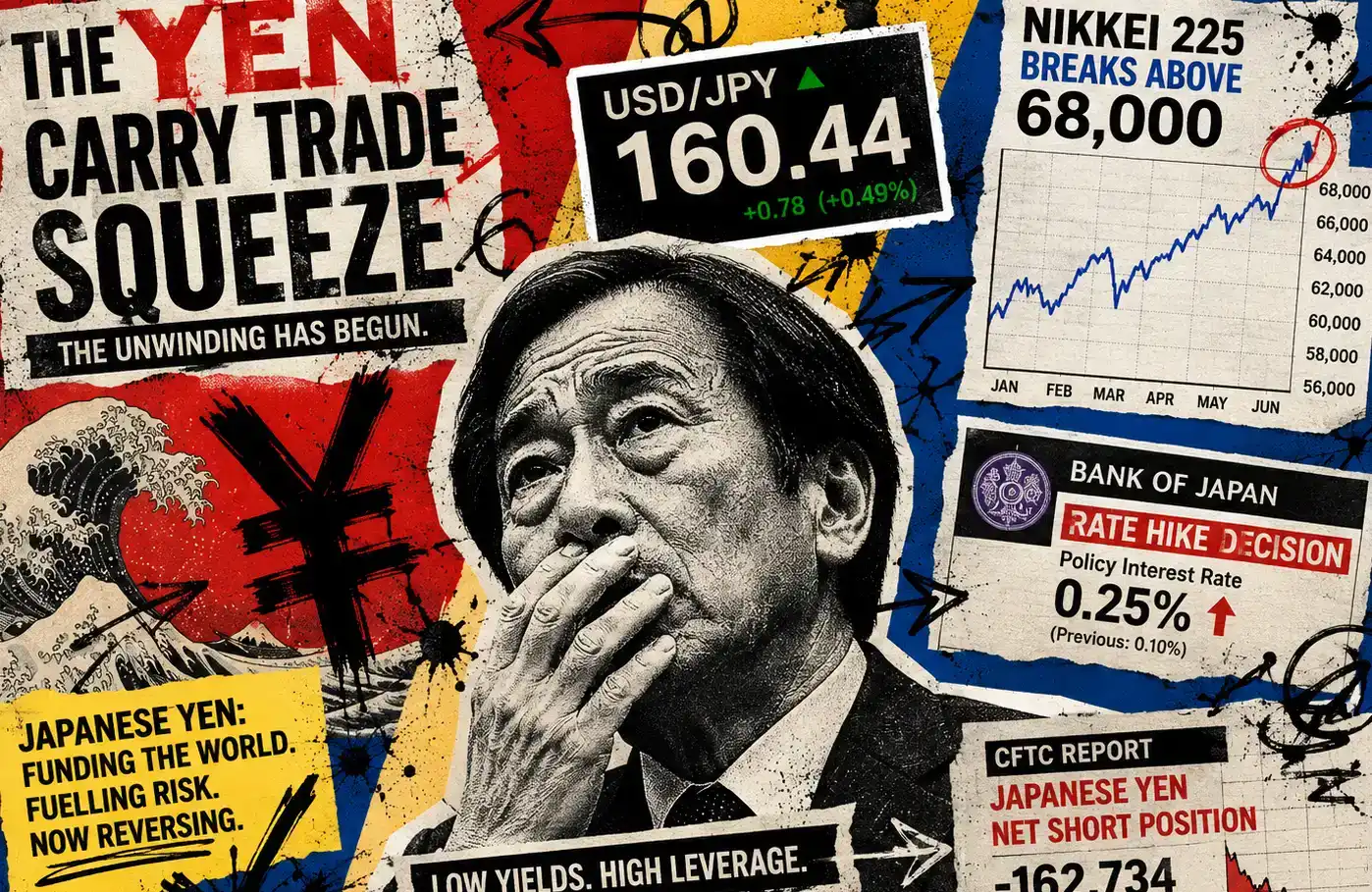
On June 3rd, USD/JPY hit 160.44, its highest level since July 2024, while the Nikkei 225 surged past 68,000 points. Contrary to popular narratives of an imminent "carry trade unwind" akin to August 2024, data reveals a more complex picture. Speculative net short positions in yen futures have actually increased, reaching -114,667 contracts by late May, suggesting traders are doubling down rather than retreating. Meanwhile, Japan's Finance Ministry conducted its largest-ever single-round FX intervention (11.73 trillion yen) in April-May but failed to hold the 160 yen line. The Nikkei's rally is not driven by carry trade dynamics. Foreign investors are aggressively buying Japanese stocks, with net purchases in 2026 running nearly 16 times higher than 2025 levels. This inflow is concentrated in AI and semiconductor-related stocks like SoftBank and Socionext, fueled by positive sector outlooks, rather than being a flight from unwinding yen shorts. Furthermore, the Nikkei has continued climbing despite the Bank of Japan's (BOJ) rate hikes to 0.75%. This disconnect exists because the current equity boom is fueled by AI-driven foreign investment, not reliant on cheap yen funding. However, this relationship remains fragile. Should the BOJ hike rates further (e.g., to 1.0%) while dollar weakness increases carry trade costs, the trajectories of the yen and Japanese stocks could reconverge, potentially triggering volatility.

marsbitHá 1h

New Wall Street Play: Yen Shorts Still Adding, But Japan Stocks Don't Rely on Carry Trade Unwinding

marsbitHá 1h

Broadcom's Q3 Guidance Misses Expectations by $12 Billion, After-Hours Trading Plummets Over 13%, AI Narrative "Cooling"?

On June 3, Broadcom released record Q2 FY26 results with revenue of $22.19B, up 48% YoY, and AI chip sales of $10.8B, up 143%. Adjusted EPS of $2.44 beat estimates. However, its Q3 AI semiconductor revenue guidance of $16B, while up over 200% YoY, fell roughly $1.2B (7%) short of analyst consensus expectations of $17.2B. This miss, coupled with slightly weaker-than-expected software revenue, triggered a severe market reaction. CEO Hock Tan maintained the FY26 AI revenue outlook of over $100B but did not raise it, disappointing investors who had priced in more robust growth. The stock plummeted over 13% in after-hours trading, erasing roughly $270B in market cap. The sell-off extended to peers like Marvell. A key concern for markets, particularly for Chinese optical module suppliers, was Tan's comment that the contribution of AI networking (e.g., Ethernet switches, optical interconnect chips) to AI revenue, currently near 40%, is expected to normalize to around 30% over time, signaling a potential peak in growth for that segment. Despite the guidance shortfall, Tan reiterated that AI demand remains "insatiable" and reaffirmed the long-term target of exceeding $100B in AI revenue by FY27. The reaction highlights the heightened sensitivity and premium valuation placed on AI-exposed stocks, where anything less than stellar guidance can prompt significant profit-taking. The broader question is whether this represents a cooling AI narrative or a correction in overstretched valuations.

marsbitHá 1h

Broadcom's Q3 Guidance Misses Expectations by $12 Billion, After-Hours Trading Plummets Over 13%, AI Narrative "Cooling"?

marsbitHá 1h

Trading

Spot
Futuros
活动图片