Tether's 'Gold Standard' Ambition: Deconstructing XAUt, How the Stablecoin Giant is Hoarding Gold?

marsbitPublicado em 2026-02-02Última atualização em 2026-02-02

Resumo

Tether, the company behind the dominant stablecoin USDT, is rapidly becoming a major global buyer of physical gold, with holdings of approximately 140 metric tons valued at around $23 billion. A significant portion of this, over 70 tons, was acquired last year alone to back its gold-backed stablecoin, XAUt. Each XAUt token represents ownership of one troy ounce of LBMA-standard gold, stored in a high-security Swiss vault. The on-chain token facilitates the transfer of ownership of the underlying physical asset. The operation is run by TG Commodities, a Salvadoran entity fully owned by Tether, which is authorized by El Salvador's national digital asset regulator. Tether's CEO has stated the company aims to allocate 10-15% of its portfolio to gold, purchasing an estimated one to two tons per week. With robust profits, this could potentially double its current XAUt reserves. This scale of purchasing has positioned Tether as a significant "marginal buyer" in the gold market, comparable to central banks. While other gold-backed tokens like PAXG and DGX exist, Tether's massive accumulation introduces a new dynamic. The product aims to make gold more divisible and transferable, but it also intertwines the stability of physical gold with the volatility of the crypto market, raising questions about the long-term implications of this new asset class.

Author: imToken

Can you imagine a company that started with a Crypto background is now buying gold at a scale approaching that of central banks?

According to Bloomberg, USDT issuer Tether has become one of the world's largest holders of gold reserves—currently holding approximately 140 tons of gold, valued at about $23 billion, with over 70 tons purchased last year alone, used to supplement its reserves and issue its gold-backed stablecoin, almost surpassing the declared purchases of most national central banks.

Behind such massive gold purchases, Tether is not betting on the price of gold but is building a long-term, scalable physical gold supply system for its tokenized gold product, XAUt.

I. What is XAUt?

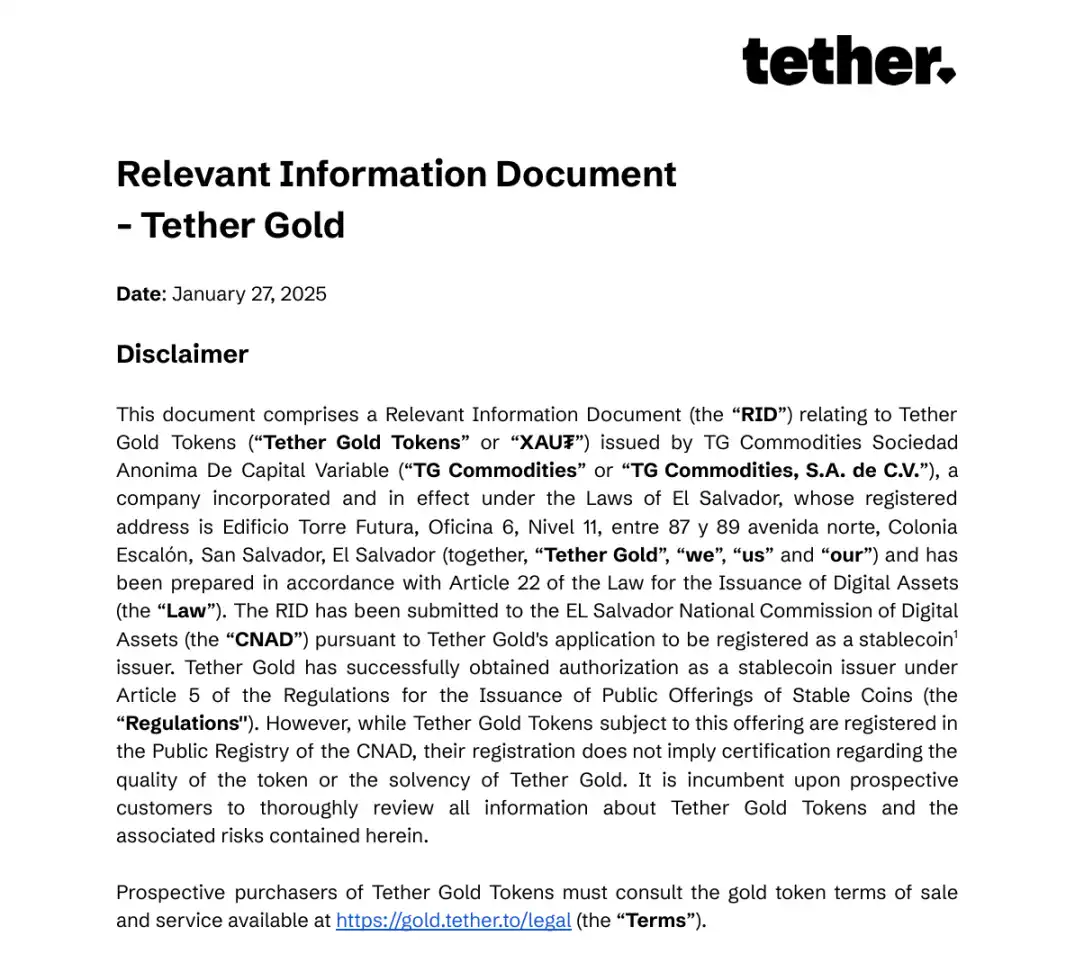
According to the latest whitepaper, "Relevant Information Document – Tether Gold(XAU₮)" released on January 27, 2025, Tether Gold (XAUt) is a gold-backed stablecoin issued by the Salvadoran company TG Commodities, S.A. de C.V.

Each XAUt token represents ownership of one troy ounce (approximately 31.1035 grams) of gold stored in a Swiss vault, meeting the London Bullion Market Association (LBMA) gold bar delivery standards. When an on-chain transaction occurs, the system automatically reallocates the gold shares in the vault to ensure that users' tokens always correspond to specific physical assets.

The physical gold is stored in a high-security vault in Switzerland. The custodian, although an affiliate, operates independently with separate financial accounts and customer records. Users can also access the official "Look-up Website" by entering their on-chain address to directly query the serial number, weight, and purity of the gold bars associated with their assets.

However, delivery must be made in whole gold bars. As described in the whitepaper, since each gold bar varies in weight (typically between 385 and 415 ounces), the official recommends users deposit at least 430 XAUt to ensure coverage. Any excess tokens will be refunded to the user.

Delivery must also occur within Switzerland, or users can request Tether to liquidate the gold into USD in the Swiss gold market, with the proceeds returned after deducting fees.
Source: Tether

It is worth noting that the issuer, TG Commodities, has been authorized by El Salvador's National Digital Asset Commission (CNAD) as a regulated stablecoin issuer and approved digital asset service provider (DASP). A look into the parent company reveals it is wholly owned by Tether Holdings and Tether Operations.

In fact, the early萌芽 of XAUt can be traced back to late 2019 when Paolo Ardoino, then CTO of Bitfinex and Tether, revealed that Tether was planning to launch a gold-backed stablecoin product, Tether Gold. The first version of the XAUT whitepaper was also released on January 28, 2022.

Little did anyone expect that in just four years, Tether would become a super gold buyer comparable to sovereign national central banks.

II. Tether: A New Force in the Gold Market That Cannot Be Ignored

As mentioned above, the whitepaper clearly states that each XAUt token represents ownership of one ounce of physical gold. Tether承诺 that every XAU₮ issued is backed by an equivalent amount of physical gold reserves, all stored in a "Swiss vault with first-class security."

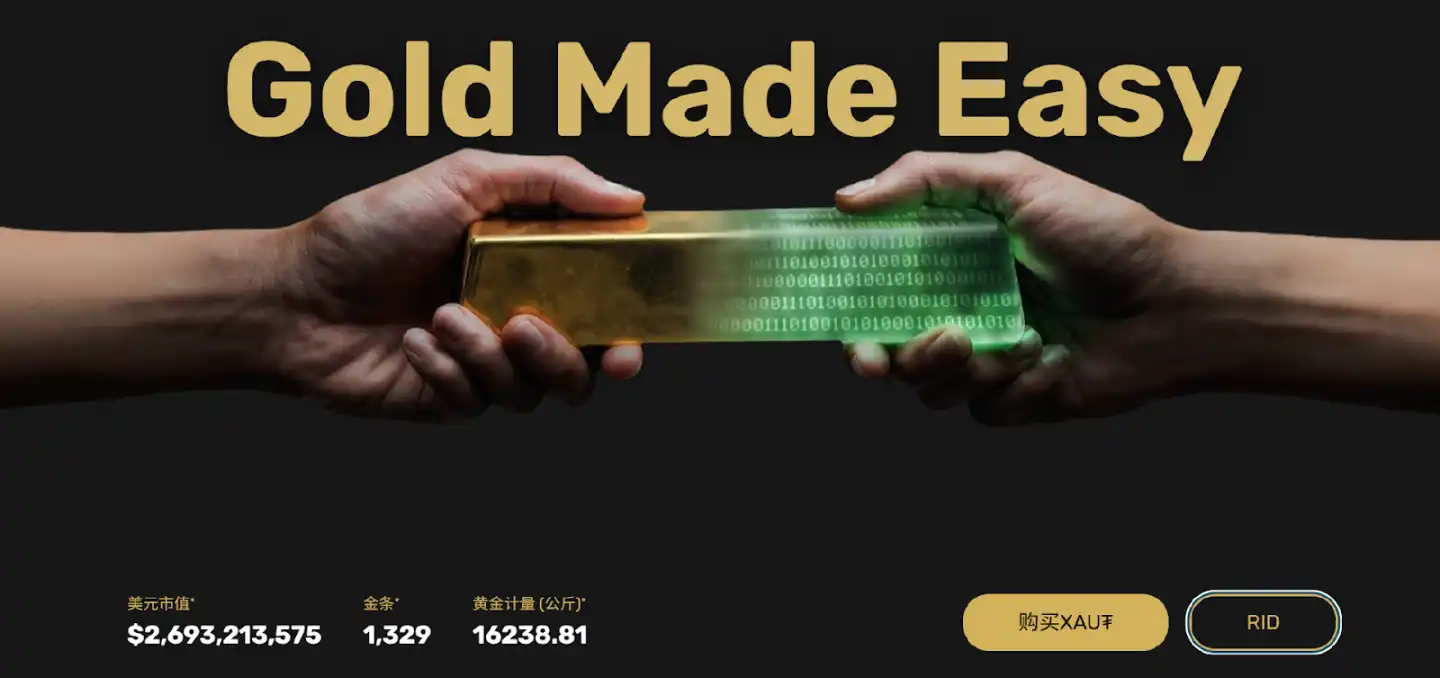
As of the time of writing, the total issuance of XAUt is approximately $2.7 billion, representing the physical reserve of about 1,329 gold bars (totaling 16,238.4 kilograms).
Source: Tether

Interestingly, Tether CEO Paolo Ardoino publicly stated that Tether plans to allocate 10% to 15% of its investment portfolio to physical gold in the future, currently purchasing about one to two tons of gold per week, and intends to continue doing so, aiming for long-term, stable access to gold supply.

According to Bloomberg's calculations, in the last year alone, Tether purchased over 70 tons of new gold to supplement its reserves and support its gold stablecoin issuance. Combining this with Tether's disclosed financial data for the first three quarters of 2025:

Its annual profit is estimated to be nearly $15 billion, with current gold and Bitcoin reserve sizes of approximately $12.9 billion and $9.9 billion, respectively, accounting for about 13% of its total reserves. To reach the 10%-15% target, Tether would need to purchase at least an additional $2-3 billion, effectively doubling the current XAUt规模!

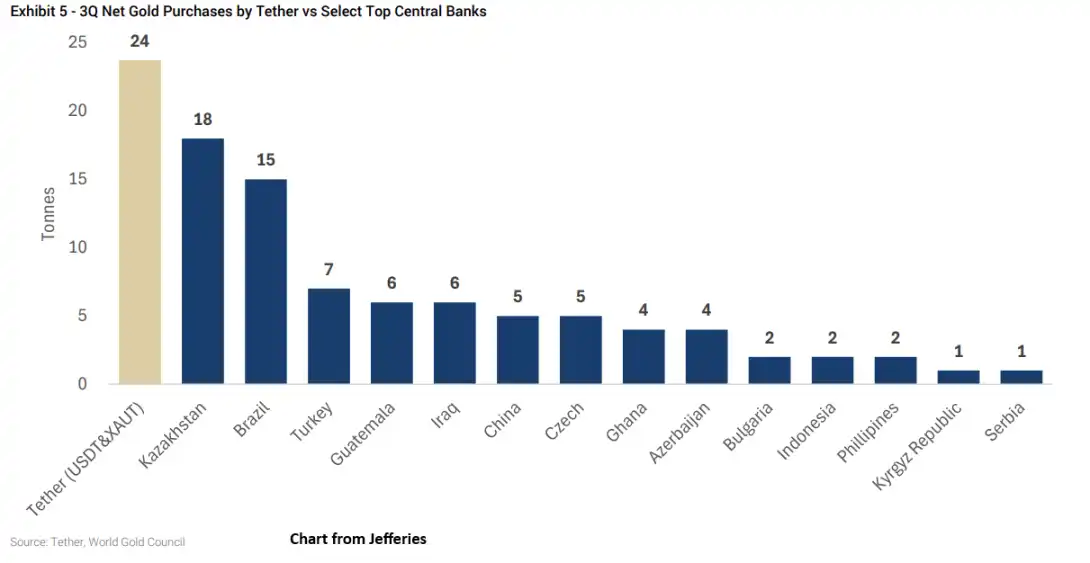
This is why some institutions have begun to view Tether as an unignorable "marginal super buyer" in the gold market. Research from Jefferies shows that in the second quarter, Tether's gold purchases accounted for about 14% of central banks'同期 purchases, and this proportion remained around 12% in the third quarter. It can be said that the timing of the second round of gold price increases高度 coincided with the acceleration of Tether's gold purchasing节奏.

Considering Tether's current strong profitability and the resilience shown by its stablecoin business amid recent crypto market volatility, this gold purchasing target is not激进 from a financial perspective.
Source: Wall Street News

III. How to View Gold-Backed Stablecoins?

Of course, the multi-trillion-dollar market for investment-grade tokenization of gold is far from being a pie that only Tether wants a piece of.

Over the years, several companies have尝试 to provide on-chain representations of gold ownership, including Digix's率先 launched DGX, a stablecoin collateralized by physical gold. Each DGX is backed by 1 gram of LBMA-certified gold bars with 99.99% purity, minted by authoritative companies and stored in The Safe House vault in Singapore.

In addition, there is another more well-known product, PAXG. In 2019, Paxos Trust Company launched PAXG, a gold token approved by the New York Department of Financial Services (NYDFS), also built on the Ethereum ERC-20 protocol. Each PAXG represents one troy ounce of a standard delivery gold bar stored in a professional vault in London.

Paxos users can redeem PAXG for fiat currency, non-bearer gold, or directly redeem physical gold bars, and can随时 query the serial number, brand, weight, and purity of the corresponding gold bar through their on-chain address.

From a product design perspective, the common goal of these gold-backed stablecoins is clear: to make gold more divisible, more liquid, and more aligned with the usage habits of the digital asset era.

However, unlike dollar stablecoins, the value logic of gold stablecoins is more complex. Because the core proposition of stablecoins is built on the demand for fully collateralized, instantly redeemable digital dollars; whereas gold stablecoins inevitably联动 with the cyclical fluctuations of the crypto market itself.

Therefore, when stablecoin demand changes急剧 due to market sentiment or liquidity conditions, this pressure could theoretically传导 to its underlying asset-liability structure—and now, part of that is a real and sizable gold reserve.

Especially as players like Tether hold more and more reserves, is this new narrative a digital rebirth for gold, or is it introducing additional volatility factors to gold?

Perhaps this is one of the issues worth pondering for every holder.

Criptomoedas em alta

Perguntas relacionadas

QWhat is XAUt and how does it relate to physical gold?

AXAUt is a gold-backed stablecoin issued by TG Commodities, S.A. de C.V. Each XAUt token represents ownership of one troy ounce of physical gold that meets the London Bullion Market Association (LBMA) good delivery specifications. The gold is stored in a high-security vault in Switzerland. When on-chain transactions occur, the system automatically reallocates the gold holdings in the vault to ensure each user's tokens are always backed by specific, identifiable physical assets.

QHow much gold does Tether currently hold to back its XAUt stablecoin, and what are its future purchasing plans?

ATether currently holds approximately 140 metric tons of gold, valued at around $23 billion, to back its XAUt stablecoin. The company plans to allocate 10% to 15% of its portfolio to physical gold and is buying about one to two tons of gold per week to achieve this long-term, stable supply goal.

QHow does a user redeem XAUt tokens for physical gold, and what are the requirements?

ARedemption for physical gold must be done in whole gold bars, which typically weigh between 385 to 415 ounces. Therefore, the official white paper recommends users hold at least 430 XAUt to cover the minimum bar weight. The physical delivery must occur within Switzerland. Alternatively, users can request Tether to sell the gold on the Swiss market for U.S. dollars, minus any applicable charges.

QBesides Tether's XAUt, what are some other prominent gold-backed stablecoins in the market?

AOther prominent gold-backed stablecoins include Digix's DGX, where each token is backed by 1 gram of LBMA-certified gold stored in a vault in Singapore, and Paxos Trust Company's PAXG, which is approved by the NYDFS and represents one troy ounce of a London Good Delivery gold bar stored in professional vaults.

QWhat potential risk does the article highlight regarding gold-backed stablecoins like XAUt?

AThe article highlights that the value proposition of gold-backed stablecoins is more complex than that of dollar stablecoins. Their value is inherently linked to the cyclical volatility of the crypto market. If demand for the stablecoin changes drastically due to market sentiment or liquidity conditions, that pressure could theoretically be transmitted to its underlying balance sheet structure, which now consists of a large, real-world gold reserve, potentially introducing additional volatility to the gold market itself.

Leituras Relacionadas

Unlocking $100 Million in Liquidity? Pump.fun's New Policy Tests the 5-Minute Pump Technique

Pump.fun, a popular meme coin launchpad, has introduced a new standard mechanism called BOOST. It aims to address a significant capital efficiency issue: when a newly launched token graduates from its initial bonding curve to a liquidity pool (LP), roughly 20% of its liquidity becomes permanently locked as "dead liquidity," estimated to waste over $100 million annually. Instead of locking these funds permanently, BOOST repurposes them. Upon a token's migration, approximately 20% of the settlement funds (e.g., 17.6 SOL or ~$2516 USDC) are used to buy back the token on the open market over a 5-minute period via a Time-Weighted Average Price (TWAP) mechanism. All purchased tokens are immediately burned. This creates a brief, systematic buy pressure immediately after migration, potentially generating a short-term price surge ("pump") while permanently reducing the token's circulating supply. The goal is to enhance the immediate post-launch trading experience, potentially increasing trader retention and sustainable protocol revenue, which funds ongoing token buybacks. However, concerns exist that this artificial 5-minute boost could lower the barrier for launching low-quality tokens and lead to steeper price crashes once the buy pressure stops, if followed by large sell-offs. The feature automatically applies to tokens migrating after July 21, 2024, but not to previously migrated tokens or those launched via the Mayhem AI Agent lab.

marsbitHá 5m

Unlocking $100 Million in Liquidity? Pump.fun's New Policy Tests the 5-Minute Pump Technique

marsbitHá 5m

Podcast Notes | Conversation with GSR Asset Management Head: To Determine if This Crypto Rally is Real, Just Watch the Lending Rates on Aave

Podcast Summary: Dialogue with GSR's Head of Asset Management: To Determine if This Crypto Rally is Real, Just Check Lending Rates on Aave Andy Baehr, Managing Director of Asset Management at GSR, discusses the current crypto market, characterizing it as stuck in a state of "ambivalence" with short-lived, unsustainable rallies. He outlines a simple framework: the market moves between "ambivalence" and "conviction" (sustained upward momentum). Currently, every rally resembles a single-stage rocket booster that quickly fizzles out. Baehr identifies three key signals to watch: 1) DeFi lending rates, 2) the potential passage of the CLARITY Act, and 3) the market forming a consensus on the "Fed hawkish peak." He emphasizes that the most immediate indicator for the sustainability of the recent CPI-triggered rally is the USDC borrowing rate on Aave, currently around 3.75%—close to U.S. Treasury yields. The absence of a credit spread indicates low leverage demand and a lack of market energy. He explains that a healthy, sustained rally requires layered buying pressure. Last year's rally progressed from an ETH short squeeze to crypto-native trader influx and finally to ETF inflows. Currently, this structure is missing. Other potential structural buyers like Digital Asset Treasury (DAT) companies are absent, and ETF flows have proven transient. Baehr notes that while small-cap crypto tokens outperformed large caps in Q2—a potential sign of capitation in major assets—capital is also flowing to more exciting opportunities like AI stocks and tech IPOs, leaving crypto sidelined. Regarding DeFi, he highlights that platforms like Aave provide a clear, real-time signal of leverage demand through their supply/demand-driven interest rates. A significant, sustained rate increase would signal genuine market conviction. He also observes the quiet emergence of fixed-income-like products and vaults in DeFi. On regulation, the probability of the CLARITY Act passing before the August 7th deadline has dropped linearly from 75% to below 40% on Polymarket. Baehr suggests its passage would be treated as a bullish surprise, a potent driver for price movement. However, political hurdles, including ethical clause debates and disclosures about the First Family's crypto profits, remain significant obstacles. Ultimately, the market awaits clarity on the Fed's terminal rate under Chair Warsh. Until the "Fed Solstice"—the point where the market collectively understands the peak of hawkish policy—sustained conviction will be difficult to achieve.

marsbitHá 36m

Podcast Notes | Conversation with GSR Asset Management Head: To Determine if This Crypto Rally is Real, Just Watch the Lending Rates on Aave

marsbitHá 36m

Trading

Spot

Artigos em Destaque

Como comprar XAUT

Bem-vindo à HTX.com!Tornámos a compra de Tether Gold (XAUT) simples e conveniente.Segue o nosso guia passo a passo para iniciar a tua jornada no mundo das criptos.Passo 1: cria a tua conta HTXUtiliza o teu e-mail ou número de telefone para te inscreveres numa conta gratuita na HTX.Desfruta de um processo de inscrição sem complicações e desbloqueia todas as funcionalidades.Obter a minha contaPasso 2: vai para Comprar Cripto e escolhe o teu método de pagamentoCartão de crédito/débito: usa o teu visa ou mastercard para comprar Tether Gold (XAUT) instantaneamente.Saldo: usa os fundos da tua conta HTX para transacionar sem problemas.Terceiros: adicionamos métodos de pagamento populares, como Google Pay e Apple Pay, para aumentar a conveniência.P2P: transaciona diretamente com outros utilizadores na HTX.Mercado de balcão (OTC): oferecemos serviços personalizados e taxas de câmbio competitivas para os traders.Passo 3: armazena teu Tether Gold (XAUT)Depois de comprar o teu Tether Gold (XAUT), armazena-o na tua conta HTX.Alternativamente, podes enviá-lo para outro lugar através de transferência blockchain ou usá-lo para transacionar outras criptomoedas.Passo 4: transaciona Tether Gold (XAUT)Transaciona facilmente Tether Gold (XAUT) no mercado à vista da HTX.Acede simplesmente à tua conta, seleciona o teu par de trading, executa as tuas transações e monitoriza em tempo real.Oferecemos uma experiência de fácil utilização tanto para principiantes como para traders experientes.

960 Visualizações TotaisPublicado em {updateTime}Atualizado em 2026.06.02

Como comprar XAUT

Discussões

Bem-vindo à Comunidade HTX. Aqui, pode manter-se informado sobre os mais recentes desenvolvimentos da plataforma e obter acesso a análises profissionais de mercado. As opiniões dos utilizadores sobre o preço de XAUT (XAUT) são apresentadas abaixo.

活动图片













