Tether’s $23B Gold Hoard Rivals Nation States As Smart Money Pivots To $HYPER

bitcoinistPublicado em 2026-02-09Última atualização em 2026-02-09

Resumo

Tether, the issuer of USDT, has accumulated a massive $23 billion in physical gold, placing it among the world's top 30 holders and surpassing many G20 nations. This signals a defensive move against macroeconomic uncertainty. Meanwhile, sophisticated investors are shifting toward high-utility infrastructure projects like Bitcoin Hyper ($HYPER), a Bitcoin Layer 2 solution integrated with Solana Virtual Machine (SVM). It aims to unlock over $1 trillion in dormant Bitcoin capital by enabling fast, low-cost transactions and decentralized applications. With over $31 million raised from large-scale investors, $HYPER is positioned to redefine Bitcoin's utility beyond a store of value.

The definition of a safe haven is shifting under our feet. According to a recent report from investment bank Jefferies, Tether, issuer of the ubiquitous $USDT, has stockpiled a staggering $23B in physical gold. This hasn’t gone unnoticed, with many commenting about the purchase on social media.

That stash places the crypto firm among the top 30 global holders of bullion, eclipsing the official reserves of many G20 nations.

This isn’t just diversification. It’s a signal. Tether holds at least 148 tonnes of the yellow metal, using commodities to back a digital dollar. The irony is rich: the main on-ramp to the crypto ecosystem is hedging against the very fiat currency it represents. This massive accumulation suggests that even the biggest liquidity providers are bracing for prolonged macroeconomic turbulence.

But while Tether plays defense with physical commodities, a more aggressive rotation is brewing elsewhere. Sophisticated investors are moving beyond passive “store of value” plays. They’re hunting for infrastructure that wakes up dormant liquidity.

Gold sits in a vault. It doesn’t yield. Bitcoin, historically, has suffered the same limitation, functioning as digital gold but offering little utility. That narrative, however, is fracturing. As institutional interest hits fever pitch, the market is aggressively repricing protocols that solve Bitcoin’s scalability bottlenecks.

This search for yield on top of the world’s most secure blockchain has channeled significant volume toward Bitcoin Hyper ($HYPER), a project engineering the first bridge between Bitcoin’s security and high-speed execution.

Bitcoin Hyper ($HYPER) Unlocks The Trillion-Dollar Dormant Economy

For over a decade, Bitcoin has faced one persistent critique: it’s secure, but it’s slow. Transactions are pricey (sometimes painfully so), and programmability is virtually non-existent compared to chains like Ethereum or Solana. The result? Over $1T in capital is essentially ‘stuck’ in digital wallets, sidelined from the DeFi economy.

Bitcoin Hyper tackles this inefficiency head-on by deploying the first-ever Bitcoin Layer 2 integrated with the Solana Virtual Machine (SVM).
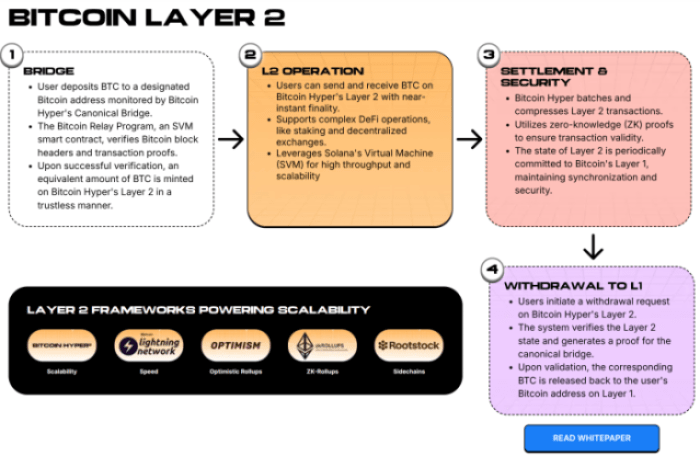
Why does this architecture matter? Because it fundamentally changes the network’s capabilities. By using the SVM for execution while relying on Bitcoin L1 for settlement, $HYPER creates a hybrid environment. Developers can build high-performance dApps using Rust, the standard for high-speed trading systems, while users keep Bitcoin’s immutable security guarantees.

The project uses a decentralized Canonical Bridge for seamless $BTC transfers into the Layer 2 ecosystem. Once bridged, that capital moves with sub-second finality and negligible fees. Suddenly, high-frequency trading, lending markets, and gaming applications, previously impossible on the mainnet, become viable.

For the broader market, this is a pivot point. It’s no longer just about holding an asset that resists inflation (like Gold or $BTC); it’s about owning the rails that power the future financial system.

EXPLORE THE BITCOIN HYPER ($HYPER) ECOSYSTEM

Whales Accumulate $31M As High-Speed Layer 2 Redefines Market Expectations

The market’s appetite for this ‘Bitcoin-on-steroids’ infrastructure shows up clearly in the on-chain flows. While retail investors chase meme coins, smart money seems to be positioning itself in infrastructure plays with tangible utility. Bitcoin Hyper ($HYPER) has already raised an impressive $31M+, signaling strong conviction from early backers.

Whale activity backs this up. Large-scale purchases of $500K, $379.9K, and $274K stand out, not only showing conviction in the project but also the desire to get in early and potentially maximize returns.

With the token currently priced at $0.0136753, these large-scale buys suggest investors see the asset as undervalued relative to its utility. The project’s tokenomics (designed to incentivize the long haul) offer high APY staking rewards immediately after the Token Generation Event (TGE). The structure includes a 7-day vesting period for presale stakers, a classic mechanism to prevent immediate dumping and stabilize price action.

The logic driving these inflows is straightforward. If Bitcoin is the digital equivalent of Tether’s gold stash, then Bitcoin Hyper is the logistical network allowing that gold to be spent, lent, and leveraged at internet speed.

JOIN THE BITCOIN HYPER ($HYPER) PRESALE

The content of this article is for informational purposes only and does not constitute financial advice. Cryptocurrency investments, including presales and Layer 2 tokens, carry inherent risks. Always conduct your own due diligence before making investment decisions.


Perguntas relacionadas

QHow much physical gold has Tether stockpiled, and what does this make them in terms of global holders?

ATether has stockpiled $23 billion in physical gold, which places the crypto firm among the top 30 global holders of bullion.

QWhat is the primary limitation that Bitcoin Hyper ($HYPER) aims to solve for the Bitcoin network?

ABitcoin Hyper aims to solve Bitcoin's scalability bottlenecks, high transaction fees, and lack of programmability to unlock over $1 trillion in dormant capital for the DeFi economy.

QWhat key technology does Bitcoin Hyper use to integrate with Bitcoin's security while enabling high-speed execution?

ABitcoin Hyper deploys the first-ever Bitcoin Layer 2 integrated with the Solana Virtual Machine (SVM), using it for execution while relying on Bitcoin L1 for settlement.

QHow much funding has Bitcoin Hyper ($HYPER) raised from early backers, according to the article?

ABitcoin Hyper has raised over $31 million from early backers, signaling strong conviction in the project.

QAccording to the article, what is the new investment focus shifting towards, beyond passive 'store of value' assets?

AThe investment focus is shifting towards infrastructure that unlocks dormant liquidity, allowing capital to be used for high-performance dApps, lending markets, and other financial applications, rather than just holding inflation-resistant assets.

Leituras Relacionadas

Within Strategy's Framework, STRC's Dividend Yield Remains at 12% as Share Price Stays Below Par Value

Michael Saylor, Executive Chairman of Strategy (MSTR), confirmed that the dividend rate for its STRC perpetual preferred shares will remain at 12.00% through August 2026. The rate has increased from 9% at its July 2025 launch to the current high via a "ratchet" mechanism, which permanently raises the rate by 0.5% whenever the share price falls below $95. This mechanism is intended to push the price back toward its $100 par value and support Strategy's "at-the-market" (ATM) program for issuing new shares to fund Bitcoin purchases. However, the mechanism has not worked as intended. STRC shares closed at $89.46 on July 31, remaining about 10-11% below par value despite the record-high dividend. Competition from rival Strive's higher-yielding SATA securities has pressured demand. The persistent discount has forced Strategy to suspend new STRC issuances via its ATM program, limiting this funding channel for Bitcoin acquisitions. STRC's struggles reflect Bitcoin's own volatility, as the preferred shares historically move in tandem. Analysts have warned the ratchet structure carries long-term, one-way risk. A law firm is investigating Strategy's ability to maintain dividend payments if Bitcoin's price stays low. Retail investors own roughly 83% of outstanding STRC shares, a group seen as prone to panic selling during downturns. In response, Strategy has established financial reserves, including a liquidity cushion covering about 26 months of dividend/interest obligations, and a $2 billion share buyback program alongside a Bitcoin monetization framework, though the company emphasized it is not obligated to sell any Bitcoin.

cryptonews.ruHá 39m

Within Strategy's Framework, STRC's Dividend Yield Remains at 12% as Share Price Stays Below Par Value

cryptonews.ruHá 39m

Analyst: Bitcoin's Price Will Drop to $60k in August, Then Rebound to $70k

Financial analyst Andrey Poroshin has provided a new forecast for Bitcoin's price dynamics in August. Poroshin, an analyst at the Bitbanker exchange, expects the cryptocurrency market to experience a downturn this month, with prices retesting the $60,000 level due to a lack of supportive macroeconomic catalysts. He noted that the recent US Federal Reserve decision to hold interest rates did not significantly impact the market, while inflation remains above the 2% target. Poroshin stated that Bitcoin is ending July under pressure from moderate volatility and a lack of new macroeconomic stimuli, leading to continued market caution. According to his base scenario, Bitcoin will drop to a range of $60,000 to $62,000 before recovering to $70,000. He pointed out that even $70,000 remains below the cost of mining in the US, which has prompted some miners to shift towards AI data center operations. Poroshin cited the winding down of BitMEX's operations as a potential catalyst for a price rebound, suggesting the exit of weaker players often coincides with market reversals and reduced short-term selling pressure. He believes Bitcoin is currently less susceptible to geopolitical shocks, such as the Iran-US conflict, and does not expect significant market changes in August related to the pending CLARITY Act. Looking ahead, Poroshin forecasts that September will bring more active price fluctuations driven by potential Fed rate decisions and possible discussions or approval of the CLARITY Act.

cryptonews.ruHá 39m

Analyst: Bitcoin's Price Will Drop to $60k in August, Then Rebound to $70k

cryptonews.ruHá 39m

Trading

Spot
活动图片




