Tether Urged To Transfer $344M In Frozen USDT To Terror Victims

bitcoinistPublicado em 2026-05-16Última atualização em 2026-05-16

Resumo

A US federal court in Manhattan is being asked to order Tether to transfer $344 million in frozen USDT to victims of Iran-linked terrorist attacks. The plaintiffs, including a Jerusalem family affected by a 1997 Hamas bombing, hold unpaid court judgments against Iran. They target two Tron blockchain wallets, frozen earlier this year by the US Treasury's OFAC as linked to Iran's Islamic Revolutionary Guard Corps. Their lawsuit argues that because Tether, as a centralized issuer, can freeze wallets, it can also be compelled by court order to move the equivalent funds to satisfy the judgments. This case could set a significant legal precedent for centralized stablecoin issuers and is part of a broader legal campaign targeting frozen crypto assets linked to sanctioned entities.

A Jerusalem family that lost relatives in a 1997 Hamas suicide bombing is among the plaintiffs pushing a US federal court to order Tether to hand over hundreds of millions in frozen digital currency.

The case, filed in Manhattan, could set a significant legal precedent for how courts treat centralized stablecoin issuers.

A Decades-Old Debt

The plaintiffs are survivors and family members of victims from Iran-linked terrorist attacks. They hold court judgments against Iran that were awarded years ago — judgments that have never been paid.

Now they are targeting a pile of frozen cryptocurrency as a way to collect what they are owed.

Attorney Charles Gerstein filed the lawsuit Thursday in the US District Court for the Southern District of New York.
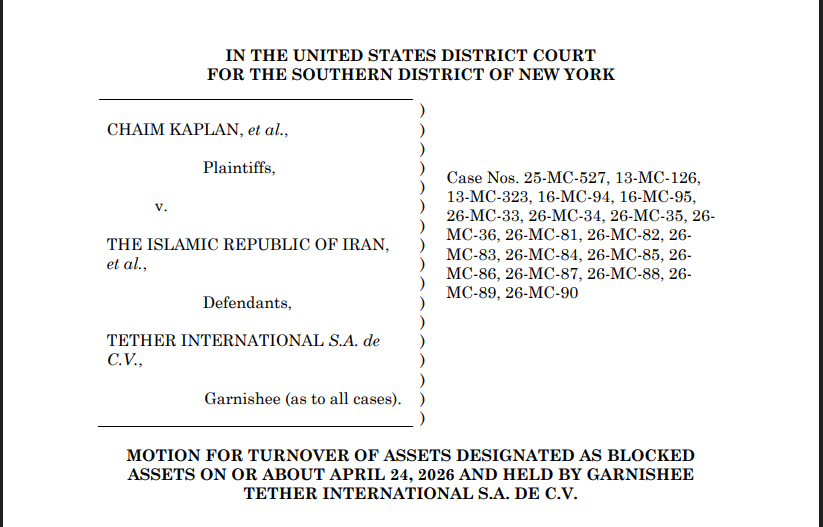
Filing against Tether submitted by Attorney Charles Gerstein.

His clients say they have a legal claim to two Tron blockchain wallet addresses holding roughly 344 million USDT. Those wallets were frozen earlier this year by the US Treasury Department’s Office of Foreign Assets Control, which identified them as linked to Iran’s Islamic Revolutionary Guard Corps.

The plaintiffs are not asking Tether to simply release those specific wallets. According to reports, they want a court order directing Tether to transfer an equivalent amount of USDT to their legal team’s wallet address.
Why Tether Can Be Compelled

Unlike Bitcoin or Ethereum, USDT is controlled by a central company. Tether can freeze wallets, block transactions, and move funds when ordered to do so. That centralized structure is at the heart of Gerstein’s legal argument.

Because a prior order already froze the wallets — something only possible because Tether has direct operational control — he contends the company can also be ordered to move the funds.

BTCUSD trading at $78,115 on the 24-hour chart: TradingView

The ownership question, he argues, is already largely settled: OFAC has already declared the wallets to be IRGC-controlled assets, which clears a path for seizure under US terrorism statutes.

Broader Legal Campaign

This is not Gerstein’s only case of this kind. Based on reports, he has filed similar actions involving North Korea-linked cyber operations against the Arbitrum platform. He is also handling a separate case involving Railgun DAO, a privacy-focused crypto protocol.

The Manhattan filing is part of what appears to be a coordinated legal push to test whether courts can compel crypto platforms with centralized control to act on frozen assets held in sanctioned wallets.

Featured image from CEPA, chart from TradingView

Perguntas relacionadas

QWhat is the plaintiffs' primary demand to Tether in this case?

AThe plaintiffs are asking the US federal court to order Tether to transfer approximately $344 million worth of frozen USDT (an equivalent amount to the funds in two sanctioned wallet addresses) to a wallet address controlled by their legal team.

QWhat is the legal basis for Attorney Charles Gerstein's argument that Tether can be compelled to move the funds?

AThe argument hinges on Tether's centralized control over USDT. Gerstein contends that because Tether can and has frozen the specific wallets (as ordered by OFAC), demonstrating direct operational control, the company can similarly be ordered by a court to move the funds.

QWhat entity froze the Tron blockchain wallets containing the 344 million USDT, and why were they frozen?

AThe wallets were frozen earlier this year by the US Treasury Department's Office of Foreign Assets Control (OFAC), which identified them as assets linked to Iran's Islamic Revolutionary Guard Corps (IRGC).

QWho are the plaintiffs in this lawsuit against Tether?

AThe plaintiffs are survivors and family members of victims from Iran-linked terrorist attacks, including a Jerusalem family that lost relatives in a 1997 Hamas suicide bombing. They hold unpaid court judgments against Iran.

QWhat potential legal significance does this case hold beyond the immediate dispute?

AThe case could set a significant legal precedent for how US courts treat centralized stablecoin issuers, testing whether courts can compel such platforms to act on frozen assets held in wallets linked to sanctioned entities under terrorism statutes.

Leituras Relacionadas

Claude Code Introduces Dynamic Workflows: Enabling AI to Form Teams and Collaborate

Claude Code introduces dynamic workflows, enabling AI to coordinate teams of specialized agents for complex tasks. This transforms Claude from a code assistant into a programmable workbench. Workflows address key limitations of single-agent systems: agentic laziness (premature task completion), self-preferential bias (favoring own outputs), and goal drift (losing sight of original objectives). The system allows Claude to dynamically create execution frameworks using JavaScript. It can split tasks, dispatch parallel agents for isolated work (e.g., in separate worktrees), implement adversarial validation, run tournaments, and synthesize results. This multi-agent approach is valuable for tasks requiring deep research, factual verification, code migration, root cause analysis, large-scale triage, and qualitative sorting. Key patterns include: classify-and-route, fan-out-and-synthesize, adversarial verification, generate-and-filter, tournaments, and loop-until-done. While token usage is higher, workflows excel where tasks resemble programming—needing problem decomposition, isolated context, hypothesis testing, and handling many details. They extend Claude Code's utility beyond technical work to areas like business plan review, resume screening, and naming brainstorm. The feature is not a universal solution but points to a future where AI tool competitiveness depends on organizing reliable, reusable, and auditable execution flows for complex goals.

marsbitHá 42m

Claude Code Introduces Dynamic Workflows: Enabling AI to Form Teams and Collaborate

marsbitHá 42m

Hyperliquid, Wall Street's 24/7 Trading Convenience Store

Hyperliquid: The 24/7 Trading "Convenience Store" for Wall Street Hyperliquid, a decentralized cryptocurrency exchange, has become a go-to platform for Wall Street traders seeking to trade around the clock, especially during traditional market closures. Founded by Jeff Yan, a former quantitative trader, after the FTX collapse, the platform emphasizes user self-custody of assets. It offers a wide range of perpetual contracts—leveraged derivatives with no expiry—on assets from Bitcoin and crude oil to the S&P 500 and even pre-IPO companies like SpaceX. A notable example involves a hedge fund trader who capitalized on geopolitical news over a weekend, securing a 243% return on oil derivatives before markets reopened. The platform, run by just 11 employees, generated approximately $800 million in revenue last year, and its native token HYPE has seen significant growth. Its rise highlights the merging of traditional finance and crypto. While U.S. users are currently restricted, recent CFTC rule changes could open access. The platform is known for its transparency, having processed $10 billion in liquidations during a market crash while competitors faltered. Regulators warn of the high risks and complexity of perpetual contracts for retail investors. Key to its appeal is a strong community culture, direct engagement with founders, and a simple interface. Despite rules against VPN use, it attracts global users with its permissionless approach. Hyperliquid plans to expand into prediction markets and options, aiming to eventually host all financial activity.

marsbitHá 43m

Hyperliquid, Wall Street's 24/7 Trading Convenience Store

marsbitHá 43m

Who Funds the Agents?

**Summary: Who Funds AI Agents?** OpenAI recently shut down a feature allowing AI agents to shop for users, highlighting the challenge of creating a secure and regulated environment for agent-driven transactions. While payment infrastructure exists, a crucial governance layer—defining spending limits, fraud detection, tax handling, and return policies—is largely missing. The potential is enormous: AI agents already processed $73M across 176M transactions last year, with McKinsey forecasting this could grow to $3-5T in global consumer commerce by 2030. The core competition isn't just about processing payments, which can be very cheap (especially with crypto-based settlement), but about controlling the rules that govern agent spending. Key players like Stripe and Coinbase are racing to dominate this governance layer. Stripe's acquisition of wallet provider Privy allows it to set spending policies, identity checks, and human-in-the-loop approvals directly at the wallet level. Similarly, Coinbase's stack, including its x402 protocol and AgentKit, embeds governance rules. This vertical integration across settlement, wallet, and governance layers is becoming the dominant strategy. Control over the governance layer is where significant future value lies. If agents handle trillions in transactions, even a small fee for managing compliance, fraud prevention, and policy enforcement could generate billions in annual revenue. The companies that successfully integrate across the payment stack will capture value from idle agent balances, transaction fees, and governance services, positioning themselves as the foundational banks of the AI agent economy.

marsbitHá 1h

Who Funds the Agents?

marsbitHá 1h

Trading

Spot
Futuros
活动图片