Tether Urged To Transfer $344M In Frozen USDT To Terror Victims

bitcoinistPublicado em 2026-05-16Última atualização em 2026-05-16

Resumo

A US federal court in Manhattan is being asked to order Tether to transfer $344 million in frozen USDT to victims of Iran-linked terrorist attacks. The plaintiffs, including a Jerusalem family affected by a 1997 Hamas bombing, hold unpaid court judgments against Iran. They target two Tron blockchain wallets, frozen earlier this year by the US Treasury's OFAC as linked to Iran's Islamic Revolutionary Guard Corps. Their lawsuit argues that because Tether, as a centralized issuer, can freeze wallets, it can also be compelled by court order to move the equivalent funds to satisfy the judgments. This case could set a significant legal precedent for centralized stablecoin issuers and is part of a broader legal campaign targeting frozen crypto assets linked to sanctioned entities.

A Jerusalem family that lost relatives in a 1997 Hamas suicide bombing is among the plaintiffs pushing a US federal court to order Tether to hand over hundreds of millions in frozen digital currency.

The case, filed in Manhattan, could set a significant legal precedent for how courts treat centralized stablecoin issuers.

A Decades-Old Debt

The plaintiffs are survivors and family members of victims from Iran-linked terrorist attacks. They hold court judgments against Iran that were awarded years ago — judgments that have never been paid.

Now they are targeting a pile of frozen cryptocurrency as a way to collect what they are owed.

Attorney Charles Gerstein filed the lawsuit Thursday in the US District Court for the Southern District of New York.
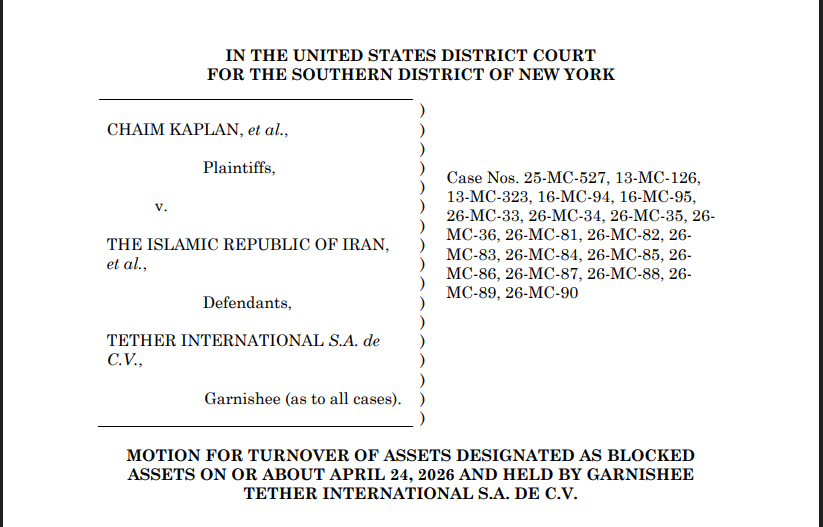
Filing against Tether submitted by Attorney Charles Gerstein.

His clients say they have a legal claim to two Tron blockchain wallet addresses holding roughly 344 million USDT. Those wallets were frozen earlier this year by the US Treasury Department’s Office of Foreign Assets Control, which identified them as linked to Iran’s Islamic Revolutionary Guard Corps.

The plaintiffs are not asking Tether to simply release those specific wallets. According to reports, they want a court order directing Tether to transfer an equivalent amount of USDT to their legal team’s wallet address.
Why Tether Can Be Compelled

Unlike Bitcoin or Ethereum, USDT is controlled by a central company. Tether can freeze wallets, block transactions, and move funds when ordered to do so. That centralized structure is at the heart of Gerstein’s legal argument.

Because a prior order already froze the wallets — something only possible because Tether has direct operational control — he contends the company can also be ordered to move the funds.

BTCUSD trading at $78,115 on the 24-hour chart: TradingView

The ownership question, he argues, is already largely settled: OFAC has already declared the wallets to be IRGC-controlled assets, which clears a path for seizure under US terrorism statutes.

Broader Legal Campaign

This is not Gerstein’s only case of this kind. Based on reports, he has filed similar actions involving North Korea-linked cyber operations against the Arbitrum platform. He is also handling a separate case involving Railgun DAO, a privacy-focused crypto protocol.

The Manhattan filing is part of what appears to be a coordinated legal push to test whether courts can compel crypto platforms with centralized control to act on frozen assets held in sanctioned wallets.

Featured image from CEPA, chart from TradingView

Perguntas relacionadas

QWhat is the plaintiffs' primary demand to Tether in this case?

AThe plaintiffs are asking the US federal court to order Tether to transfer approximately $344 million worth of frozen USDT (an equivalent amount to the funds in two sanctioned wallet addresses) to a wallet address controlled by their legal team.

QWhat is the legal basis for Attorney Charles Gerstein's argument that Tether can be compelled to move the funds?

AThe argument hinges on Tether's centralized control over USDT. Gerstein contends that because Tether can and has frozen the specific wallets (as ordered by OFAC), demonstrating direct operational control, the company can similarly be ordered by a court to move the funds.

QWhat entity froze the Tron blockchain wallets containing the 344 million USDT, and why were they frozen?

AThe wallets were frozen earlier this year by the US Treasury Department's Office of Foreign Assets Control (OFAC), which identified them as assets linked to Iran's Islamic Revolutionary Guard Corps (IRGC).

QWho are the plaintiffs in this lawsuit against Tether?

AThe plaintiffs are survivors and family members of victims from Iran-linked terrorist attacks, including a Jerusalem family that lost relatives in a 1997 Hamas suicide bombing. They hold unpaid court judgments against Iran.

QWhat potential legal significance does this case hold beyond the immediate dispute?

AThe case could set a significant legal precedent for how US courts treat centralized stablecoin issuers, testing whether courts can compel such platforms to act on frozen assets held in wallets linked to sanctioned entities under terrorism statutes.

Leituras Relacionadas

STRC Breaks Below $95: Why Does It Continue to Depeg? Is There Default Risk?

"STRC Falls Below $95: Why the Persistent Depegging and Is There Default Risk?" The article discusses the recent decline in the price of STRC, a perpetual preferred stock issued by Strategy (MSTR) designed to trade around a $100 par value. As of publication, STRC traded at $94.65, raising market concerns. STRC is described as a high-yield cash flow product, offering an 11.50% annual dividend paid monthly. Its "preferred" status grants it priority over common stock for dividends and in liquidation. Key reasons cited for the price depegging include: 1. **Bitcoin's Price Drop:** MSTR's assets are heavily tied to Bitcoin (BTC), which fell over 21% from its recent high, pressuring all Strategy-related products. 2. **Competitive Pressure:** Rival Strive Asset Management's similar product, SATA, offers daily dividends and has maintained its $100 par value with a ~13% yield. In response, Strategy has proposed changing STRC's dividend frequency from monthly to bi-weekly, pending shareholder vote. 3. **Technical Selling:** A break below $100 may have triggered algorithmic selling and stop-losses, exacerbating the decline. Regarding default risk, the analysis suggests it is currently low. Strategy founder Michael Saylor confirmed the June 2026 dividend rate remains at 11.50% with no cuts or suspensions. The company's massive reserve of 843,706 BTC provides a significant backstop for its obligations. Industry opinions are mixed. Some analysts view the BTC holdings as reliable support for dividends, while critics like Peter Schiff warn of potential dividend cuts leading to price crashes and lawsuits. Others highlight inflation risk and the company's ability to reduce dividends without a formal default. In summary, STRC's drop is attributed to BTC volatility, competition, and technical factors. While immediate default risk appears contained, the product faces challenges from market conditions and competitive dynamics.

marsbitHá 1h

STRC Breaks Below $95: Why Does It Continue to Depeg? Is There Default Risk?

marsbitHá 1h

AI Trading Cools, South Korean Stocks Plunge 1.8%, Spot Gold Rises 1%, Bitcoin Dives

A sell-off in AI-related stocks, triggered by Broadcom's disappointing earnings forecast, sent shockwaves through global markets. South Korea's KOSPI led Asia's decline, plunging 1.8% as the risks from concentrated chip stock gains and surging leveraged investments came to the fore. The tech-heavy Nasdaq 100 futures fell 0.5% following Broadcom's 14% after-hours plunge, which signaled a slower-than-expected transition to AI clients. This pullback extended Wall Street's weakness, halting the S&P 500's nine-day rally amid hawkish Fed signals and renewed Middle East tensions. South Korean authorities convened an emergency meeting, pledging "immediate measures" against market volatility and warning of record-high stock margin debt. The adjustment rippled across assets: Bitcoin fell to around $64,000, its lowest since February, while safe-haven gold rose 1% on bargain hunting. Oil prices dipped on Middle East ceasefire news. Market analysts noted the sell-off was driven by profit-taking after massive gains, particularly in chip stocks like Samsung and SK Hynix, which now dominate the KOSPI. Wall Street banks are divided on Korea's outlook, with Goldman Sachs raising its target while Citigroup and others warn of overvaluation and a potential bubble. Bridgewater's Ray Dalio noted that great technological shifts often create bubbles. Meanwhile, Fed officials' hints at potential future rate hikes added to the cautious mood ahead of key U.S. jobs data.

华尔街日报Há 1h

AI Trading Cools, South Korean Stocks Plunge 1.8%, Spot Gold Rises 1%, Bitcoin Dives

华尔街日报Há 1h

Trading

Spot
Futuros
活动图片





