Tether Ramps Up Wallet Freezes, Blocking Over $500M In USDT

bitcoinistPublicado em 2026-05-10Última atualização em 2026-05-10

Resumo

Tether has significantly increased its wallet freezing activity, blocking over $514 million in USDT across 370 addresses on the Tron and Ethereum networks in just the past 30 days. Data from BlockSec shows the vast majority of these freezes (328 addresses, $506 million) occurred on Tron. The pace is accelerating, with the 2025 annual total of $1.26 billion across 4,163 addresses at risk of being surpassed this year. Once frozen, wallets are rarely reinstated, and more than half of the associated funds are typically permanently destroyed. A growing portion of these enforcement actions are coordinated with law enforcement. Recent examples include freezing $344 million linked to suspected sanctions evasion with Iran and $61 million tied to "pig butchering" scams. Cumulatively from 2023-2025, Tether has frozen roughly $3.3 billion across 7,268 addresses, far exceeding actions by competitors like Circle. This surge has sparked broader debate within crypto about the power issuers and projects hold to freeze or recover funds, highlighting how compliance and central controls remain integral behind the scenes of decentralized ecosystems.

Once frozen, a Tether-blacklisted wallet almost never comes back. Only 3.6% of addresses placed on the blocklist in 2025 were later removed, according to BlockSec data.

More than half of the funds tied to those wallets were permanently destroyed using the contracts’ “destroyBlackFunds” function — a detail that underscores just how final these enforcement actions tend to be.

Freezes Surge Across Tron And Ethereum

In the past 30 days alone, Tether froze over $514 million in USDT across 370 addresses on the Ethereum and Tron networks.

BlockSec’s USDT Freeze Tracker shows 328 of those addresses were on Tron, with about $506 million locked there. Ethereum accounted for 42 addresses and $8.73 million. The gap between the two networks points to Tron as the main front in Tether’s enforcement push.
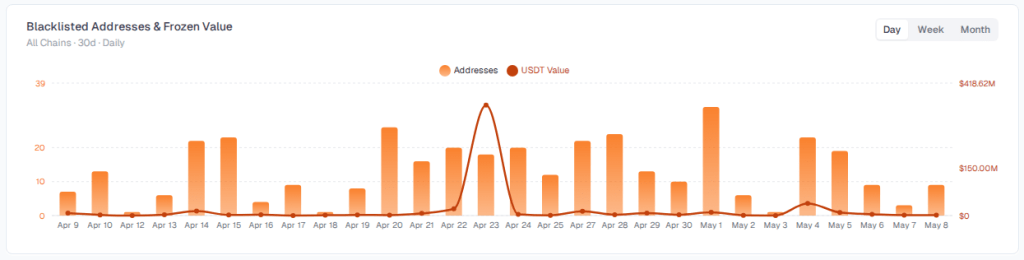
Source: BlockSec

The pace is picking up. All of 2025 saw Tether blacklist 4,163 addresses and freeze a combined $1.26 billion. At the current rate, that annual total could be surpassed well before December.

A broader study covering 2023 through 2025 put the cumulative figure at roughly $3.3 billion across 7,268 addresses — far ahead of rival stablecoin issuer Circle over the same period.

Law Enforcement Plays A Growing Role

Some of the largest recent freezes were tied directly to government investigations. In April, Tether coordinated with the US Treasury’s Office of Foreign Assets Control to lock more than $344 million in USDT across two Tron addresses.

Bitcoin is currently trading at $80,349. Chart: TradingView

Officials said those wallets were linked to suspected sanctions evasion involving Iran. Months earlier, in February, Tether assisted authorities in seizing over $61 million connected to pig butchering scams — a form of fraud where victims are manipulated into sending large sums under false pretenses.

Tether had previously disclosed that it froze around $4.2 billion in tokens over three years due to links with illicit activity, with $3.5 billion of that amount locked since 2023 as law enforcement agencies stepped up crypto-related investigations.

Broader Questions Around Freeze Powers

The surge in blacklisting has sparked debate beyond stablecoins. Some decentralized finance projects have used upgradeable contracts and admin controls to halt or recover funds after major exploits, raising questions about who holds those powers and when they should be used.

For stablecoins like USDT, issuers retain direct control over minting and burning. Data shows these freeze mechanisms are now a routine part of fraud, sanctions, and scam investigations — used not occasionally, but consistently and at scale.

Featured image from Halo, chart from TradingView

Perguntas relacionadas

QWhat percentage of Tether-blacklisted wallets in 2025 were later removed, and what happens to the funds?

AOnly 3.6% of Tether-blacklisted addresses in 2025 were later removed. More than half of the funds tied to those wallets were permanently destroyed using the 'destroyBlackFunds' contract function.

QHow much USDT did Tether freeze in the past 30 days, and which blockchain network was most impacted?

AIn the past 30 days, Tether froze over $514 million in USDT across 370 addresses. The Tron network was the most impacted, with 328 addresses and about $506 million frozen, compared to 42 addresses and $8.73 million on Ethereum.

QWhat was the cumulative amount of USDT frozen by Tether from 2023 through 2025, and how does it compare to its rival Circle?

AFrom 2023 through 2025, Tether froze roughly $3.3 billion in USDT across 7,268 addresses. This amount is far ahead of what its rival stablecoin issuer, Circle, froze over the same period.

QWhat were two notable law enforcement-related Tether freezes mentioned in the article?

ATwo notable law enforcement-related freezes were: 1) In April, Tether coordinated with the U.S. Treasury's OFAC to freeze over $344 million in USDT linked to suspected sanctions evasion involving Iran. 2) In February, Tether assisted in seizing over $61 million connected to pig butchering scams.

QWhat broader debate has the surge in Tether blacklisting sparked, according to the article?

AThe surge in Tether blacklisting has sparked a broader debate about who holds freeze powers and when they should be used, extending beyond stablecoins to decentralized finance projects that use upgradeable contracts and admin controls to halt or recover funds after major exploits.

Leituras Relacionadas

The Value Distribution of Stablecoins

**Summary: The Value Distribution of Stablecoins** The article argues that stablecoins are evolving from mere trading tools into broader channels for dollar access. It divides the stablecoin ecosystem into four layers to analyze how value is distributed: 1. **Issuance Layer:** Mints stablecoins, holds reserve assets, and captures the spread between reserve yield and user costs (e.g., Tether, Circle). This layer currently earns the largest profit margin. 2. **Infrastructure Layer:** Connects stablecoins to the traditional financial system, handling fiat on/off-ramps, banking integration, compliance (KYC/AML), and asset management (e.g., Bridge, BVNK). This is the "unglamorous" but critical work, building the essential bridges between crypto and real-world finance. 3. **Acquiring/Distribution Layer:** Integrates stablecoins into merchant systems, manages payment flows, and provides enterprise financial software (e.g., Stripe, Coinbase). They act as the access point for businesses. 4. **Application Layer:** The end-users and businesses that ultimately use stablecoins for payments, settlements, or as a store of value. They benefit from convenience but have little pricing power. The core thesis is that while the issuance layer currently dominates profits, the often-overlooked **infrastructure layer holds significant long-term potential**. The real challenge and barrier to mass adoption is not the on-chain transfer of stablecoins (which is simple), but the complex "last mile" integration into existing business workflows, banking systems, and regulatory frameworks across different countries. Companies in this layer are currently in a "land grab" phase, investing heavily to build networks, secure bank partnerships, and establish compliance pathways. While their position is currently pressured by the profitable issuers above and distribution platforms below, the article suggests that if stablecoins become a default financial rail for businesses, the infrastructure providers who have done the hard work of integration will ultimately gain strong pricing power and become entrenched, essential players.

marsbitHá 5h

The Value Distribution of Stablecoins

marsbitHá 5h

The Value Distribution of Stablecoins

The Value Distribution of Stablecoins The article argues that stablecoins are evolving from a mere trading tool into a broad "dollar channel." It analyzes the industry's value chain through four layers: 1. **Issuance Layer (e.g., Tether, Circle):** The top layer that mints stablecoins, holds reserve assets, and captures the thickest interest rate spread. 2. **Infrastructure Layer (e.g., Bridge, BVNK):** Connects stablecoins to the traditional financial system, handling critical but complex "dirty work" like fiat on/off-ramps, banking integration, compliance (KYC/AML), and cross-border settlement. 3. **Acquiring/Distribution Layer (e.g., Stripe, Coinbase):** Embeds stablecoins into merchant systems, manages payment flows, and integrates with enterprise software. 4. **Application Layer:** End-users and businesses that ultimately use stablecoins for payments, settlement, or storing value. The author posits that while the issuance layer currently captures the most profit, the most overlooked and potentially critical layer is infrastructure. The core challenge for stablecoin adoption isn't the on-chain transfer (which is simple), but bridging the gap between blockchain and the real-world financial system. This involves solving practical problems for businesses: fiat conversion, reconciliation, tax handling, and user onboarding. Infrastructure companies are currently in a difficult "land-grab" phase—building networks, securing banking relationships, and achieving compliance country-by-country. They face pressure from both the profitable issuance layer above and distribution platforms below. However, the author suggests this layer is building a crucial moat. Once stablecoins become a default business rail, the infrastructure players who have done the hard work of integration may gain significant, durable value and pricing power.

链捕手Há 5h

The Value Distribution of Stablecoins

链捕手Há 5h

Trading

Spot
Futuros
活动图片