Tether Launches Bitcoin Mining OS, Fueling $HYPER’s $31.2M Presale

bitcoinistPublicado em 2026-02-03Última atualização em 2026-02-03

Resumo

Tether, the major stablecoin issuer, is expanding its influence in Bitcoin infrastructure by launching MOS, a proprietary mining operating system that integrates IoT technology to optimize energy efficiency. This move signals a strong institutional commitment to Bitcoin's foundational growth. However, Bitcoin's inherent limitations in transaction speed and scalability for DeFi applications remain a challenge. Addressing this, Bitcoin Hyper ($HYPER) is gaining attention as a Bitcoin Layer 2 solution that combines Bitcoin's security with the high-speed performance of the Solana Virtual Machine (SVM). It enables fast, low-cost transactions and smart contracts in Rust, making Bitcoin more usable for DeFi. The project's presale has raised over $31.2 million, indicating significant investor interest, particularly from larger entities, ahead of its Token Generation Event (TGE). The tokenomics include immediate staking post-TGE with a 7-day vesting period to reduce sell pressure. This development represents a growing trend to enhance Bitcoin's utility alongside infrastructure improvements.

Tether isn’t just a stablecoin issuer anymore. It’s rapidly becoming a dominant force in Bitcoin infrastructure.

The company’s recent launch of MOS, its proprietary mining operating system, marks a massive shift in how institutional capital interacts with the network.
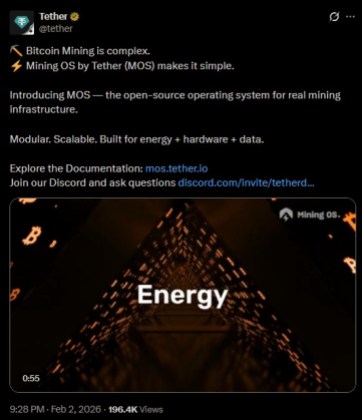
By fusing Internet of Things (IoT) technology with mining hardware, Tether is optimizing energy efficiency in a way that screams long-term commitment. It’s not just about holding $BTC; it’s about building the rails.

That validates the ‘Bitcoin as infrastructure’ thesis. When the world’s largest stablecoin issuer, sitting on over $100B in liquidity, pivots to mining logistics, it de-risks the network for everyone else. But while Tether tackles hardware inefficiencies, a glaring gap remains on the software side: Bitcoin simply can’t handle complex, high-speed transactions natively.

Consequently, focus is shifting toward solutions that can unlock Bitcoin’s $1T+ capital for decentralized finance (DeFi). The liquidity is there. The rails? Too slow. This search for scalability has pushed massive capital toward Layer 2 protocols.

Right now, smart money is circling Bitcoin Hyper ($HYPER), a project merging Bitcoin’s security with the Solana Virtual Machine’s (SVM) speed to bridge institutional security with retail velocity.

You can buy $HYPER here.

Bitcoin Hyper Bridges the Gap Between Security and SVM Speed

Bitcoin’s core limitation has always been the ‘trilemma’ trade-off: it sacrifices speed for absolute decentralization. While reliable for settlement, frankly, it’s functionally useless for modern DeFi applications that require sub-second finality.

Bitcoin Hyper ($HYPER) tackles this by integrating the Solana Virtual Machine (SVM) directly as a Layer 2 execution environment.

This isn’t just narrative fluff, it’s a technical leap. By using the SVM, Bitcoin Hyper lets developers write smart contracts in Rust (the language powering Solana’s ecosystem) while anchoring the final state to Bitcoin’s Layer 1. This modular approach separates execution from settlement.
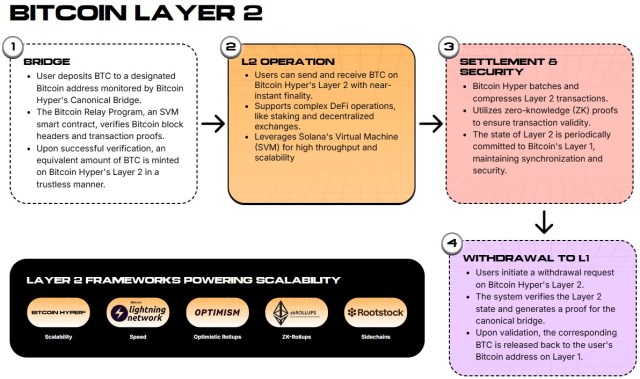
Transactions happen in real-time on the SVM layer, delivering the snappy, low-cost experience users expect, while security remains tied to Bitcoin.

For developers, this removes the friction of learning archaic scripting languages like Bitcoin Script. For users, it means interacting with Bitcoin DeFi without exorbitant fees or 10-minute waits. The protocol includes a Decentralized Canonical Bridge to keep value transfers trust-minimized.

That infrastructure is crucial for high-frequency trading and gaming dApps, stuff that was previously impossible on the Bitcoin network.

Explore the Bitcoin Hyper ecosystem.

Whale Accumulation Signals Confidence as Presale Clears $31M

The appetite for high-performance Bitcoin Layer 2s is real. Just look at the capital flows surrounding the Bitcoin Hyper presale. Official data shows the project has raised over $31.2M, a figure that underscores demand despite market chop. With tokens priced at $0.013675, the valuation offers an early-stage entry point compared to established competitors like Stacks.
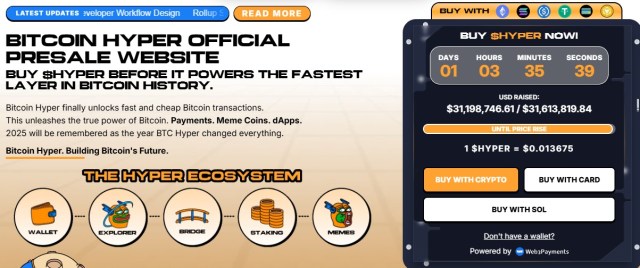
Sophisticated actors appear to be positioning themselves ahead of the Token Generation Event (TGE). The implication? Larger entities are betting the “SVM on Bitcoin” narrative will outperform standard EVM-based Layer 2s.

The tokenomics look designed for the long haul. Bitcoin Hyper offers immediate staking after TGE (though APY rates are still under wraps). There’s a catch: a 7-day vesting period for presale stakers. But that’s likely a feature, not a bug, intended to mitigate immediate sell pressure.

As Tether industrializes Bitcoin mining, projects like Bitcoin Hyper are industrializing Bitcoin utility, creating a dual engine for the network’s next growth phase.

Check out the Bitcoin Hyper presale.

Disclaimer: This article is for informational purposes only and does not constitute financial advice. Cryptocurrency investments, including presales and Layer 2 tokens, carry high risks. Always perform your own due diligence before investing.


Perguntas relacionadas

QWhat is the main focus of Tether's new initiative mentioned in the article?

ATether is expanding beyond stablecoin issuance by launching its proprietary Bitcoin mining operating system (MOS), focusing on optimizing energy efficiency and becoming a dominant force in Bitcoin infrastructure.

QHow does Bitcoin Hyper ($HYPER) aim to solve Bitcoin's scalability issue?

ABitcoin Hyper integrates the Solana Virtual Machine (SVM) as a Layer 2 execution environment, enabling high-speed, low-cost transactions while anchoring security to Bitcoin's Layer 1, thus addressing Bitcoin's limitations for DeFi applications.

QWhat technical advantage does Bitcoin Hyper offer to developers?

AIt allows developers to write smart contracts in Rust (the language used in Solana's ecosystem) instead of Bitcoin Script, reducing friction and enabling the creation of high-frequency trading and gaming dApps on Bitcoin.

QHow much capital has the Bitcoin Hyper presale raised, and what does it indicate?

AThe Bitcoin Hyper presale has raised over $31.2 million, indicating strong demand and confidence in the 'SVM on Bitcoin' narrative, with whale accumulation signaling institutional interest.

QWhat is one key feature of Bitcoin Hyper's tokenomics designed for long-term stability?

AThe tokenomics include immediate staking after the Token Generation Event (TGE) with a 7-day vesting period for presale stakers to mitigate immediate sell pressure and encourage long-term holding.

Leituras Relacionadas

The Verdict in Choi Tae-won's Divorce Case: Revealing the Inheritance Undercurrent Behind SK Hynix's Trillion-Won Empire

SK Group Chairman Chey Tae-won's high-profile divorce case, involving a record 1.38 trillion won settlement, has drawn attention to the succession plans for Korea's second-largest conglomerate, especially its crown jewel, SK hynix. Unlike traditional chaebol scripts centered on the eldest son, Chey's three children from his marriage to former President Roh Tae-woo's daughter, Roh Soh-yeong, are carving distinct, non-traditional paths. Eldest daughter Chey Yun-jung (b. 1989) is seen as the most evident successor. With a scientific and consulting background, she holds executive roles at SK bioscience and SK Inc.'s growth support department, focusing on future strategy and biopharma. Her marriage is to an AI infrastructure entrepreneur, not a traditional business alliance. Second daughter Chey Min-jung (b. 1991) took a unique route, voluntarily serving as a South Korean naval officer, including an anti-piracy deployment. She later worked on policy and strategy for SK hynix in Washington D.C. before co-founding an AI-driven healthcare startup. She married a former U.S. Marine Corps officer, connecting her to U.S. defense and policy circles—networks crucial for a global semiconductor giant. The only son, Chey In-geun (b. 1995), who studied physics like his father, worked briefly at SK E&S before joining McKinsey. Despite fitting the traditional "heir" profile as the eldest son, he remains silent and holds no public position or shares in SK, suggesting the old succession playbook is obsolete. As SK hynix's valuation soars, becoming a geopolitical asset in the AI era, the heirs' legitimacy is no longer automatic. They must prove themselves in fields like AI biotech, global policy, and strategic consulting. Their marriages also reflect new elite networks in tech and defense, not old political alliances. Their inheritance is the complex challenge of navigating a globalized, tech-driven world, not just a corporate throne.

marsbitHá 2h

The Verdict in Choi Tae-won's Divorce Case: Revealing the Inheritance Undercurrent Behind SK Hynix's Trillion-Won Empire

marsbitHá 2h

From OpenSea to OpenRouter: Is Alex Atallah Repeating His 'Exit at the Peak' Playbook?

From OpenSea to OpenRouter: Is Alex Atallah Repeating His "Exit at the Peak" Playbook? According to the Wall Street Journal, payments giant Stripe is in talks to acquire the AI model aggregation platform OpenRouter in a potential deal valuing the company near $100 billion. This would mark founder Alex Atallah's second creation of a company reaching a $100 billion valuation, following his co-founding of NFT marketplace OpenSea. OpenRouter, founded just over three years ago, has grown rapidly by acting as a unified gateway for developers to access over 400 AI models. It currently has about 10 million users and processes over 200 trillion tokens monthly. While the platform's annualized revenue is around $50 million, its valuation has skyrocketed from $1.3 billion in March 2026. The potential acquisition by Stripe, a company OpenRouter's founder once likened it to, represents a major expansion into AI infrastructure for the payments leader. This move echoes Atallah's previous timing with OpenSea, where he departed before the NFT market's significant downturn. For OpenRouter, selling now may be strategic. Despite its scale, its business model—charging a 5-5.5% fee on AI inference calls—faces pressure from competition, open-source models, and potential price wars among model providers, limiting its profitability narrative for an IPO. A key asset for potential acquirers like Stripe is OpenRouter's vast repository of real-world AI usage data, which offers unique insights into model performance and developer preferences that are difficult to replicate. Whether this potential deal signifies a new valuation benchmark for AI infrastructure or another market peak signal remains to be seen.

链捕手Há 2h

From OpenSea to OpenRouter: Is Alex Atallah Repeating His 'Exit at the Peak' Playbook?

链捕手Há 2h

Trading

Spot
活动图片




