Tether Expands South Korea Trademark Filings As Stablecoin Rules Take Shape

bitcoinistPublicado em 2026-05-21Última atualização em 2026-05-21

Resumo

Tether has significantly expanded its trademark filings in South Korea, applying for seven trademarks covering its company name, logo, and Tether Gold (XAUT) token, a strategic departure from its previous focus on just product names. This move, coinciding with South Korea's development of new stablecoin regulations, suggests Tether is preparing to establish a formal business presence in the country, potentially in response to upcoming rules that may require foreign issuers to set up local branches. South Korea's large and active crypto market makes it a crucial battleground. Rival stablecoin issuer Circle has already made inroads, filing trademarks last year and increasing USDC's market share. While Circle has advanced its local relationships through high-level meetings, Tether's strategy also targets the broader payments landscape. It sees an opportunity to serve South Korea's export economy by offering faster, cheaper cross-border transactions using stablecoins as payment tools, indicating a future competition that extends beyond trading into mainstream finance.

Tether’s latest move in South Korea goes beyond protecting a product name. The company behind the world’s largest stablecoin filed seven trademark applications with the Korea Intellectual Property Rights Information Service on May 19, covering not just its tokens but its company name, official logo, and gold-backed asset Tether Gold, known as XAUT.

A Shift In Strategy

That’s a departure from how Tether has approached South Korea before. Earlier filings were limited to stablecoin product names. Covering the broader brand signals something bigger — a possible push toward establishing an actual business presence in the country, not just protecting a label.

Timing is everything here. South Korea is in the middle of drafting new rules under the second phase of its Digital Asset Basic Act.

One proposal under discussion would require foreign stablecoin companies to set up a local branch before they can legally offer their tokens to South Korean users.
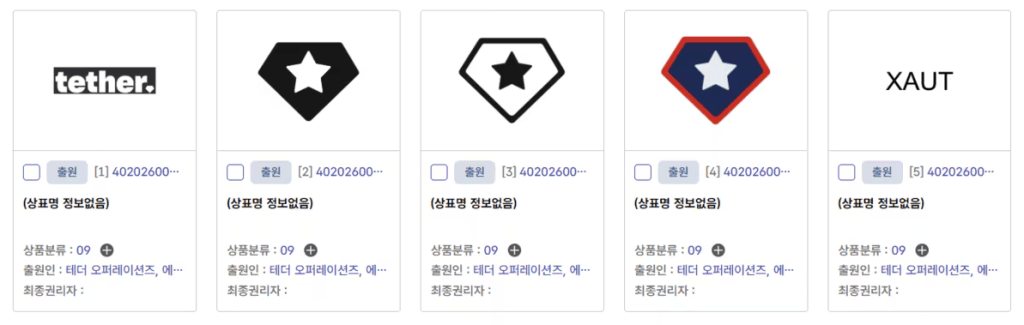
Trademarks for Tether's company name and logo filed with KIPRIS.

Tether’s trademark filings, some observers say, look like early preparation for that kind of requirement.

South Korea is not a small market. The country has one of the most active retail crypto trading populations in the world, which makes it a place no major stablecoin issuer can afford to ignore.

Circle Already Has A Head Start

Tether is not alone in moving on South Korea. Circle, the company behind USDC, filed 11 local trademarks last year and has already seen results — USDC’s market share in the country grew by 10%.

USDT market cap currently at $189 billion. Chart: TradingView

Tether now has seven active trademarks in South Korea, a number that has been growing as competition between the two stablecoin giants heats up.

Earlier this year, Circle CEO Jeremy Allaire traveled to South Korea and held meetings with major banks and crypto exchanges, exploring possible partnerships.

That kind of ground-level relationship building puts Circle ahead in terms of local ties, at least for now.

Seoul, South Korea. Image: Silversea

Payments, Not Just Trading

The trademark filings also fit into a wider ambition Tether has for South Korea. The country runs a significant export economy, and businesses there regularly move money across borders.

Tether sees that as an opening. Using blockchain-based payments instead of traditional bank transfers through systems like SWIFT could offer faster, cheaper transactions for South Korean exporters.

That vision — stablecoins as a real payment tool, not just a trading instrument — reflects where the bigger competition between Tether and Circle may eventually play out, well beyond crypto exchanges and into mainstream finance.

Featured image from Unsplash, chart from TradingView

Perguntas relacionadas

QWhat is the main strategic shift indicated by Tether's recent trademark filings in South Korea?

AThe main strategic shift indicated is that Tether is now filing to protect its broader brand, including its company name, logo, and Tether Gold, rather than just product names. This signals a possible push toward establishing a formal business presence in the country, potentially in response to upcoming regulations.

QWhat specific regulatory requirement might Tether be preparing for with these trademark filings?

ATether might be preparing for a proposed requirement under South Korea's new Digital Asset Basic Act rules that would mandate foreign stablecoin companies to set up a local branch before legally offering their tokens to South Korean users.

QHow is Circle's position in the South Korean market different from Tether's according to the article?

ACircle already has a head start in the South Korean market. It filed trademarks last year, saw USDC's market share grow by 10%, and its CEO has personally traveled to South Korea to build ground-level relationships with major banks and crypto exchanges, giving it stronger local ties for now.

QBeyond crypto trading, what other major use case does Tether see for stablecoins in South Korea?

ABeyond crypto trading, Tether sees stablecoins as a payment tool for international commerce. It aims to serve South Korea's significant export economy by offering faster and cheaper blockchain-based cross-border payments for businesses, as an alternative to traditional systems like SWIFT.

QWhat broader competition does the article suggest is developing between Tether and Circle?

AThe article suggests the broader competition is shifting beyond dominance on crypto exchanges and into mainstream finance, specifically in establishing stablecoins as practical tools for global payments and financial services.

Leituras Relacionadas

From 'Old Guys' to 'New Favorites': How AI Is Revaluing Old Infrastructure from Dell to Nokia?

From "Vintage Tech" to "New AI Darlings": How AI Revalues Old Infrastructure One year ago, tech giants like Dell, Nokia, Cisco, and Western Data were seen as slow-growth, low-valuation stories, far from the AI spotlight dominated by players like Nvidia. Now, these legacy tech stocks are gaining market attention, sparking debate on whether this is genuine industry revaluation or a temporary narrative. As AI moves from model parameters to real-world data centers, the market is recognizing companies with proven delivery and infrastructure capabilities. This shift marks a change in the AI investment thesis: from pure model and GPU focus to the complex systems engineering required for deployment. Companies like Dell, HPE, and Corning are being revalued not for being "sexy" AI innovators, but for their decades of accumulated expertise in supply chains, enterprise delivery, and infrastructure—assets that have become critical in the AI buildout phase. The revaluation is unfolding across three key infrastructure lines: 1. **Servers & System Integration:** Dell and HPE are emerging as crucial system integrators or "general contractors" for AI data centers, translating GPU orders into complete, deployable server racks integrated with power, cooling, and networking. 2. **Networking & Connectivity:** AI's scale demands robust high-speed connections. Corning (fiber optics), Nokia (AI-RAN, 6G), and Cisco (data center switches) are gaining importance for enabling efficient data transfer within and between AI clusters. 3. **Storage:** Beyond high-speed memory (HBM/DRAM), the AI data explosion is driving demand for high-capacity hard drives (HDDs) from companies like Western Digital and Seagate to handle training data, logs, and cold storage cost-effectively. For this revaluation to be substantive and not just a narrative, three criteria are key: 1) Concrete AI-related order and revenue growth (e.g., Dell's AI server sales), 2) Upward revisions to company financial guidance, and 3) Sustainable improvements in profit quality, not just top-line revenue spikes. In essence, AI's transition to a real construction phase is re-pricing "old assets" against "new demand." The opportunity, however, is selective. Only those legacy firms that are demonstrably integrated into the capital expenditure chains of data center and enterprise AI deployment are likely to experience a true "logic re-rating" rather than just a temporary valuation bounce.

marsbitHá 3m

From 'Old Guys' to 'New Favorites': How AI Is Revaluing Old Infrastructure from Dell to Nokia?

marsbitHá 3m

The Merger of Codex and ChatGPT Marks the Beginning of a Major Reshuffle in Programming Tools

OpenAI is shifting its strategic focus from ChatGPT to Codex, merging them along with the browser tool Atlas into a unified desktop super-app. This move signals an internal belief that Codex, originally a programming tool, represents the next evolution of AI more than conversational models like ChatGPT. Over the past year, Codex's weekly active users have surged past 5 million. The key distinction is that while ChatGPT answers questions, Codex executes tasks. Enterprises increasingly value this ability to get work done over simply receiving advice. Consequently, Codex is attracting professionals beyond developers, including analysts, bankers, marketers, and product managers. OpenAI's reorganization and increased investment in Codex stem from recognizing that the future of AI competition lies in execution capabilities, not just conversation. The company is launching role-specific plugins (e.g., for data analysis, sales, design) to transform Codex into a broad knowledge work platform that automates and redefines white-collar workflows. Beyond being a tool, Codex reflects OpenAI's ambition to redefine software. New features like "Sites"—which generates interactive websites from documents—and collaborative "Annotations" aim to create a paradigm where the AI understands the goal and handles the tools and steps, functioning more like a digital colleague than traditional software. The ultimate goal is a unified experience where the user cares only about the completed task.

marsbitHá 13m

The Merger of Codex and ChatGPT Marks the Beginning of a Major Reshuffle in Programming Tools

marsbitHá 13m

Interpreting Investment Opportunities in the Age of Great Navigation, Invesco Great Wall Fund Releases '2026 Report on Chinese Enterprises Going Global'

Invesco Great Wall Fund has released its "2026 China Corporate Globalization Report," titled "The 'Great Navigation Era' of Chinese Enterprises." The report analyzes the new trends and investment opportunities as Chinese companies expand globally, moving from simple product exports to comprehensive overseas operations involving services, branding, and local production. Driven by factors like trade friction, the pursuit of higher profit margins abroad, and policy support, globalization is becoming essential for Chinese companies. The report outlines an evolution: from early product export ("Globalization 1.0") to the current "Globalization 2.0," characterized by overseas capacity, capital goods investment, consumer brand expansion, and service exports. Chinese firms' competitive advantages are highlighted, including a vast engineer talent pool, low-cost and robust infrastructure, and complete industrial clusters. Specific sectors with significant出海 potential are identified: * **Capital Goods** (e.g., engineering machinery, power equipment): Benefiting from global demand, especially in Belt & Road markets and the AI-driven power grid upgrade cycle. * **Consumer Brands**: Transitioning from cost to brand advantage, leveraging供应链 efficiency. * **Technology & Innovation**: Including AI applications, optical modules within global tech supply chains, and new energy vehicles focusing on local production. * **Pharmaceuticals**: Chinese biotech firms are becoming preferred partners for global pharma, with potential for breakthrough drugs in areas like oncology and weight loss. The report concludes that corporate globalization represents a sustained, core theme for China's capital markets, though companies must navigate challenges like geopolitics and localization.

marsbitHá 25m

Interpreting Investment Opportunities in the Age of Great Navigation, Invesco Great Wall Fund Releases '2026 Report on Chinese Enterprises Going Global'

marsbitHá 25m

GitHub, Transfixed by AI

On the night of February 9th, GitHub suffered a major outage caused by a simple configuration change—reducing a cache refresh interval from 12 to 2 hours—that triggered a cascade of failures. This was not an isolated event, but part of a broader pattern. In early 2026, GitHub experienced at least 8 major incidents, failing to meet its promised 99.9% availability. These outages stemmed from structural issues: explosive growth in load, tight service coupling, and insufficient protection against abnormal traffic. This unprecedented load is driven by AI Agents. In 2025, GitHub handled ~1 billion commits. By 2026, weekly commits reached 275 million, projecting to ~14 billion for the year—a 14x increase. AI tools like Claude Code now contribute 4.5% of all public repository commits, with weekly submissions surging 25x in just three months. AI-generated pull requests jumped from 4 million to 17 million per month in half a year. Unlike human developers, AI Agents work continuously, generating commits at a scale that overwhelms infrastructure designed for human rhythms. The surge also shattered GitHub's business model. Copilot's flat-rate pricing, based on assisting human developers, became unsustainable as Agentic AI sessions consumed resources worth hundreds of dollars for a few dollars in fees. In response, GitHub imposed usage limits and, by June 1st, shifted to a pay-per-use "AI Credits" system. Facing this new reality, GitHub realized a 10x scaling plan was insufficient. It announced a need to *redesign* its architecture for 30x current scale—decoupling services, adding fault isolation, and improving change management to prevent cascading failures. Other platforms like Stripe and AWS are facing similar challenges with AI Agents. Fundamentally, GitHub is transitioning from a human collaboration platform to an "exhaust pipe" for automated AI workflows. Its detailed post-mortem reports aim to maintain trust during this turbulent rebuild. The February outage was not just a technical glitch, but a signal of the software industry's entry into a new, AI-driven era.

marsbitHá 1h

GitHub, Transfixed by AI

marsbitHá 1h

Trading

Spot
Futuros
活动图片





