Teen Accused Of $13M Crypto Scam That Funded Miami Luxury

bitcoinistPublicado em 2026-06-12Última atualização em 2026-06-12

Resumo

A Canadian teenager, Trenton Richard David Johnston, is accused of running a cryptocurrency fraud scheme from the Miami area, allegedly causing over $13 million in losses. The 19-year-old and unnamed co-conspirators are charged with posing as support representatives from a major search engine and crypto companies to gain access to victims' digital accounts and crypto wallets. He was indicted on charges of conspiracy to commit wire fraud and money laundering. Prosecutors allege that Johnston, along with co-defendant Brandon Michael Tardibone, laundered more than $1 million of the illicit funds to finance luxury vehicles, high-end jewelry, and an extravagant nightlife. Tardibone is additionally charged with harboring Johnston, who had overstayed his visa. Both defendants face up to 20 years in prison if convicted. The case is being prosecuted by the U.S. Attorney's Office for the Southern District of Florida.

A Canadian teenager accused of running a multimillion-dollar crypto fraud operation from the Miami area has become the latest young defendant tied to a high-value social-engineering theft case in the US Prosecutors say the scheme caused more than $13 million in losses and helped finance luxury vehicles, jewelry and nightlife spending.

The case centers on Trenton Richard David Johnston, a Canadian national who was 19 when federal prosecutors in the Southern District of Florida announced the indictment on May 11. According to the US Attorney’s Office, Johnston had overstayed his visa and remained in the US unlawfully while allegedly operating a fraud scheme that targeted victims’ digital accounts and crypto wallets.

Federal prosecutors said Johnston and unnamed co-conspirators posed as support representatives from a major search engine and crypto-related companies. The alleged objective was familiar but effective: convince victims that their accounts were at risk or already compromised, obtain access to the accounts, and move the assets before the victims could respond.

The DOJ framed the core allegation bluntly, saying Johnston and others “allegedly impersonated support representatives from a popular search engine and cryptocurrency-related companies.” The agency also cautioned: “An indictment/complaint is merely an allegation. All defendants are presumed innocent until proven guilty beyond a reasonable doubt in a court of law.”

Johnston was charged with conspiracy to commit wire fraud and conspiracy to commit money laundering. A later docket entry listed a plea agreement as to Johnston filed on June 9, indicating the case has already moved beyond the initial indictment stage for at least one defendant.

Crypto Scam: Luxury Spending Becomes Part Of The Case

The alleged theft was not described as a simple wallet-drain operation. Prosecutors also accused Johnston and Brandon Michael Tardibone, 28, of Miami, of laundering proceeds through financial transactions designed to conceal the nature and source of the funds.

According to the DOJ, Johnston and Tardibone allegedly used more than $1 million in illicit proceeds to lease luxury vehicles, buy high-end jewelry and finance what prosecutors called an “extravagant nightlife and entertainment lifestyle.” That spending trail is central to the government’s theory: the alleged crypto theft did not just move across wallets, but into visible luxury assets and services.

Tardibone was separately accused of knowingly harboring Johnston while Johnston was unlawfully present in the US Prosecutors said Tardibone provided lodging at a luxury Miami-area residence in an effort to help Johnston evade immigration authorities. He was charged with conspiracy to commit money laundering and harboring an alien in the United States.

The case is being investigated by HSI Miami, with assistance from the Federal Deposit Insurance Corporation Office of Inspector General, IRS Criminal Investigation, US Customs and Border Protection, and the Golden Beach Police Department. Assistant US Attorneys Jackson K. Dering V and Robert F. Moore are prosecuting the matter.

If convicted on the original charges, Johnston faced up to 20 years in prison on the wire fraud conspiracy and money laundering conspiracy counts. Tardibone also faces up to 20 years on the money laundering conspiracy charge and up to 10 years on the harboring charge.

At press time, the total crypto market cap stood at $2.14 trillion.
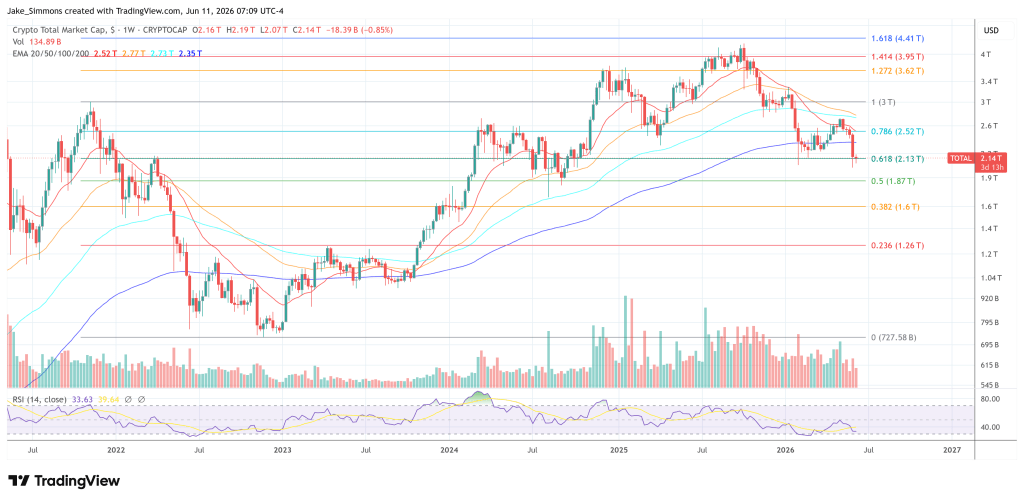
Total crypto market cap must stay above the 0.618 Fib, 1-month chart | Source: TOTAL on TradingView.com

Perguntas relacionadas

QWhat is the core allegation against Trenton Richard David Johnston according to the US Department of Justice?

AAccording to the DOJ, Johnston and others allegedly impersonated support representatives from a popular search engine and cryptocurrency-related companies to convince victims their accounts were compromised, gain access, and steal assets.

QHow did the defendants allegedly use the proceeds from the crypto scam?

AThey allegedly used over $1 million in illicit proceeds to lease luxury vehicles, buy high-end jewelry, and finance an extravagant nightlife and entertainment lifestyle.

QWhat charges was Brandon Michael Tardibone facing in connection to this case?

ABrandon Michael Tardibone was charged with conspiracy to commit money laundering and harboring an alien (Johnston) in the United States.

QWhat was the status of Johnston's legal case as indicated by a docket entry mentioned in the article?

AA docket entry listed a plea agreement for Johnston filed on June 9, indicating the case had moved beyond the initial indictment stage for at least one defendant.

QWhat agencies were involved in investigating this crypto fraud case?

AThe case was investigated by HSI Miami, with assistance from the Federal Deposit Insurance Corporation Office of Inspector General, IRS Criminal Investigation, U.S. Customs and Border Protection, and the Golden Beach Police Department.

Leituras Relacionadas

Investors Are Now Hunting for AI Projects on Bilibili and Xiaohongshu

Investors Turn to Bilibili and Xiaohongshu to Source AI Projects The AI hardware boom is in full swing in 2025, with a surge in smart wearables like AI glasses, rings, toys, and companion robots. This frenzy has investors scrambling, not just sifting through business plans, but actively hunting for promising "under-the-radar" projects on youth and tech-enthusiast content platforms like Bilibili and Xiaohongshu. The logic is straightforward: for consumer-facing AI hardware, genuine user demand and potential pitfalls are often revealed earlier in public discussions, comments, and critiques on these communities than in formal pitches. As one industry insider notes, these products must ultimately be tested and understood by real people. This shift highlights a crucial challenge in the sector: user education. The success of AI hardware depends on moving beyond mere efficiency gains to fulfilling higher-order needs like "unleashing personal creativity." Products must convince users they are natural, unobtrusive additions to daily life. Early hype, as seen with devices like the Rabbit R1, often fades if the product fails to clearly solve real-world problems, leading to high return rates and market rejection. The market is now entering a shakeout phase. 2026 is seen as a year of commercial validation. Some projects have already stalled or been canceled due to market resistance, lack of differentiation, or financial woes. However, the long-term opportunity remains vast, with forecasts predicting a multi-trillion dollar global AI hardware market by 2030. The competition is intensifying. With giants like OpenAI and Meta preparing their own hardware, and Chinese companies launching diverse AI-powered products, the battle for user attention, product excellence, and market understanding is just beginning. The core principle endures: in the AI era, it remains a user-sovereign market.

marsbitHá 9m

Investors Are Now Hunting for AI Projects on Bilibili and Xiaohongshu

marsbitHá 9m

"Agents' Last Exam", Claude Fable 5 Actually Loses to GPT 5.5

Surprisingly, in the newly released "Agents' Last Exam" (ALE) benchmark from UC Berkeley, GPT-5.5 has outperformed the recently launched and highly-regarded Claude Fable 5. ALE tests AI agents on their ability to perform real-world tasks across 55 professional domains—such as 3D modeling in Siemens NX, creating game scenes in Unreal Engine, and visual effects work in Adobe After Effects—by granting them full GUI and command-line access. In the core task completion rate ranking, GPT-5.5 configurations secured the top two spots (24.0% and 23.0%), while Claude Fable 5 with Claude Code came in third (22.0%). Notably, the highest pass rate was only 24%, and the most difficult "Last-Exam" tier saw most top models, including GPT-5.5 and Fable 5, scoring zero. The benchmark also revealed significant cost and efficiency gaps: Fable 5 spent over four times more money than GPT-5.5's most expensive configuration for a slightly lower score, and was much slower. ALE differs from previous knowledge-based benchmarks by evaluating practical "ability to do" rather than static knowledge retrieval. Its tasks are derived from real expert projects, automatically scored, and designed to prevent cheating through a rotating pool of private challenges. The results suggest that high performance on traditional benchmarks does not necessarily translate to proficiency in complex, open-ended real-world work. The study also notes that agents often fail by prematurely declaring tasks complete without proper verification, and that no single model excels uniformly across all diverse domains.

marsbitHá 15m

"Agents' Last Exam", Claude Fable 5 Actually Loses to GPT 5.5

marsbitHá 15m

Trading

Spot
Futuros
活动图片





