Technical Wave Patterns Turn Bullish for Ethereum as Price Reaction Intensifies Before Fed Decision

bitcoinistPublicado em 2025-12-11Última atualização em 2025-12-11

Resumo

Ethereum (ETH) is showing bullish technical signals, breaking above key resistance near $3,300 as market sentiment strengthens ahead of the Federal Reserve's expected 25-basis-point rate cut. The ETH/BTC ratio has improved, and spot Ethereum ETFs saw significant inflows. Institutional interest is growing, highlighted by BlackRock's filing for an Ethereum Staking Trust ETF. Supply is tightening as exchange reserves hit multi-year lows. Technical analysis suggests a potential move toward $3,600, with some analysts targeting $4,200–$4,300 if the bullish trend continues. The Fed's decision remains a critical factor for momentum.

Ethereum (ETH) is under a pivotal week as traders weigh a mix of macroeconomic expectations, institutional developments, and strengthening technical signals.

Related Reading: Midnight Goes Live As Cardano Founder Targets A $10 Billion Ecosystem

With the Federal Reserve set to deliver its next rate decision, market participants are watching how Ethereum’s recent momentum interacts with a broader risk-on environment.

The second largest cap cryptocurrency has already staged a notable rebound, breaking key resistance levels and drawing renewed interest from both retail and institutional investors.
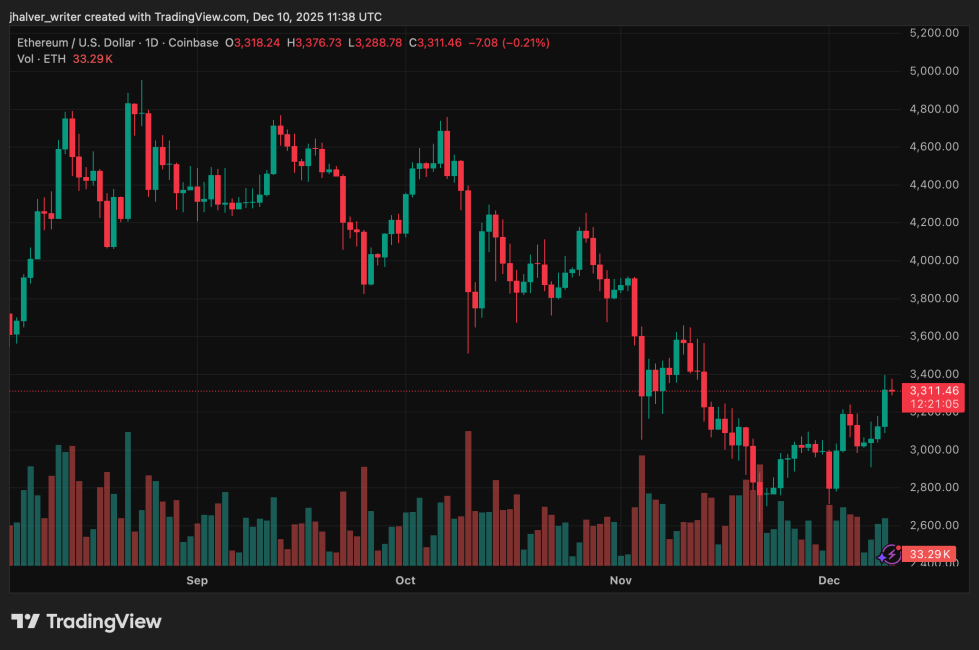
ETH's price sees some gains on low timeframes as recorded on the daily chart. Source: ETHUSD on Tradingview

Fed Expectations Drive Ethereum Position Repricing

Ethereum surged past $3,300 and briefly approached $3,400 after recording a 6% jump over the past 24 hours.

The rally comes as traders price in a high probability, close to 90%, that the Federal Reserve will announce a 25-basis-point rate cut. Lower interest rates tend to improve liquidity conditions, a factor that has historically supported digital assets.

Bitcoin’s recovery above $94,000 added further confidence to the market, though Ethereum outperformed on a relative basis. The ETH/BTC ratio reached its strongest point since late October, indicating a shift of capital from Bitcoin to Ethereum.

Spot Ethereum ETFs also saw $177.7 million in inflows on December 9, surpassing Bitcoin’s inflows on the same day.

Institutional Moves Add to Bullish Sentiment

One major catalyst behind this shift has been BlackRock’s filing for the iShares Ethereum Staking Trust ETF. The fund would offer exposure not only to ETH’s price but also to staking rewards, expanding access to yield-bearing strategies.

Analysts note that such products could increase liquidity inflows into Ethereum, especially as institutional portfolios diversify beyond Bitcoin. This filing arrives at a time when the amount of ETH held on centralized exchanges has fallen to its lowest level since 2015, roughly 8.7% of the total supply.

Large buyers, including Bitmine Immersion, have accumulated billions of dollars’ worth of ETH in recent months. Combined, these developments indicate a tightening of supply conditions.

Technical Breakouts Reinforce the Trend

Chart analysts highlight that Ethereum has broken above a downward trendline that previously capped rallies for nearly two months.

Momentum indicators, including MACD and RSI, show increasing buyer strength despite approaching overbought territory. Ethereum’s break above the $3,300 zone has shifted focus toward the next resistance level at $3,500, with wave-pattern analysis suggesting potential upside toward $3,600.

Related Reading: Bitwise Rolls Out New ETF For Broad Crypto Exposure, Including BTC, XRP, And ADA

Analysts such as Captain Faibik argue that a confirmed breakout could support a rally of up to 30%, targeting the $4,200–$4,300 region if bullish conditions persist. However, the Fed’s upcoming decision remains a key variable in determining whether momentum continues or cools.

Cover image from ChatGPT, ETHUSD chart from Tradingview

Leituras Relacionadas

You Should Still Believe in Crypto

The article "You Should Still Believe in Crypto" addresses the growing sense of burnout and disillusionment within the cryptocurrency industry, sparked by a post from Aevo co-founder Ken Chan titled "I Wasted 8 Years of My Life in Crypto." It acknowledges the collective fatigue many feel due to the industry's fast-paced, often speculative nature, where narratives shift rapidly, and projects frequently fail or disappear. However, the piece argues that the core value of crypto remains vital. It references Nic Carter’s response, highlighting crypto’s potential to create a more robust monetary system, encode business logic via smart contracts, establish true digital property rights, improve capital market efficiency, and enhance global financial inclusion. The article revisits Bitcoin’s origin as a peer-to-peer electronic cash system born from the 2008 financial crisis, emphasizing its purpose as a trustless, decentralized alternative to traditional finance. It points to real-world adoption in high-inflation countries like Argentina and Turkey, where Bitcoin and stablecoins serve as essential financial tools, and notes increasing institutional embrace from firms like BlackRock and Fidelity. Finally, it draws a parallel to the early internet era, arguing that despite chaos, failed projects, and speculative excess, the crypto industry—like the internet—is laying foundational groundwork for future technological and financial evolution. The conclusion is a call to persevere, recognizing that the collective efforts of developers, researchers, and builders worldwide are contributing to a transformative global shift.

marsbitHá 17m

You Should Still Believe in Crypto

marsbitHá 17m

Oracle Plunges 40%, Will Excessive AI Infrastructure Overbuild Drag Down Giants?

Oracle's stock has plummeted 40% from its September peak, despite securing over $500 billion in AI infrastructure orders, signaling that massive backlogs alone no longer assure investor confidence. Similarly, Broadcom, with a $73 billion AI order backlog, and CoreWeave, which recently landed $36 billion in deals with OpenAI and Meta, have also faced stock declines. The market is growing skeptical of the AI infrastructure boom, concerned not only about suppliers' ability to fund and deliver these projects but also about the financial health and commitment of their major clients—primarily tech giants like Meta, Alphabet, Microsoft, Amazon, Apple, and Nvidia, alongside AI startups like OpenAI and Anthropic. While giants have robust finances, they are increasingly relying on debt to fuel AI capex, with soaring expenditures on data centers straining cash reserves and free cash flow. For instance, Microsoft, Alphabet, and Amazon are projected to collectively invest $1 trillion over four years. However, AI still contributes minimally to their overall revenue, raising questions about the sustainability of using profits from core businesses to fund speculative AI expansions. Execution challenges—such as power grid limitations, cooling issues, and community opposition—further complicate timely deployment. The critical uncertainty remains: if exponential AI demand fails to materialize and monetize quickly enough, these vast investments could lead to underutilized infrastructure, massive losses, and a fundamental weakening of these tech titans. The race between AI infrastructure build-out and actual market payoff will determine whether this bet becomes a triumph or a disastrous overreach.

marsbitHá 1h

Oracle Plunges 40%, Will Excessive AI Infrastructure Overbuild Drag Down Giants?

marsbitHá 1h

Trading

Spot
Futuros
活动图片