Tariff Threat Shocks Market: Trump's Post Triggers Bitcoin Safe-Haven Sell-off

比推Publicado em 2026-01-19Última atualização em 2026-01-19

Resumo

Cryptocurrency markets experienced a sharp sell-off on the morning of January 19, with Bitcoin dropping from $95,531 to a low of $91,910. Ethereum and Solana also saw significant declines, along with several altcoins falling over 10%. The sell-off resulted in $830 million in liquidations over 12 hours, predominantly long positions. The downturn was triggered by former U.S. President Donald Trump’s announcement on Truth Social that the U.S. would impose tariffs—starting at 10% on February 1 and rising to 25% by June—on imports from eight European countries, including Denmark, Germany, and the UK. The move is tied to Trump’s demand for a “complete and total purchase of Greenland,” citing unspecified security concerns. European leaders strongly opposed the tariffs, warning of strained transatlantic relations and potential benefits to geopolitical rivals like China and Russia. Meanwhile, traditional safe-haven assets like gold and silver surged to record highs amid the geopolitical tension and market uncertainty. With a 96% probability that the Federal Reserve will hold interest rates steady, risk assets faced additional pressure. Market analysts suggested that investors take profits and await clearer signals, though some remain optimistic about Bitcoin’s long-term potential, citing macroeconomic trends and increasing demand.

Author: Ma He, Foresight News

Original Title: Trump Stirs Trouble Again: An Island Causes Bitcoin to Plunge by $3,000


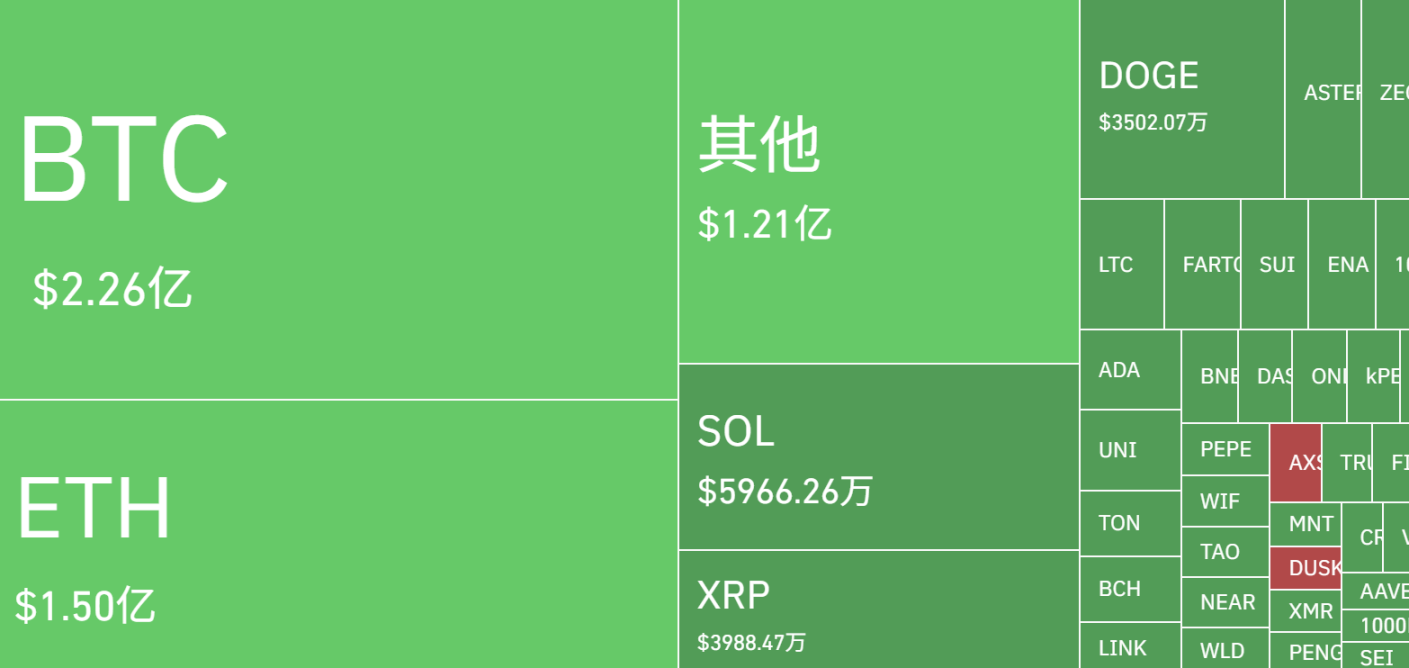
At around 7:00 AM on January 19, the cryptocurrency market experienced a sudden flash crash. The price of BTC plummeted sharply in a short period, dropping from $95,531 to a low of $91,910. ETH fell from $3,350 to a low of $3,177, and SOL dropped from $143 to a low of $130. Some altcoins like SUI, XPL, and ASTER saw declines of over 10% in 24-hour period.

According to Coinglass data, over the past 12 hours, $830 million was liquidated across the network, with long positions accounting for $764 million of that. In the past 24 hours, the largest single liquidation order occurred on Hyperliquid for a BTC-USDT perpetual contract worth $25.8337 million.
Meanwhile, traditional safe-haven assets like gold and silver bucked the trend and surged to record highs. Spot gold broke through the $4,690 per ounce mark,刷新历史高点, with a daily increase of over 2%. Spot silver broke through the $94 per ounce mark, hitting a record high, with a daily gain of over 4%.

U.S. stock markets are closed today. The U.S. Dollar Index fell 0.26% to 99.14. U.S. stock futures opened lower, with S&P 500 futures down 0.71% and Nasdaq futures down as much as 1.1% at one point. U.S. 10-year Treasury futures rose 5 ticks, and 30-year Treasury futures also rose 5 ticks.

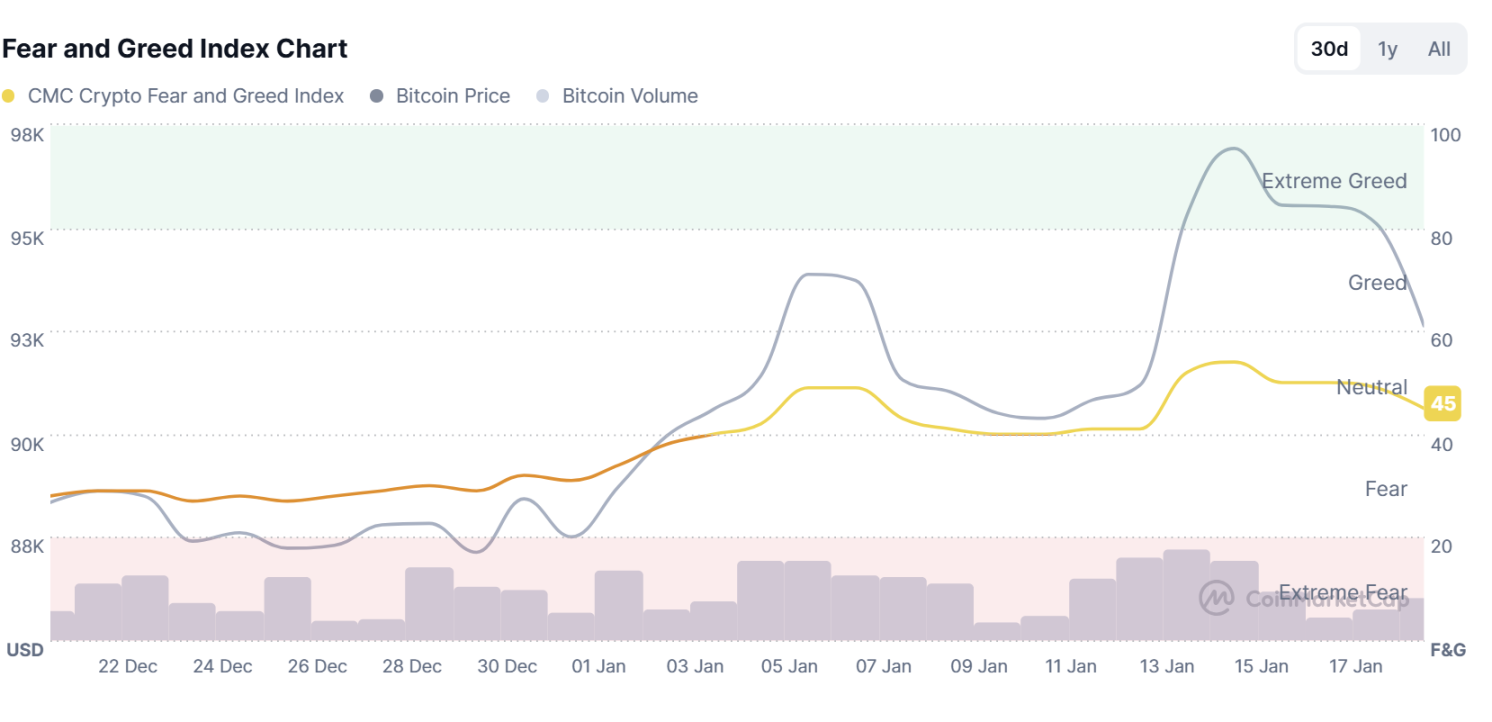
The Crypto Fear & Greed Index has currently retreated to 45.
This event is not isolated but the result of intertwined macroeconomic factors and geopolitical tensions.

Trump Wields Tariff Stick Again, Imposing Tariffs on 8 European Countries Starting February 1st

Last year, the trigger for the crypto market's "1011暴跌" (October 11th crash) was Trump wielding tariff threats against China. Now, this scene is repeating itself.

On January 18, Trump posted on Truth Social, stating that due to the Greenland issue, starting February 1st of this year, all goods exported to the U.S. from Denmark, Norway, Sweden, France, Germany, the UK, the Netherlands, and Finland will be subject to an additional 10% tariff. By June 1st of this year, the tariff will increase to 25%. These tariffs are to be paid continuously until an agreement on the "comprehensive and thorough purchase of Greenland" is reached.

In his post, Trump stated, "These countries—Denmark, Norway, Sweden, France, Germany, the UK, the Netherlands, and Finland—have all gone to Greenland for unknown purposes. This poses a very dangerous situation for the safety, security, and survival of our planet. These countries are playing an extremely dangerous game, and the level of risk they bring is intolerable and unsustainable. Therefore, to protect global peace and security, strong measures must be taken to bring this potential dangerous situation to a swift and indisputable end."

Furthermore, according to CNBC, after Trump issued tariff threats against European allies over the "Greenland issue," several European leaders responded强硬ly, emphasizing that Greenland's sovereignty is non-negotiable and warning that this move would further撕裂 transatlantic relations.

European Commission President Ursula von der Leyen and European Council President António Costa stated that pressuring allies with tariffs would damage EU-US relations and could trigger a "dangerous vicious cycle"; EU High Representative for Foreign Affairs and Security Policy Kaja Kallas said that tariffs would only harm shared prosperity, divert Europe's priorities on Ukraine, and allow rivals like Russia and China to "reap the benefits." Additionally, Spanish Prime Minister Pedro Sánchez warned that more激进 U.S. actions on Greenland would have a major impact on NATO. EU ambassadors from 27 countries plan to hold an emergency meeting to coordinate their response.

That day, according to Bloomberg, Senate Democrats plan to introduce legislation to阻止 Trump from imposing tariffs on European countries that oppose the U.S. annexation of Greenland. Previously, Senate Minority Leader Chuck Schumer criticized the move for harming the U.S. economy and relations with allies.

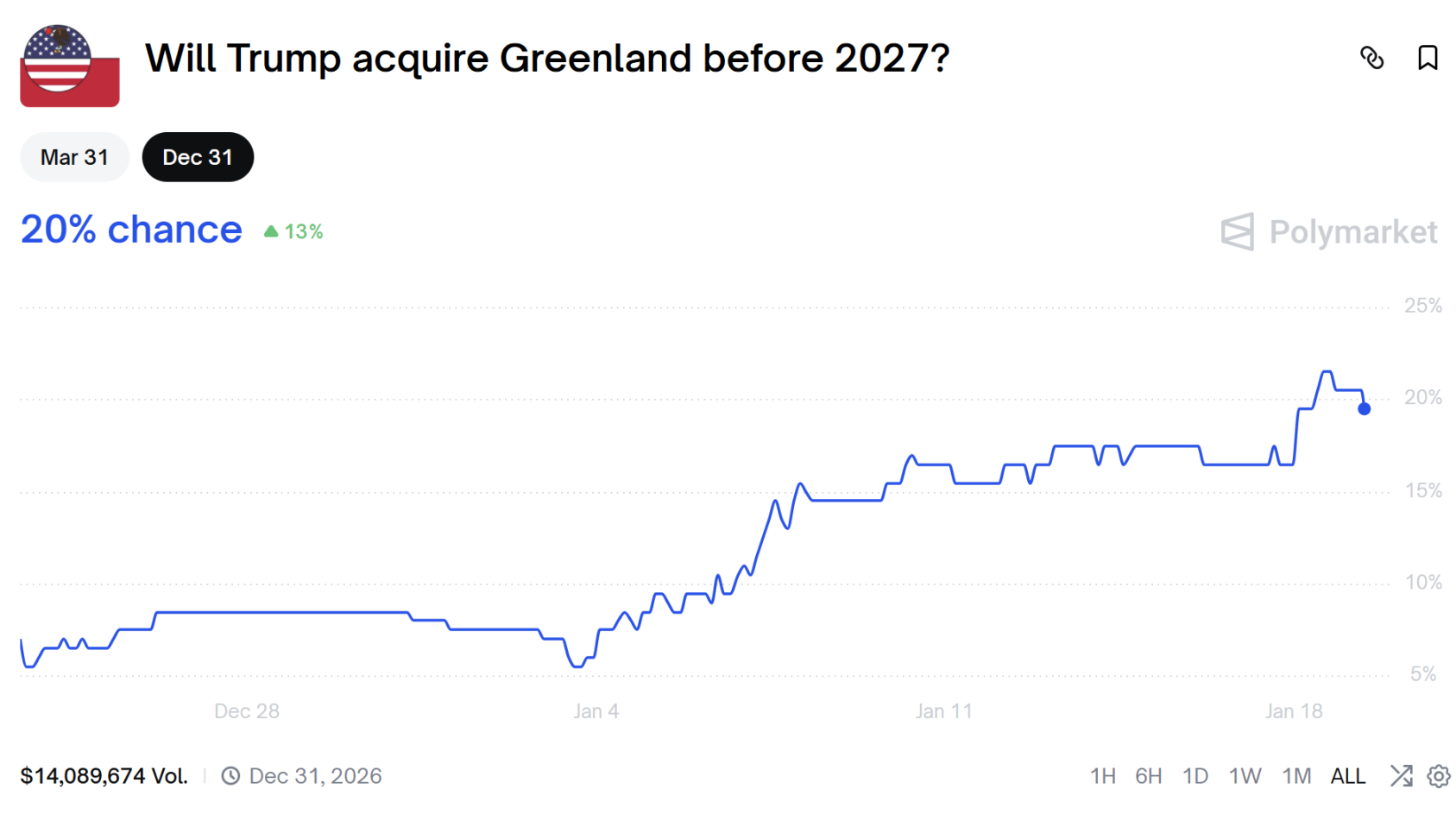
Latest data from Polymarket shows the market is betting a 20% probability that Trump will acquire Greenland by 2027.

Tariffs and geopolitical concerns have caused investors to turn to gold and silver for safety, leading to an outflow of funds from crypto.

Additionally, the probability of the Federal Reserve holding rates steady this January is extremely high. According to Polymarket data, the market's bet on no rate cut has now risen to 96%, putting pressure on risk assets.

On the evening of January 18, crypto trading indicator analysis platform CoinKarma posted, stating, "BTC rose to nearly $98,000 this week, but when it reached that price level, the market saw the most significant selling pressure in recent weeks, causing a slight pullback. However, the overall liquidity between buyers and sellers has not shown a significant imbalance and remains relatively balanced. Other key market indicators have not yet given clear signals. Based on the current situation, long position holders who entered at the relatively low points at the beginning of the year may consider taking profits, either fully or partially closing their positions, and waiting for clearer signals before re-entering the market."

Seasoned crypto investor Dan Tapiero stated: "If investing $10,000 in crypto assets in 2026, I think you can directly allocate funds to Bitcoin, Ethereum, and Solana. As for the specific allocation, it depends on your preference."

Dan Tapiero believes that the biggest opportunities in the cryptocurrency space in 2026 lie in infrastructure and the adoption of stablecoins. Tapiero stated that he expects Bitcoin to rise to $180,000 in this cycle, citing the combined effect of growing demand and a shift in global monetary policy. Falling interest rates and massive government investment in AI infrastructure will bring strong positive factors. This global push is leading to the devaluation of all fiat currencies, including the U.S. dollar. This is very favorable for Bitcoin.


Twitter:https://twitter.com/BitpushNewsCN

Bitpush TG Discussion Group:https://t.me/BitPushCommunity

Bitpush TG Subscription: https://t.me/bitpush

Original article link:https://www.bitpush.news/articles/7604166

Perguntas relacionadas

QWhat was the immediate impact of Trump's tariff threat on cryptocurrency markets?

ACryptocurrency markets experienced a sharp flash crash, with Bitcoin dropping from $95,531 to a low of $91,910, Ethereum falling from $3,350 to $3,177, and Solana declining from $143 to $130 within a short period.

QWhich traditional safe-haven assets saw price increases following the geopolitical tension?

ATraditional safe-haven assets like gold and silver surged to record highs, with spot gold rising over 2% to above $4,690 per ounce and spot silver increasing over 4% to above $94 per ounce.

QWhich European countries did Trump threaten with tariffs starting February 1st, and why?

ATrump threatened to impose tariffs on Denmark, Norway, Sweden, France, Germany, the UK, the Netherlands, and Finland, citing their activities in Greenland as a 'very dangerous situation' for global security and demanding a agreement for the 'complete and total purchase of Greenland'.

QHow did European leaders respond to Trump's tariff threat over Greenland?

AEuropean leaders strongly opposed the move, emphasizing Greenland's sovereignty is non-negotiable. EU officials warned it would damage transatlantic relations and could create a 'vicious cycle,' while some leaders cautioned it would benefit rivals like Russia and China and impact NATO.

QWhat was the market's probability assessment of Trump acquiring Greenland by 2027 according to Polymarket?

APolymarket data showed a 20% probability that Trump would acquire Greenland by 2027.

Leituras Relacionadas

Apple's Desired On-Device AI Sees a Dark Horse Emerge: The First Cognitive Model is Born, 4B Matches GPT-5.4

A Chinese company, Tomorrow's Journey (Nextie), has introduced what it is calling the industry's first "cognitive model" for edge devices. Named New Journey Alpha, this 4-billion-parameter model reportedly matches the performance of trillion-parameter giants like GPT-5.4 in group intelligence tasks such as debate and collective decision-making. The development follows Andrej Karpathy's vision of stripping vast factual knowledge from large language models to retain only a smaller "cognitive core" capable of reasoning, planning, and knowing its own limits. This approach directly addresses the soaring computational costs and token expenses hindering AI's widespread deployment, as highlighted by incidents like Amazon shutting down an internal AI tool due to prohibitive costs. Trained via reinforcement learning on a corpus of academic papers from 1800-2020 to enhance generalization, the model enables three key advancements: 1) Improved decision quality in multi-agent systems, 2) Drastically reduced compute costs, allowing for cost-effective cloud or on-device (e.g., MacBook) deployment, and 3) The feasibility of "proactive" AI agents that act autonomously without user prompts, unlocking new commercial possibilities beyond today's reactive models. Built by the former Microsoft Xiaoice team—known for creating a 3.6B model that outperformed a 65B Llama model—the company is now focusing on the multi-agent systems sector, a field gaining significant investor interest. The model's economic impact is profound; by achieving high-level performance with minimal parameters, it fundamentally alters the cost structure of AI services, challenging the prevailing model of ever-larger parameter counts.

marsbitHá 1h

Apple's Desired On-Device AI Sees a Dark Horse Emerge: The First Cognitive Model is Born, 4B Matches GPT-5.4

marsbitHá 1h

OpenAI's 'Blueprint for the Future': Making AI Beneficial for Every Person on the Planet

A new transformative technology emerges every few generations. OpenAI draws a parallel with the advent of electricity in the 1920s, which initially brought convenience but ultimately enabled unprecedented progress in medicine, engineering, and living standards by empowering people to create new possibilities. AI is poised to recreate this phenomenon. Its true significance lies not in the technology itself, but in what people can achieve with it—from understanding a medical bill or starting a business to aiding scientific discovery. OpenAI believes AI should be universally accessible, allowing everyone to use it according to their own needs. This future, however, is not guaranteed. While transformative tech can centralize power, OpenAI's philosophy is that AI must serve humanity, augmenting human capabilities and broadly distributing its benefits. The company's first commitment is to build AI for human service, aiming to empower the many rather than concentrate power in a few. Safety, alignment with human intent, and oversight are paramount. OpenAI is optimistic about AI's potential to expand human welfare but remains clear-eyed about risks. The goal is to help people achieve more, not to replace them. Full automation is not the desired future; human judgment, values, and direction will become even more critical. OpenAI outlines three core goals: 1. Build automated AI researchers to accelerate and increasingly automate the research process itself, maintaining close human collaboration. The internal projection is that by March 2028, a significant portion of their research will be conducted by AI systems working alongside human researchers. 2. Accelerate economic development by advancing science, boosting productivity, and fostering growth, while ensuring the fruits are widely shared. 3. Provide a personal AGI for everyone on Earth, allowing individuals to benefit from this transformative technology in their own way. The company is entering its third phase, moving from foundational AGI research (Phase 1) to product deployment and learning from real-world use (Phase 2). The current challenge is making advanced AI abundant, affordable, safe, practical, and usable for all individuals and organizations. OpenAI concludes that a widely distributed power structure leads to a more resilient, adaptable, and free society. A positive AI future should not be controlled by a handful of entities but built, benefited from, and owned by many. If realized correctly, AI can become a cornerstone for enhancing global productivity, creativity, scientific advancement, and economic opportunity, fulfilling the mission to ensure AGI benefits all of humanity.

marsbitHá 2h

OpenAI's 'Blueprint for the Future': Making AI Beneficial for Every Person on the Planet

marsbitHá 2h

Arthur Hayes' New Article: AI Bubble Nears Bursting, Crypto Market Faces Short-Term Pressure

In a new essay, Arthur Hayes argues that the AI market bubble is approaching a rupture, which will place significant short-term pressure on crypto assets. He identifies rising oil prices, a trio of massive tech IPOs (SpaceX, Anthropic, OpenAI), and potential anti-AI political rhetoric from Trump as the three key catalysts for a correction. Hayes posits that the prolonged blockage of the Strait of Hormuz will drive energy prices higher, increasing operational costs for data centers and squeezing AI company profits. Simultaneously, the market may struggle to absorb the upcoming wave of multi-trillion dollar tech IPOs. Furthermore, with high inflation hurting his election chances, Trump could pivot to attacking the AI sector with proposals for heavy taxation and regulation to win over voters, spooking the market. Hayes notes that nearly all new dollar liquidity since 2022 has flowed into the AI sector, leaving little for Bitcoin, explaining its recent underperformance. He believes an AI stock crash would trigger a broad risk-off sentiment and credit contraction, dragging down crypto in the near term. Consequently, his fund, Maelstrom, has sold all AI-related stocks and non-core cryptocurrencies, retaining only Bitcoin and Ethereum while building positions in traditional energy stocks. He anticipates Bitcoin will bottom and resume its bull run only after the AI bubble pops and a new monetary easing cycle begins.

marsbitHá 2h

Arthur Hayes' New Article: AI Bubble Nears Bursting, Crypto Market Faces Short-Term Pressure

marsbitHá 2h

Trading

Spot
Futuros
活动图片





