Source: @Eli5defi
Compiled and Edited by: BitpushNews
(Note: The article was compiled from January 16, 2026. Some data may have changed.)
If you woke up today and found your timeline unusually quiet (or chaotic, depending on that mysterious algorithm), it’s not your imagination.
The "InfoFi" ban is officially in effect. X (formerly Twitter) has revoked API access for the "post-to-earn" apps we all knew (and some loved to hate), including Kaito, Cookie, Wallchain, Xet, and others.
Well, "easy mode" is over. The harvest period has ended.
We need to talk about Goodhart's Law: "When a measure becomes a target, it ceases to be a good measure." We turned "replies" into a target, and in doing so, we turned the timeline into a Turing test where everyone failed.
But now what?
Why Did the Bubble Burst?
Let's be honest: the "attention economy" is suffering from hyperinflation. Apps like Kaito, Cookie, and Wallchain attempted to financialize attention.
In theory, it incentivized activity. In practice, it created a perverse incentive structure where "engagement" became decoupled from "value."
We weren't building communities; we were conducting a distributed, human-powered DDoS attack on the notification bar.

X finally realized that if they let third-party apps consume X users' dopamine, they would lose control over ad inventory and, more importantly, over genuine interaction and content on X. This is a battle for platform sovereignty.
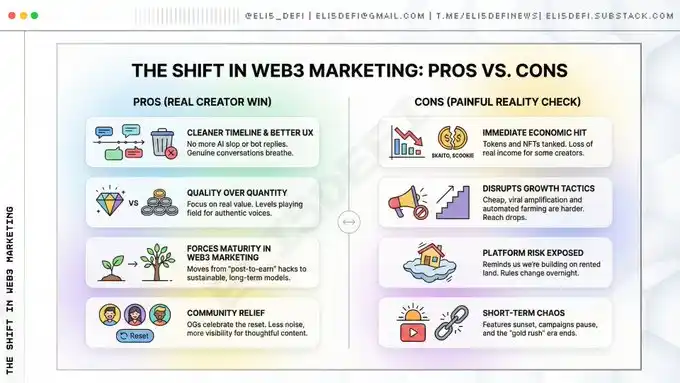
The Upside (Why This is Good for Real Creators)
- A cleaner timeline and better UX: No more endless AI-generated junk, "gm" farms, or bot replies clogging every post's replies. Real conversations can breathe again.
- Quality over quantity: Projects and creators who relied on paid spam now have to focus on real value. This levels the playing field for authentic voices (less noise = higher visibility for thoughtful content).
- Forcing Web3 marketing to mature: The "post-to-earn" model was a short-term hack that made quick money but burned communities and damaged long-term trust. This pushes us towards more sustainable models.
- Community relief: Many OGs and seasoned users are celebrating (ZachXBT called it a "fact-based decision," and even some creators see it as a reset for Crypto Twitter).
The Downside (The Painful Reality)
- Immediate economic hit: Tokens like $KAITO, $COOKIE, and related NFTs plummeted 15-20%+ overnight. Many creators (especially in emerging markets) lost a tangible source of income as leaderboard rewards or campaigns stopped abruptly with no compensation in sight.
- Disrupting growth strategies: Web3 projects loved using InfoFi for cheap, viral marketing. Without automated farming, promotion just got harder. Crypto topic reach might drop further.
- Platform risk exposure: X can change the rules overnight (again). It's a reminder we're building on rented land. One policy update, and your entire strategy crumbles.
- Short-term chaos: Projects are shutting down features, campaigns are on pause, and some creators are mourning the "gold rush" era that paid their rent for daily posting.
What We Need to Do from Now On
X's InfoFi ban has stirred the pot, but it's paving the way for a more structured, professional path for Web3 content creation. I see it as a nudge towards genuine project/agency partnerships and tight-knit creator communities.
Many creators are already pivoting in this direction, agencies are gearing up to fill the gap, building curated networks, and creator collectives are emerging as new hubs for deals and collaboration.
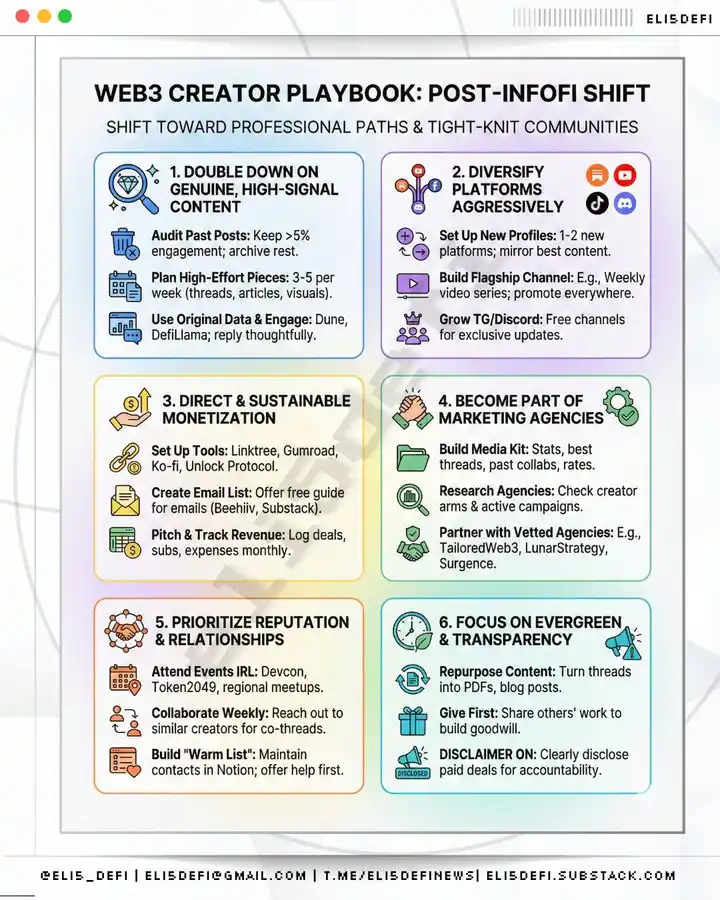
Here is the complete, updated playbook, with detailed steps for each point:
1. Double Down on High-Quality, High-Signal Content
Focus on deep analysis, threads, visual content, and genuine insights (this is what got me here in the first place). If the content is human-made and valuable, X will still reward quality interactions.
Detailed Steps:
- Audit your last 30 days of posts: Keep only those with engagement rates >5% or meaningful replies; delete or archive the rest.
- Plan 3-5 premium posts per week: (e.g., 10-tweet threads / long-form posts / articles with charts, simple analogies, or breakdowns).
- Use data tools: Use @Dune, @DefiLlama, @getmoni_io, @nansen_ai, etc., for original insights, not machine-generated AI summaries.
- Engage with replies: Thoughtfully respond to every high-quality comment within 24 hours to build genuine dialogue.
- Subscribe to quality research: Subscribe to outlets like @fourpillarsFP, @shoalresearch, @oak_res_EN, @delphi_digital, etc. Full list here: [https://x.com/i/lists/1956904918348190144)
- Track performance: Use X Analytics to see which format (threads vs. polls vs. video) generates the most bookmarks/shares.
2. Diversify Platforms
Detailed Steps:
- Set up 1-2 new platforms: (e.g., Substack + YouTube); sync your best X content there.
- Cross-post strategically: When sharing a post on X, include a link back to X.
- Build a flagship channel: For example, start a weekly YouTube/TikTok series (like "DeFi in 5 Minutes") and promote it everywhere.
- Grow Telegram/Discord: Create a free channel/group for exclusive updates and to connect with your audience.
3. Pivot to Direct, Sustainable Monetization
Open up DMs for genuine brand/marketing deals (this is where many projects will turn). Build your own audience flywheel: an email list, a personal site, or a paid community.
Detailed Steps:
- Set up tools: Create a Linktree and use Beehiiv or Substack to build an email list. You can try offering a freebie (like a "DeFi Starter Guide" PDF) as an opt-in. Find what works for you.
- Pitch yourself or offer free exposure: Reach out to projects proactively.
- Track revenue: Use a simple spreadsheet to log deals, subscriptions, and payouts monthly.
4. Join Marketing Agencies
The ban killed permissionless reward spam, so brands/projects will rely more on trusted agencies for distribution. Top crypto/Web3 marketing agencies have already built out or expanded creator arms. Even Kaito seems to be heading down this path with Kaito Studio.
Some top agencies I've worked with (in no particular order):
@TailoredWeb3, @radarblock, @GREEND0TS, @PinkBrains_io, @apcollective, @funhouse_la, @yaptradeDAO, @JELabs2024, @growgami, @LunarStrategy, @surgence_io
Detailed Steps:
- Build your media kit: Aggregate data (follower count, avg. engagement rate, niche focus), 3-5 best threads, past collaborations, and rates.
- Research agencies: Visit their websites, check their creator recruitment announcements, see if they have ongoing campaigns, and pitch yourself.
5. Prioritize Reputation and Relationships
Attend in-person events, collaborate with like-minded creators, and create evergreen value that compounds (not daily spam).
Detailed Steps:
- Attend 1-2 events per quarter: Aim for conferences like Devcon, Token2049, or regional meetups (check Eventbrite or CryptoEvents).
- Collaborate weekly: Reach out to 3 creators of similar size for joint threads, guest spots, or shoutouts.
- Build a "warm list": Maintain a Notion doc with 50+ contacts (creators, founders, community managers) and note how you help each other.
- Focus on evergreen content: Repurpose top threads into Notion pages, PDFs, or permanent blog posts.
- Be altruistic first: Offer free value (e.g., tagging helpful people, sharing their work) to build goodwill.
- Disclosure ON: If you take a paid deal, ensure you clearly disclose it. This ensures accountability and keeps your audience fully informed.
Conclusion
The crypto space moves fast. There may be new, similar InfoFi-like models on friendlier platforms in the future. But the lesson is clear: never bet your farm on a centralized platform's incentive mechanics.
It's painful in the short term, but long term? This might be the best thing to happen to Crypto Twitter. Less noise, more signal, and the real creators will win.






