Sumit Gupta Highlights Competition After 49 Crypto Exchanges Report FIU Registration

TheNewsCryptoPublicado em 2026-01-06Última atualização em 2026-01-06

Resumo

CoinDCX CEO Sumit Gupta emphasized the competitive nature of India's crypto market, noting that over 100 exchanges are still pending registration with the Financial Intelligence Unit (FIU). This follows reports that 49 exchanges—45 domestic and 4 offshore—registered with the FIU in FY 2024-2025. India is strictly monitoring the sector, imposing penalties of approximately ₹28 crore on non-compliant platforms. The FIU, designated as the sole regulatory authority for virtual digital assets, requires exchanges to share financial accounts, appoint compliance officers, and conduct internal audits to mitigate money laundering and terror financing risks.

Sumit Gupta, the Chief Executive Officer of CoinDCX, has underlined the level of competition that exists in the Indian crypto market. His statement comes after reports surfaced, highlighting the number of crypto exchanges that have registered with the Financial Intelligence Unit (FIU). India continues to monitor developments in its crypto market.

Sumit Gupta on Indian Crypto Market

CoinDCX CEO has stated that the Indian crypto market is more competitive than most people think it is. He based this on the fact that at least a hundred exchange platforms are yet to complete their registrations with the FIU, a federal agency that is responsible for reviewing the misuse of the country’s financial system.

A statement by Sumit Gupta came after reports stated that 49 crypto exchanges had registered with the FIU in FY 2024-2025. This includes 45 India-based platforms and 4 offshore platforms. Sumit’s statement emphasizes that there are 100s more exchange platforms, in addition to these 45, waiting to complete their registration.

India Monitoring its Crypto Market

India is closely and strictly monitoring the crypto market. This is evident from the imposition of penalties worth approximately ₹28 crore on non-compliant platforms during the same year. A compliant crypto exchange platform is essentially required to identify and report the ownership of wallets while monitoring crowdfunding activities by blockchain projects.

The crypto market is gaining traction in India with the potential to transform the financial sector and generate wealth creation opportunities. Per the FIU report accessed by PTI, the traction has been rather significant, and the ecosystem is rapidly evolving. A major risk identified in the same report is only in the form of money laundering and terror financing risks.

Addressing Risks

Nevertheless, India is addressing risks related to the crypto market early. It has designated FIU as the sole authority to register and monitor cryptocurrencies, referred to as virtual digital assets. Operational under the Finance Ministry, FIU is also tasked with monitoring VDA service providers, or exchange platforms.

Crypto exchange platforms are required to share bank and financial institution accounts after completing their registration. Additionally, they must appoint a director along with a principal officer with the complete contact details. Internal audits are another requirement listed by FIU on top of adopting risk-based customer due diligence.

Highlighted Crypto News Today:

U.S. Faces Scrutiny Over Bitcoin Sale Despite Strategic Reserve Order

TagsCrypto ExchangesIndia

Perguntas relacionadas

QWhat did Sumit Gupta, CEO of CoinDCX, highlight about the Indian crypto market?

ASumit Gupta highlighted that the Indian crypto market is more competitive than most people think, based on the fact that at least a hundred exchange platforms are yet to complete their registrations with the Financial Intelligence Unit (FIU).

QHow many crypto exchanges have registered with India's FIU in FY 2024-2025, and what is the breakdown?

A49 crypto exchanges have registered with the FIU in FY 2024-2025. This includes 45 India-based platforms and 4 offshore platforms.

QWhat is one of the major risks identified in the Indian crypto market according to the FIU report?

AA major risk identified in the FIU report is money laundering and terror financing.

QWhat are some of the requirements for crypto exchange platforms to be compliant with Indian regulations?

ACompliant crypto exchange platforms are required to identify and report wallet ownership, monitor crowdfunding activities, share bank and financial institution accounts, appoint a director and a principal officer with complete contact details, conduct internal audits, and adopt risk-based customer due diligence.

QWhat action has India taken against non-compliant crypto platforms, as mentioned in the article?

AIndia has imposed penalties worth approximately ₹28 crore on non-compliant crypto platforms during the same year.

Leituras Relacionadas

Circle CEO's Seoul Visit: No Korean Won Stablecoin Issuance, But Met All Major Korean Banks

Circle CEO Jeremy Allaire's recent activities in Seoul indicate a strategic shift for the company, moving away from issuing a Korean won-backed stablecoin and instead focusing on embedding itself as a key infrastructure provider within Korea’s financial and crypto ecosystem. Despite Korea accounting for nearly 30% of global crypto trading volume—with a market characterized by high retail participation and altcoin dominance—Circle has chosen not to compete for the role of stablecoin issuer. Instead, Allaire met with major Korean banks (including Shinhan, KB, and Woori), financial groups, leading exchanges (Upbit, Bithumb, Coinone), and tech firms like Kakao. This approach reflects a broader industry transition: the core of stablecoin competition is shifting from issuance rights to systemic positioning. With Korean regulators still debating whether banks or tech companies should issue stablecoins, Circle is avoiding regulatory uncertainty by strengthening its role as a service and technology partner. The company is deepening integration with trading platforms, building connections, and promoting stablecoin infrastructure. This positions Circle to benefit regardless of which entity eventually issues a won stablecoin. Allaire also noted the potential for a Chinese yuan stablecoin in the next 3–5 years, underscoring a regional trend of stablecoins becoming more regulated and integrated with traditional finance. Ultimately, Circle’s strategy highlights that future influence in the stablecoin market will belong not necessarily to the issuers, but to the foundational infrastructure layers that enable cross-system transactions.

marsbitHá 5m

Circle CEO's Seoul Visit: No Korean Won Stablecoin Issuance, But Met All Major Korean Banks

marsbitHá 5m

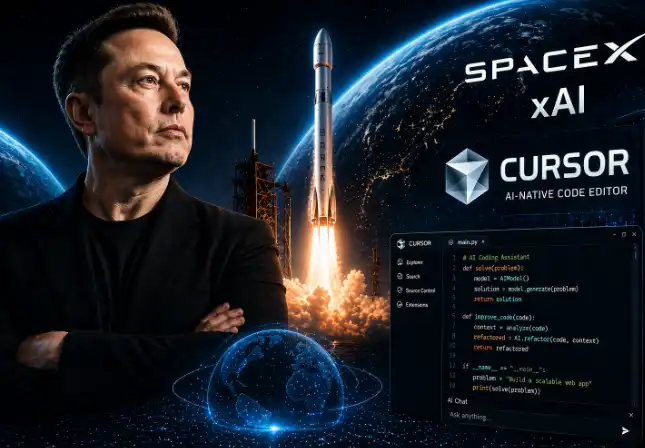
SpaceX Ties Up with Cursor: A High-Stakes AI Gambit of 'Lock First, Acquire Later'

SpaceX has secured an option to acquire AI programming company Cursor for $60 billion, with an alternative clause requiring a $10 billion collaboration fee if the acquisition does not proceed. This structure is not merely a potential acquisition but a strategic move to control core access points in the AI era. The deal is designed as a flexible, dual-path arrangement, allowing SpaceX to either fully acquire Cursor or maintain a binding partnership through high-cost collaboration. This "option-style" approach minimizes immediate regulatory and integration risks while ensuring long-term alignment between the two companies. At its core, the transaction exchanges critical AI-era resources: SpaceX provides its Colossus supercomputing cluster—one of the world’s most powerful AI training infrastructures—while Cursor contributes its AI-native developer environment and strong product adoption. This synergy connects compute power, models, and application layers, forming a closed-loop AI capability stack. Cursor, founded in 2022, has achieved rapid growth with over $1 billion in annual revenue and widespread enterprise adoption. Its value lies in transforming software development through AI agents capable of coding, debugging, and system design—positioning it as a gateway to future software production. For SpaceX, this move is part of a broader strategy to evolve from a aerospace company into an AI infrastructure empire, integrating xAI, supercomputing, and chip manufacturing. Controlling Cursor fills a gap in its developer tooling layer, strengthening its AI narrative ahead of a potential IPO. The deal reflects a shift in AI competition from model superiority to ecosystem and entry-point control. With programming tools as a key battleground, securing developer loyalty becomes crucial for dominating the software production landscape. Risks include questions around Cursor’s valuation, technical integration challenges, and potential regulatory scrutiny. Nevertheless, the deal underscores a strategic bet: controlling both compute and software development access may redefine power dynamics in the AI-driven future.

marsbitHá 45m

SpaceX Ties Up with Cursor: A High-Stakes AI Gambit of 'Lock First, Acquire Later'

marsbitHá 45m

Trading

Spot
Futuros
活动图片