SUI Faces Daily $15 Million Token Unlock, While BEAT Leads $81 Million Token Release Wave This Week

cryptonews.ruPublicado em 2026-07-29Última atualização em 2026-07-29

Resumo

The article discusses significant token unlocks planned for this week in the crypto market. According to Cryptorank, seven assets, including $SUI and $BEAT, are set for major releases. Analyst account Top7 estimates a $74.9 million one-time unlock for $BEAT on August 1, constituting about 2.12% of its circulating supply. $EIGEN and $KITE will also unlock on the same day for $7.65M and $6.08M respectively, with $BTW and $ZAMA following on August 2 for a combined $13.24M. In contrast to these large, concentrated unlocks, the $SUI token follows a different, continuous daily vesting mechanism, distributing approximately $15.4 million worth of tokens weekly into circulation among community reserves, early contributors, and the Mysten Labs treasury. This gradual release is seen as less likely to cause immediate selling pressure compared to one-time events. As of July 29, $SUI trades at $0.69 with a market cap of around $2.78 billion. The piece explains that large unlocks are important for traders as they increase the pool of tokens available for sale, potentially creating downward price pressure if supply outpaces demand. This effect is considered strongest for "cliff" unlocks like $BEAT's. Despite being a regular feature on unlock trackers due to its volume and vesting schedule, $SUI's ecosystem has shown independent growth, including a reported influx of $65 billion in stablecoin volume following a recent fee reduction. A key test will be whether $SUI's price holds steady from ...

Token unlocking occurs when previously restricted circulation cryptocurrencies, typically reserved for the project team, early investors, or an ecosystem fund, become available for trading on the open market. In a Cryptorank review, $SUI was named one of seven assets with significant unlocks scheduled for this week, alongside $BEAT, $BTW, ENA from Ethena, $EIGEN from EigenLayer, $ZAMA from Zama, and $KITE from Kite AI.
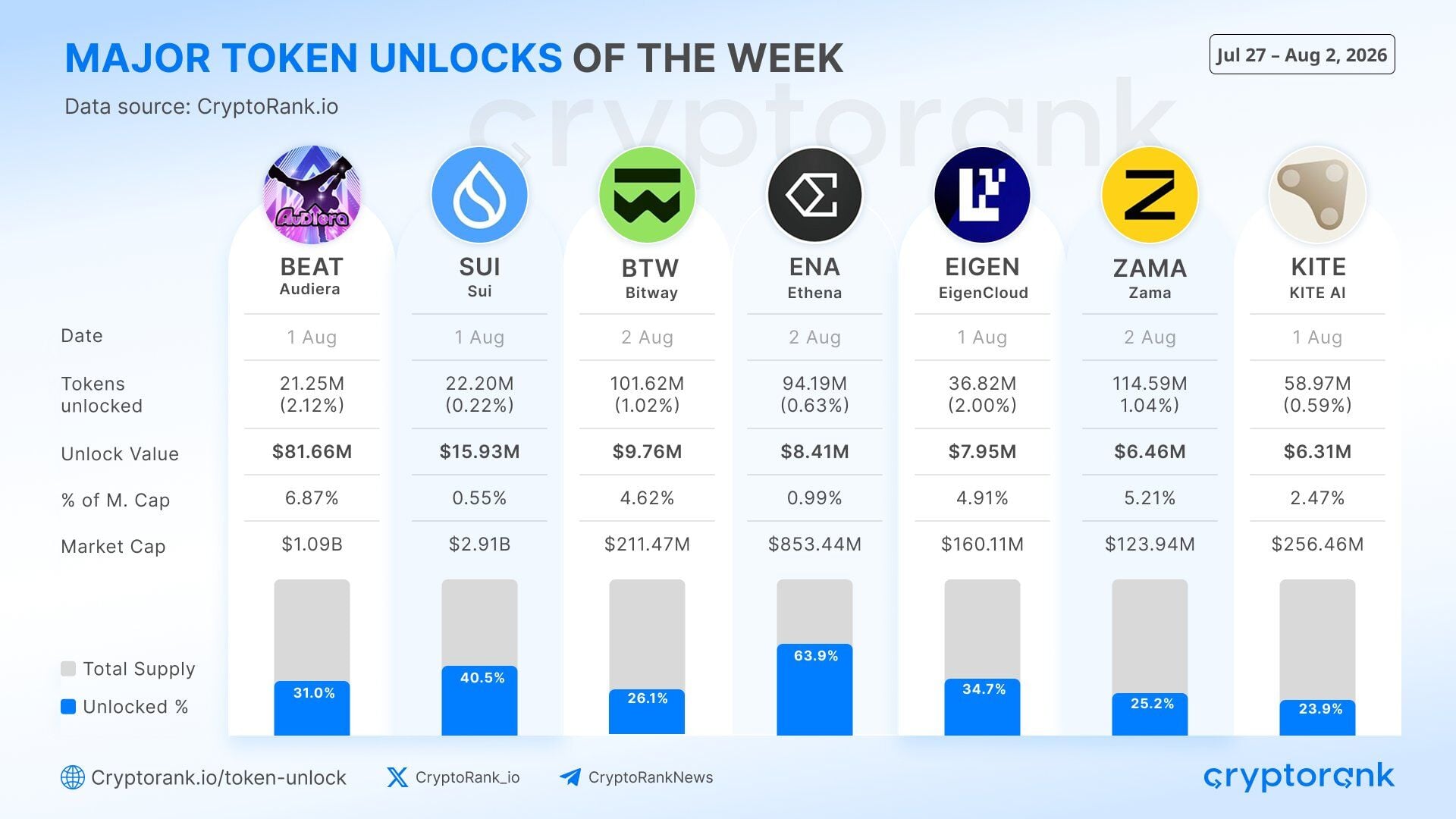
A separate tracker maintained by the crypto analytics account Top7 estimates the $BEAT release volume at $74.9 million, scheduled for a one-time unlock on August 1, representing approximately 2.12% of the total circulating token supply. The $EIGEN and $KITE token unlocks follow on the same day, valued at $7.65 million and $6.08 million respectively, while $BTW and $ZAMA follow on August 2 with a combined value of $13.24 million.

The $SUI Unlock Mechanism Works Differently

Unlike the one-time event for $BEAT, $SUI does not release tokens in a single batch. More precisely, the Sui network, developed by Mysten Labs, distributes the new supply on a constant daily basis to categories such as the Community Reserve, early contributors, and the Mysten Labs treasury.

This structure introduces approximately $15.4 million worth of $SUI into circulation over the week, rather than concentrating the impact on a single trading day.

The maximum supply of $SUI is capped at 10 billion tokens, with about 4.05 billion, or roughly 40%, already in circulation. As of July 29, the token is trading at $0.69, giving it a market capitalization of approximately $2.78 billion.

On August 1 alone, approximately 13.72 million $SUI will be unlocked, distributed among three stakeholder groups: 4 million will go to the Community Reserve, 7.65 million to early contributors, and 2.07 million to the Mysten Labs treasury.

Why Unlocks Affect Markets

Large unlocks are significant for traders as they increase the pool of tokens that can be sold simultaneously. When new supply hits exchanges faster than demand absorbs it, prices can experience downward pressure, especially for tokens where the unlocking holders include venture investors or early team members looking to realize profits.

Analysts tracking vesting schedules argue this effect is strongest with "cliff" unlocks, such as with $BEAT, where a significant portion of supply is released at once, as opposed to gradual daily releases like those for $SUI.

This aspect alone has made $SUI a regular feature on unlock watchlists, not necessarily signaling acute selling pressure. The token has appeared in weekly unlock listings throughout 2026, given its volume and continuous vesting mechanism, even as the Sui ecosystem has shown growth in other areas independent of this.

Earlier this year, Mysten Labs reduced transaction fees on the Sui network, and as reported by Bitcoin.com News, this move helped attract $65 billion worth of stablecoin volume to the network, indicating that trader attention to this asset extends far beyond its unlock schedule.

The next signal to watch is whether the price of $SUI holds steady between August 1 and 2, even as five other tokens simultaneously absorb concentrated releases—this test could determine how traders price in future weeks of unlocks on the Sui network.

end-content

Perguntas relacionadas

QWhat is token unlocking in the context of crypto markets, and why is it significant?

AToken unlocking refers to the release of previously restricted or locked cryptocurrencies—typically reserved for project teams, early investors, or ecosystem funds—into the open market for trading. It is significant because it increases the supply of tokens available for sale. If new supply enters exchanges faster than demand can absorb it, prices can face downward pressure, especially when large, concentrated unlocks occur.

QAccording to the article, how is SUI's token unlock mechanism different from that of BEAT?

ASUI's token unlock mechanism differs from BEAT's in its distribution schedule. SUI does not release tokens in a single, lump-sum event. Instead, the Sui network, developed by Mysten Labs, distributes new supply on a continuous, daily basis to categories like community reserves, early contributors, and the Mysten Labs treasury. This spreads approximately $15.4 million worth of SUI into circulation over a week. In contrast, BEAT is scheduled for a one-time, lump-sum unlock of roughly $74.9 million on August 1.

QWhich token is expected to have the largest value unlock on August 1 according to the tracker mentioned in the article?

AAccording to the tracker from crypto analytics account Top7 mentioned in the article, the token expected to have the largest value unlock on August 1 is $BEAT, with an estimated value of $74.9 million.

QWhat are the three stakeholder groups that will receive unlocked SUI tokens on August 1, and what are the respective amounts?

AOn August 1, three stakeholder groups will receive unlocked SUI tokens: 4 million SUI will go to the community reserve, 7.65 million SUI to early contributors, and 2.07 million SUI to the Mysten Labs treasury.

QWhy do analysts suggest that 'cliff' unlocks (like BEAT's) have a stronger market impact than gradual daily unlocks (like SUI's)?

AAnalysts suggest that 'cliff' unlocks have a stronger immediate market impact than gradual daily unlocks because they release a significant portion of the token supply all at once. This sudden influx of new, sellable tokens can quickly outpace market demand, creating more pronounced downward pressure on prices. Gradual daily releases, like SUI's, distribute the selling pressure over time, which can be more easily absorbed by the market.

Leituras Relacionadas

The Turning Point of the AI Bull Market: Leverage Blow-ups, Overcapacity in Compute, Why This Macro Analyst is Fully Bearish

AI Bull Market Reaches Inflection Point: Analyst Turns Bearish Due to Leverage, Chinese Competition, and Overcapacity Fidenza Macro analyst Geo Chen explains his decision to sell all AI semiconductor and infrastructure holdings in June, offering a comprehensive bearish thesis. He argues the AI-driven bull market has peaked, citing several key factors. First, unsustainable buying pressure: a massive influx of "low-quality" capital from Korean retail investors using highly leveraged ETFs on stocks like SK Hynix created a parabolic, fragile rally. Recent liquidations have wiped out billions and impacted over a million accounts, removing a key market driver. Second, a competitive threat: the rapid rise of powerful, cost-effective open-source AI models from China, such as MoonShot AI's Kimi K3 and Alibaba's Qwen 3.8, is commoditizing intelligence. This undermines the pricing power and high-valuation financing prospects of closed-source leaders like OpenAI and Anthropic, potentially creating a "single point of failure" for the ecosystem. Third, an impending capacity glut: while AI compute and components are currently in shortage, Chen warns this is typical of a cycle top. Massive, committed capex from cloud providers will likely lead to a supply overhang within 1-2 years. Data shows token spending has already peaked and declined since June, while bond spreads for data center companies are widening, signaling rising credit risk. Chen also highlights broader macro headwinds: the protracted Iran conflict acts as a persistent stagflationary force, and the Federal Reserve under Chair Kevin Warsh is losing credibility in its inflation fight. Long-term Treasury yields breaking above 5.2% present a new challenge for equities. In summary, Chen believes the convergence of speculative excesses, competitive disruption, looming overcapacity, and adverse macroeconomic conditions marks a significant turning point for the AI investment theme.

marsbitHá 15m

The Turning Point of the AI Bull Market: Leverage Blow-ups, Overcapacity in Compute, Why This Macro Analyst is Fully Bearish

marsbitHá 15m

Saeed Al-Marri: How Tokenization Unlocks New Opportunities for Shipping Funds

Said Al-Marri: How Tokenization Opens New Opportunities for Shipping Funds For centuries, commercial shipping has been a capital-intensive asset class limited to institutional funds and shipping dynasties. Said bin Saleh Al-Marri, CEO of Ethra Invest and Ethra Ship, aims to break down these barriers by combining Real World Asset (RWA) tokenization with conservative private equity principles. This bridges decentralized finance (DeFi) with the physical realities of global trade. Tokenization allows fractional ownership of ships on a blockchain, giving smaller investors access to previously inaccessible markets. However, Al-Marri warns it is not a regulatory loophole or a cure for asset illiquidity. The core physical risks are isolated in Special Purpose Vehicles (SPVs) for qualified investors. While tokenization enhances transparency and ownership record-keeping, Al-Marri stresses that a liquid secondary market depends on transparent asset valuation and must not interfere with ship operations managed by professionals. Regarding legal enforcement, smart contracts cannot physically seize a ship. Legal recourse still relies on traditional maritime courts, ship mortgages, and flag state laws, with blockchain records needing to mirror legal ownership in the SPV perfectly. Beyond ownership, the industry faces administrative hurdles like paper-based bills of lading. Al-Marri argues the bottleneck is legal and operational standardization, not technology. He advocates for a hybrid model combining digital trade documents and programmable settlements with support from regulated financial institutions, rather than a full crypto replacement for tools like Letters of Credit. A major challenge is decarbonizing the global fleet by 2050. Transitioning to green fuels requires massive upfront investment. Al-Marri emphasizes a conservative, holistic approach to underwriting these projects, evaluating technology, fuel availability, safety, and resale value. Investments must be justified under conservative forecasts, not just optimistic ones. By combining pragmatic risk management with digital infrastructure, leaders like Al-Marri show that the evolution of maritime finance is about mobilizing capital to build a modernized and sustainable global fleet, not just putting ships on a blockchain.

cryptonews.ruHá 30m

Saeed Al-Marri: How Tokenization Unlocks New Opportunities for Shipping Funds

cryptonews.ruHá 30m

Trading

Spot
活动图片