Author: Joe Burnett, Vice President of Bitcoin Strategy, Strive
Compiled by: Jiahuan, ChainCatcher
Last quarter, when Bitcoin fell more than 50% from its highs, I argued that bear markets are not a systemic flaw, but part of Bitcoin's early adoption process. Earlier this year, I explained why Bitcoin could reach $11 million by 2036. I still believe this scenario is possible, but the more pertinent question is: what path will Bitcoin take to get there?
Early Bitcoin cycles saw hundred-fold gains, while the returns in recent cycles have clearly narrowed. If this trend continues, Bitcoin will eventually look more and more like a mature asset, and its returns will gradually normalize.
The power law model aptly summarizes this change. (Referring to the relatively stable power function relationship between Bitcoin price and time over the long term) As the asset size grows, its returns gradually decline. For over a decade, Bitcoin has followed a highly stable long-term trajectory.
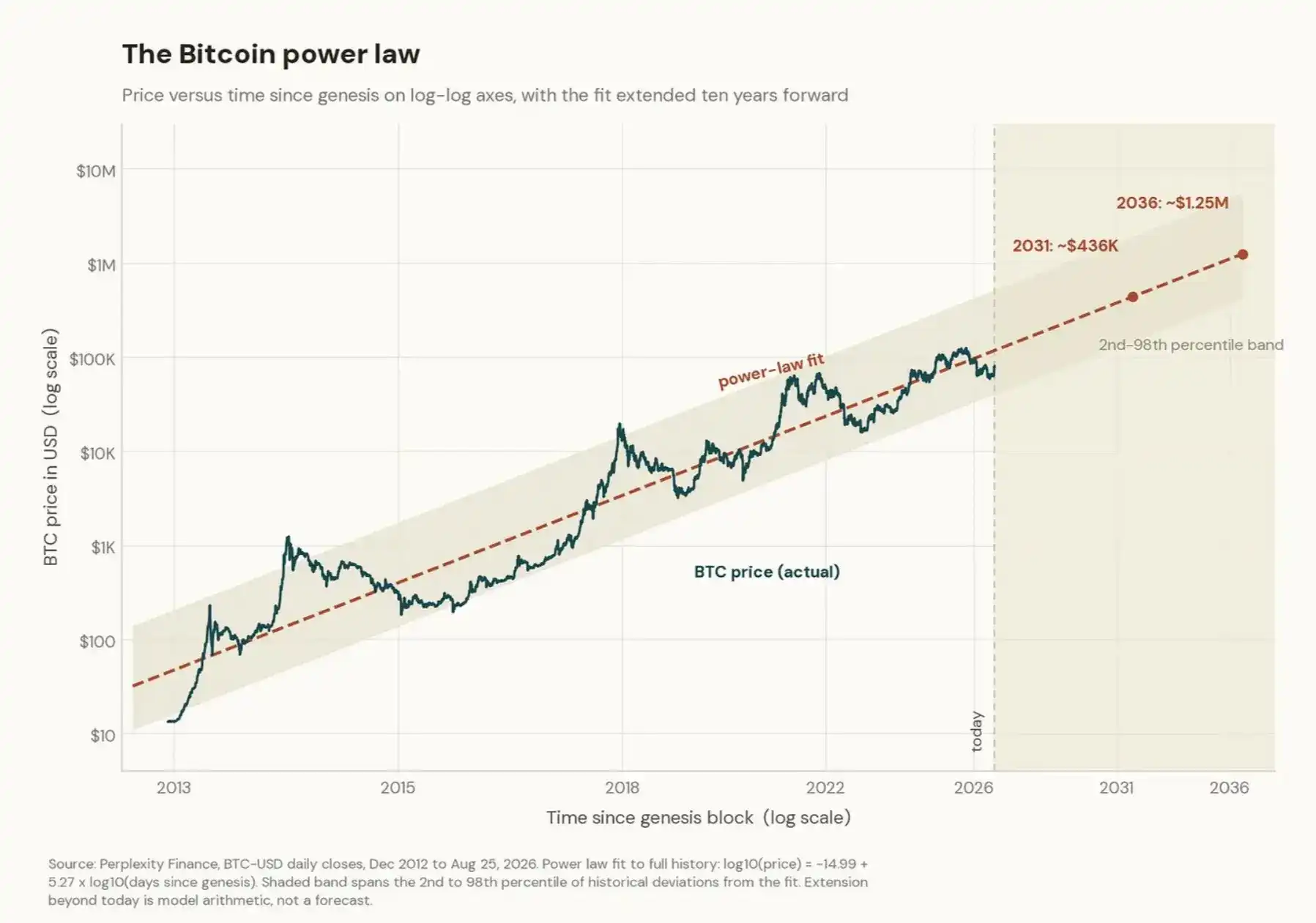
I acknowledge the explanatory power of the power law framework and believe Bitcoin may continue to roughly follow this trajectory for many years to come. But I am no longer convinced that the power law is sufficient to describe Bitcoin's endgame.
As Bitcoin matures, returns are declining, and volatility is also declining. Lower volatility will not only change the scale of capital Bitcoin can absorb but also expand its uses within the financial system.
Lower volatility improves Bitcoin's risk-adjusted returns and makes it easier to obtain financing using Bitcoin as collateral. When Bitcoin becomes a high-quality collateral asset in the global financial system, the scale of dollar-denominated credit backed by it could expand significantly.
Diminishing returns suppress volatility, lower volatility attracts more capital, and expands the financing scale Bitcoin can support. Ultimately, these forces may instead push Bitcoin's price to re-accelerate, breaking upwards through the power law trajectory.
Diminishing Returns Might Just Be the Prelude to the Next Phase
There is an interesting analogy in materials science.
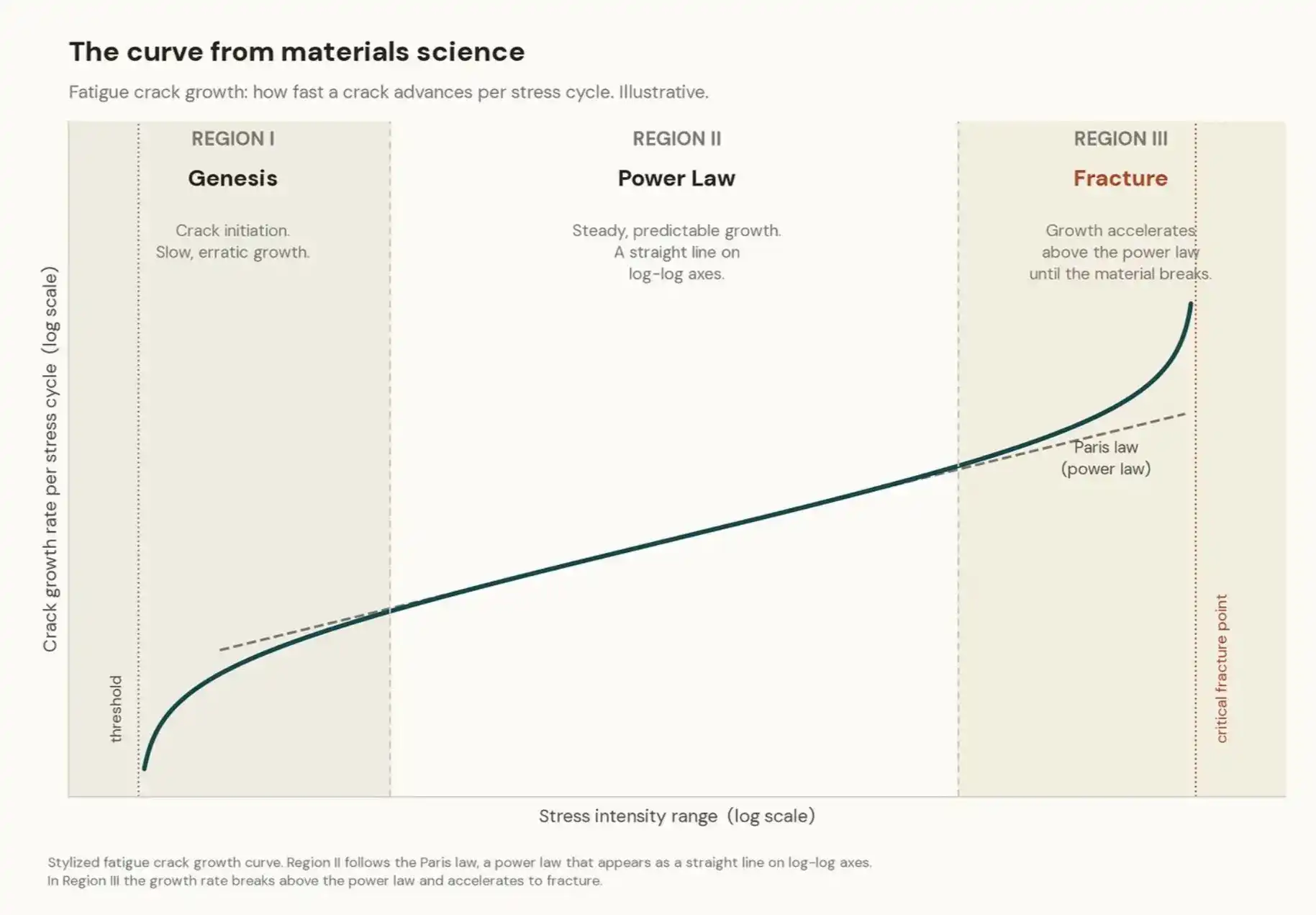
Engineers studying metal fatigue observe how cracks propagate under repeated stress. An airplane wing bends slightly with each flight, and a bridge deck is repeatedly compressed and unloaded as vehicles pass over it. The damage from each stress cycle is minimal, but this damage accumulates over time, eventually forming an expanding crack. Engineers typically divide the crack growth curve into three regions.
The first region is the crack initiation period, where growth is irregular and difficult to model.
In the second region, crack growth becomes more predictable, known in engineering as the Paris law regime (Paris law describes the power-law relationship between fatigue crack growth rate and stress intensity). Here, crack growth approximates a straight line on a log-log plot.
In the third region, the crack reaches a critical point and grows rapidly. The power law that described the intermediate stage no longer applies, and the material ultimately fractures.
I believe Bitcoin's monetization process follows a similar trajectory. In this analogy, the material under continuous stress is the US dollar credit system.
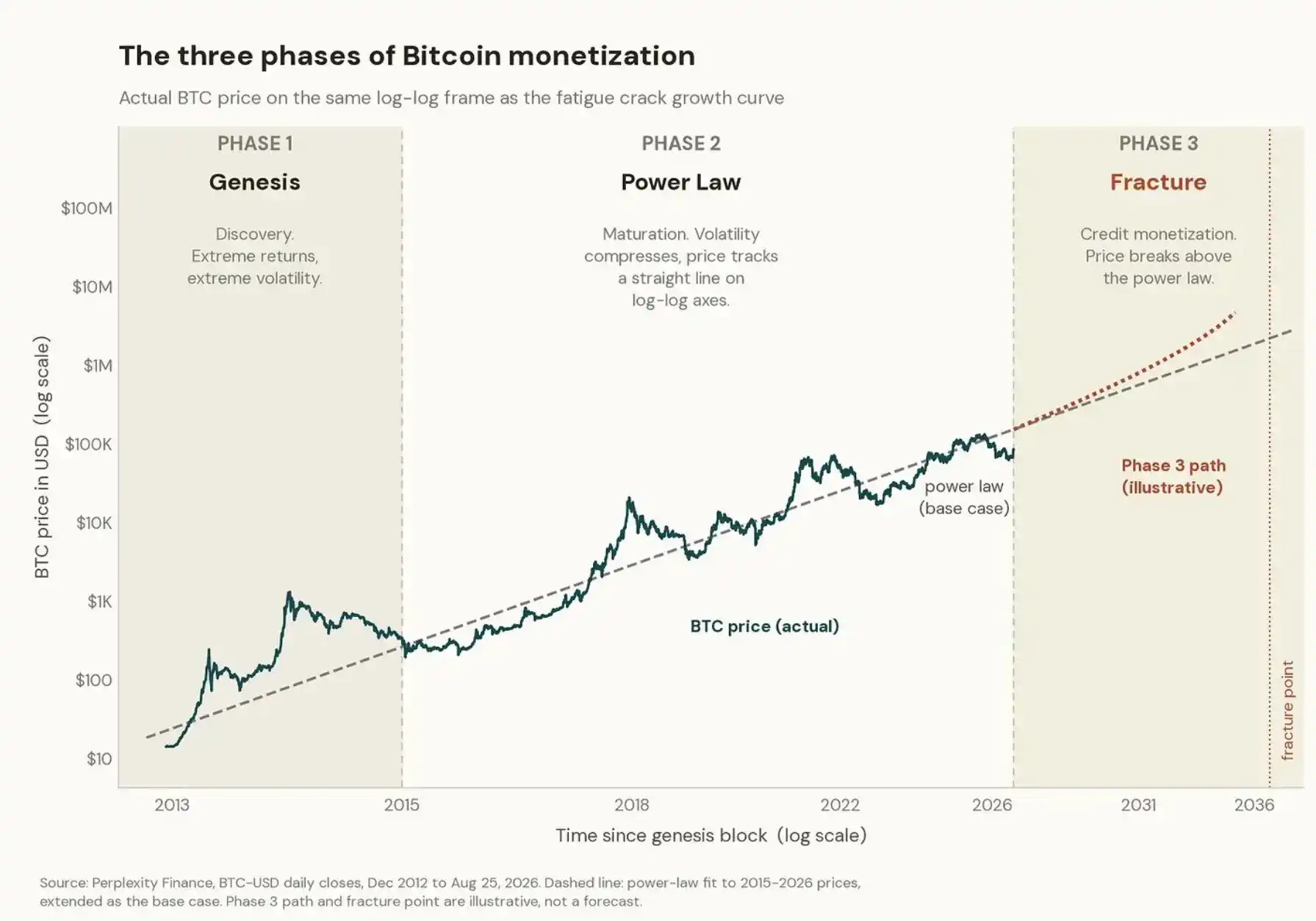
Phase One is Discovery. Returns and volatility are extremely high. It is difficult for large capital to allocate to Bitcoin or use it as collateral for financing.
Phase Two is Maturation. Both returns and volatility narrow. Bitcoin's risk-adjusted returns improve, investors can increase allocation sizes, and it gradually becomes more attractive collateral.
Phase Three is System-Driven Monetization. Purchases driven by both dedicated capital and credit begin to enter the Bitcoin market on a large scale, initiating a self-reinforcing cycle. Price appreciation re-accelerates and breaks upwards through the power law trajectory.
Most people see Phase Two and assume diminishing returns will continue forever. But in my view, Phase Two is precisely creating the conditions for Phase Three. As Bitcoin matures, with lower volatility, improved risk-adjusted returns, and enhanced collateral quality, it becomes easier for existing capital to allocate to Bitcoin, and financing purchases via credit becomes more viable.
Declining Volatility is Reshaping Bitcoin's Asset Properties
Bitcoin's volatility has declined significantly.
In March 2014, Bitcoin's one-year realized volatility once approached 147%; as of the article's publication, data from Perplexity Finance shows this figure has dropped to around 44%. Fidelity recently also pointed out that Bitcoin's current volatility is lower than 98.5% of its historical trading days.
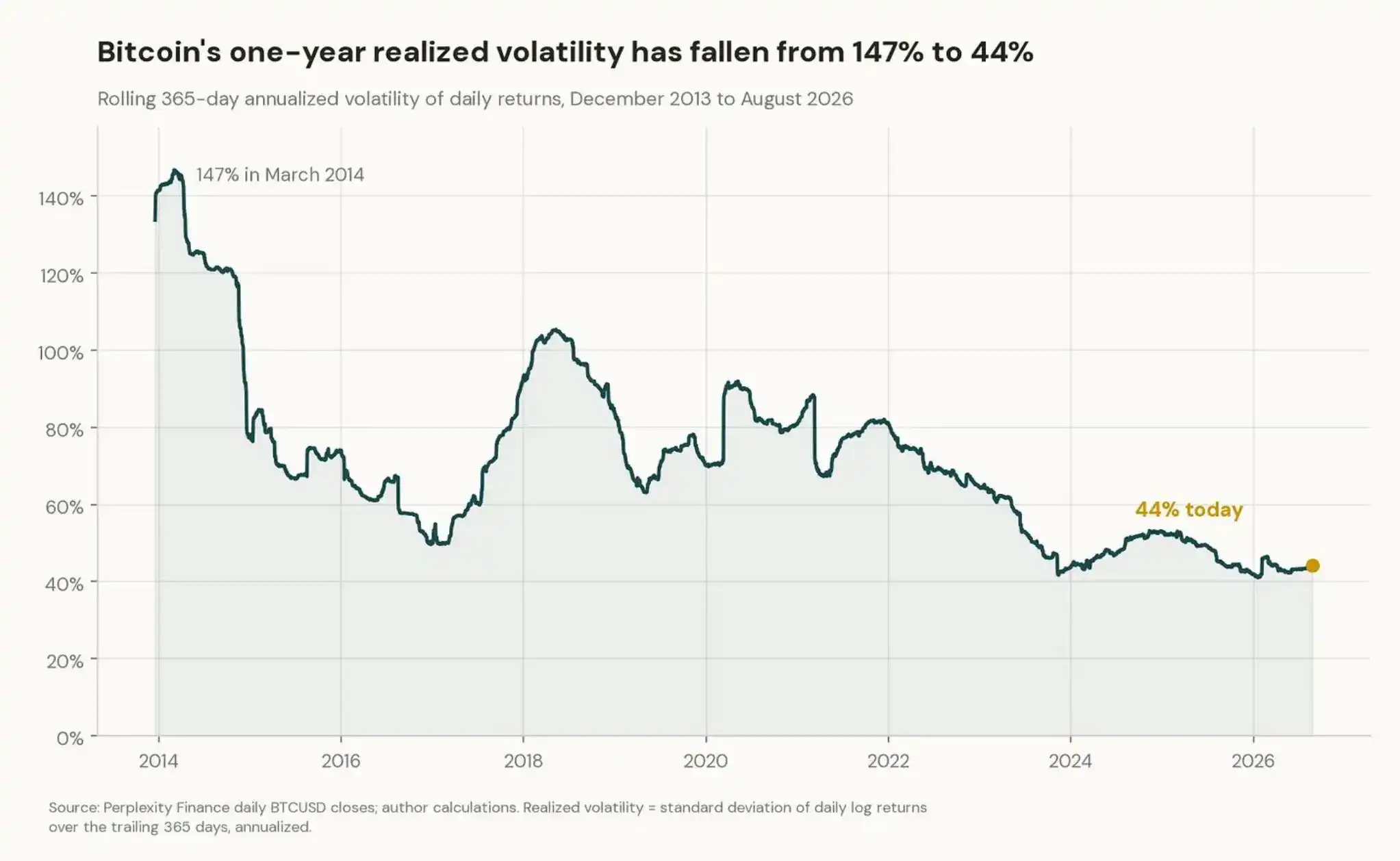
While long-term returns remain outstanding, Bitcoin's volatility continues to decline, and its Sharpe ratio rises accordingly. This means Bitcoin can attract more capital simply through the improvement in its risk-return profile, without relying on new credit creation. Similar signs appeared between 2016 and early 2017: volatility narrowed significantly, and strong performance began attracting more capital.
Volatility also acts as a kind of "invisible tax" on position size. For an investor with a fixed risk budget, if Bitcoin's volatility is cut in half, they could theoretically double their position size without increasing their portfolio's risk contribution. Therefore, even without creating any new credit, lower volatility itself expands the space for existing capital to allocate to Bitcoin.
Historical maximum drawdowns tell the same story. The maximum drawdowns in Bitcoin's three previous major bear markets were approximately 85%, 84%, and 77%. In this cycle, Bitcoin fell from a high of around $125,000 in October 2025 to a low of about $58,500 in June 2026, a drawdown of roughly 53%.
NYDIG also reached a similar conclusion near the June lows: this drawback was 52.7%, compared to 77.6% in 2021-2022, with earlier cycles ranging between 84% and 94%. Each cycle's decline has been shallower, and the bottoms higher. NYDIG identifies this long-term decline in volatility as one of the defining characteristics of the current phase.
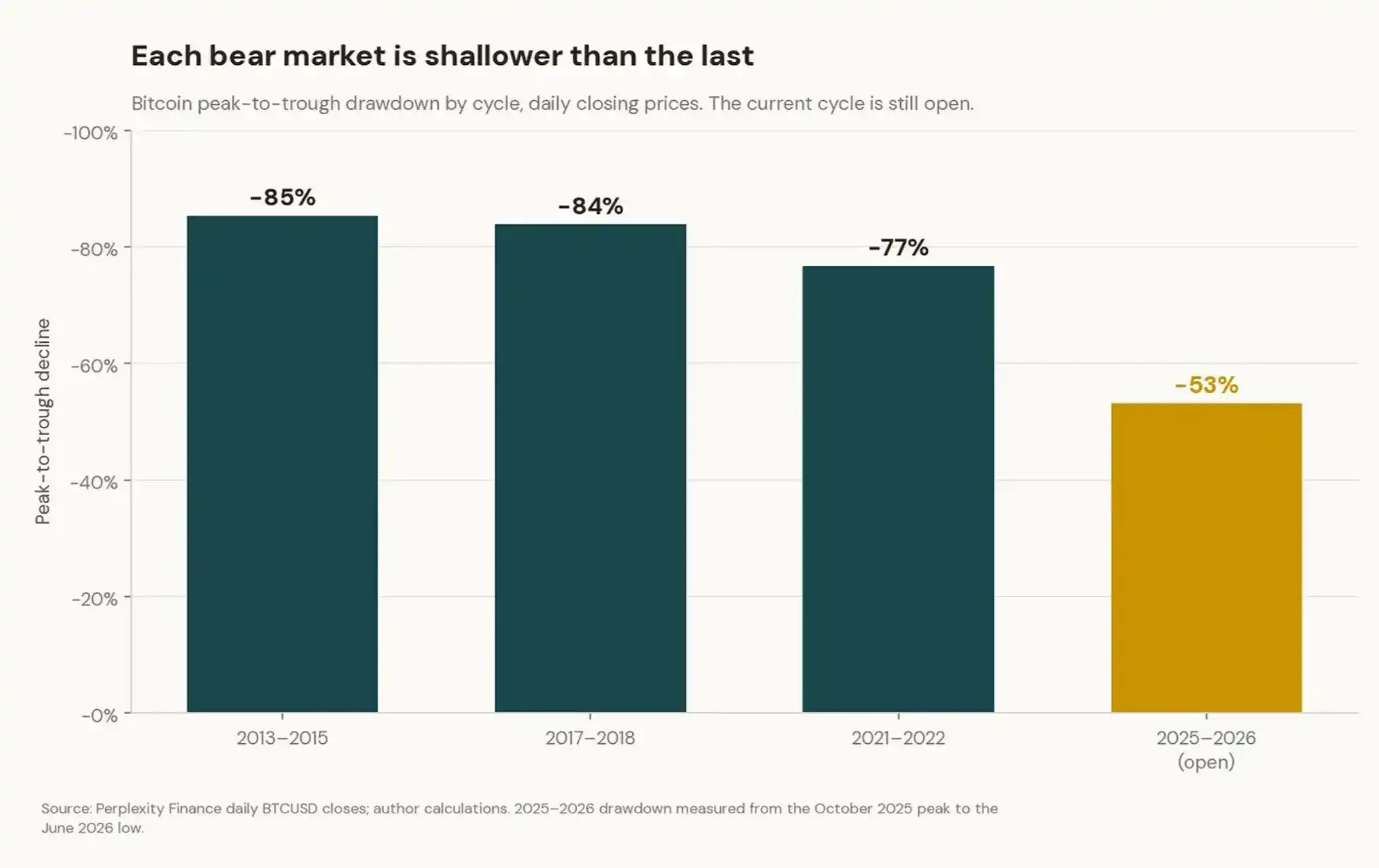
For Bitcoin holders, this change might be disappointing: bull market gains are smaller, bear market losses are smaller, and overall returns are declining.
But from a lender's perspective, the same trend is highly attractive because Bitcoin is becoming higher-quality collateral.
Lower Volatility Means More Credit Bitcoin Can Support
From a lender's perspective, the most important question is: how much can Bitcoin fall before the collateral value approaches the loan balance?
Suppose someone holds $100,000 worth of Bitcoin and borrows $20,000 against it, with an initial loan-to-value (LTV) ratio of 20%; the lender will liquidate the collateral when the LTV reaches 80%.
The smaller the worst-case drawdown Bitcoin could experience, the higher the loan amount a lender can safely issue against the same collateral. With unchanged liquidation rules, if the expected worst-case drawdown decreases from 80% to 50%, the safely issuable loan amount increases to 2.5 times the original.
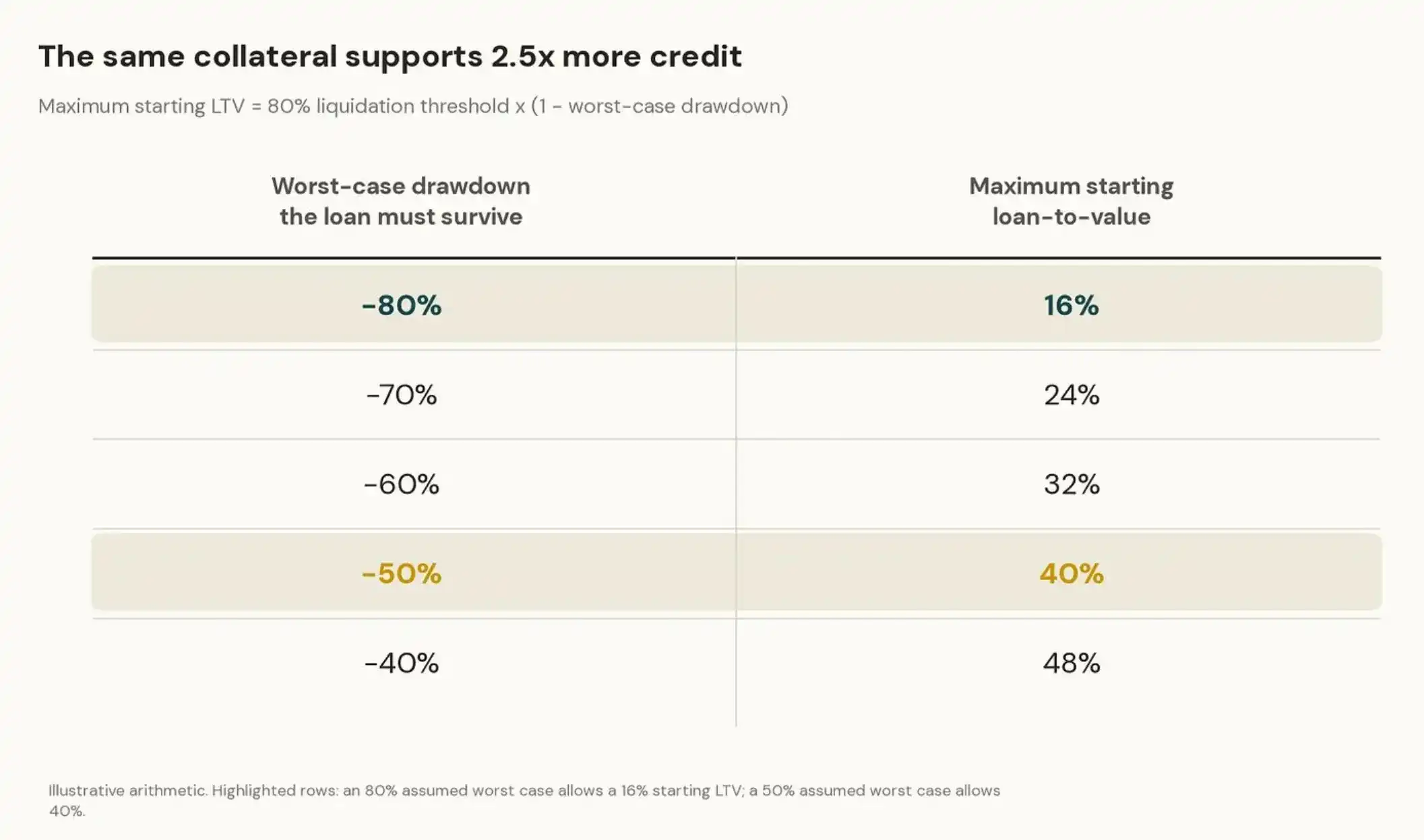
The same logic applies to borrowers. Financing structures used by companies like Strategy and Strive can increase Bitcoin exposure through leverage without bearing short-term forced liquidation risk; shallower drawdowns make these structures more resilient. Therefore, lower volatility can support larger financing scales while reducing credit risk.
Price increases further amplify this effect. If the Bitcoin price doubles while the corresponding dollar debt remains unchanged, the LTV is halved. The same amount of Bitcoin can thus support more borrowing, providing funds for subsequent purchases.
Even as Bitcoin matures and annual returns no longer reach 100%, this financing logic could still hold, and the expandable credit scale could remain considerable.
Assuming Bitcoin's expected annual return drops to 30%, while the financing cost for Bitcoin-related preferred shares is about 13%, there is still an expected return spread of about 17 percentage points.
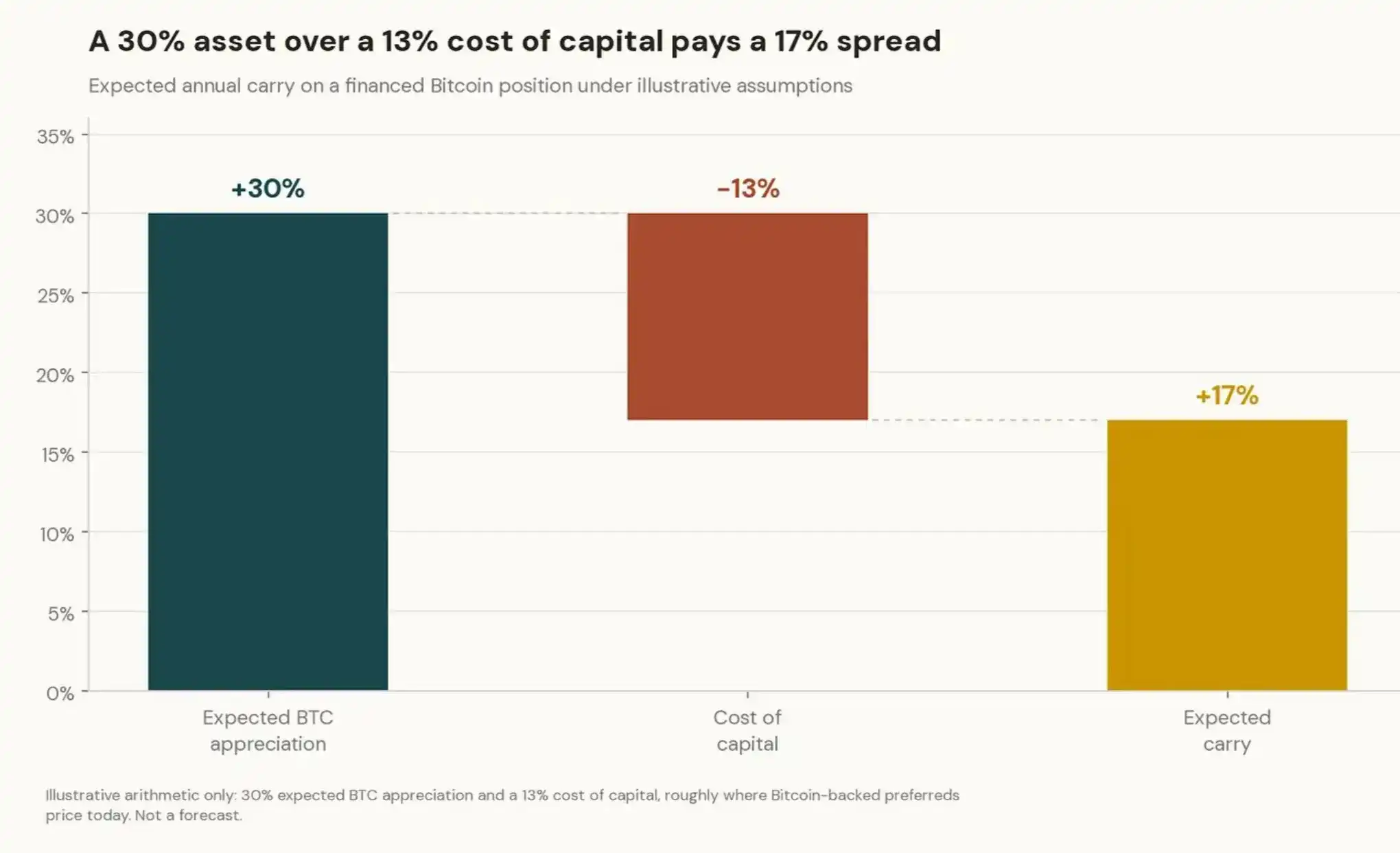
When the extreme drawdowns of the collateral keep narrowing, such a return spread can still support large-scale financing. As the market's assessment of collateral risk decreases, lower-cost financing channels may gradually open, including bank credit lines, investment-grade bonds, and securitization of Bitcoin-backed loans.
This mechanism is already beginning to manifest in public markets. Strategy has published an illustrative credit model that uses hypothetical Bitcoin volatility to derive the credit spread for its preferred shares.
All else being equal, when Bitcoin volatility is 60%, the model gives an STRC credit spread of 360 basis points (1 basis point equals 0.01 percentage points), placing it in the non-investment-grade range. When volatility drops to 40%, close to current realized levels, the spread narrows sharply to 56 basis points, entering the investment-grade range. When volatility drops further to 30%, the spread is only 6 basis points. Meanwhile, the model's probability of collateral assets failing to cover debt claims drops from about 26% to less than 0.5%.
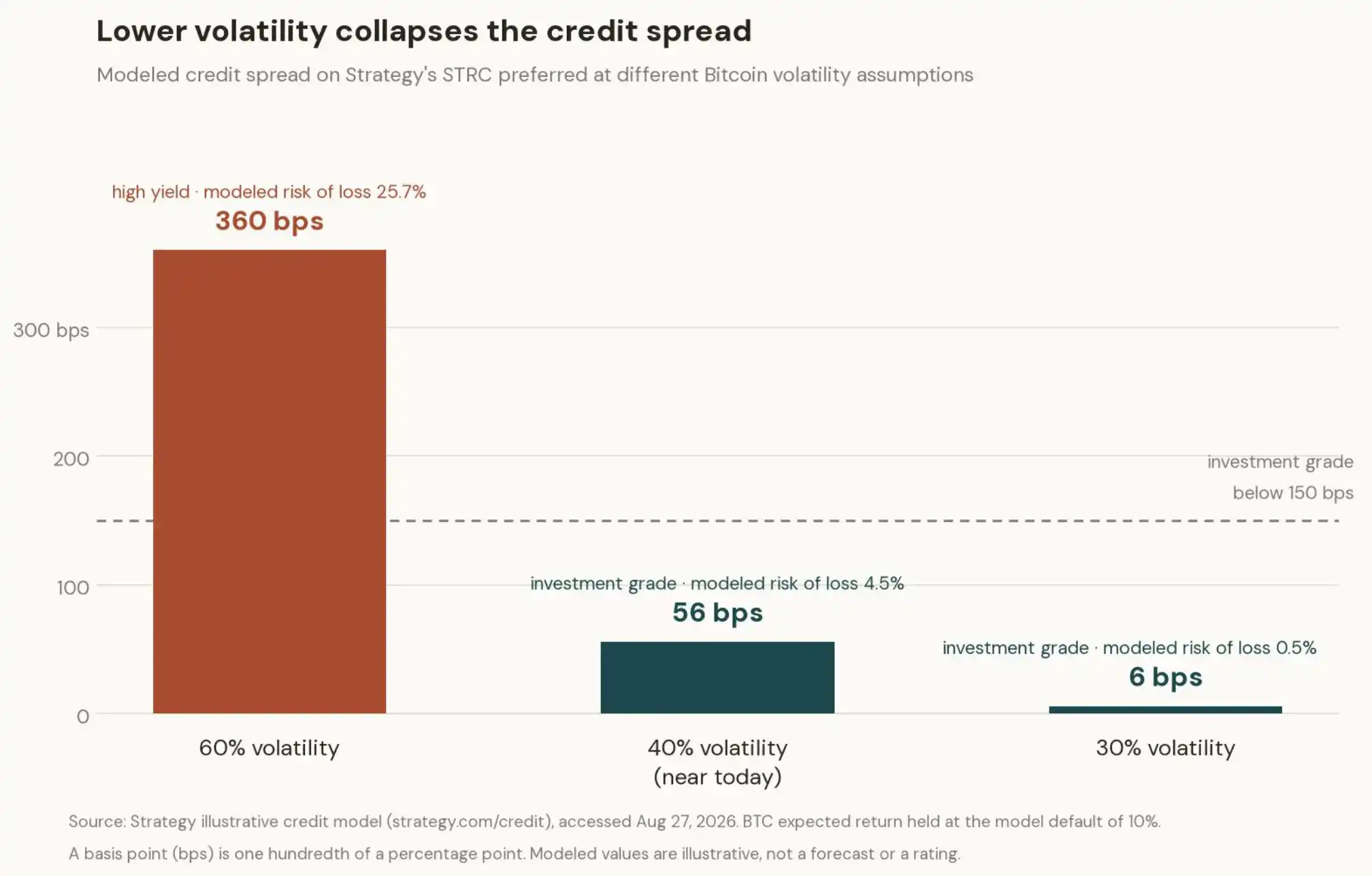
Lower volatility makes the same instrument appear less credit risky; lower credit risk typically means the financial system is willing to provide more capital.
The starting point is declining returns and volatility, but the result could be a re-acceleration of returns.
The Flywheel of Capital and Credit, Pushing Prices to Re-accelerate
When these factors combine, they create a self-reinforcing cycle.
Bitcoin continues to grow and mature, and volatility decreases accordingly. Improved risk-adjusted returns enable investors to deploy more capital. Enhanced collateral quality makes financing cheaper and more abundant. Dedicated capital and dollar-credit-fueled purchases begin to compete for the fixed supply of 21 million Bitcoins, pushing prices higher. Price increases, in turn, raise collateral values, unlocking more financing capacity, perpetuating the cycle.
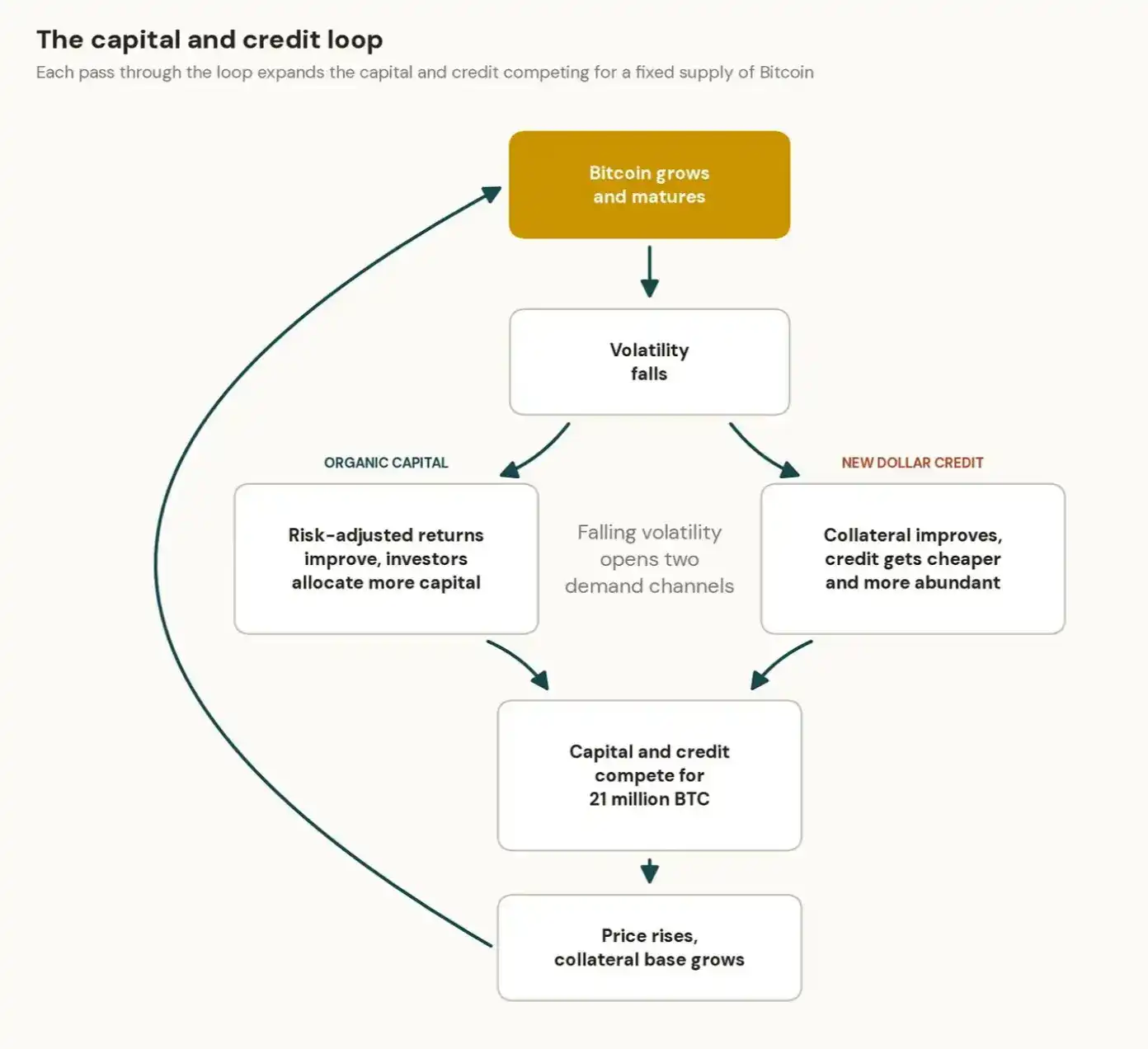
From a credit expansion perspective, this cycle resembles a speculative attack in macro-finance (borrowing a relatively weak currency to buy assets that are harder to dilute, forming a self-reinforcing trading mechanism).
Credit expansion could come from multiple paths. Banks can issue Bitcoin-backed loans, and as the Bank of England explained in "Money Creation in the Modern Economy," commercial banks create deposit money when they issue loans. Companies can also issue convertible bonds and perpetual preferred shares, using the proceeds to purchase Bitcoin. Both paths expand US dollar-denominated credit while removing more Bitcoin from market circulation.
The Moment of Breaking the Power Law
So, what would be the endpoint of this process?
New technology adoption typically follows an S-curve: slow initially, then rapid adoption, finally saturating. Many extrapolate from this that Bitcoin's price will follow the same curve and gradually flatten. But this overlooks that the USD side of the BTC/USD pair is not static: the pool of dollar funds and credit available to buy or finance Bitcoin can still expand.
The quantity of Bitcoin is fixed, but there is no fixed cap on the scale of dollar funds and credit available to purchase Bitcoin. Lower volatility allows more existing capital to reasonably allocate to Bitcoin; higher collateral quality strengthens the financial system's ability to expand dollar credit against it.
Even if Bitcoin's adoption rate eventually saturates, the amount of capital willing to hold Bitcoin directly or finance purchases of Bitcoin may continue to expand. The dollar-denominated price of Bitcoin could also re-accelerate, breaking upwards through the power law trajectory that described Phase Two.
This is Region Three in the metal fatigue curve. Cracks don't propagate forever at the speed described by Paris's law; they accelerate after reaching a critical point, ultimately causing fracture. Lower volatility first widens the space for capital allocation and credit expansion; when these forces begin competing for the fixed supply of Bitcoin, returns and upside volatility may simultaneously rebound.
In this analogy, the material under continuous stress is the US dollar credit system; the so-called "fracture" is the moment Bitcoin's dollar price breaks upwards through the power law.