Strive Buys Strategy Stock, Bitcoin Treasury Firms Begin Interlocking Dolls

marsbitPublicado em 2026-03-12Última atualização em 2026-03-12

Resumo

On March 11, Strive, a Bitcoin treasury company, announced it had purchased $50 million worth of preferred shares (STRC) issued by MicroStrategy (now Strategy)—another major corporate Bitcoin holder. This represents over one-third of Strive’s treasury. Both companies use raised capital to buy Bitcoin, and both issue high-yield preferred shares (SATA from Strive, STRC from Strategy) to fund these purchases. Strive’s Chief Risk Officer justified the move by claiming STRC offers better risk-adjusted returns than U.S. Treasuries. However, this creates a circular dependency: Strategy uses proceeds from STRC to buy Bitcoin, and Strive relies on Strategy’s Bitcoin performance to earn yield on its STRC investment—which it may use to buy more Bitcoin or pay dividends on its own SATA shares. Strive, founded in 2022, has rapidly accumulated 13,311 BTC (worth ~$930 million), making it a top-ten corporate Bitcoin holder. Its stock (ASST) has fallen 97% from its peak, trading far below its Bitcoin-backed NAV. Despite this, Strive continues to aggressively accumulate Bitcoin and raise dividends on SATA shares. This reflects a broader trend: over 200 companies now emulate MicroStrategy’s “Bitcoin treasury” strategy. As these firms begin investing in each other’s debt-like instruments, the ecosystem becomes increasingly interconnected—and vulnerable—to Bitcoin's price volatility.

Author: Curry, Deep Tide TechFlow

On March 11, a company called Strive announced several things.

It increased its Bitcoin holdings by 179 coins, bringing its total to 13,311 BTC, worth approximately $930 million. It raised the dividend yield on its own preferred stock, SATA, to 12.75%. And, it spent $50 million to buy Strategy's preferred stock, STRC.

$50 million—that's over one-third of Strive's corporate treasury.

What does Strive do? It hoards Bitcoin. What does Strategy do? It also hoards Bitcoin.

So this became: A company that hoards Bitcoin used one-third of its money to buy stock issued by another company that hoards Bitcoin.

Strive's Chief Risk Officer, Jeff Walton, posted a tweet saying STRC is a "high-quality credit product with good liquidity and a superior risk-reward ratio compared to traditional fixed income." Translation: We think this is better than government bonds.

He even did the math, saying that if this $50 million were used to buy U.S. Treasury bonds, the annual interest would be a few million. Buying STRC could yield an extra $3.9 million annually.

It sounds like a good deal.

But think about it: Where does the money from Strategy's STRC issuance come from?

Strategy raises funds by issuing STRC and uses that money to buy Bitcoin. STRC can pay you interest, provided Strategy's Bitcoin doesn't drop too much.

So the underlying logic of Strive's investment is: My hoarded Bitcoin will rise, his hoarded Bitcoin will also rise, and only if his Bitcoin rises can he pay me interest, which I then use to buy more Bitcoin.

This isn't called diversification; it's called nesting dolls.

In Case You Didn't Know Strive

Many people know about Strategy (the former MicroStrategy), but not many know about Strive.

But now this company holds 13,311 Bitcoin, worth about $930 million, just surpassing Tesla's holdings and ranking around tenth among global publicly listed companies.

Strive's founder is Vivek Ramaswamy, a second-generation Indian immigrant, Harvard undergraduate, Yale Law School graduate. In 2022, he and a high school classmate founded Strive in Ohio, focusing on asset management and issuing ETF funds.

Early investors included PayPal co-founder Peter Thiel and hedge fund manager Bill Ackman.

Within a year and a half of launch, its assets under management exceeded $1 billion. But Vivek didn't stay long; he resigned in early 2023 to run for U.S. President. He lost the Republican primary to Trump, and this year he switched to running for Governor of Ohio. Interestingly, both Trump and Musk showed support for him...

After Vivek left, the new CEO became Matt Cole, who previously managed $70 billion at the California Public Employees' Retirement System, coming from a traditional finance background. But last year he made a rather unconventional decision.

In September 2025, Cole announced Strive would transform from a fund company into a "Bitcoin treasury company." In one go, it spent $675 million to buy over 5,800 Bitcoin at an average price of $116,000. In the same month, it announced the acquisition of another listed company, Semler Scientific, merging to hold over 10,000 Bitcoin.

Half a year later, its holdings have now grown to 13,311 coins.
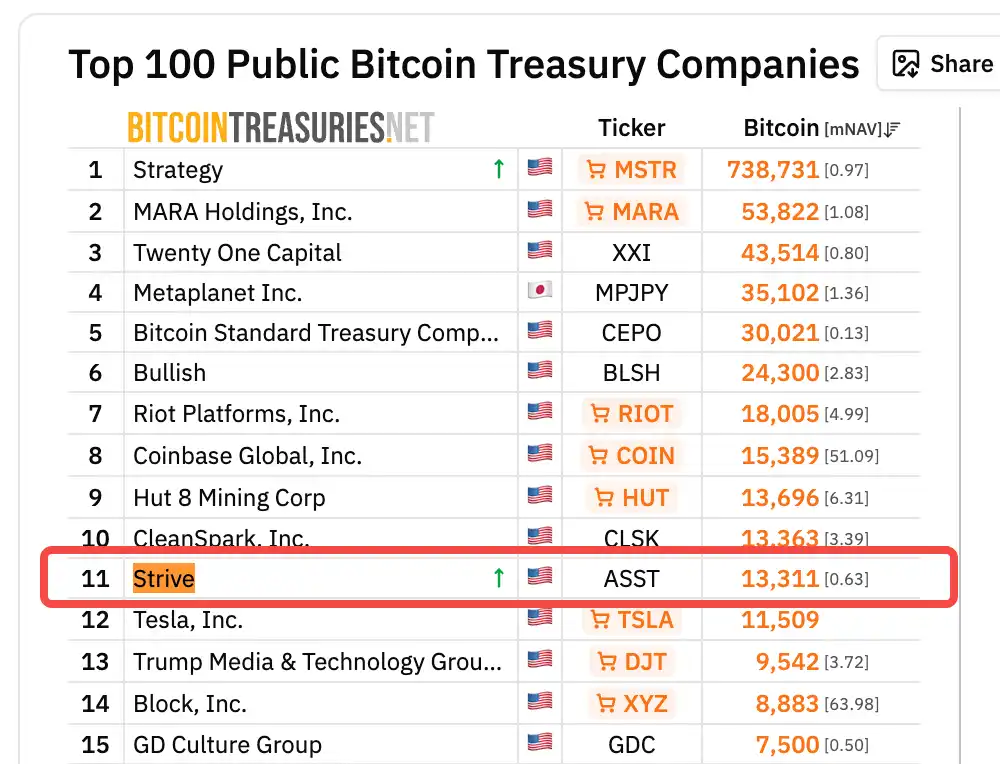
A fund company founded in 2022 transformed into one of the world's top ten corporate Bitcoin holders in just three years. The speed is so rapid it makes one ask a question:

What money was used to buy these Bitcoins?

Nesting Doll Stock Issuance

Where did Strive get the money to buy Bitcoin? It raised it by issuing stock.

Last November, Strive issued a type of preferred stock called SATA. Investors buy it, and Strive pays quarterly interest, currently at an annualized rate of 12.75%. The money raised is used by Strive to buy Bitcoin.

Strive didn't invent this playbook. The inventor is Michael Saylor.

Saylor's company, Strategy, holds over 730,000 Bitcoin, making it the world's largest corporate Bitcoin holder. Last year, he launched a similar product called STRC. Investors buy it, Strategy pays interest, currently at an annualized 11.5%. The money raised is also used by Strategy to buy Bitcoin.

Up to this point, the two companies were playing their own games, following the same logic, unrelated.

But the transaction on March 11 connected these two lines. Strive used $50 million to buy STRC.

The chain now looks like this:

Strategy issues STRC to raise money to buy Bitcoin. Strive buys their STRC to earn interest. Strive then issues its own SATA to raise money to continue buying Bitcoin and STRC.
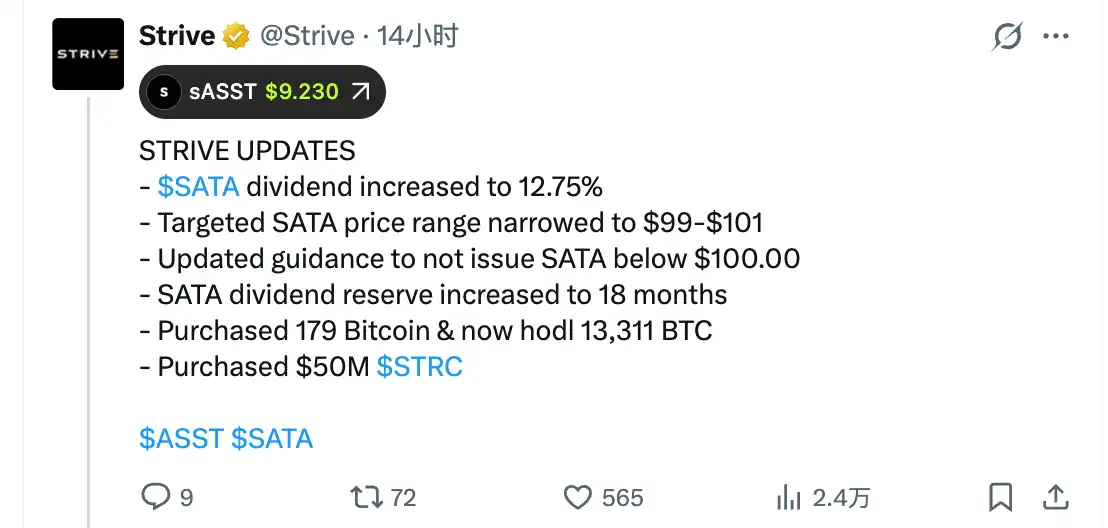
Layers upon layers, each layer paying investors double-digit interest, each layer's confidence to pay that interest stemming from the same thing: Bitcoin must not fall sharply.

If Bitcoin rises, everyone makes money. If Bitcoin falls, everyone's interest payments are at risk, but no single layer can stop losses independently because your asset is someone else's liability.

Three layers of products, three layers of interest, three layers of investors. Underneath it all, one asset: BTC, which must not fall.

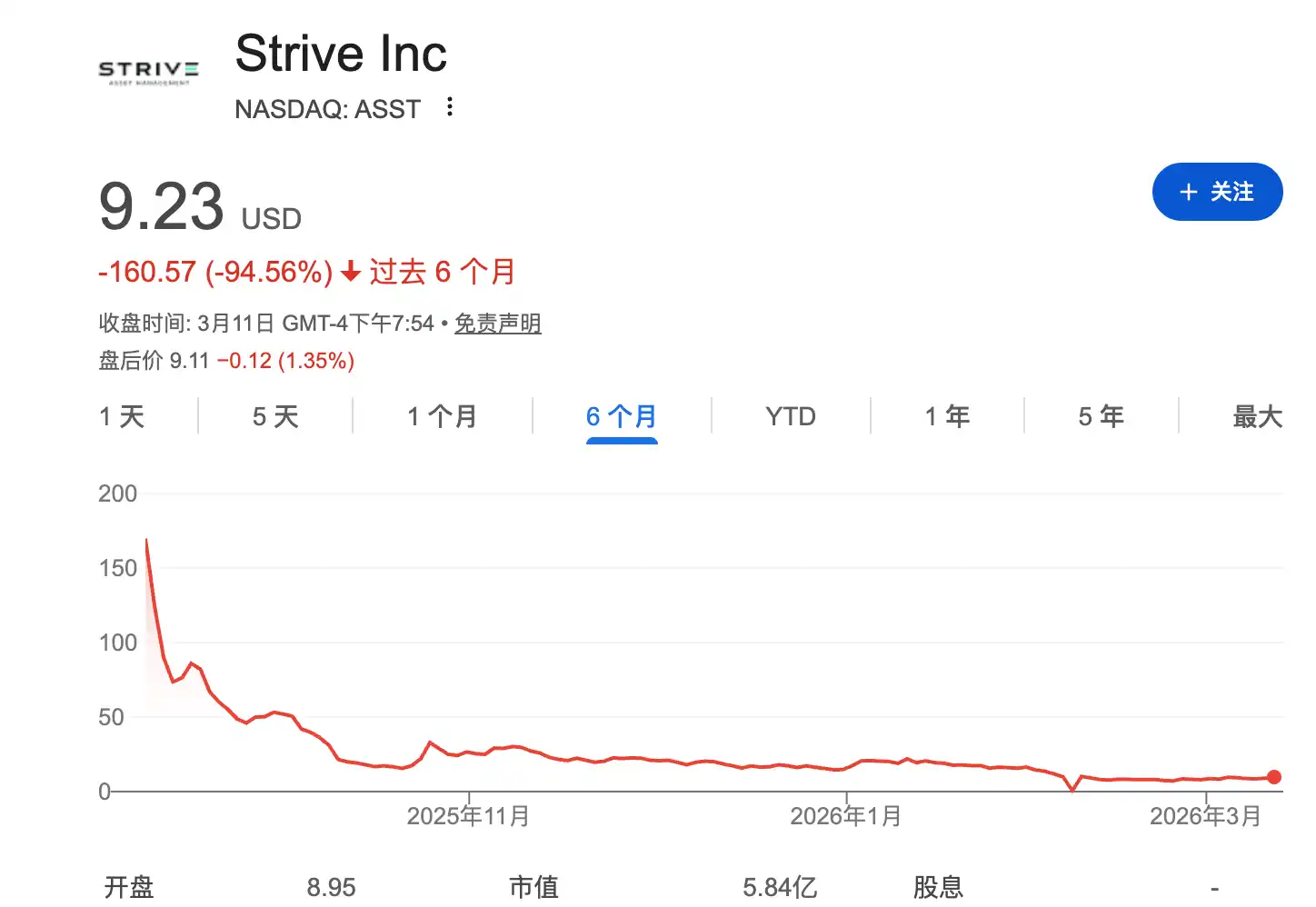
Meanwhile, Strive's own stock, ASST, had a 52-week high of $268 and is now trading at less than $9, down 97%. On the day it announced the STRC purchase (March 11), the stock price only rose 5.52%.

At the end of October last year, ASST once fell below $0.80, nearly 50% below its net asset value in Bitcoin.

So the picture is this: A company holding $930 million worth of Bitcoin has a market capitalization of just over $500 million. Its stock price is down 97% from its high. But management is doubling down—buying more Bitcoin, buying STRC, raising the SATA dividend.
However, Strategy's own stock, MSTR, has been falling for eight consecutive months this year. Bitcoin has also pulled back significantly from last year's highs.

But everyone in this chain is increasing their bets.

Strategy bought 66,000 new Bitcoins in the first two months of this year, more than in any full year before. Strive is increasing its Bitcoin holdings while also spending $50 million on STRC. SATA's dividend yield has been raised from 10% at issuance to 12.75%. STRC's dividend yield has also been raised from 10% to 11.5%.

Rising interest rates mean it's getting harder to retain investors—they have to pay more.

Data shows that there are now over 200 publicly listed companies globally that have announced adopting the "Bitcoin treasury strategy." Before 2025, this number was less than 30.

Saylor invented a new game, and 200 companies copied the homework. Now, they're starting to buy each other's issued products.

When everyone's bet is on the same table, the difference between "structured financing" and "concentrated gambling" might just be a few extra arrows on a PowerPoint slide.


Perguntas relacionadas

QWhat did Strive announce on March 11th regarding its Bitcoin holdings and investment activities?

AOn March 11th, Strive announced it had purchased an additional 179 bitcoins, bringing its total holdings to 13,311 BTC (worth approximately $930 million). It also raised the dividend yield on its preferred stock (SATA) to 12.75% and invested $50 million in Strategy's preferred stock (STRC).

QWhat is the core business model of both Strive and Strategy, and why is Strive's investment in STRC considered a 'nested doll' strategy?

ABoth Strive and Strategy are Bitcoin treasury companies, meaning their core business is accumulating and holding Bitcoin. Strive's investment in Strategy's STRC stock is considered a 'nested doll' or circular strategy because Strive is using capital (raised from its own SATA stock) to buy a financial product (STRC) whose returns are dependent on Strategy's Bitcoin holdings performing well. This creates a layered financial structure where the success of each company's debt payments is ultimately tied to the same underlying asset (Bitcoin) not decreasing in value.

QWho is the founder of Strive, and what notable shift did the company undergo in 2025?

AStrive was founded by Vivek Ramaswamy. In September 2025, under new CEO Matt Cole, the company underwent a significant shift, transforming from an asset management firm into a 'Bitcoin treasury company.' It purchased over 5,800 bitcoins for $675 million and later merged with Semler Scientific, pushing its total holdings above 10,000 bitcoins.

QHow does the financial structure involving SATA and STRC create risk for investors?

AThe structure creates significant concentration risk. Both SATA (from Strive) and STRC (from Strategy) pay high dividend yields (12.75% and 11.5% respectively), which are funded by the companies' Bitcoin holdings. If the price of Bitcoin falls substantially, it could jeopardize both companies' ability to service their debt and pay these dividends. Since Strive is investing in Strategy's debt, the risk is interconnected; a failure at one company could impact the other, and all investors are ultimately exposed to the volatility of a single asset.

QWhat does the 97% decline in Strive's stock price (ASST) indicate about market sentiment towards its strategy?

AThe massive decline in Strive's stock price (ASST), from a 52-week high of $268 to under $9, indicates extremely negative market sentiment. It suggests that investors are skeptical of the company's Bitcoin-focused business model and its high-yield financing strategy (SATA), valuing the company significantly below the net asset value of its Bitcoin holdings.

Leituras Relacionadas

Agent Race Ends, Super Workbench Takes Over

The era of fragmented AI agents is ending. Over the past month, China's tech giants—Tencent, Alibaba, and ByteDance—have simultaneously shifted strategy: instead of launching new, standalone AI agents, they are consolidating their various agent projects into unified "super workbenches." Tencent integrated its QClaw teams into WorkBuddy, a strategic product hailed as a potential third flagship after QQ and WeChat. Alibaba is merging its QoderWork, Wukong, and MuleRun agents into a new "Qianwen Office" platform under DingTalk's leadership. ByteDance rebranded its TRAE SOLO coding agent to TRAE Work, signaling a broader focus on workflow collaboration. This convergence marks a pivotal industry consensus. The initial exploration phase, where companies rapidly built numerous overlapping agents for different scenarios, proved costly and inefficient. With open-source tools eroding technical barriers, competition has shifted from agent creation to resource consolidation and cost control. Historically, platform wars are won not by creating more products, but by simplifying them—as seen with browsers unifying web access and super-apps consolidating services. Now, the "super workbench" aims to become the unified AI entry point for work. This reflects a deeper market realization: the primary audience for AI is no longer just programmers (a market in the tens of millions) but all knowledge workers (a market of billions). The real opportunity lies in augmenting everyday tasks—managing emails, documents, data, and meetings—across the entire workday. The core battleground is becoming control over the primary AI entry point that employees use daily. Tencent's WorkBuddy leverages WeChat and Tencent Docs; Alibaba's Qianwen Office taps into DingTalk's organizational data; ByteDance's TRAE Work integrates with Feishu's workflows. Whoever owns this "super workbench" gains strategic control over orchestrating enterprise data and APIs. This shift is redefining enterprise software. Traditional SaaS applications, valued for their user interfaces, will recede into the background. Their core functionalities will be exposed as standardized "Skills" or APIs for the super workbench's agents to invoke. Software value will shift from selling user seats to charging based on API calls and outcomes delivered. The evolution of agents is moving through clear stages: first as novel standalone products, then as consolidated primary work entry points, and finally as pervasive, invisible capabilities embedded into the digital fabric. The recent moves by major tech firms signal the transition from the first stage into the second, accelerating toward the third. In the end, the most successful agent technology may become invisible—like electricity or the HTTP protocol—a fundamental, unnamed infrastructure powering work itself.

marsbitHá 12m

Agent Race Ends, Super Workbench Takes Over

marsbitHá 12m

Michael Saylor: 110 Reasons to Oppose BIP-110

Michael Saylor presents 110 arguments against Bitcoin Improvement Proposal (BIP) 110, a soft fork aimed at restricting certain non-monetary data storage uses (like inscriptions) on the Bitcoin blockchain. He acknowledges the proponents' valid concerns—such as node costs, fee pressure, and preserving Bitcoin's monetary focus—but fundamentally disagrees with the proposed solution. Saylor argues that BIP 110 represents a dangerous precedent of using consensus rules to enforce value judgments on transaction validity, moving away from Bitcoin's core principles of neutrality and permissionless innovation. His key objections are organized into eleven categories: 1) It violates neutrality and hard consensus by banning currently valid transactions. 2) It fails to meet the high burden of proof required for a consensus change, lacking concrete data on the alleged crisis. 3) Its seven bundled technical restrictions are overly broad, targeting generic script functionalities and blocking future upgrade paths. 4) It sacrifices compatibility and future optionality by closing off designed upgrade hooks. 5) Its temporary rules add significant complexity (grandfathering, expiry states) without sufficient justification. 6) The economic and security impacts, particularly on miner revenue and fee markets, are uncertain and unmodeled. 7) Superior, market-based tools (fee markets, relay/mining policies) already exist to manage blockchain load. 8) It stifles innovation by creating a chilling effect for developers. 9) Its modified activation mechanism (55% threshold, forced signaling) is aggressive and risks network splits. 10) The precedent it sets—using consensus to suppress disliked but legal uses—is more dangerous than the problem it aims to solve. 11) A better path exists: improving measurements, refining resource-based policies, and allowing market forces to work. Saylor concludes that Bitcoin's strength lies in its neutral rules, open markets, and hard consensus. Changing these foundational elements to target specific use cases is an unnecessary and risky "iatrogenic" intervention. He advocates for guarding Bitcoin's neutrality rather than acting as its redeemer.

marsbitHá 27m

Michael Saylor: 110 Reasons to Oppose BIP-110

marsbitHá 27m

Trading

Spot
活动图片

