STRC Severely Unpegged, What Risks Is the Market Pricing In?

marsbitPublicado em 2026-06-18Última atualização em 2026-06-18

Resumo

The article analyzes the recent significant de-pegging of Strategy's perpetual preferred stock, STRC, whose price fell to approximately $89, far below its $100 face value. This discount has pushed its simple yield to around 12.9%, creating a paradox. The stock was designed as a high-yield instrument trading near par, and Strategy maintains an 11.5% annual dividend, even recently switching to semi-monthly payments to support the price. The author explores several reasons why the high yield hasn't attracted enough buying pressure to restore the par value. A key factor is potential reverse deleveraging from carry trades, where leveraged investors may be forced to sell due to margin calls as the price falls, creating a self-reinforcing downward spiral. Additionally, the tokenization and integration of STRC into DeFi protocols (like Apyx, Saturn, Pendle) have introduced faster, more transparent, and potentially more volatile price adjustment mechanisms through leverage and yield-splitting products. The emergence of a competing product, Strive's SATA, offering a 13% yield with daily dividends, has also changed the yield benchmark, challenging STRC's unique high-yield narrative. Furthermore, the market is questioning the distinction between Strategy's substantial Bitcoin reserves, which provide long-term balance sheet coverage, and the certainty of stable near-term cash flow for dividends. Ultimately, the price dip represents a stress test for this type of BTC-backed, high-yield ...

TL;DR

Over the past two days, Strategy's perpetual preferred shares, STRC, have fallen to around $89, significantly deviating from their $100 par value. This has pushed its current simple yield at the current price to about 12.9%.

The anomaly lies in the fact that STRC was originally designed as a high-yield instrument trading around par value. Strategy maintains an 11.5% annualized dividend, and shareholders approved a change in the dividend payment frequency from monthly to semi-monthly on June 8th. The public implementation is expected to start in July, with the first semi-monthly payment date projected for July 15th, pending declaration by the board. Intuitively, more frequent payouts should help pull the price closer to $100.

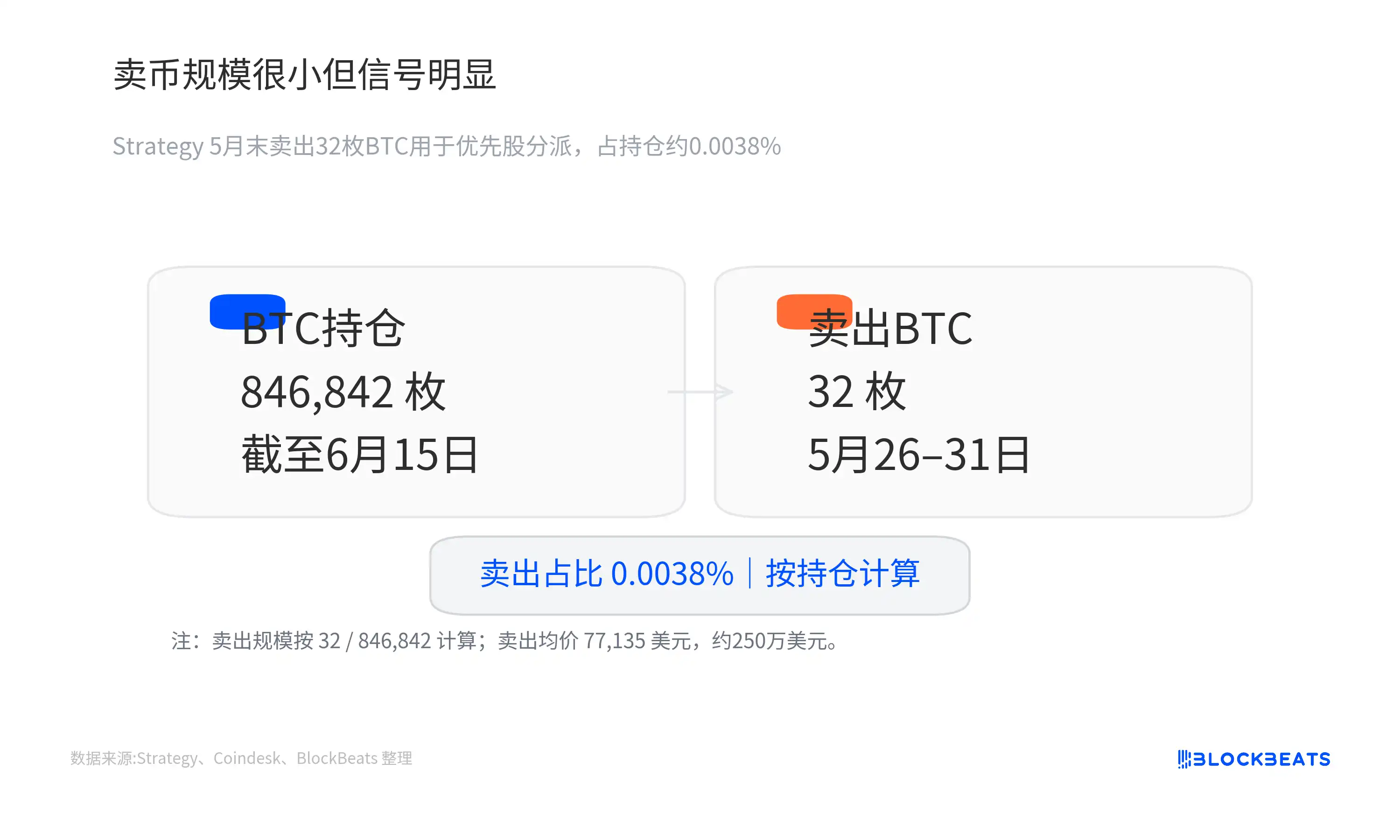
The market hasn't priced it that way. Strategy and Michael Saylor emphasize the asset coverage logic: as of June 15th disclosure, the company holds 846,842 BTC. Their credit metrics page shows BTC Years of Dividends is about 31.6 years, and the STRC BTC Rating is 3.1x. The market's concern expressed by the $89 price is a different layer: these high-yield financing tools backed by BTC reserves bear higher leverage, liquidity, competition, and cash flow discount risks.

For holders, the question isn't whether 12.9% looks high enough, but why the high yield isn't pulling the price back to par. This determines whether STRC's current discount is a temporary mispricing or the starting point for a new risk premium.
High-Yield Assets Can Also Trigger Reverse Deleveraging

After STRC fell to $89, one of the most discussed explanations in the market is the potential unwinding of carry trades.

Carry trade refers to borrowing low-cost funds to buy high-yield assets. Investors borrow USD or stablecoin funds to buy STRC, profiting from the spread between the 11.5% nominal dividend and their funding cost. As long as STRC hovers around $100, this trade appears stable and backed by Strategy's BTC narrative.

The risk appears when the price anchor loosens. Once STRC falls from around $100 to $95, $92, $89, the risk management logic for leveraged accounts changes. Some investors may need to post additional margin, reduce positions, or even sell STRC to repay loans. Selling pressure drives the price down further, which triggers more risk controls, leading to a self-reinforcing selling cycle even for a high-yield asset.

Boundaries should be maintained here. Currently, there's no public data at the exchange, brokerage, or custodian level proving large-scale institutional liquidations. A more accurate statement is that if STRC's high-yield stability narrative attracted sufficient leveraged capital over the past few months, the decline to around $89 may not be solely a fundamental revaluation, but also include mechanical deleveraging.

This explains why a higher yield doesn't necessarily immediately bring in buyers. For unleveraged cash buyers, 12.9% is more attractive. For leveraged buyers, the price drop first brings margin pressure; the higher yield may not be realized in time.

On-Chain Wrapping Amplifies Price Adjustments

A new variable for STRC is that it no longer exists solely in traditional brokerage accounts but has also been wrapped into DeFi yield and leverage structures.
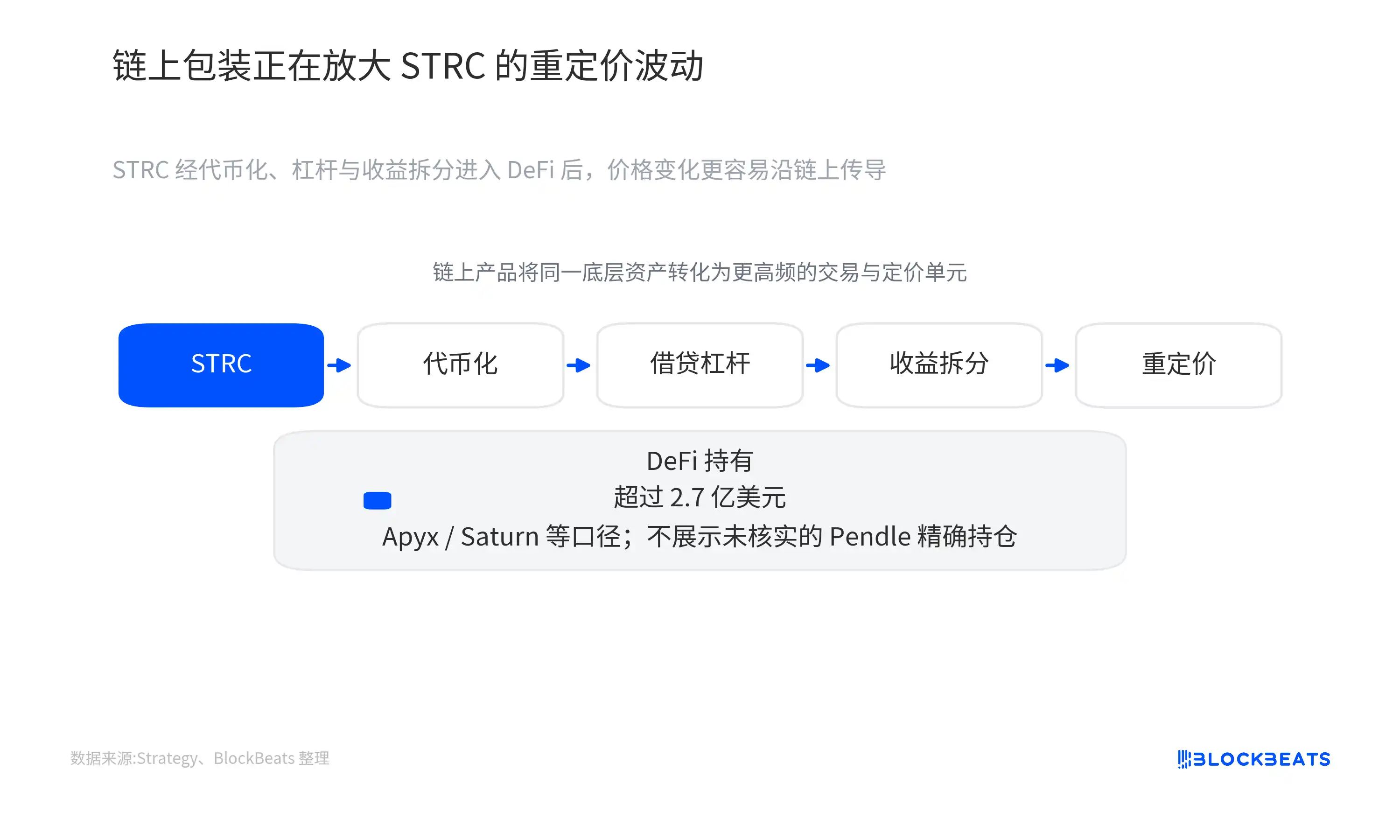
Preferred shares are inherently relatively slow assets: periodic dividends, secondary market trading, and price fluctuation around yield. When STRC is tokenized and enters lending, leverage, and yield-splitting systems, it connects to the faster liquidation and speculation mechanisms of the crypto market.

Protocols like Apyx, Saturn, Pendle have already built various forms of on-chain products around STRC. Saturn tokenizes it into an interest-bearing asset, Apyx offers leveraged yield aggregation, and Pendle can split the asset into PT (Principal Token) and YT (Yield Token) components. Investors can not only buy STRC itself but also trade the discounted principal or the rights to future dividends.

In plain terms, this is akin to splitting a traditional high-yield preferred share into multiple layers of crypto yield components. Some buy stable yield, some add leverage to amplify APY, and some bet solely on future dividends. Capital efficiency increases, but so does fragility. Once the underlying asset price drops, on-chain collateral ratios, borrowing positions, and yield token prices may adjust simultaneously.

A more prudent current assessment is that STRC has entered the on-chain yield, leverage, and splitting ecosystem. Strategy's documentation mentions sizes like Apyx (~$280M), xSTRC (~$83M), and STRC-backed stablecoins (~$70M). Pendle-related pools and trading also have notable size, though public information is insufficient to support claims of vault holdings reaching hundreds of millions of dollars.

Therefore, DeFi wrapping is better understood as a volatility amplification channel. It may not be the first domino to fall, nor can it directly prove this decline was led by on-chain liquidations. But it makes the originally slower price adjustment faster, more transparent, and more susceptible to repeated trading by leveraged capital.

SATA Changes the Yield Benchmark

Part of STRC's past appeal came from scarcity. It was a key product within the Strategy BTC financing system targeting yield-seeking capital, combining high yield, the BTC narrative, and a relatively clear par value anchor.

The emergence of SATA weakens this scarcity. According to Coindesk, Strive's SATA offers a 13% annualized yield and switched to distributing dividends every business day starting June 16th. Compared to STRC, SATA is smaller in scale and less liquid; it cannot be simply considered a direct replacement of the same magnitude. However, for purely yield-seeking capital, it provides a new benchmark for comparison.
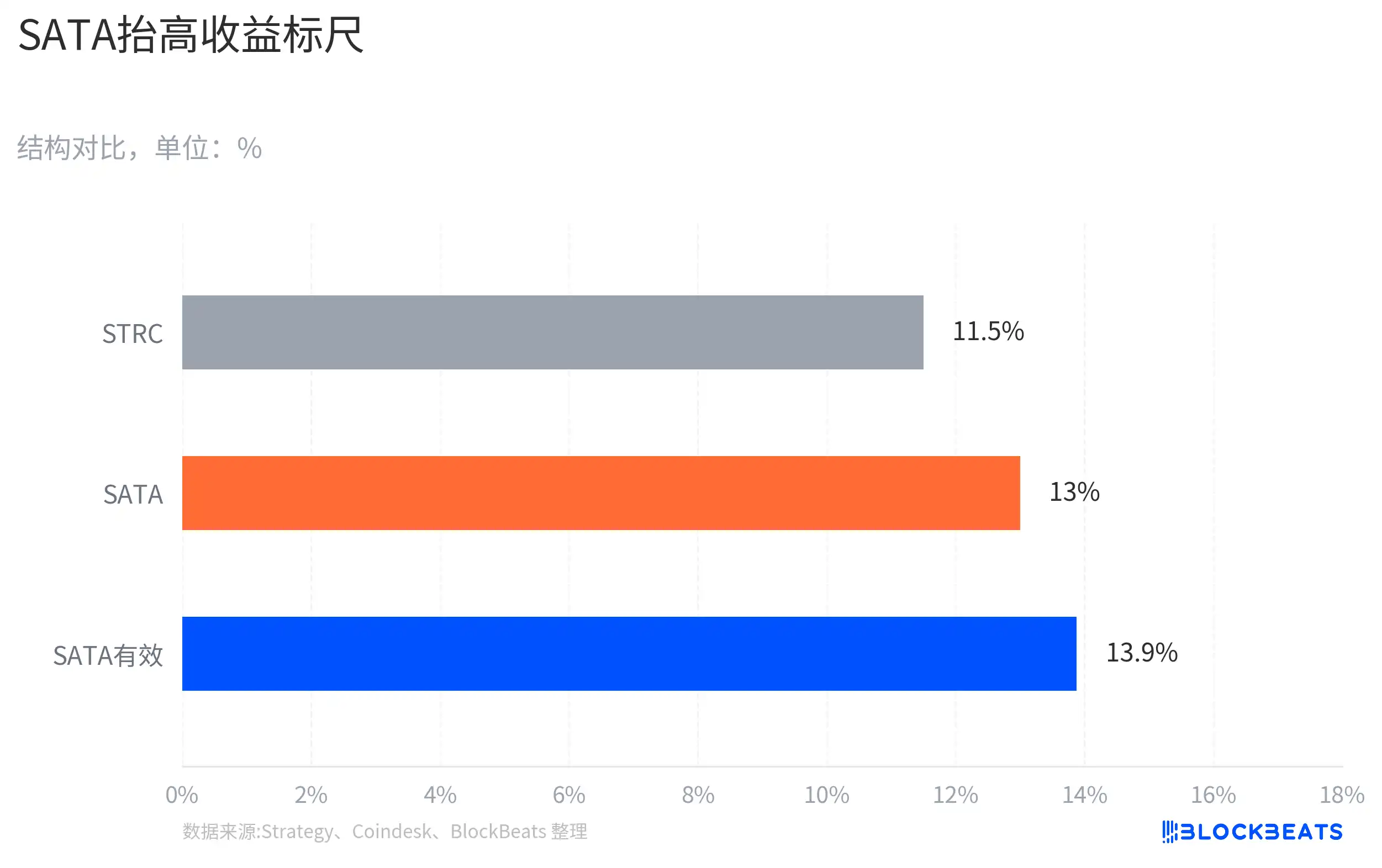
This impact doesn't require the premise that capital has already flowed massively from STRC to SATA. Yield-seeking capital will compare nominal yield, payout frequency, liquidity, issuer credit, asset coverage metrics, and secondary market discounts. As long as the market sees a benchmark offering higher yield and more frequent payouts, STRC's original "unique high-yield BTC instrument" narrative gets re-evaluated.

Around $100, STRC's 11.5% might have been attractive enough. But when the price falls to $89, the question becomes: Is the current simple yield of 12.9% sufficient compensation for Strategy's financing structure, BTC volatility, potential leverage squeeze, and cash flow uncertainty?

STRC's former anchor was "Strategy + BTC reserves + $100 par." The market now incorporates a yield curve of similar products. When a similar product offers higher nominal yield and more frequent payouts, for STRC to return to par, it needs stronger buying, clearer expectations of rate adjustments, or reduced leverage pressure.

Parity Mechanism Faces Cash Flow Scrutiny

STRC can be understood as a high-yield preferred share with no maturity date, anchored to a $100 par value. It has no fixed principal repayment date. Investors mainly look at two things: whether dividends can be sustained, and whether the secondary market price can stay near par.

Strategy designed an adjustable dividend mechanism for STRC. It's not a fixed-coupon preferred share leaving pricing entirely to the market; the company can adjust the dividend level monthly, aiming to keep the price around $100. Shareholder approval for the semi-monthly payment arrangement follows the same price stabilization logic: shortening the dividend waiting period, reducing uncertainty for yield-seeking capital.

Another layer of backing provided by the Saylor system is the BTC reserve. Strategy packages STRC as a special security: not a regular bank preferred share, nor a pure crypto token, but a high-yield financing tool backed by one of the world's largest corporate BTC holdings.

But asset coverage does not equate to cash flow without risk. The ~31.6 years of dividend coverage indicates a balance sheet buffer, reliant on BTC price, financing capability, and the company's long-term capital market access. It doesn't guarantee stable operating cash flow for each dividend period, nor does it mandate that the secondary market price must return to $100.

Strategy's June 1st disclosure showed that between May 26th and 31st, it sold 32 BTC at an average price of ~$77,135, totaling ~$2.5 million, for dividend-related arrangements. This scale is a tiny fraction of the holdings, hardly indicative of reserve pressure. But it reminds the market to distinguish between two things: having a large amount of BTC, and having stable cash flow.

Whether the Parity Anchor Can Be Restored Determines Financing Cost

The most important test for STRC now is not the ~31.6-year coverage claim itself, but whether Strategy will use actual mechanisms to pull the price back towards $100.

If Strategy continues to maintain an 11.5% annualized dividend while STRC remains in the $90 range for an extended period, the market may conclude the company tolerates higher financing costs, or that the adjustable dividend mechanism is not immediately repairing the unpegging. Conversely, if the company further increases the dividend rate, adjusts issuance pace, or uses other methods to boost secondary market confidence, $89 is more likely to be seen as an excessive discount following a deleveraging wave.

The on-chain side also needs monitoring. Whether STRC-related positions in Apyx, Saturn, Pendle, etc., cool down, and whether collateral and yield-splitting trades stabilize, will determine if the DeFi amplifier continues to add volatility or becomes a source of demand again post-deleveraging. The size and liquidity of SATA are also crucial. If it remains a small-scale high-yield benchmark, its impact on STRC stays largely in valuation comparison; if it continues to scale while maintaining the appeal of daily business-day payouts, STRC's scarcity discount will be harder to eliminate.

For investors, $89 is not simply a cheap tag, nor definitive proof of Strategy's model failure. It's more like a stress test: when BTC reserves, high nominal yield, on-chain leverage, and competing products are all presented to the market, what yield investors are ultimately willing to accept to hold such instruments. The next dividend adjustment, whether STRC can return near par, and whether leveraged positions continue to unwind, will answer this question better than the coverage period declaration.


Perguntas relacionadas

QWhy has STRC, a perpetual preferred share designed to trade around par, recently fallen to around $89, significantly below its $100 face value?

ASTRC's recent price drop below par is attributed to a combination of factors: potential reverse unwinding of carry trades causing mechanical deleveraging as prices fall, amplification of price adjustments through DeFi wrapping and leverage structures, competition from newer high-yield instruments like SATA which offer higher nominal yields and more frequent payments, and market concerns about the distinction between MicroStrategy's substantial BTC asset coverage and the actual sustainability of short-term dividend cash flows.

QHow does the concept of 'carry trade reverse unwinding' potentially explain STRC's price decline despite its attractive yield?

AA carry trade involves borrowing at low cost to buy high-yield assets like STRC. When STRC's price falls significantly from par, leveraged investors face margin calls, forcing them to sell STRC to cover positions. This selling pressure drives the price down further, triggering more forced selling. Thus, the rising yield (to ~12.9%) doesn't immediately attract new buyers because for leveraged holders, the price drop creates a pressing liquidity/risk management crisis that overshadows the now-higher yield.

QWhat role does DeFi wrapping play in the price dynamics of STRC?

ADeFi wrapping (through protocols like Apyx, Saturn, and Pendle) tokenizes STRC and integrates it into lending, leverage, and yield-splitting systems. This increases capital efficiency but also vulnerability. It connects STRC to the faster, more transparent, and often leveraged mechanisms of the crypto market, amplifying price adjustments. A decline in the underlying STRC price can trigger simultaneous adjustments in on-chain collateral ratios, loan positions, and the pricing of future yield rights, accelerating and magnifying volatility.

QHow does the emergence of SATA (Strive Asset Management's product) impact the valuation of STRC?

ASATA introduces a new point of comparison for yield-seeking capital. By offering a higher nominal yield (13% vs. 11.5%) and more frequent dividend payments (daily business days vs. monthly/semi-monthly), it challenges STRC's narrative as a uniquely attractive high-yield BTC-backed instrument. This doesn't require massive capital flight from STRC to SATA; its mere presence forces the market to re-evaluate whether STRC's current yield adequately compensates for its specific risks, thereby weakening its scarcity premium and making a return to the $100 par anchor more difficult.

QWhat is the key factor that will determine if STRC's price can return to its $100 par anchor?

AThe key factor is MicroStrategy's response and the market's perception of its commitment to the price stabilization mechanism. If the company takes concrete actions—such as significantly raising the dividend rate, adjusting issuance, or using other methods to boost secondary market confidence—the current discount could be seen as temporary. Conversely, if STRC remains discounted for an extended period while the dividend stays unchanged, the market may interpret it as MicroStrategy accepting a higher cost of capital or the stabilization mechanism being ineffective, solidifying the new risk premium.

Leituras Relacionadas

After Three Consecutive Quarters of Decline, Can the Crypto Market Find a Window for Stabilization in Q3?

The cryptocurrency market has just concluded its worst-performing quarter since 2022, with total capitalization dropping 12.6% to $2.1 trillion. All core metrics indicate capital is leaving the sector, not just rotating within it. Bitcoin fell 14.2% and Ethereum dropped 25.4% in Q2, breaking their previous correlation with US tech stocks. A key driver is the reversal in US spot Bitcoin ETF flows, which saw a net outflow of approximately $4.67 billion in Q2, including a record monthly outflow near $4.5 billion in June. While recent data suggests long-term holders are accumulating again, sustained ETF outflows mean continued selling pressure. Market focus is now singularly on the Federal Reserve. The upcoming July FOMC meeting is seen as the most critical event for Q3. A dovish signal could support Bitcoin reclaiming a $68,000-$84,000 range, while a hawkish stance might establish a new trading band around $50,000-$56,000. Additionally, regulatory uncertainty persists, with the progress of the crucial *CLARITY Act* stalling in the Senate, reducing its perceived 2026 passage probability to 40-45%. Despite the broad downturn, a few sectors showed growth. Prediction markets saw nominal volume surge 48.7% year-over-year to $113.8 billion, and tokenized collectibles transaction volume rose 143% quarterly to $1.4 billion. The Real-World Asset (RWA) tokenization sector also continued steady growth, now representing ~$28.1 billion in on-chain value. The market's foundation for an extreme crash appears limited, with Bitcoin price hovering near its 200-week moving average. However, the trading paradigm has shifted from narrative-driven speculation to decisions based on price action, policy developments, and interest rate expectations, making a broad sentiment-driven rally unlikely in the near term.

marsbitHá 15h

After Three Consecutive Quarters of Decline, Can the Crypto Market Find a Window for Stabilization in Q3?

marsbitHá 15h

BIT Trading Moment: BTC Still Suppressed by Weekly 200 EMA, Rejection May Restart Decline; Storage and Semiconductors that Surged Last Night Begin Falling in Evening Trading

**Crypto & Stock Market Wrap: Bitcoin Tests Resistance, Stocks Retreat After AI Surge** Bitcoin consolidates around $66,000, facing key resistance near $68,000—an area seen as a major psychological and technical hurdle where previous rallies have failed. Analysts note the cryptocurrency is caught between its 200-week moving average (~$63,333) and 200-week EMA (~$68,328). A clear break above $68k is needed to signal a stronger bullish trend, while a rejection could lead to a retest of $63k support. Market sentiment remains cautious, with low futures open interest pointing to a low-liquidity rebound rather than a full bull market. Bitcoin spot ETFs saw another $203 million inflow. US stock futures pointed lower after a strong Tuesday session led by a massive rebound in semiconductors and memory stocks. The rally was fueled by renewed optimism about AI-driven hardware demand, with Micron, SanDisk, and SK Hynix surging. However, those gains reversed in pre-market trading. Super Micro Computer (SMCI) soared over 20% after hours on strong guidance and a record backlog. Other standouts included Rocket Lab and nuclear energy plays Oklo and X-Energy. Rising oil prices (Brent above $91) and climbing Treasury yields (10-year near 4.64%), however, are reigniting inflation concerns and acting as a headwind for equities. In Asia, markets were mixed. South Korea's KOSPI pared early gains to close slightly higher as semiconductor stocks like SK Hynix gave back initial surges. Japan's Nikkei edged lower as the yen hit a fresh 38-year low against the dollar, raising fears of potential market intervention. Key events to watch include the Samsung Galaxy launch, AMD's AI event, and a slew of major tech earnings from Alphabet, Tesla, and IBM after the close on Wednesday, followed by the ECB meeting and Intel's earnings on Thursday.

marsbitHá 15h

BIT Trading Moment: BTC Still Suppressed by Weekly 200 EMA, Rejection May Restart Decline; Storage and Semiconductors that Surged Last Night Begin Falling in Evening Trading

marsbitHá 15h

Former CFTC Chairman, Circle President Tarbert: Preaching Long-Termism While Cashing Out $30 Million Himself

Former CFTC Chairman and Circle President Heath Tarbert has consistently advocated for a long-term vision in public, urging patience from investors as Circle’s stock price has fallen significantly from its peak. However, it has been revealed that since Circle’s IPO, Tarbert has continuously sold his CRCL shares through pre-arranged trading plans, cashing out approximately $30 million, without making any public market purchases. This contrast between his public messaging and personal actions has drawn criticism. Tarbert joined Circle in July 2023 as Chief Legal Officer, leveraging his regulatory experience to help guide the company through its IPO and expansion. Despite promoting stablecoins as long-term infrastructure, he established a 10b5-1 trading plan just before Circle went public, leading to substantial stock sales over the following year. In March 2026, he initiated another plan to sell more shares. His career trajectory highlights a pattern of moving between high-level regulatory roles and influential positions in the financial sector. After resigning as CFTC Chairman in early 2021, he joined Citadel Securities as Chief Legal Officer just 27 days later, during a period of intense regulatory scrutiny for the firm. He later joined Circle, aiding its efforts to navigate regulatory challenges for its public listing. While Tarbert's expertise in policy and compliance is valuable to companies like Circle, his actions—advocating long-term confidence while personally divesting—raise questions about the alignment between his public statements and his private financial decisions, leaving investors who followed his advice to bear the market risks.

marsbitHá 15h

Former CFTC Chairman, Circle President Tarbert: Preaching Long-Termism While Cashing Out $30 Million Himself

marsbitHá 15h

Gate Research Institute: The 'Wall Street-ization' Wave of Crypto Financial Products – Competition or Integration?

The article titled "Gate Research Institute: Are Crypto Financial Products Sparking a 'Wall Street' Wave—Competition or Convergence?" explores the evolving relationship between the crypto ecosystem and traditional finance (TradFi). The piece begins by reflecting on Bitcoin's original 2009 vision of decentralization, disintermediation, and moving away from banks. It then contrasts this with the 2024 landscape, where key crypto assets like Bitcoin are increasingly held through Wall Street products like ETFs issued by giants like BlackRock. The article questions whether this signifies that TradFi is systematically taking over the rights to issue, price, custody, and distribute crypto financial assets. The core argument is that this is not a zero-sum takeover but rather a bidirectional convergence where each side addresses the other's weaknesses. Crypto offers 24/7 global markets, programmable settlement, and open access but lacks compliant channels, institutional-grade custody, deep fiat liquidity, and mainstream distribution. TradFi possesses these but is constrained by legacy systems, limited operating hours, and slow settlement. Two primary convergence paths are highlighted: * **Path A (CEX to TradFi):** Exemplified by Gate, which has progressed from offering tokenized stocks and CFDs to providing direct, real stock trading (US, Hong Kong, South Korea) within its platform, using USDT. * **Path B (TradFi to Crypto):** Exemplified by Robinhood, which has integrated crypto trading, acquired exchanges like Bitstamp, and is moving traditional assets like stocks onto the blockchain via tokenization and its own Layer 2. Both paths are ultimately competing to become the next-generation, unified financial account—a "super account" where users can seamlessly trade cryptocurrencies, stocks, ETFs, RWA (Real World Assets), and tokenized treasury products in one interface. The growth of RWA and tokenized treasuries (e.g., BlackRock's BUIDL) is presented as the asset-layer fusion, providing stable, yield-bearing assets on-chain and acting as a bridge between the two worlds. In conclusion, the "Wall Street-ization" of crypto is framed as a mutual transformation. Decentralized ideals persist in the protocol layer, while at the application layer, a more efficient, global, and accessible unified capital market is emerging from this convergence. The future competition lies not between crypto exchanges and stockbrokers, but between platforms vying to offer the most comprehensive asset coverage, liquidity, and user experience within a single account.

marsbitHá 16h

Gate Research Institute: The 'Wall Street-ization' Wave of Crypto Financial Products – Competition or Integration?

marsbitHá 16h

Trading

Spot
活动图片




