Strategy Watch: February

insights.glassnodePublicado em 2026-03-03Última atualização em 2026-03-03

Resumo

Glassnode launches Strategy Watch, a monthly newsletter analyzing fund performance and allocation trends in digital assets. The February 2026 edition reports a sharp negative shift in capital flows for Bitcoin, Ethereum, and stablecoins since late October 2025, signaling weakening institutional demand and a defensive market regime. ETF and Digital Asset Trust (DAT) net flows have also softened, indicating slowing institutional interest. Additionally, Ethereum's DeFi Total Value Locked (TVL) has been declining since August 2025, reflecting reduced conviction in DeFi yields. The CME basis yield for both Bitcoin and Ethereum has compressed significantly, suggesting a pullback in institutional leverage and market-neutral strategies.

The full report is available in PDF format.

Access PDF version

Welcome to Strategy Watch

In a rapidly evolving market, where traders and funds chase returns amid volatility, while asset allocators seek data-driven conviction for long-term positioning, Glassnode occupies a unique vantage point. Our on-chain and wider market intelligence has served as a cornerstone for both groups since 2018, earning their trust through consistent, impartial data, analytics and research.

A core Glassnode belief is that genuine insight in digital assets comes from neutrality and depth, unbiased data that empowers decisions across the ecosystem. That is why we are thrilled to launch Strategy Watch, a new monthly newsletter dedicated to the analysis of fund-level performance and allocation trends in digital assets.

We hope to bring value by regularly delivering clear, high-signal analysis of capital flows, head-to-head strategy performance benchmarks, and the most important allocation moves actually being made by institutions and funds. But this is just the beginning. We are actively exploring ways to bridge these worlds further, and would love your feedback as Strategy Watch evolves.

Inside the Latest Strategy Watch

You'll find a wealth of insides spread across 6 sections:

  • Institutional Flow Monitor
  • Fund and SMA Performance
  • On-chain Vault Performance
  • Manager Monitor
  • Allocation Updates
in partnership with

The Premier Digital Assets Allocator Platform. Learn more


Institutional Flow Monitor

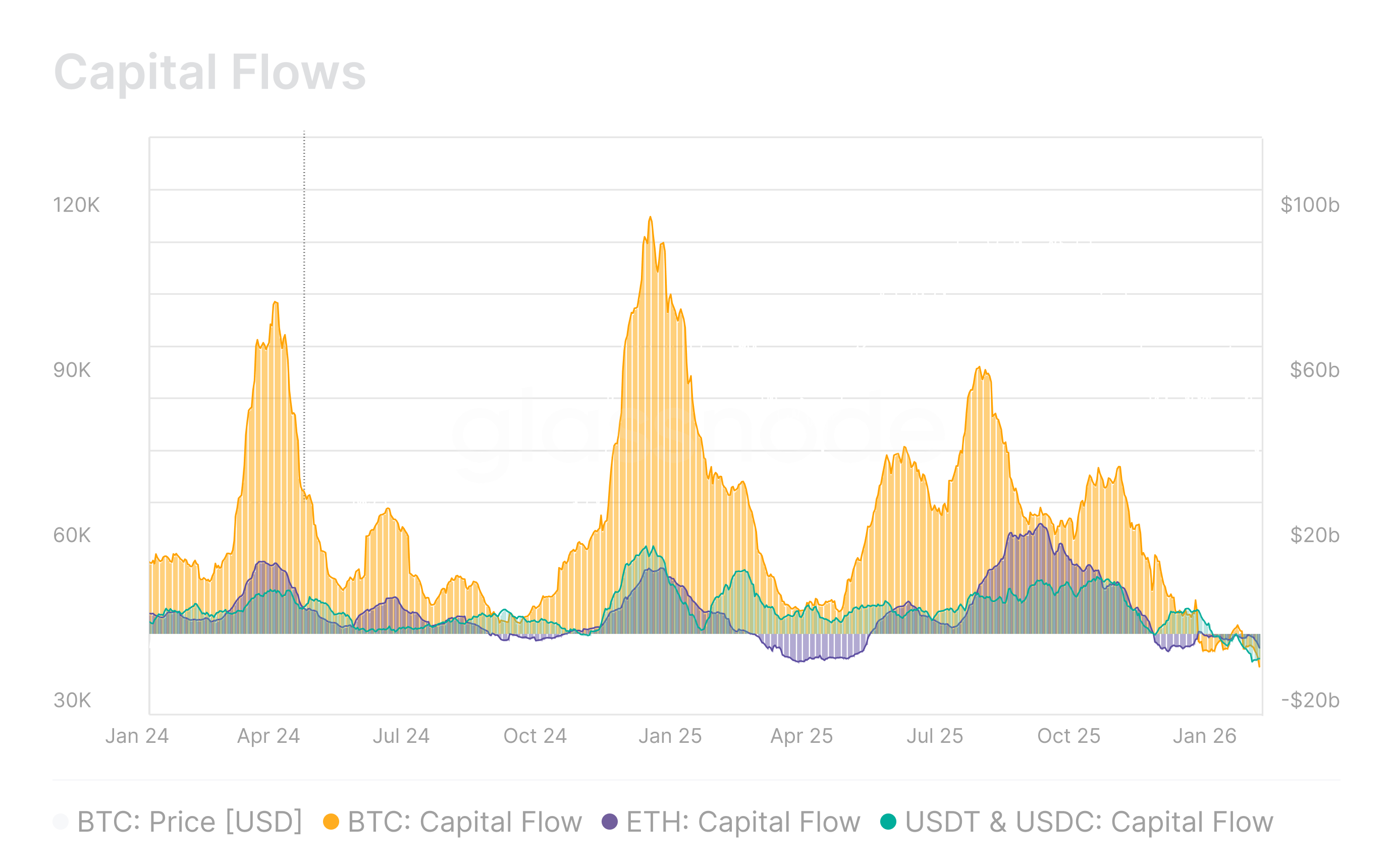
Since late October 2025, capital flows to BTC, ETH and Stablecoins have turned negative sharply.

Bitcoin, Ethereum, and Stablecoins have seen a clear slowdown in capital inflows, signalling weakening demand and a structural contraction in liquidity. All three assets have now shifted into net outflow, with Bitcoin at –$8.4B per month, Ethereum at –$3.8B, and stablecoins at –$6.4B. This broad-based drawdown across core crypto assets reflects a defensive regime, where institutional capital is de-risking rather than re-entering risk positions. This negative trend has further accelerated as of January 2026.
ETF & DAT Net Flows

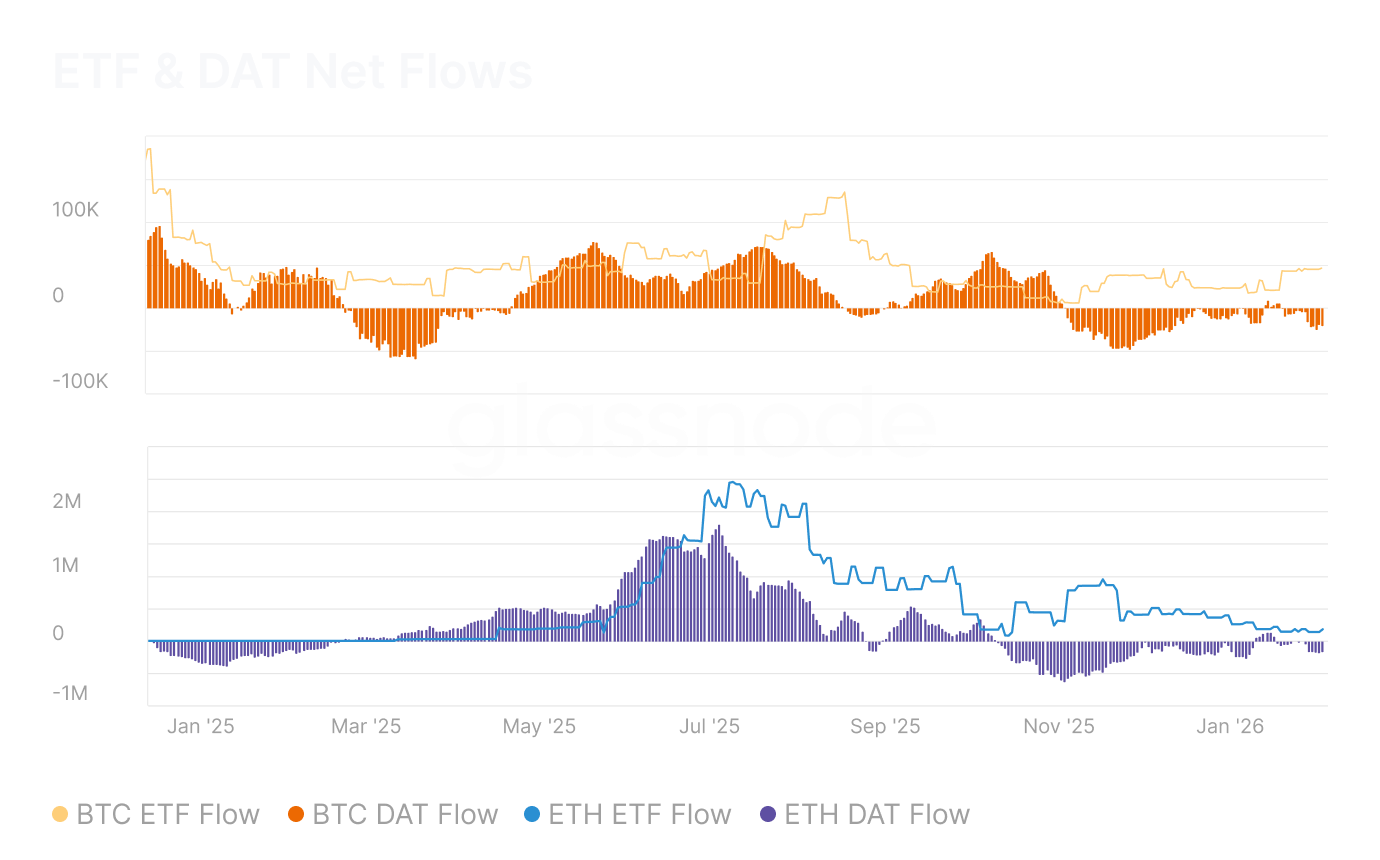
ETF & DAT net flows remain positive, but weakened, signalling slowing institutional demand.

Net flows into these vehicles act as a proxy for institutional demand. In Q4 2025 and early January, institutions were net sellers through the ETF channel, with Bitcoin ETF outflows approximating –35.8k BTC per month and Ethereum ETF flows around –257.6k ETH per month. Over the same period, DATs saw strong inflows in August 2025 driven by new product launches, but buy pressure has since softened; nonetheless, flows into DATs remain positive, indicating ongoing, albeit weaker, institutional interest via balance-sheet exposure.
DeFi TVL & Stablecoin Cap

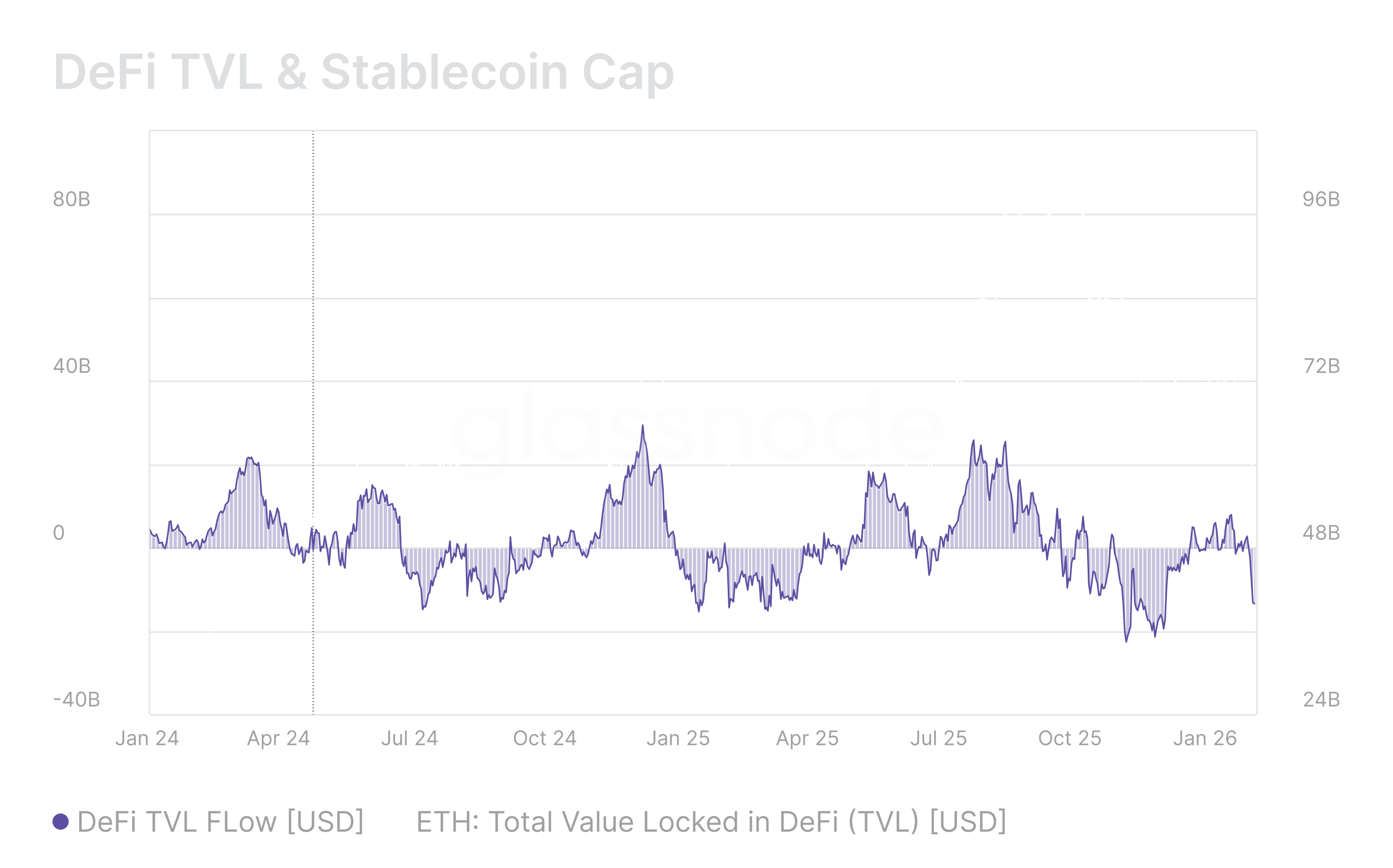
TVL on Ethereum has been declining since August 2025, signalling softer conviction in DeFi yield curves.

DeFi has served as another active playground for institutional capital through strategies such as liquidity provisioning, collateralized lending, and structured yield harvesting. Total Value Locked (TVL) on Ethereum, began to shrink from August 2025 onward, and is now declining at approximately –$15.3M per month. A contraction in TVL implies that larger allocators are withdrawing from on-chain financial services, reducing liquidity depth and signalling softer conviction in DeFi yield and risk-adjusted returns relative to alternative venues.
CME Basis Yield

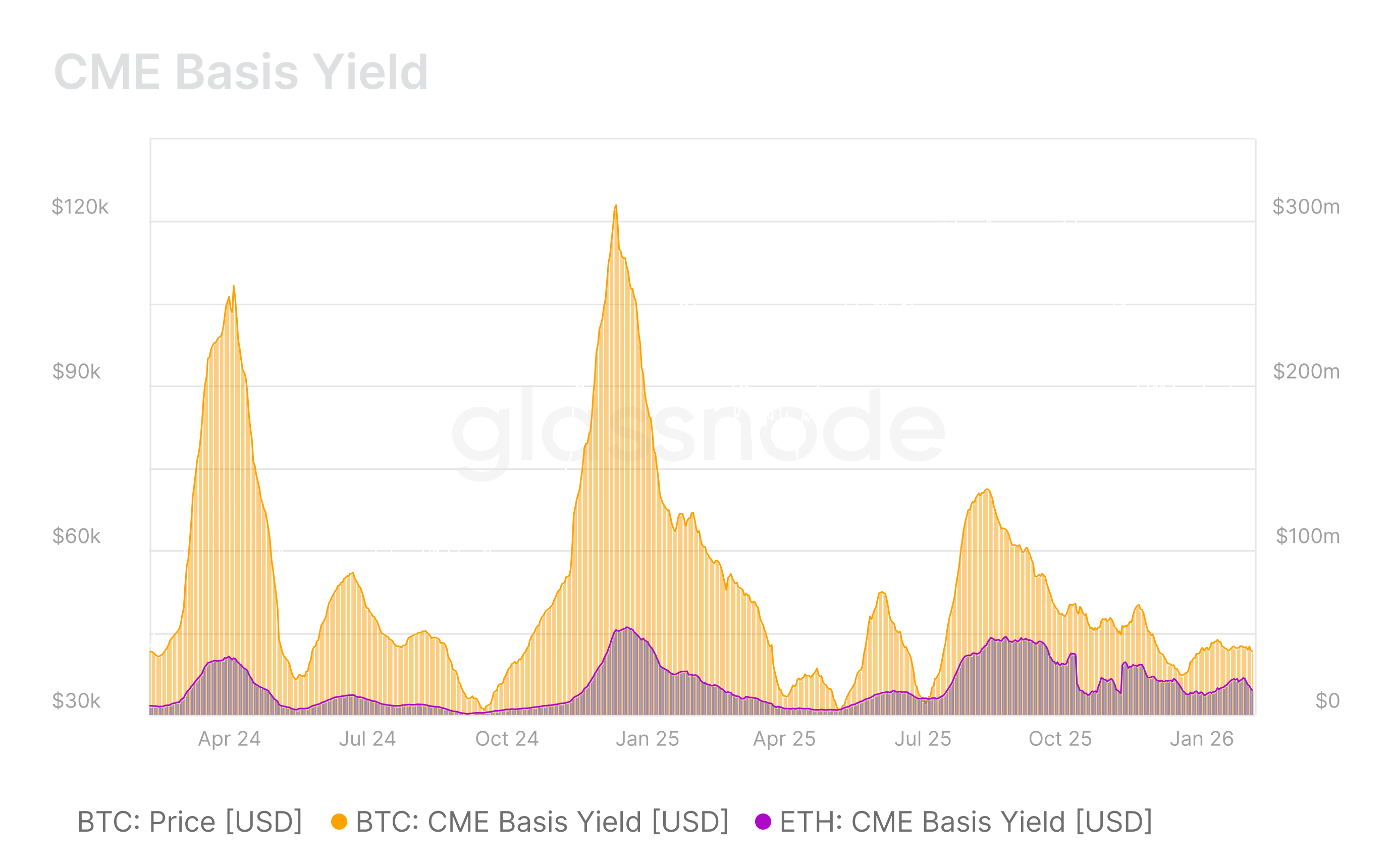
Contraction signals are waning incentive for market-neutral strategies.

Another key dimension of institutional engagement is the CME Basis Yield, which estimates the monthly dollar value earned by institutions from cash-and-carry strategies, capturing the premium between spot prices and CME calendar futures. Since August 2025, both Bitcoin and Ethereum have seen a sharp compression in this yield, with Bitcoin declining from approximately $136.6M to $38.6M per month, and Ethereum from $47.5M to $14.8M per month. This contraction rreflects reduced leverage deployment, softer futures demand, and a broader pullback in balance-sheet commitment amid tightening liquidity conditions.

Want to feature in the next edition of Strategy Watch? Share your updates on recent launches or milestones.

Submit an update

Disclaimer: This report does not provide any investment advice. All data is provided for information and educational purposes only. No investment decision shall be based on the information provided here and you are solely responsible for your own investment decisions.
Exchange balances presented are derived from Glassnode’s comprehensive database of address labels, which are amassed through both officially published exchange information and proprietary clustering algorithms. While we strive to ensure the utmost accuracy in representing exchange balances, it is important to note that these figures might not always encapsulate the entirety of an exchange’s reserves, particularly when exchanges refrain from disclosing their official addresses. We urge users to exercise caution and discretion when utilizing these metrics. Glassnode shall not be held responsible for any discrepancies or potential inaccuracies. Please read our Transparency Notice when using exchange data.

Perguntas relacionadas

QWhat is the main purpose of Glassnode's new Strategy Watch newsletter?

AStrategy Watch is a monthly newsletter dedicated to the analysis of fund-level performance and allocation trends in digital assets, providing clear analysis of capital flows, strategy performance benchmarks, and institutional allocation moves.

QWhich three core crypto assets have experienced a shift into net capital outflows according to the report?

ABitcoin, Ethereum, and Stablecoins have all shifted into net outflow, with Bitcoin at -$8.4B per month, Ethereum at -$3.8B, and stablecoins at -$6.4B.

QWhat does the contraction in CME Basis Yield for Bitcoin and Ethereum indicate about institutional activity?

AThe contraction in CME Basis Yield indicates reduced leverage deployment, softer futures demand, and a broader pullback in balance-sheet commitment amid tightening liquidity conditions, showing waning incentive for market-neutral strategies.

QHow many sections is the Strategy Watch report organized into, and what are two of them?

AThe report is organized into 6 sections, including Institutional Flow Monitor, Fund and SMA Performance, On-chain Vault Performance, Manager Monitor, and Allocation Updates.

QWhat trend does the declining Total Value Locked (TVL) on Ethereum signal about institutional behavior in DeFi?

AThe declining TVL on Ethereum signals that larger allocators are withdrawing from on-chain financial services, reducing liquidity depth and showing softer conviction in DeFi yield and risk-adjusted returns relative to alternative venues.

Leituras Relacionadas

How Risky is the "Death Spiral" of MSTR and STRC?

Summary: This article explores the perceived "death spiral" risk between MicroStrategy (MSTR), its Bitcoin holdings, and its perpetual preferred stock (STRC), drawing comparisons to the LUNA-UST collapse. While both systems feature price anchors, high yields for holders, and potential feedback loops, their core mechanisms differ fundamentally. The MSTR-STRC structure relies on continuous financing to sustain its high dividend payouts, primarily through stock ATM offerings. A negative feedback cycle could occur: falling MSTR stock price makes raising equity capital harder, increasing pressure to sell Bitcoin, which undermines STRC confidence and further depresses MSTR. However, unlike LUNA-UST's automated, direct linkage, the MSTR-STRC loop is weaker and has brakes: STRC dividends can be deferred or rates lowered, and STRC holders have a $100/share liquidation preference in bankruptcy, providing a price floor. The company's sustainability hinges on its ability to continue financing. Its current ~$900 million USD reserves cover only about 6.3 months of its ~$1.71 billion annual interest/dividend burden. The next six months are critical, aligning with both the potential bottom in Bitcoin's four-year cycle and the depletion timeline of its reserves. While a LUNA-style catastrophic collapse is deemed highly unlikely due to structural differences, the key question is whether MicroStrategy can navigate this period through healthy deleveraging to restart its capital engine.

Foresight NewsHá 2m

How Risky is the "Death Spiral" of MSTR and STRC?

Foresight NewsHá 2m

How Much Debt Does Strategy Really Have? Is There a Risk of Implosion?

MicroStrategy's Debt Risk: A Turning Point in the "Never Sell" Strategy As of June 3, 2026, MicroStrategy holds 843,706 bitcoins (valued at ~$53.1B) but faces significant financial obligations. Its capital structure includes $6.75B in convertible notes and $15.48B in perpetual preferred stock (led by the $8.5B STRC series), creating an annual payout burden of ~$1.71B. With software revenue at only ~$500M, interest and dividend obligations far exceed operating income. A critical shift occurred in late May 2026 when the company sold 32 bitcoins for ~$2.5M to cover dividends, breaking CEO Michael Saylor's long-standing "never sell" pledge. This symbolic move triggered a sharp decline in both Bitcoin's price and MSTR stock, reflecting market fears about cash flow sustainability. The core of the strain is the STRC perpetual preferred stock, designed as a "permanent loan" with no maturity date but requiring high monthly dividends (currently 11.5%). Its business model relies on a three-part cycle: issuing new STRC shares, using proceeds to buy more Bitcoin and fund a USD reserve, and using that reserve to pay dividends. This cycle depends on continuous investor demand for STRC and Bitcoin's price appreciation. Analysis shows Bitcoin needs to appreciate at least 2.3% annually to cover the $1.71B in yearly obligations at current holdings. With Bitcoin price down ~22% from March 2026 highs, this pressure has intensified. The company's $900M USD reserve can only cover about 7 months of payments if STRC issuance stalls. Key risks are not immediate bankruptcy or forced Bitcoin liquidation (as BTC is not collateral), but rather: 1) The erosion of MSTR's premium to its Bitcoin holdings (mNAV), which would cripple its ability to raise cheap capital; 2) A vicious cycle where stagnant Bitcoin prices reduce STRC demand, draining the USD reserve and forcing BTC sales, further depressing prices. The period from February 2027 to September 2028 is a crucial test, with over $5.9B in convertible notes facing put options or maturity. In essence, MicroStrategy has evolved from a simple Bitcoin holder into a complex financial entity acting like a "private Bitcoin bank," leveraging its BTC holdings to create layered financial products. Its survival depends on maintaining Bitcoin's price trend, its stock premium, and market appetite for its preferred shares. The recent token sale marks not a betrayal of its Bitcoin thesis, but an admission that the leveraged strategy must eventually be paid for.

marsbitHá 12m

How Much Debt Does Strategy Really Have? Is There a Risk of Implosion?

marsbitHá 12m

Anthropic Cries Wolf: Is the AGI Threat Real, or Just an IPO Story?

Anthropic has published an article titled "When AI builds itself," discussing the emerging concept of "recursive self-improvement," where AI begins to actively participate in designing, training, testing, and optimizing its own subsequent versions. The company presents internal data showing that by May 2026, over 80% of code merged into its codebase was written by Claude, its AI model. Claude's capabilities have expanded to handling complex, open-ended engineering tasks, achieving a 76% success rate in such areas, and even contributing to research processes, such as optimizing code performance and conducting AI safety experiments. Anthropic outlines an evolution from human-driven development to AI-assisted workflows, culminating in the current stage where AI agents can autonomously write, run, and delegate code. The company cautions that the path toward a "closed loop," where AI continuously improves itself, is becoming visible. It calls for coordinated global mechanisms to potentially slow or pause frontier AI development to allow safety research and societal structures to catch up. However, the timing of this warning coincides with Anthropic's preparations for an IPO, framing the narrative not just as a safety concern but also as a demonstration of Claude's advanced capabilities and its integral role in accelerating Anthropic's own R&D—creating a potential "flywheel" effect for competitive advantage. This contrasts with OpenAI's recent, more policy-oriented discussion of the same risks, highlighting the competitive dynamics in the AI industry as companies position themselves in both the technological and regulatory landscape.

marsbitHá 1h

Anthropic Cries Wolf: Is the AGI Threat Real, or Just an IPO Story?

marsbitHá 1h

Trading

Spot
Futuros
活动图片