Strategy Launches 'Digital Credit Capital Framework': Authorizes Sale of $12 Billion in Bitcoin, Ending the 'Never Sell' Script

marsbitPublicado em 2026-06-29Última atualização em 2026-06-29

Resumo

Strategic, the world’s largest corporate holder of Bitcoin (formerly MicroStrategy), has dramatically shifted its long-standing “never sell Bitcoin” strategy by announcing a new “Digital Credit Capital Framework” on June 29. This plan authorizes the sale of up to $1.25 billion worth of Bitcoin to raise cash, establishes a $2.55 billion USD reserve, increases the dividend rate on its STRG preferred shares to 12%, and authorizes up to $1 billion each for repurchases of its own digital credit securities and Class A common stock. This pivot comes amid severe financial pressure. The company’s STRG preferred shares are trading at a ~24% discount to their $100 face value, making new issuances difficult and stalling its buy-Bitcoin funding flywheel. Its annualized dividend obligation has surged to ~$1.2 billion. Meanwhile, its MSTR stock has plummeted 36% in eight days, erasing its traditional premium over its Bitcoin holdings per share. In recent weeks, Strategic has already shifted focus from accumulating Bitcoin to bolstering cash reserves by selling its own MSTR shares. The new framework formalizes this defensive turn, aiming to ensure liquidity, cover dividends, and support its securities prices through buybacks. However, the move risks triggering a “death spiral” if Bitcoin sales pressure the market, further devaluing the company’s core asset. The company also faces a potential securities investigation and carries significant debt, with Bitcoin’s current price below its avera...

Curry, Shenchao TechFlow

Shenchao Insights:

Strategy, which holds 847,000 Bitcoin, officially rewrote its four-year 'buy only, never sell' script on June 29 by launching a 'Digital Credit Capital Framework'. The new framework authorizes the sale of Bitcoin to raise up to $12.5 billion, establishes a $25.5 billion cash reserve, raises the STRC dividend rate to 12%, and authorizes up to $10 billion each for repurchasing its own securities. This comes against a backdrop where MSTR plunged 36% in eight days, the preferred stock STRC fell to about 24% below its face value, and the annual dividend obligation quadrupled in a year to $12 billion. For holders, this is a 'stop-loss plan', but whether it will work depends on the Bitcoin price.
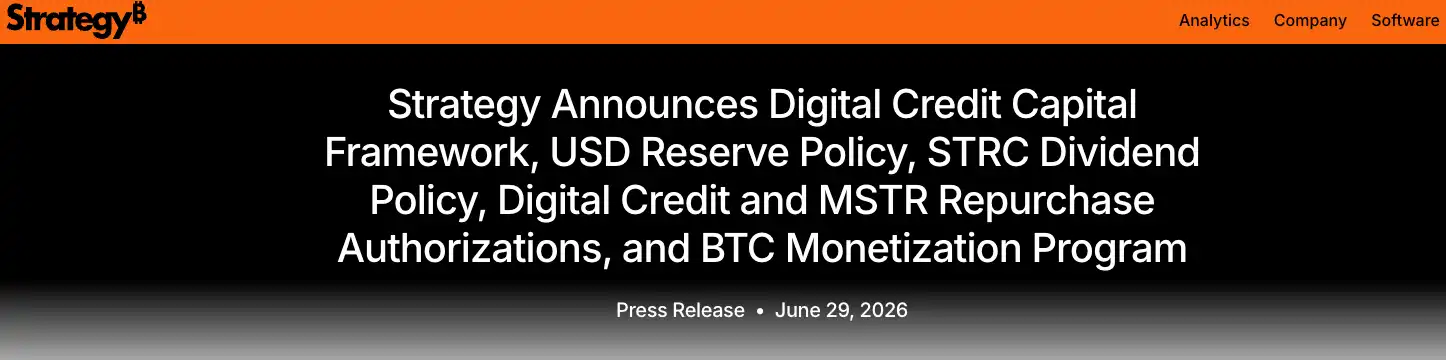
Strategy (formerly MicroStrategy) has officially acknowledged that the flywheel of buying Bitcoin indefinitely by issuing preferred stock can no longer keep spinning.

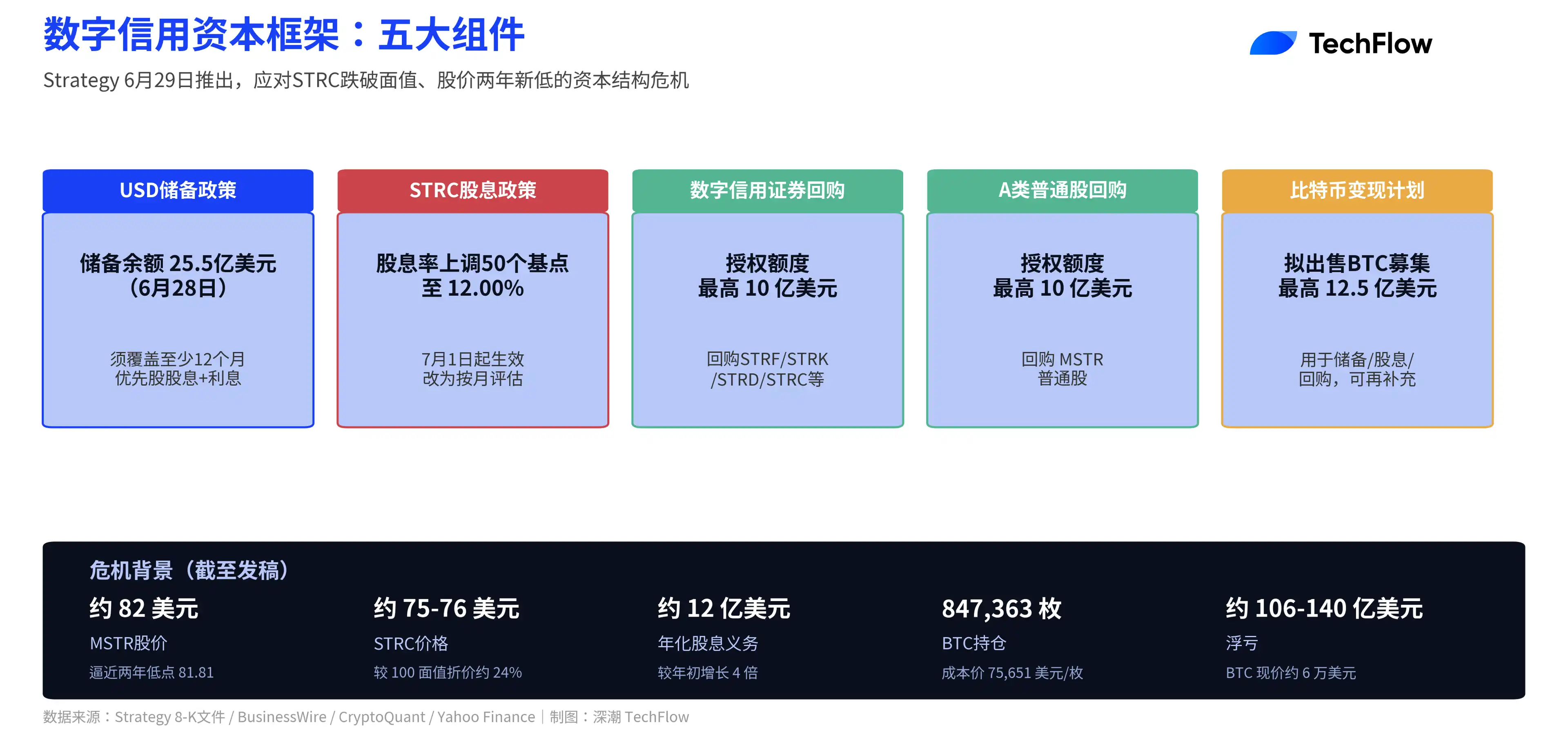
On June 29, the world's largest corporate Bitcoin holder announced the launch of a 'Digital Credit Capital Framework', introducing a comprehensive set of cash reserves, repurchase, and Bitcoin sale mechanisms to provide a safety net for its nearly out-of-control capital structure. The framework consists of five components: a USD reserve policy, a revised STRC dividend policy, a Digital Credit Securities Repurchase Plan, a Class A Common Stock Repurchase Plan, and a Bitcoin Monetization Plan.

The most impactful item is this: the company's board has authorized the sale of Bitcoin to raise up to $12.5 billion, to be used to supplement the cash reserve, pay preferred stock dividends and interest, or repurchase its own securities. For a company that built its faith on 'never selling Bitcoin', this is akin to officially laying down the institutional runway for selling.

Founder Michael Saylor's wording in the statement has already shifted from the past. He said Bitcoin remains the company's 'primary treasury reserve asset,' but immediately admitted: 'Digital credit requires liquidity, discipline, and proactive capital management.'

Translated, it means holding Bitcoin alone can no longer support the $1.2 billion annual dividend bill.

STRC Dividend Rate Soars to 12%, Preferred Stock Falling Below Par is the Trigger

To understand this framework, one must first see how passive Strategy's situation has become.

The company simultaneously announced it is raising the annual dividend rate for its variable-rate Series A Perpetual Preferred Stock STRC from approximately 11.5% by 50 basis points to 12.00%, effective for record dates on or after July 1. Superficially, this offers increased returns to investors, but the essence is being forced by the market—the STRC price has fallen to around $75-$76, a discount of about 24% from its $100 face value, hitting a record low.

STRC falling below par strikes at the heart of Strategy's financing model. This preferred stock was the company's 'money printer': continuously issuing new shares at or above face value to raise funds for buying Bitcoin. Once the price is deeply discounted, new preferred shares cannot be issued at a favorable price, and the entire financing flywheel jams. Julio Moreno, Head of Research at on-chain analytics firm CryptoQuant, calculated in a report on June 23: Strategy's annualized dividend obligation has skyrocketed from about $300 million at the beginning of the year to about $12 billion, quadrupling in one year, while the dividend coverage period shrank from over seven years to about 14 months. He directly advised the company to pause Bitcoin purchases and rebuild its cash reserve to about $28 billion first.

For preferred stock holders, a 12% coupon sounds attractive, but only if the company can pay. The new framework requires the USD reserve to cover at least 12 months of preferred stock dividend and interest obligations, effectively writing the ability to 'pay on time' into a hard constraint.

$25.5 Billion Cash Reserve: Shifting from 'HODLing' to 'HODLing Cash'

Strategy's cash reserve is visibly swelling, in the opposite direction of its past strategy.

According to the company's 8-K filing, as of June 28, the USD reserve balance was $25.5 billion, including anticipated cash proceeds from Class A common stock ATM offerings that have not yet settled. This number shows a significant jump compared to $1.4 billion on June 21 and $1.44 billion when it was initially established in early December 2025. Where is the money coming from? The answer is selling its own stock, not buying Bitcoin.

Operations over the past three weeks have already hinted at the pivot. In the week of June 22, the company bought only 520 Bitcoin for approximately $34.9 million, one-third of the previous week; during the same period, it sold 2.71 million shares of MSTR common stock, raising $335.5 million, but allocated less than 11% into Bitcoin, with the remainder all going to the cash reserve.

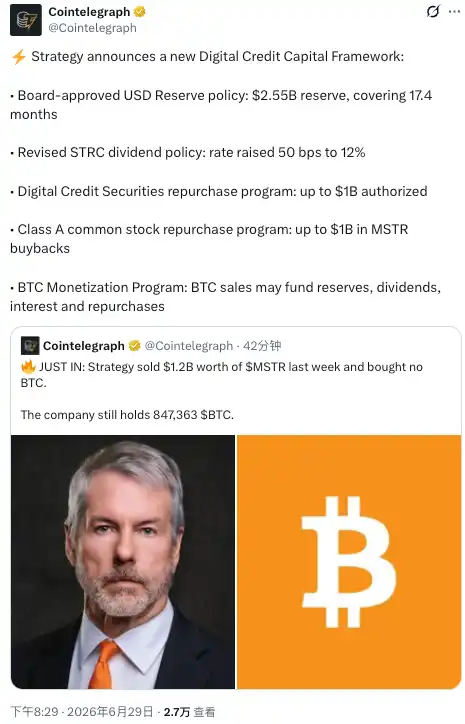
Cointelegraph posted on June 29 that Strategy sold $1.2 billion worth of MSTR shares last week and did not buy any Bitcoin. If accurate, this indicates that the intensity of selling shares to replenish cash is increasing (Note: The $1.2 billion weekly sale figure is significantly higher than previously disclosed weekly data and should be verified against the company's latest filing prior to publication). The company currently holds 847,363 Bitcoin with a weighted average cost of approximately $75,651 per coin.
The cost of shifting to 'HODLing cash' is dilution. Issuing new shares when the MSTR stock price is below its per-share Bitcoin Net Asset Value dilutes the amount of Bitcoin backing each share. MSTR fell to around $82 this week, approaching a two-year low of $81.81; the 'premium' that fueled the flywheel's operation no longer exists.

$10 Billion Each for Repurchases: Trying to Buy Back the Discount

The framework also hides two 'repurchase knives': the Digital Credit Securities Repurchase Plan and the Class A Common Stock Repurchase Plan, each with an authorization ceiling of up to $10 billion.
The logic isn't complicated. STRC and other preferred securities and MSTR common stock are trading at deep discounts. The company using cash (or proceeds from Bitcoin sales) to repurchase at low prices can theoretically narrow the discount and protect the price. Bitcoin critic Peter Schiff has repeatedly posted on X in recent days, saying Saylor's best option is to sell Bitcoin to repurchase shares and close the discount.

Now Strategy has written this suggestion into its formal framework, though Schiff simultaneously warned that forced Bitcoin sales could conversely crash the Bitcoin price, plunging the entire structure into a death spiral.

Whether the repurchases will work depends on how much cash the company has. For investors holding MSTR or preferred stock, the $10 billion authorization is just a ceiling, not a guarantee of full execution; the actual buying pace will depend on subsequent disclosures.

More Than Just Stopping the Bleeding: Legal Probes and Mounting Debt

This framework was hastily launched under multiple pressures; looking at financial numbers alone is insufficient.

On June 25, Rosen Law Firm disclosed it is investigating Strategy and Saylor, alleging they may have issued 'materially misleading information' to investors regarding Bitcoin holdings. The investigation covers all five of the company's securities: MSTR, STRF, STRC, STRK, and STRD. The probe is still in its early stages with no formal lawsuit yet, but the timing coincides with the continuous decline in stock price.

The debt situation is equally tight.

According to multiple media reports, Strategy's total debt on its balance sheet is about $8.2 billion. Since 2026, its cash reserve has shrunk by approximately 38%, and the company also conducted a debt buyback in May. With Bitcoin currently around $60,000, it has fallen below the cost basis of all Strategy's purchase batches from 2024 to 2026. Paper losses range between $10.6 billion and $14 billion (varies by source).

For investors on the sidelines, the key metric to watch now is the discount of the MSTR stock price relative to its per-share Bitcoin Net Asset Value. If the discount remains persistently deep, the ATM offering engine will stall. That is the outcome this framework truly aims to avoid—yet may not be able to prevent.


Criptomoedas em alta

Perguntas relacionadas

QWhat is the new 'Digital Credit Capital Framework' announced by Strategy, and what major shift does it represent?

AStrategy announced a 'Digital Credit Capital Framework' to stabilize its capital structure. It includes five components: a USD reserve policy, a revised STRC dividend policy, a digital credit securities repurchase plan, a Class A common stock repurchase plan, and a Bitcoin monetization plan. The major shift is the authorization to sell up to $1.25 billion worth of Bitcoin to fund cash reserves and obligations, effectively ending its previous 'never sell' Bitcoin strategy and marking a turn towards active capital management.

QWhat was the immediate trigger for Strategy to implement this new capital framework?

AThe immediate trigger was the market pressure stemming from its STRC preferred stock trading at a significant discount. The STRC shares fell to approximately $75-76, a discount of about 24% from their $100 par value. This threatened the company's core funding model, which relied on issuing preferred shares near or above par value to buy Bitcoin. Furthermore, the annualized dividend obligation on these preferred shares had surged to around $1.2 billion, creating a critical liquidity strain.

QHow has Strategy's approach to its cash reserves changed recently, and what are the implications?

AStrategy has shifted from aggressively accumulating Bitcoin to aggressively building its USD cash reserves. The reserve balance grew to $2.55 billion by June 28, up from $1.4 billion in early December 2025. This growth is funded primarily by selling its own MSTR common stock through its ATM program, with a decreasing portion of the proceeds being used to buy Bitcoin. The implication is a strategic pivot from 'hoarding Bitcoin' to 'hoarding cash' to meet obligations, which comes at the cost of potential shareholder dilution when MSTR trades below its Bitcoin-per-share NAV.

QWhat are the two key repurchase plans included in the framework, and what is their intended purpose?

AThe framework authorizes two repurchase plans, each with a ceiling of $1 billion: a Digital Credit Securities Repurchase Plan (targeting preferred shares like STRC) and a Class A Common Stock Repurchase Plan (targeting MSTR stock). The intended purpose is to buy back these securities while they are trading at deep discounts to their par value or NAV. The goal is to support their market prices, narrow the discount gap, and restore investor confidence in the company's capital structure.

QWhat are some of the additional pressures, beyond financials, that Strategy is currently facing?

ABeyond the financial pressures, Strategy is facing a legal investigation and significant debt burdens. On June 25, Rosen Law Firm announced it is investigating the company and Michael Saylor for potentially issuing 'materially misleading' information to investors regarding its Bitcoin holdings. Additionally, the company carries approximately $8.2 billion in cumulative debt, and with Bitcoin's price below its average acquisition cost, the company is facing substantial paper losses estimated between $10.6 billion and $14 billion.

Leituras Relacionadas

In Conversation with Ray Dalio: We Are Currently in an AI Bubble, with 1% of My Portfolio in Bitcoin

Ray Dalio, founder of Bridgewater Associates, warns in an interview that the current AI boom shows classic bubble characteristics, which could lead to significant economic downturns as seen in past cycles like 1929 or 2000. He explains that speculative enthusiasm, fueled by debt and overvaluation, often precedes a crash when rising rates or taxation force asset sales, causing widespread losses and recession. Dalio also outlines his "Big Cycle" theory, describing an approximate 80-year pattern where widening wealth gaps, massive government deficits, and shifting geopolitical power (like China's rise) create internal conflict and global instability. He emphasizes that we are in a late-cycle, transitional phase where traditional powers like the US and UK face decline. For personal wealth protection, Dalio advises diversification beyond cash into assets like stocks, bonds, real estate, and particularly gold, which he prefers over Bitcoin. While he holds about 1% of his portfolio in Bitcoin as a non-printable hard asset, he views gold as more secure from technological or governmental threats. Regarding AI's impact, Dalio believes it will disproportionately benefit capital owners, worsening inequality by replacing both physical and cognitive labor. He suggests that human intuition and emotional intelligence, combined with AI, will be key for future workers. On taxation, Dalio argues that wealth taxes are impractical and risk triggering asset sell-offs, reducing productive investment. He points to the UK as a cautionary example of debt, low productivity, and political strife. Geopolitically, Dalio foresees a more regionalized world, with the US showing weakness in prolonged conflicts like with Iran, akin to past imperial declines. The ideal outcome, he suggests, is coexisting powerful blocs (e.g., Americas, China-Asia Pacific) without major war.

marsbitHá 1h

In Conversation with Ray Dalio: We Are Currently in an AI Bubble, with 1% of My Portfolio in Bitcoin

marsbitHá 1h

Daily 7.2 Trillion KRW: Foreign Capital's Record Net Buying on Friday! Wall Street Says Headwinds for Korean Stock Fund Flows Have Subsided

South Korean stock market sees a dramatic shift in fund flows. On July 31, foreign investors made a record net purchase of approximately KRW 7.2 trillion in KOSPI stocks, marking a fundamental reversal from the persistent large-scale net outflows seen in previous months. This contributed to a significant narrowing of foreign net selling in July to KRW 9.8 trillion, down sharply from KRW 48.4 trillion in June and KRW 44.5 trillion in May. Simultaneously, domestic institutional pressure eased. South Korean pension funds and asset managers turned to a net buying position in July, purchasing KRW 1.0 trillion worth of KOSPI shares, contrasting with net sales in May and June. Market volatility is expected to be dampened by new financial regulations. Effective July 31, the Financial Services Commission tightened access for retail investors to single-stock leveraged ETFs by raising the minimum cash deposit requirement. Trading volumes for these products subsequently dropped to about 50% of their monthly average. Citigroup Research maintains its year-end KOSPI target of 10,000 points. The firm cites several supportive factors: the substantial easing of headwinds from capital outflows, a robust fundamental outlook for the semiconductor sector, historically low market valuations, strong economic fundamentals, and the potential for policy support from financial authorities if needed.

marsbitHá 1h

Daily 7.2 Trillion KRW: Foreign Capital's Record Net Buying on Friday! Wall Street Says Headwinds for Korean Stock Fund Flows Have Subsided

marsbitHá 1h

Thanks to Dice Rolls, Bitcoin Keys Are Stored Offline, But Not Everyone Will Do It

The article discusses using dice rolls to generate secure Bitcoin wallet seeds, providing entropy independent of potentially flawed hardware random number generators. It explains that each fair dice roll offers about 2.585 bits of entropy, with around 50 rolls needed for a standard 12-word seed phrase and 99+ recommended for higher security. This method gained attention after a vulnerability was revealed in some Coldcard hardware wallets, where a faulty firmware RNG (dating back to 2021) compromised generated keys. The analysis notes that while a dice-generated main seed was safe from this specific flaw, other Coldcard functions (like creating paper wallets, backup keys, or passwords) could still be vulnerable if they used the defective RNG. The piece argues that while dice-based entropy is technically robust, the manual process is error-prone, tedious, and unrealistic for most new users, who might make mistakes in recording or inputting rolls. It concludes that while manual entropy generation should remain an option for advanced users, the long-term goal is to develop reliable, user-friendly hardware and software that securely generates randomness without requiring specialized knowledge. Coldcard users are advised to check their firmware version and replace any secondary secrets (like paper wallet keys) created with vulnerable devices, while also considering multi-signature setups with devices from different manufacturers for added security.

cryptonews.ruHá 6h

Thanks to Dice Rolls, Bitcoin Keys Are Stored Offline, But Not Everyone Will Do It

cryptonews.ruHá 6h

Trading

Spot

Artigos em Destaque

O que é BITCOIN

Compreender o HarryPotterObamaSonic10Inu (ERC-20) e a Sua Posição no Espaço Cripto Nos últimos anos, o mercado de criptomoedas assistiu a um aumento na popularidade das moedas meme, cativando não apenas os traders, mas também aqueles que procuram envolvimento comunitário e valor de entretenimento. Entre estes tokens únicos está o HarryPotterObamaSonic10Inu (ERC-20), um projeto intrigante que mistura referências culturais no tecido das criptomoedas. Este artigo explora os principais aspetos do HarryPotterObamaSonic10Inu, examinando os seus mecanismos, a sua ética orientada pela comunidade e o seu envolvimento com o vasto panorama cripto. O que é o HarryPotterObamaSonic10Inu (ERC-20)? Como o nome sugere, o HarryPotterObamaSonic10Inu é uma moeda meme construída na blockchain Ethereum, classificada sob o padrão ERC-20. Ao contrário das criptomoedas tradicionais, que podem enfatizar a utilidade prática ou o potencial de investimento, este token prospera no valor de entretenimento e na força da sua comunidade. O projeto visa promover um ambiente onde utilizadores envolvidos possam reunir-se, partilhar ideias e participar em atividades inspiradas por diversos fenómenos culturais. Uma característica notável do HarryPotterObamaSonic10Inu é a zero taxa sobre transações. Este elemento atraente visa encorajar a negociação e o envolvimento da comunidade, isento de encargos adicionais que podem desencorajar os traders de pequena escala. A oferta total da moeda está fixada em mil milhões de tokens, uma cifra que marca a sua intenção de manter uma circulação substancial dentro da comunidade. Criador do HarryPotterObamaSonic10Inu (ERC-20) As origens do HarryPotterObamaSonic10Inu estão um pouco envoltas em mistério; os detalhes sobre o criador permanecem desconhecidos. O desenvolvimento deste token carece de uma equipa identificável ou de um plano explícito, o que não é raro no setor das moedas meme. Em vez disso, o projeto surgiu de forma orgânica, com o seu progresso a depender fortemente do entusiasmo e da participação da sua comunidade. Investidores do HarryPotterObamaSonic10Inu (ERC-20) No que diz respeito a investimentos externos e apoios, o HarryPotterObamaSonic10Inu também permanece ambíguo. O token não lista quaisquer fundações de investimento conhecidas ou apoio organizacional significativo. Em vez disso, o “sangue vital” do projeto é a sua comunidade de base, que informa o seu crescimento e sustentabilidade através da ação coletiva e do envolvimento no espaço cripto. Como Funciona o HarryPotterObamaSonic10Inu (ERC-20)? Como uma moeda meme, o HarryPotterObamaSonic10Inu opera principalmente fora dos quadros tradicionais que muitas vezes governam o valor dos ativos. Existem vários aspetos distintivos que definem como o projeto funciona: Transações Sem Taxas: Sem taxas sobre transações, os utilizadores podem comprar e vender o token livremente, sem a preocupação de custos ocultos. Envolvimento da Comunidade: O projeto prospera na interação da comunidade, aproveitando plataformas de redes sociais para criar entusiasmo e facilitar a participação. Discussões, partilha de conteúdo e envolvimento são elementos cruciais que ajudam a expandir o seu alcance e a fomentar a lealdade entre os apoiantes. Sem Utilidade Prática: Deve ser notado que o HarryPotterObamaSonic10Inu não oferece utilidade concreta dentro do ecossistema financeiro. Em vez disso, é classificado como um token principalmente para entretenimento e atividades comunitárias. Referência Cultural: O token incorpora de forma inteligente elementos da cultura popular para atrair interesse, conectando-se tanto com entusiastas de memes como com seguidores de criptomoedas. HarryPotterObamaSonic10Inu exemplifica como as moedas meme operam de forma diferente de projetos de criptomoedas mais tradicionais, entrando no mercado como construções sociais inovadoras em vez de ativos utilitários. Linha do Tempo do HarryPotterObamaSonic10Inu (ERC-20) A história do HarryPotterObamaSonic10Inu é marcada por vários marcos notáveis: Criação: O token surgiu de um meme viral, capturando a imaginação de muitos entusiastas de criptomoedas. Datas específicas de criação não estão disponíveis, sublinhando a sua ascensão orgânica. Listagem em Exchanges: O HarryPotterObamaSonic10Inu conseguiu entrar em várias exchanges, permitindo um acesso e negociação mais fáceis pela comunidade. Iniciativas de Envolvimento da Comunidade: Atividades contínuas direcionadas a melhorar a interação comunitária, incluindo concursos, campanhas em redes sociais e geração de conteúdo por fãs e defensores. Planos de Expansão Futura: O roteiro do projeto inclui o lançamento de uma coleção de NFTs, mercadorias e um site de eCommerce relacionado aos seus temas culturais, envolvendo ainda mais a comunidade e tentando adicionar mais dimensões ao seu ecossistema. Pontos-Chave sobre o HarryPotterObamaSonic10Inu (ERC-20) Natureza Orientada pela Comunidade: O projeto prioriza a contribuição coletiva e a criatividade, assegurando que o envolvimento dos utilizadores está na vanguarda do seu desenvolvimento. Classificação como Moeda Meme: Representa o epítome da criptomoeda baseada em entretenimento, destacando-se dos veículos de investimento tradicionais. Sem Afiliação Direta com o Bitcoin: Apesar da semelhança no nome do ticker, o HarryPotterObamaSonic10Inu é distinto e não tem qualquer relação com o Bitcoin ou outras criptomoedas estabelecidas. Foco na Colaboração: O HarryPotterObamaSonic10Inu é projetado para criar um espaço de colaboração e partilha de histórias entre os seus detentores, proporcionando uma via para a criatividade e o fortalecimento da comunidade. Perspectivas Futuras: A ambição de expandir além da sua premissa inicial para NFTs e mercadorias delineia um caminho para o projeto potencialmente entrar em avenidas mais mainstream dentro da cultura digital. À medida que as moedas meme continuam a capturar a imaginação da comunidade cripto, HarryPotterObamaSonic10Inu (ERC-20) destaca-se devido aos seus laços culturais e abordagem centrada na comunidade. Embora possa não se encaixar no molde típico de um token orientado para utilidade, a sua essência reside na alegria e camaradagem fomentadas entre os seus apoiantes, destacando a natureza em evolução das criptomoedas em uma era cada vez mais digital. À medida que o projeto continua a desenvolver-se, será importante observar como as dinâmicas comunitárias influenciam a sua trajetória no panorama em constante mudança da tecnologia blockchain.

2.0k Visualizações TotaisPublicado em {updateTime}Atualizado em 2024.12.03

O que é BITCOIN

Como comprar BTC

Bem-vindo à HTX.com!Tornámos a compra de Bitcoin (BTC) simples e conveniente.Segue o nosso guia passo a passo para iniciar a tua jornada no mundo das criptos.Passo 1: cria a tua conta HTXUtiliza o teu e-mail ou número de telefone para te inscreveres numa conta gratuita na HTX.Desfruta de um processo de inscrição sem complicações e desbloqueia todas as funcionalidades.Obter a minha contaPasso 2: vai para Comprar Cripto e escolhe o teu método de pagamentoCartão de crédito/débito: usa o teu visa ou mastercard para comprar Bitcoin (BTC) instantaneamente.Saldo: usa os fundos da tua conta HTX para transacionar sem problemas.Terceiros: adicionamos métodos de pagamento populares, como Google Pay e Apple Pay, para aumentar a conveniência.P2P: transaciona diretamente com outros utilizadores na HTX.Mercado de balcão (OTC): oferecemos serviços personalizados e taxas de câmbio competitivas para os traders.Passo 3: armazena teu Bitcoin (BTC)Depois de comprar o teu Bitcoin (BTC), armazena-o na tua conta HTX.Alternativamente, podes enviá-lo para outro lugar através de transferência blockchain ou usá-lo para transacionar outras criptomoedas.Passo 4: transaciona Bitcoin (BTC)Transaciona facilmente Bitcoin (BTC) no mercado à vista da HTX.Acede simplesmente à tua conta, seleciona o teu par de trading, executa as tuas transações e monitoriza em tempo real.Oferecemos uma experiência de fácil utilização tanto para principiantes como para traders experientes.

4.5k Visualizações TotaisPublicado em {updateTime}Atualizado em 2026.06.02

Como comprar BTC

O que é $BITCOIN

OURO DIGITAL ($BITCOIN): Uma Análise Abrangente Introdução ao OURO DIGITAL ($BITCOIN) OURO DIGITAL ($BITCOIN) é um projeto baseado em blockchain que opera na rede Solana, com o objetivo de combinar as características dos metais preciosos tradicionais com a inovação das tecnologias descentralizadas. Embora partilhe um nome com o Bitcoin, frequentemente referido como “ouro digital” devido à sua percepção como uma reserva de valor, o OURO DIGITAL é um token separado projetado para criar um ecossistema único dentro da paisagem Web3. O seu objetivo é posicionar-se como um ativo digital alternativo viável, embora os detalhes sobre as suas aplicações e funcionalidades ainda estejam em desenvolvimento. O que é o OURO DIGITAL ($BITCOIN)? OURO DIGITAL ($BITCOIN) é um token de criptomoeda explicitamente projetado para uso na blockchain Solana. Em contraste com o Bitcoin, que fornece um papel amplamente reconhecido como armazenamento de valor, este token parece focar em aplicações e características mais amplas. Aspectos notáveis incluem: Infraestrutura Blockchain: O token é construído na blockchain Solana, conhecida pela sua capacidade de lidar com transações de alta velocidade e baixo custo. Dinâmicas de Oferta: O OURO DIGITAL tem um fornecimento máximo limitado a 100 quatrilhões de tokens (100P $BITCOIN), embora os detalhes sobre o seu fornecimento circulante ainda não tenham sido divulgados. Utilidade: Embora as funcionalidades precisas não estejam explicitamente delineadas, existem indicações de que o token poderia ser utilizado para várias aplicações, potencialmente envolvendo aplicações descentralizadas (dApps) ou estratégias de tokenização de ativos. Quem é o Criador do OURO DIGITAL ($BITCOIN)? Neste momento, a identidade dos criadores e da equipa de desenvolvimento por trás do OURO DIGITAL ($BITCOIN) permanece desconhecida. Esta situação é típica entre muitos projetos inovadores no espaço da blockchain, particularmente aqueles alinhados com finanças descentralizadas e fenómenos de moedas meme. Embora tal anonimato possa fomentar uma cultura orientada pela comunidade, intensifica as preocupações sobre governança e responsabilidade. Quem são os Investidores do OURO DIGITAL ($BITCOIN)? As informações disponíveis indicam que o OURO DIGITAL ($BITCOIN) não tem apoiantes institucionais conhecidos ou investimentos proeminentes de capital de risco. O projeto parece operar num modelo peer-to-peer focado no apoio e adoção da comunidade, em vez de rotas de financiamento tradicionais. A sua atividade e liquidez estão principalmente situadas em exchanges descentralizadas (DEXs), como a PumpSwap, em vez de plataformas de negociação centralizadas estabelecidas, destacando ainda mais a sua abordagem de base. Como Funciona o OURO DIGITAL ($BITCOIN) A mecânica operacional do OURO DIGITAL ($BITCOIN) pode ser elaborada com base no seu design de blockchain e nas características da rede: Mecanismo de Consenso: Ao aproveitar o exclusivo proof-of-history (PoH) da Solana combinado com um modelo de proof-of-stake (PoS), o projeto assegura uma validação eficiente das transações, contribuindo para o alto desempenho da rede. Tokenomics: Embora mecanismos deflacionários específicos não tenham sido extensivamente detalhados, o vasto fornecimento máximo de tokens implica que pode atender a microtransações ou casos de uso de nicho que ainda estão por definir. Interoperabilidade: Existe o potencial para integração com o ecossistema mais amplo da Solana, incluindo várias plataformas de finanças descentralizadas (DeFi). No entanto, os detalhes sobre integrações específicas permanecem não especificados. Cronologia de Eventos Chave Aqui está uma cronologia que destaca marcos significativos relacionados ao OURO DIGITAL ($BITCOIN): 2023: O lançamento inicial do token ocorre na blockchain Solana, marcado pelo seu endereço de contrato. 2024: O OURO DIGITAL ganha visibilidade ao tornar-se disponível para negociação em exchanges descentralizadas como a PumpSwap, permitindo que os utilizadores o negociem contra SOL. 2025: O projeto testemunha atividade de negociação esporádica e potencial interesse em envolvimentos liderados pela comunidade, embora não tenham sido documentadas parcerias ou avanços técnicos notáveis até ao momento. Análise Crítica Forças Escalabilidade: A infraestrutura subjacente da Solana suporta altos volumes de transações, o que pode aumentar a utilidade do $BITCOIN em vários cenários de transação. Acessibilidade: O potencial preço de negociação baixo por token pode atrair investidores de retalho, facilitando uma participação mais ampla devido a oportunidades de propriedade fracionada. Riscos Falta de Transparência: A ausência de apoiantes, desenvolvedores ou um processo de auditoria publicamente conhecidos pode gerar ceticismo em relação à sustentabilidade e confiabilidade do projeto. Volatilidade do Mercado: A atividade de negociação depende fortemente do comportamento especulativo, o que pode resultar em volatilidade significativa dos preços e incerteza para os investidores. Conclusão O OURO DIGITAL ($BITCOIN) surge como um projeto intrigante, mas ambíguo, dentro do ecossistema em rápida evolução da Solana. Embora tente aproveitar a narrativa do “ouro digital”, a sua divergência do papel estabelecido do Bitcoin como reserva de valor sublinha a necessidade de uma diferenciação mais clara da sua utilidade pretendida e estrutura de governança. A aceitação e adoção futuras dependerão provavelmente da abordagem da atual opacidade e da definição mais explícita das suas estratégias operacionais e económicas. Nota: Este relatório abrange informações sintetizadas disponíveis até outubro de 2023, e desenvolvimentos podem ter ocorrido além do período de pesquisa.

241 Visualizações TotaisPublicado em {updateTime}Atualizado em 2025.05.13

O que é $BITCOIN

Discussões

Bem-vindo à Comunidade HTX. Aqui, pode manter-se informado sobre os mais recentes desenvolvimentos da plataforma e obter acesso a análises profissionais de mercado. As opiniões dos utilizadores sobre o preço de BTC (BTC) são apresentadas abaixo.

活动图片













